Alaska’s 5 mph Campground Limit
A campground speed limit can feel almost comically slow after a day on Alaska’s trails, especially when you’re just moving from your campsite to the exit. At Jim Creek, the campground limit is 5 mph. This guide explains where that limit matters, how to ride responsibly around tents and people, and what to check before you unload your ATV or UTV.
What the 5 mph campground limit means
Slow down as soon as you enter the campground
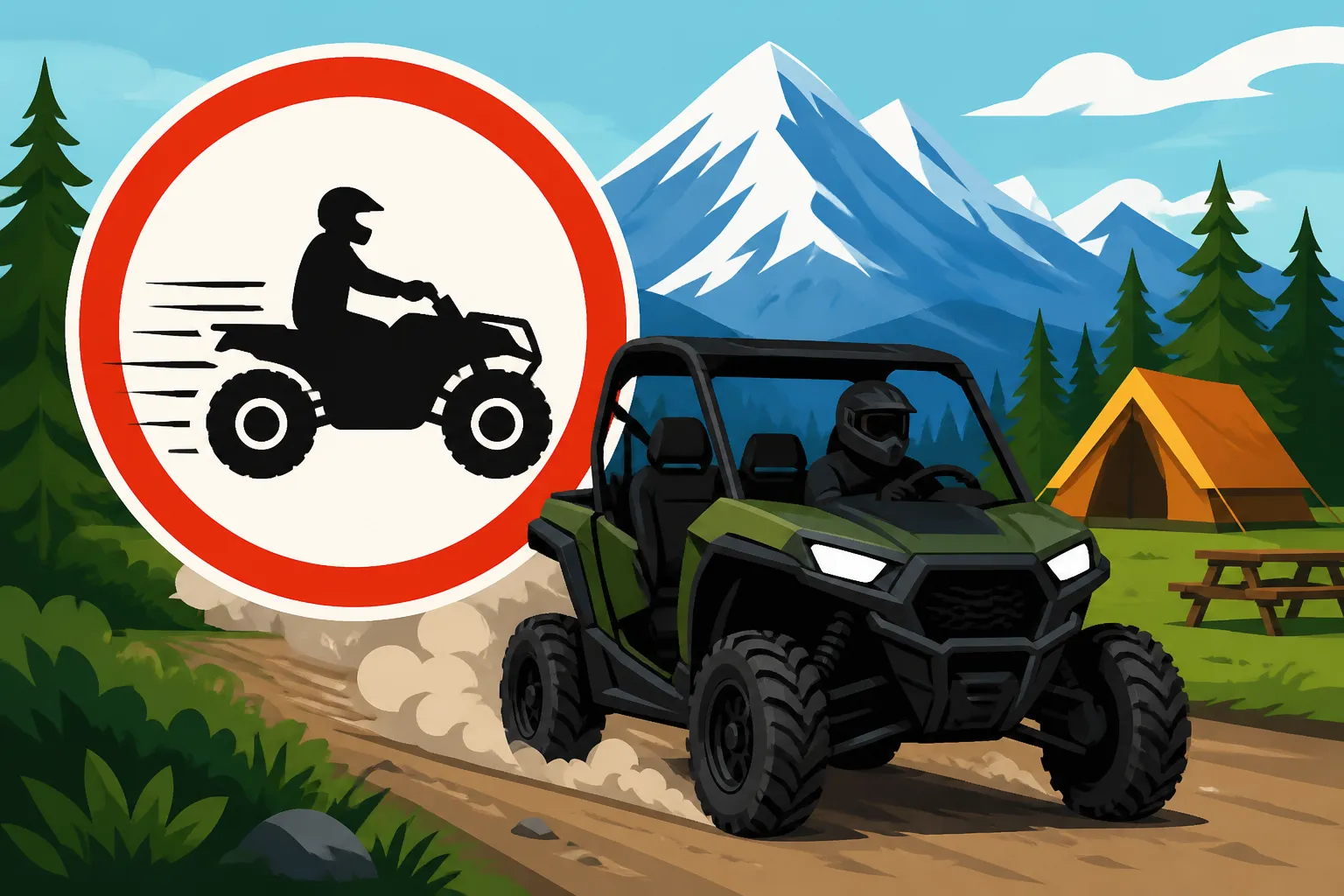
The 5 mph limit at Jim Creek applies in the campground, including the area past the tents. It is a low-speed zone, not a suggestion to ride at trail speed until you reach your own campsite. If you are towing a trailer, carrying a passenger, or navigating a busy stretch of the campground, leave yourself enough room to stop comfortably.
That can feel like a sudden change after riding open trails. A machine that seems easy to control at speed can still throw gravel, stir up dust, or surprise someone when it moves through a narrow campground lane. Shift down, ease off the throttle, and treat the entire shared area as a place where people may step into your path without warning.
Keep your speed low even if the road ahead looks empty. Campers may be inside tents, around a fire, unloading gear, or walking back from a restroom or vehicle. Children and dogs can be especially hard to spot from a seated position on an ATV or inside a side-by-side. A slow, predictable pace gives everyone more time to see and respond to you.
Know where campground travel ends and trail riding begins
A campground is not simply another part of the riding area. It is a place where visitors sleep, cook, unload machines, and move around on foot. The 5 mph limit is a reminder that the setting has changed, even if your machine is still pointed toward a trail or open riding ground.
At Jim Creek, plan to crawl through the campground rather than accelerating between campsites. Do not use the campsite lanes as a shortcut, a warm-up loop, or a place to test how the machine handles. If you need to get from camp to the riding area, follow the route permitted for that purpose and stay alert for signs, barriers, people, and other campground traffic.
It is also worth separating two different questions: how fast you may travel within the campground, and where you may ride once you leave it. A campground speed limit does not grant permission to ride anywhere beyond the campground boundary. Before setting out, review [Alaska OHV Camping With Trail Access] and [Alaska Riding at Knik River] so you can plan around the specific access and riding rules for the area.
Why a very low speed matters around campsites
People and machines share tight spaces
Campgrounds can be deceptively busy. A vehicle may be backing a trailer into a site while someone else carries a cooler across the lane. A child might run from a tent toward a parent, or a dog could slip its leash. From the rider’s seat, a parked truck, camper, or tent may block the view of what is happening just beyond it.
That is why the safest approach is not to assume you have the right of way simply because you are on a machine. Ease off early, scan both sides of the lane, and be ready to stop. If another vehicle is maneuvering or a group is walking through, pause and let them finish rather than trying to squeeze by.
The same applies when you are riding a side-by-side. Its wider body can make narrow campground lanes feel especially tight, and the driver may have limited visibility close to the vehicle. A passenger can help watch for people and obstacles, but the driver should not rely on someone else to catch every hazard.
Dust, noise, and gravel affect neighboring camps
A quick burst of throttle can have consequences beyond the machine itself. Loose gravel may scatter toward a tent or parked vehicle, and a cloud of dust can drift into a neighboring campsite. Even when no one is directly in your path, a loud or abrupt pass can disturb people who are resting, eating, or trying to put children to bed.
Slow, smooth riding helps limit those effects. Avoid unnecessary revving, spinning tires, and hard acceleration in the campground. If a machine is noisy or the ground is dry, take extra care around occupied sites. Good campground manners are not just about avoiding a collision; they also make it easier for riders and non-riders to share the area.
Be particularly considerate early in the morning and later in the evening. A legal speed limit does not mean every way of riding within that limit is equally courteous. Keep your movements direct, avoid laps around camp, and use the appropriate route rather than repeatedly passing the same occupied sites.
How to ride through a campground safely
Use a simple approach before moving
Before you start your machine, take a moment to look at the route from your campsite to the campground exit or authorized riding area. Check for pedestrians, children, pets, parked vehicles, trailer tongues, and low objects that could be hard to see from the seat. If your machine has a passenger, make sure they are settled and ready before you move.
Then travel at a walking pace or no faster than the posted 5 mph limit. Keep both hands ready to control the machine, avoid sharp turns, and leave a generous gap from people and other vehicles. If visibility is blocked, do not edge forward quickly to see around an obstacle. Stop first, then move only when the route is clear.
A practical routine can help when you have ridden a long trail and are returning to camp tired or muddy:
- Stop before entering the campground if you need to adjust gear or check directions.
- Reduce speed before reaching tents and occupied sites.
- Follow the marked or otherwise authorized route through the campground.
- Watch for people and vehicles at every campsite entrance.
- Stop and wait when someone is walking or maneuvering nearby.
- Park in the designated area and shut the machine off before unloading.
This routine is simple, but it prevents the familiar mistake of arriving back at camp with trail momentum still in mind.
Give children, pets, and parked vehicles extra space
Children are unpredictable, and adults may not see them approaching a moving ATV. Leave enough room to stop, and slow down further when kids are playing near a lane or walking between campsites. If a child is close to your route, stop and wait until the path is clearly open rather than expecting the child to understand what you are doing.
Dogs can move suddenly, even when they appear calm. Do not rev the engine to make an animal move away, and do not try to pass closely while someone is managing a leash. Give the person time and space to get control of the situation. If the lane is too narrow to pass safely, wait.
Parked vehicles and trailers also create blind spots. A person may step out from behind a truck, or a vehicle may begin backing without much warning. Do not follow close behind a truck that is reversing, and do not ride between a backing vehicle and its trailer. A few seconds of waiting is far easier than trying to recover from a collision in a confined space.
Planning a Jim Creek campground stay
Check the layout and access before you arrive
A little planning can prevent confusion when you reach the campground with a trailer, passengers, and a loaded machine. Look at the route to the area, identify where you expect to park, and consider how you will move from your site to the riding route without crossing unnecessary parts of the campground. If the map is unclear, ask the appropriate recreation staff or campground contact before riding.
Digital mapping tools can help you get oriented, especially when you are comparing trail access with a campground location. For example, onX Offroad can help riders review mapped routes and plan where to go next. Treat any app as a planning aid rather than permission to ride: check local signs and current land-management information, and do not assume that a line on a map establishes access through a campsite or closed area. onX Offroad is most useful when you use it alongside on-the-ground signs and official guidance.
It can also help to review [Jim Creek Trailhead's Sullivan Road in Alaska] and [Booking a Site at the Jim Creek Campground] before you head out. Knowing how you will reach the trailhead and where your group will stage makes it less likely that you will need to circle through occupied camping areas looking for a place to stop.
Keep campground rules separate from trail and camping rules
The 5 mph limit is one part of responsible campground use, but it is not the only rule that may affect your visit. Camping duration, check-in and check-out expectations, day-use access, and trailhead fees are separate matters. Do not assume that satisfying one rule answers the others.
At Jim Creek, campground details such as the [Alaska's 26-Site Campground at Jim Creek], [Alaska's 5 mph Campground Limit], and [Alaska's 14-Night Camping Limit] are useful to review together when you are planning a stay. This gives you a fuller picture of where the limit applies, how the campground operates, and what you should confirm before booking or arriving.
Likewise, trailhead access and campground access are not interchangeable. A trailhead pass does not automatically establish permission to ride across every nearby parcel, and a campground reservation does not mean every route is open to machines. Review [Alaska Trailhead Passes at Government Peak] or [Alaska Trailhead Passes at Crevasse Moraine] if your plans include other Mat-Su trailheads, and confirm the requirements for the specific place you intend to use.
| Situation | Sensible campground response |
|---|---|
| Riding past occupied tents | Stay at or below 5 mph and be ready to stop |
| A child or pet is near the lane | Stop and wait until the route is clearly open |
| A vehicle is backing a trailer | Keep well clear and let the maneuver finish |
| Dust or gravel is loose | Use gentle throttle and avoid unnecessary passes |
| Your route is uncertain | Stop, check signs, and ask the appropriate contact |
| You are leaving camp for a trail | Use the authorized route and confirm access separately |
Common mistakes to avoid
Treating the limit as a target
Five mph is the maximum campground speed described for Jim Creek, not a speed you must maintain in every situation. If people, vehicles, poor visibility, or rough ground make even that speed feel too fast, slow down further or stop. A speed limit cannot account for every hazard in a particular lane at a particular moment.
A rider may also underestimate how fast a machine covers a short distance. At a campsite entrance, a few seconds can be enough for someone to step into the lane. Looking far ahead is helpful, but keep scanning close to the machine as well. Pay attention to what is beside you, not only what is at the end of the road.
Another common mistake is to slow down only near one’s own campsite. The entire campground is a shared space, so maintain the low-speed approach while passing other sites too. If you are new to the area, take the first trip through especially slowly and observe the layout before deciding where you will park.
Assuming campground access permits broader riding
Being allowed to drive through a campground does not automatically mean you may ride on nearby land, use an unmarked track, or cross a closed area. A campground lane, trail, road, and parcel boundary may each have different rules. When in doubt, stop and verify rather than relying on what another rider appears to be doing.
This matters around public-use areas, where land management can be complex and routes may pass near different kinds of property. Use a map to orient yourself, but check signs and land-manager information for the place you plan to ride. onX Offroad can support route planning, but it cannot replace permission or confirm that a route is open at the time you arrive. When using onX Offroad, compare the mapped route with local signs and the relevant land manager’s instructions.
For a broader overview of trip preparation, read [Alaska Trail Etiquette Locals Expect] and [Alaska Campgrounds Near a Trailhead]. They can help you think beyond the speed limit, including how to share narrow routes, keep a group organized, and avoid creating unnecessary disturbance around other visitors.
The easiest way to remember the rule is to treat Jim Creek’s campground as a pedestrian space that happens to allow machines. Enter slowly, stay at or below 5 mph, leave room for people and vehicles, and keep trail riding to authorized areas. That small change in pace makes camp safer and more comfortable for everyone sharing it.
Disclaimer
This article is for general informational purposes only and does not constitute professional advice. Laws, prices and regulations vary by location and change over time. Consult a qualified professional for guidance on your specific situation.