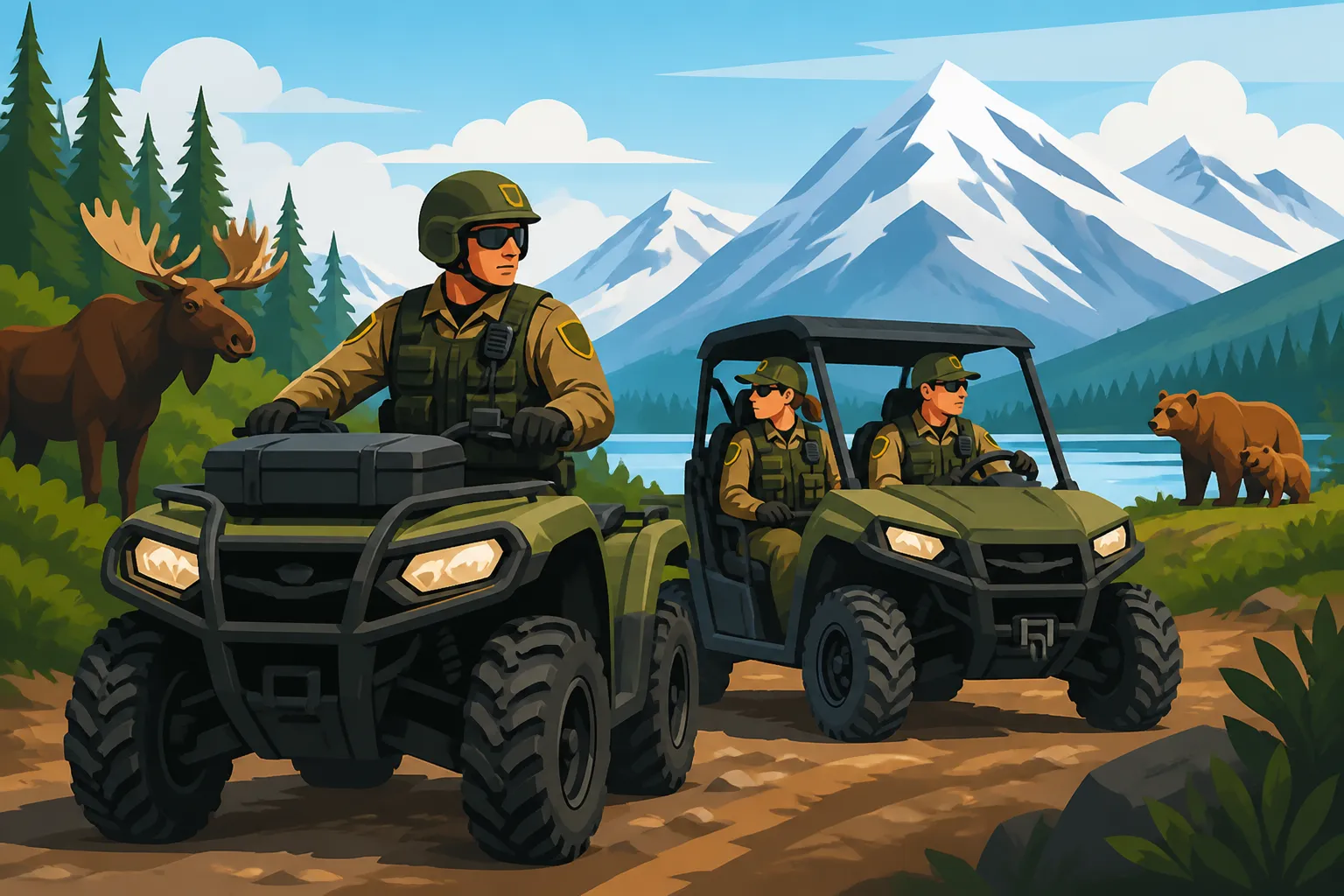
Troopers and Wildlife Troopers on Patrol
A patrol encounter can feel unsettling when you are miles from the road, especially if you are unsure which documents or riding rules apply. Alaska State Troopers and Alaska Wildlife Troopers may patrol roads, trails, public lands, and remote areas for different reasons. This guide explains what they may check, how to prepare, and how to handle a roadside or trail encounter calmly.
Who Patrols Alaska’s ATV and UTV Riding Areas
Alaska State Troopers and Wildlife Troopers have different roles
Alaska State Troopers provide law enforcement across the state, including communities and areas where local police services may not be available. Their work can involve traffic enforcement, public safety, investigations, and responding to calls. During an ATV or UTV ride, an encounter with a trooper might be part of a broader patrol rather than a planned inspection of riders.
Alaska Wildlife Troopers are part of the state’s law enforcement system, with a focus on enforcing hunting, fishing, and other wildlife-related rules. You may see them near hunting areas, access routes, waterways, or places where outdoor recreation overlaps with wildlife activity. A rider transporting game, traveling during hunting season, or using a machine to reach a remote area may attract questions related to that activity.
The roles can overlap in practical ways. Either kind of officer may respond to a safety concern, investigate a reported problem, or ask about what is happening in an area. Don’t assume that a Wildlife Trooper is only interested in hunting, or that a State Trooper will only ask about traffic. The reason for a conversation depends on the circumstances.
Patrols are not limited to busy roads
Patrol activity is easier to notice on main roads, at popular trailheads, or near communities such as Palmer, Wasilla, Fairbanks, or Soldotna. But Alaska’s riding areas can extend well beyond paved roads. A patrol may take place on a gravel route, near a public access point, or in an area where land ownership and permitted use are not obvious to visitors.
Remote riding adds a practical complication: help and communication may be limited. Officers may also be checking on public safety or responding to a report rather than conducting a routine document check. A patrol vehicle may not be able to follow every trail, and a lack of visible patrols does not mean an area is open to ride or that requirements do not apply.
Before heading out, check the local rules and the status of the land you plan to cross. A trail map can help you understand the route, but a line on a map does not by itself establish permission to ride. [Alaska Land Ownership and Who to Ask] explains why confirming who manages or owns the ground can matter as much as finding a trail.
What Officers May Ask or Check During a Ride
Registration, identification, and equipment
If you are riding in a place where registration requirements apply, keep the relevant registration information available and make sure the machine’s decal is present and readable. Alaska uses registration decals rather than conventional license plates for applicable machines, so a rider should know where the decal is and be prepared to identify the machine. [What You Get Instead of a License Plate] and [Why Your Decal Number Is the Registration Number] cover how that system works.
An officer may ask for identification or inquire about whether the machine is properly registered for the place and type of riding. Requirements can depend on the vehicle, the land, and whether you are using public property. If you are unsure whether registration applies to your route, review [Do You Need to Register an ATV in Alaska?] before you leave rather than trying to work it out during an encounter.
Equipment can also come up, particularly if the machine is being operated where road-use requirements apply or if an equipment issue creates a safety concern. Riders using an ATV or UTV on public roads should not assume that off-road equipment alone makes the machine legal for road use. Alaska has requirements that may involve lights, brakes, a muffler, and other equipment; the specific rules depend on the use and location. See [Alaska OHV Equipment Requirements] and [Alaska APV Road Rules Explained] for related details.
Land access, hunting, and other outdoor activity
Questions about where you are riding may be as important as questions about the machine. Public land, private property, state parks, federal land, and Alaska Native corporation land do not all follow the same access rules. A road or trail that looks established may cross several types of ownership or management along the way.
If you are using a machine to reach a hunting area, transporting game, or traveling across land managed by another entity, be ready to explain your route and activity accurately. A hunting license or a general land-use permit does not automatically grant permission to ride everywhere. Rules may also limit the use of machines for particular hunting activities. [Alaska Hunting Access by Machine] and [Alaska ANCSA Corporation Land Permits] are useful starting points when your ride involves hunting or corporation land.
| What an officer may ask about | Why it may matter | Practical preparation |
|---|---|---|
| Your identity and destination | Helps clarify who is riding and where the group is headed | Carry identification and tell someone your planned route |
| The machine’s registration | Requirements depend on the machine and where it is being operated | Keep registration details accessible and check whether a decal is required |
| Safety equipment | Defective or missing equipment can create risks, especially on roads or after dark | Inspect lights, brakes, throttle, and other required equipment before leaving |
| Land access | The route may cross land with different owners or rules | Check land status and get permission when required |
| Hunting or transported game | Wildlife rules may apply to the activity and the machine’s use | Keep required documents available and know the rules for your hunt |
| A reported hazard or incident | An officer may be responding to a concern, not conducting a routine stop | Stay calm, explain what you know, and follow lawful directions |
How to Prepare Before Riding
Check the route, land status, and local rules
Planning a route in Alaska takes more than choosing a trailhead and estimating the distance. Conditions can change, access may depend on land ownership, and a route can pass through a place with restrictions that are easy to miss. Review land-status information and contact the relevant land manager or landowner when the rules are unclear.
Tools such as onX Offroad can help riders view routes and land-ownership information while planning. Treat any mapping app as a planning aid, not as permission to ride. Verify access with the responsible agency, municipality, landowner, or corporation where needed. This is particularly important around private inholdings, state parks, Native corporation lands, and areas with seasonal closures.
Local rules also matter. A ride near Anchorage, Fairbanks, or a Mat-Su trailhead may involve different road-use or access considerations than a remote route. Before you go, read [Alaska Boroughs With Their Own Rules] and check the relevant city or borough requirements. If your planned route uses a road, review [Alaska Communities That Ban APV Road Use] rather than assuming a road is open to ATV or UTV traffic because it appears on a map.
Carry documents and make them easy to reach
Keep required documents in a place where you can retrieve them without emptying a wet pack beside the trail. A waterproof pouch or sealed bag can protect paperwork from rain, mud, snow, and river spray. If your route includes hunting, keep the applicable license and other required documents with you, and know which rules apply to the activity.
A phone can store copies of useful information, but don’t rely on it as your only option in an area with weak service, a dead battery, or cold-weather battery drain. Save route details offline, carry paper notes when appropriate, and make sure another person knows your plan. onX Offroad’s offline mapping features may be useful where service drops out, but riders should still confirm that the route and access are lawful before departure.
If the machine’s paperwork is incomplete or the registration status is uncertain, resolve that before riding where the requirement applies. [Alaska Registration Paperwork Checklist] can help you identify documents to gather, while [Alaska Proof of Ownership on the Trail] offers related guidance for keeping ownership information organized.
How to Handle a Patrol Encounter
Stop safely and communicate clearly
If an officer signals you to stop, slow down and choose a safe place to pull over. Avoid stopping in the middle of a narrow trail, on unstable ground, or somewhere that blocks other riders if you can safely move to a suitable spot. Turn off the machine when appropriate, keep your hands visible, and give the officer room to approach.
Speak calmly and answer questions truthfully. If you do not understand what is being asked, say so and ask for clarification rather than guessing. If you are with a group, one person can do most of the talking while the others remain orderly and avoid interrupting. A group that crowds an officer or starts moving machines around without explanation can make a routine interaction more confusing than it needs to be.
Do not argue about a land boundary or riding rule based on a map screenshot alone. If an officer says a route is closed or you are in an area where riding is not allowed, ask respectfully what the concern is and what you should do next. If the situation involves a citation or an enforcement decision, take note of the details and use the appropriate process afterward rather than escalating the exchange on the trail.
If you are asked about an incident or hunting activity
An officer may ask about a crash, damaged property, a blocked route, transported game, or another reported concern. Give a clear account of what you observed and what you personally did. If you did not see part of an event, say that plainly instead of filling in gaps with assumptions.
If someone in your group is hurt, prioritize immediate safety and medical assistance. In remote areas, describe your location as precisely as you can, including the trail name, nearby landmarks, route direction, and any coordinates available on your device. Keep your group together if it is safe to do so, and avoid sending riders off in different directions without a plan.
Riders sometimes worry that asking questions will make an encounter worse. It is reasonable to ask for clarification about a direction, the location of a boundary, or the next step you should take. Keep the tone respectful, follow lawful instructions, and save detailed discussions or disputes for the appropriate channel after the immediate situation is over.
Common Mistakes That Can Turn a Simple Ride Into a Problem
Treating a mapped route as automatic permission
A route shown in an app or on an older paper map may cross land where access is limited or permission is required. Even an established track can be affected by a closure, a seasonal restriction, a changed boundary, or a local ordinance. Check the current land manager’s information and confirm access when the route crosses land you do not own.
onX Offroad can help you spot potential ownership changes and plan around them, but it should be one part of your preparation. Look for signs at trailheads and along routes, respect gates and closures, and do not treat an unclear boundary as an invitation to continue. [Checking a Land Status Map] explains how to use ownership information as part of a more careful route check.
Assuming a remote ride means no one will check
A remote trail may feel far removed from town, but riders still have responsibilities around land access, vehicle operation, hunting, and public safety. Patrols are not necessarily frequent or predictable, and the lack of an officer nearby does not change the rules. Plan as though you may need to explain your route and show the information relevant to your ride.
A little preparation usually makes the encounter less stressful. Know what machine you are riding, where you intend to go, who manages the land, and which rules apply. Keep your paperwork dry, inspect the machine before departure, and share your trip plan. These habits help whether you meet an officer, need assistance, or simply have to turn around because conditions have changed.
Disclaimer
This article is for general informational purposes only and does not constitute professional advice. Laws, prices and regulations vary by location and change over time. Consult a qualified professional for guidance on your specific situation.