Alaska DNR and Who Issues the Permit
If you ride an ATV or UTV on Alaska state land, you may need to understand the Department of Natural Resources’ general permit—but DNR is not the permit office for every place you might ride. The key is to identify who manages the ground, what kind of permit applies, and whether your route crosses land with different rules. This guide explains who to contact and what to check before you unload.
What Alaska DNR’s permit is for
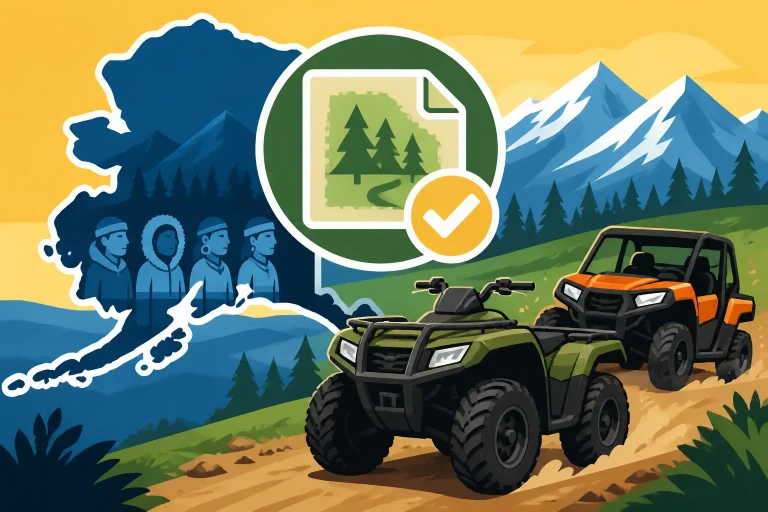
The Alaska Department of Natural Resources, usually called DNR, manages much of the state’s public land. Its general permit for off-road vehicle use applies to certain recreational riding on eligible state land. It is not a statewide pass that gives you permission to ride anywhere in Alaska.
The practical starting point is this: DNR is the place to check for riding on land it manages, but the correct office and authorization depend on the land and the activity. A general permit may cover ordinary recreational use on eligible state land, subject to its conditions. It does not override closures, land-use restrictions, or the authority of another landowner or agency.
DNR’s Division of Mining, Land and Water is a useful starting point for questions about state land and its general permit. But DNR is a large department, and a specific parcel or recreation area may be managed by a different division or have special rules. If you are headed to a state park, check with the Division of Parks and Outdoor Recreation rather than assuming the general DNR permit is enough.
A permit is also different from vehicle registration. Registration concerns the machine and its identifying information; a land-use permit concerns where and under what conditions you may ride. An Alaska registration decal does not grant permission to cross private property, ride on land managed by another agency, or enter a closed area. For that distinction, see Alaska General Permit Requirements and Alaska OHV Registration Terms Explained.
It helps to think of your ride as a chain of land parcels, not a single destination. You may launch from a public trailhead, ride on state land, cross a private inholding, and then reach land managed by a federal agency. Each segment can have a different manager and different access rules. A permit that applies to one segment does not automatically carry over to the next.
Before setting out, identify:
- The land where you plan to ride, not just the trailhead or parking area.
- The agency or owner responsible for each part of your route.
- Whether the land is eligible for the general permit or has separate restrictions.
- Whether you need an additional permit, pass, or direct permission.
- Any current closures, seasonal limits, or vehicle restrictions.
If you are unsure, contact the land manager and describe the route as specifically as possible. A road name, trailhead, map pin, parcel number, or screenshot of the route is more useful than asking whether “ATV riding around there” is allowed.
Who issues which permit
There is no single Alaska office that approves every ATV or UTV ride. The agency or owner responsible for the ground is usually the first place to ask. The table below is a starting point, not a substitute for checking the rules at a particular location.
| Where you plan to ride | Who to contact first | What to confirm |
|---|---|---|
| Eligible state land | Alaska DNR, including the relevant land-management office | Whether the general permit applies, and whether the parcel or route has restrictions |
| State park land | Alaska DNR’s Division of Parks and Outdoor Recreation | Whether motorized riding is allowed and whether the park requires separate authorization |
| Federal land | The federal agency managing that unit | Whether motorized use is allowed, which routes are open, and whether a permit or local authorization is needed |
| Alaska Native corporation land | The corporation or its authorized land-access office | Whether access is permitted and whether a land-use permit or fee applies |
| Village corporation land | The corporation or its designated contact | Whether the route crosses its property and what permission is required |
| Private land | The landowner or authorized representative | Whether you have permission to enter or cross |
| Municipal or borough recreation area | The local government or area manager | Whether local riding rules, closures, or trailhead fees apply |
State land
For eligible state land, DNR is the appropriate starting point for the statewide general permit and land status. Read the permit’s conditions rather than relying on a general description of it. Conditions can address where and how vehicles may be operated and can exclude specific lands or activities.
A state-owned parcel is not necessarily open to every kind of motorized use at every time. Designations, closures, resource protections, and local management decisions may limit access. A route that appears on a map may cross a restricted area, and a trailhead sign may explain rules that do not appear in a general overview.
Start with Alaska’s General Permit Covers State Land to understand the general scope, then check the particular area through Alaska Land Status Maps. If the map or permit language leaves you uncertain, ask DNR to confirm the status of the specific parcel or route.
State parks
State parks are managed separately from ordinary state land. Do not assume the DNR general permit authorizes riding in a park. The park may prohibit motorized use in some areas, allow it only on designated routes, or have a separate approval process.
Check the park’s rules before driving to the trailhead. A state park boundary can be easy to miss on the ground, especially where trails or roads continue across different ownerships. Why State Parks Sit Outside Alaska’s General Permit explains why a general state-land authorization should not be treated as park permission.
Federal land
Federal land is managed by federal agencies, not DNR. Depending on the location, the responsible manager may be the Bureau of Land Management, the U.S. Forest Service, the U.S. Fish and Wildlife Service, or the National Park Service. Each agency can have its own maps, motorized-use rules, seasonal restrictions, and permit procedures.
Do not assume that an Alaska state permit applies simply because the federal parcel lies within the state. Check with the agency responsible for the specific unit or area. Alaska Land Managed by Other Agencies provides a broader overview of why land manager matters.
Native corporation, village corporation, and private land
Alaska Native corporation land is not state land. Permission from DNR does not authorize you to ride across it. The same is true of village corporation property and private land. If your route enters or crosses land owned by a corporation or private owner, ask that owner or its authorized land-access contact what permission is required.
This matters even when the ride is mostly on public ground. A short crossing can still be trespass if you lack permission. Land ownership and access can be complicated, so check parcel boundaries rather than guessing from a road, trail, or nearby public sign. See Alaska Native Corporation Land Permissions and Asking Who Owns the Ground First for more on checking access.
How to work out whether you need a permit
A reliable answer comes from matching the route to the land manager and then checking the rules for that exact place. Use this process before the ride, especially if you are new to the area or planning to travel beyond a familiar trail system.
-
Draw the route you actually plan to ride. Include the staging area, trail, intended turnarounds, crossings, and any alternate route. A destination name alone may not show that the route crosses several parcels.
-
Check land status along the whole route. Use official land-status information where available, and look for ownership boundaries, agency boundaries, and designated areas. Online maps can be useful for planning, but a map layer may be incomplete, outdated, or too coarse to resolve a boundary on the ground. See Checking a Land Status Map and Looking Up Who Owns a Parcel Before You Ride.
-
Identify the manager for each segment. A state parcel, park unit, federal area, municipal trail, and private inholding can sit close together. Record who manages each part rather than assuming the nearest office controls the entire route.
-
Read the applicable permit and local rules. If DNR’s general permit appears to apply, check its current conditions and exclusions. Then look for area-specific restrictions, signs, seasonal closures, and route designations. A general permit is not permission to ignore a local closure.
-
Ask the manager about anything unclear. Provide the location, route, vehicle type, and purpose of the ride. Ask whether the general permit applies, whether a separate permit is needed, and whether any part of the route is closed or restricted. If you get an answer by phone, note the office and the date so you can follow up if the route changes.
-
Check again shortly before departure. Conditions, closures, and access rules can change. A route that was open on a previous visit may be closed for resource protection, maintenance, or other management reasons.
A useful question is not simply, “Do I need a permit in Alaska?” Ask instead: “I plan to ride this route, with this type of machine, on these parcels. Which agency manages each section, and what authorization or restrictions apply?” That gives the office enough detail to answer the real question.
If you are having trouble identifying a parcel, Alaska Land Ownership Lookups and Alaska Land Ownership and Who to Ask can help you organize the search. Treat map results as a planning aid, then confirm uncertain boundaries and access rules with the responsible manager.
What the general permit does not replace
Even when DNR’s general permit applies, it does not grant every right associated with a ride. It is important to separate land-use permission from the other requirements that can affect your trip.
It is not vehicle registration
A permit for use of land does not register your ATV or UTV. Registration requirements depend on the machine and the circumstances of use. Likewise, a decal or registration record does not serve as a land-use permit. Keep the two questions separate: “Is this machine properly registered?” and “Am I allowed to ride it on this ground?”
For registration details, start with How to Register an ATV in Alaska. If you are taking a machine from another state, Does an Out-of-State Machine Need Alaska Registration? addresses a different issue from land access.
It does not grant access across someone else’s land
A state permit cannot authorize you to cross a private parcel or Native corporation land. Nor does permission to use one parcel necessarily include a right-of-way across neighboring property. If a public route depends on crossing land you do not control, confirm that the crossing is authorized before riding it.
Do not infer permission from tire tracks, an open gate, a worn trail, or the fact that other riders have used the route. Those clues do not establish who owns the land or whether access is currently allowed. If you are dealing with a corporation or village landowner, ask the organization directly; Buying a Land Use Permit From a Native Corporation may help explain the process.
It does not make a closed route open
Closures and restrictions can apply even on state land. A permit should not be read as overriding a closure sign, a seasonal limit, a designated-area restriction, or a direction from the land manager. Conditions on wet ground, tundra, stream banks, or other sensitive areas can also affect whether riding is allowed.
Be particularly cautious when a route changes from a firm trail to wetland, tundra, or an unmarked crossing. The fact that a machine can physically travel across the surface does not mean that the area is open to vehicle use. See Alaska Tundra and Wetland Conditions and Riding a Closed Area by Accident for practical examples.
It does not replace trailhead fees or local requirements
A trailhead pass, day-use fee, campground charge, or municipal authorization is a separate matter from a land-use permit. Paying a parking fee does not necessarily authorize riding beyond the parking area, and holding a general land permit does not necessarily cover the trailhead or facility you are using.
Before you leave home, check both the access rules and the costs or requirements connected with the staging area. Alaska Borough Trailhead Passes and A Trailhead Pass Is Not a Land Permit explain why those permissions should not be confused.
What to bring and how to handle uncertainty
You do not need to turn every ride into a paperwork exercise, but it is sensible to carry enough information to explain where you are authorized to ride. Save or print the current permit information if it applies to your route, and keep a map that shows your planned track and the relevant boundaries. If you rely on a digital map, download the information before leaving areas with reliable service.
A waterproof document pouch can keep printed permit details and maps readable in rain or mud. If you shop for one through Amazon, check the closure and dimensions rather than choosing by appearance alone; the pouch should fit folded papers and stay closed when carried on a ride. A map case can also help when you need to compare your location with land boundaries at a stop. Some riders use Amazon to find a compact case that fits their navigation setup, but make sure it can be read without exposing your phone or map to weather.
A portable charger can help keep a phone or GPS usable, but it is not a substitute for offline maps or a backup plan. If you buy one through Amazon, check that it suits your device and that you can protect it from water and cold. Keep essential route information accessible even if your electronics fail.
Before riding, make sure your group understands the route and where the rules change. A passenger or riding partner can help monitor the map, but the operator remains responsible for staying on authorized ground. If the route becomes unclear, stop and verify rather than continuing on the assumption that a track is legal.
When a manager’s response is not definitive, narrow the question. Ask about the exact parcel, road, or crossing, and describe the vehicle use you have in mind. If access depends on another owner, contact that owner as well. If you cannot establish permission for a segment, choose a route that avoids it.
A quick pre-ride checklist:
- Confirm the land manager for each part of the route.
- Check whether DNR’s general permit applies to the state-land sections.
- Verify separate rules for parks, federal land, corporation land, and private parcels.
- Check for current closures, signs, and seasonal restrictions.
- Keep route and permit information available offline.
- Confirm that trailhead fees or local requirements are handled separately.
- Turn around if a boundary or permission is unclear.
The simplest way to avoid a permit problem is to treat access as route-specific. DNR can answer questions about the state land it manages, but another agency or owner may control the next section of trail. Identify those boundaries before the ride, check the rules with each manager, and do not let one permit stand in for permission you have not confirmed.
Disclaimer
This article is for general informational purposes only and does not constitute professional advice. Laws, prices and regulations vary by location and change over time. Consult a qualified professional for guidance on your specific situation.