Alaska Village Land Permission
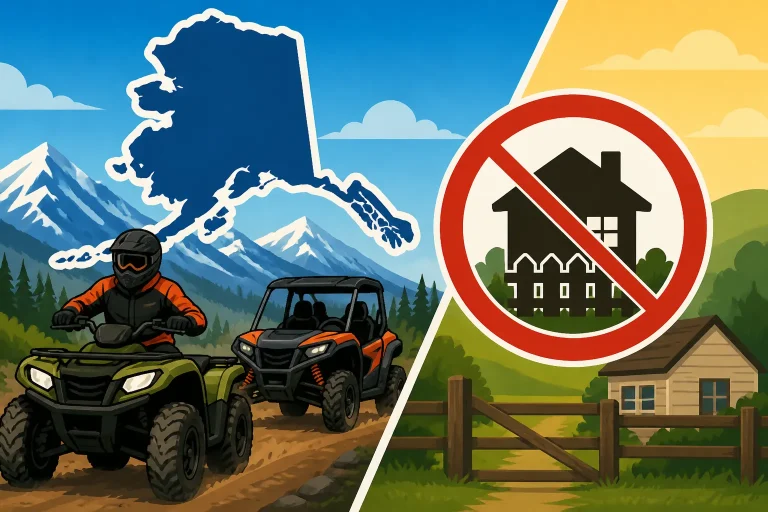
Alaska village land permission can be confusing because “village land” may mean land owned or managed by different entities, each with its own access rules. A state permit or a trail that appears open does not automatically give you permission to ride across it. The safest approach is to identify who controls the specific parcel, ask before entering, and keep clear proof of any approval.
What “village land” means for ATV and UTV access
A village is not a single landowner. The ground around a community may include land owned by a village corporation, a regional corporation, an individual, a government agency, or another entity. Different parcels can sit side by side, so permission for one route or area does not necessarily extend to the next.
Alaska Native village corporations are private corporations that may own land around a community. Their land-use rules are not automatically the same as rules set by a village council or tribal government. Those organizations may have important local roles, but do not assume that one can grant permission for land owned by another. Confirm which entity controls the parcel and who is authorized to approve vehicle access.
The statewide general permit for riding on certain state land does not grant permission to cross private land. It also does not replace separate rules that apply on land managed by another agency or within restricted areas. For more on the boundary, see Alaska’s Permit Excludes Private Land and Alaska Village Corporation Land Rules.
| Land or access situation | What to confirm before riding |
|---|---|
| Village corporation land | Which corporation controls the parcel, whether ATV or UTV use is allowed, and whether permission or a permit is required |
| Land managed by a tribal government or village organization | Which organization has authority over the area and what access rules apply |
| Private land near a community | The landowner’s permission, permitted route, and any limits on where or when you may ride |
| State land | Whether the route is open to your machine and whether the relevant state permit or other restrictions apply |
| A road, trail, or crossing through several parcels | Who controls each section and whether any access right applies along the entire route |
A route people commonly use is not necessarily an authorized route. It may cross private property, follow a permitted corridor, or be subject to seasonal or local restrictions. Even if you see tracks, a trail sign, or other riders, those clues do not establish that you have permission.
Before planning a ride, use land-status information to get a starting point, then confirm the status and access rules with the appropriate land manager. Maps may not show every easement, change in ownership, closure, or local condition. See Alaska Land Ownership and Who to Ask and Checking a Land Status Map for help with the first step.
How to ask for permission
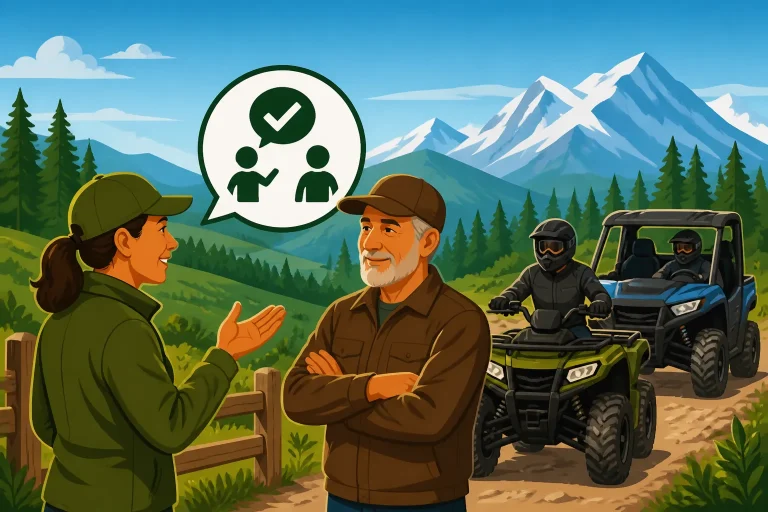
Start with a specific location, not a general question such as “Can I ride around the village?” Explain where you want to enter, the route you expect to follow, and where you plan to turn around. A land manager is more likely to give a useful answer when the request is clear enough to assess.
If you are not sure who owns the land, ask the local organization or office that handles land access where riders should direct their request. The organization you contact may point you to the actual owner or manager. Do not treat a referral, a friendly conversation, or a general statement that “people ride there” as permission unless the person has authority to grant access and is approving your use.
When you make the request, include practical details:
- The date or approximate period you want to ride.
- Whether you will use an ATV, UTV, or more than one machine.
- The number of riders and machines.
- Your intended entry point, route, and destination.
- Whether you will be carrying passengers, towing a sled, or hauling supplies.
- Whether the trip is recreational, for access to a cabin, for subsistence activity, or for another purpose.
- Whether you expect to camp, stop, or cross a stream or other sensitive area.
Ask whether permission must be in writing, whether an access permit or payment is required, and whether conditions apply. For example, permission may be limited to a named route, a particular date range, a specific purpose, or a certain type of vehicle. Ask whether you need to stay on an established trail and whether any sections are closed or unsuitable during breakup, wet conditions, or other seasonal periods.
A land-use permit is not automatically available everywhere, and the process can vary by landowner. If a corporation offers permits, confirm what the permit authorizes, how long it is valid, whether it applies to your machine and purpose, and whether it covers the whole route you intend to ride. A permit for one parcel may not authorize passage over neighboring land. See Alaska Native Corporation Land Permissions and Buying a Land Use Permit From a Native Corporation.
Try to get the answer in a form you can retain, such as a written permit, email, or other confirmation from an authorized representative. If approval is given verbally, ask whether the land manager can send or record the details. Keep the terms with you during the trip and make sure everyone in your group understands them. A brief note should identify the approving person or organization, the area or route, the dates, and any conditions.
A waterproof document pouch can help protect printed permission and route notes from rain, mud, or snow. If you prefer a small pouch, outdoor retailers such as Amazon carry options; the important thing is that the document remains readable and available, not where you buy it.
Confirm the route, conditions, and local rules
Permission to enter a parcel does not always mean permission to ride anywhere on it. Read the conditions carefully and follow the approved route. Do not assume that approval includes an adjacent trail, a shortcut, a camping area, a river crossing, or a return route over a different parcel.
When the route crosses multiple ownerships, check each section. One landowner’s approval cannot grant access across another owner’s land. The same issue can arise where an access road meets a private driveway, a public route crosses a restricted area, or a trail leads from community land onto state or federal land.
A village council may set local requirements or share guidance for riders, but its role depends on the land and the rule involved. A council’s support for riding in a general area should not be treated as a substitute for permission from the actual landowner. Ask who has authority over the parcel and whether there are separate community rules. What a Village Council Can Require of Riders explains why those questions matter.
Before departure, confirm current conditions and any temporary closures with the land manager. A route that is passable in frozen conditions may be soft or vulnerable during thaw. Wet ground and tundra can be damaged by repeated or off-route travel, and stream crossings may have separate restrictions. If the route has changed, a bridge is out, or the ground is visibly deteriorating, stop and check rather than creating a new track.
Do not treat a state permit, a trailhead pass, or a permit for a different purpose as permission to cross village corporation land. Each addresses a particular access question. If your ride includes state land, state parks, private land, or land managed by another agency, check the rules for each part. A Trailhead Pass Is Not a Land Permit is useful when a paid parking or recreation pass is part of the trip.
If you are traveling through a community, ask about customary expectations as well as written rules. Residents may rely on the same routes for daily travel, work, or access to services. Ride slowly near homes and shared routes, avoid blocking access, and respect requests to stay clear of yards, buildings, equipment, and community facilities. These are sound practices even when a permit does not spell them out.
What to carry and what to do if permission is unclear
Carry a copy of your written permission or permit, along with a simple map or description of the approved route. Keep contact details for the land manager available if the approval has conditions you may need to clarify. Share the route and any restrictions with your group before starting. Do not rely on one person to remember the details for everyone.
If you cannot confirm who controls the land, or you cannot get a clear answer about access, do not ride onto the parcel while you wait to find out. Choose a route with confirmed access or postpone the trip. Turning around can be frustrating, but it is preferable to crossing land without authorization and creating a dispute with the owner or community.
If a land manager tells you to leave or identifies an area as closed, stop riding there and follow the direction. Do not argue that other riders use the route or that you have a state permit for another area. Record the information so you can clarify the boundary or request access later through the proper contact. For more on respectful requests and potential disputes, see Asking Before You Ride Through and What Follows a Trespass Complaint on Alaska Native Land.
A quick pre-ride check can prevent most avoidable problems:
- Identify the parcels and land managers along the full route.
- Ask the relevant owner or authorized manager for permission.
- Confirm the allowed dates, vehicle types, route, and purpose.
- Check for conditions, closures, fees, or required permits.
- Carry proof of approval and make sure your group understands its limits.
- Turn back if the route is unclear, closed, or outside the permission granted.
Permission is specific to the land and the terms provided. If your plans change, such as adding riders, taking a different trail, or traveling on a different date, ask whether the approval still applies. When access is uncertain, a short confirmation before the trip is better than assuming that permission extends beyond what was agreed.
Disclaimer
This article is for general informational purposes only and does not constitute professional advice. Laws, prices and regulations vary by location and change over time. Consult a qualified professional for guidance on your specific situation.