Alaska Campground Fees for Riders
Alaska campground fees can be hard to budget for when an ATV or UTV trip includes a campsite, a trailhead and land-use rules managed by different agencies. The key is to separate the cost of staying overnight from fees for parking or riding access. Once you know which charges apply to your route, you can check the right office and avoid treating one pass as permission for everything.
What campground fees may cover
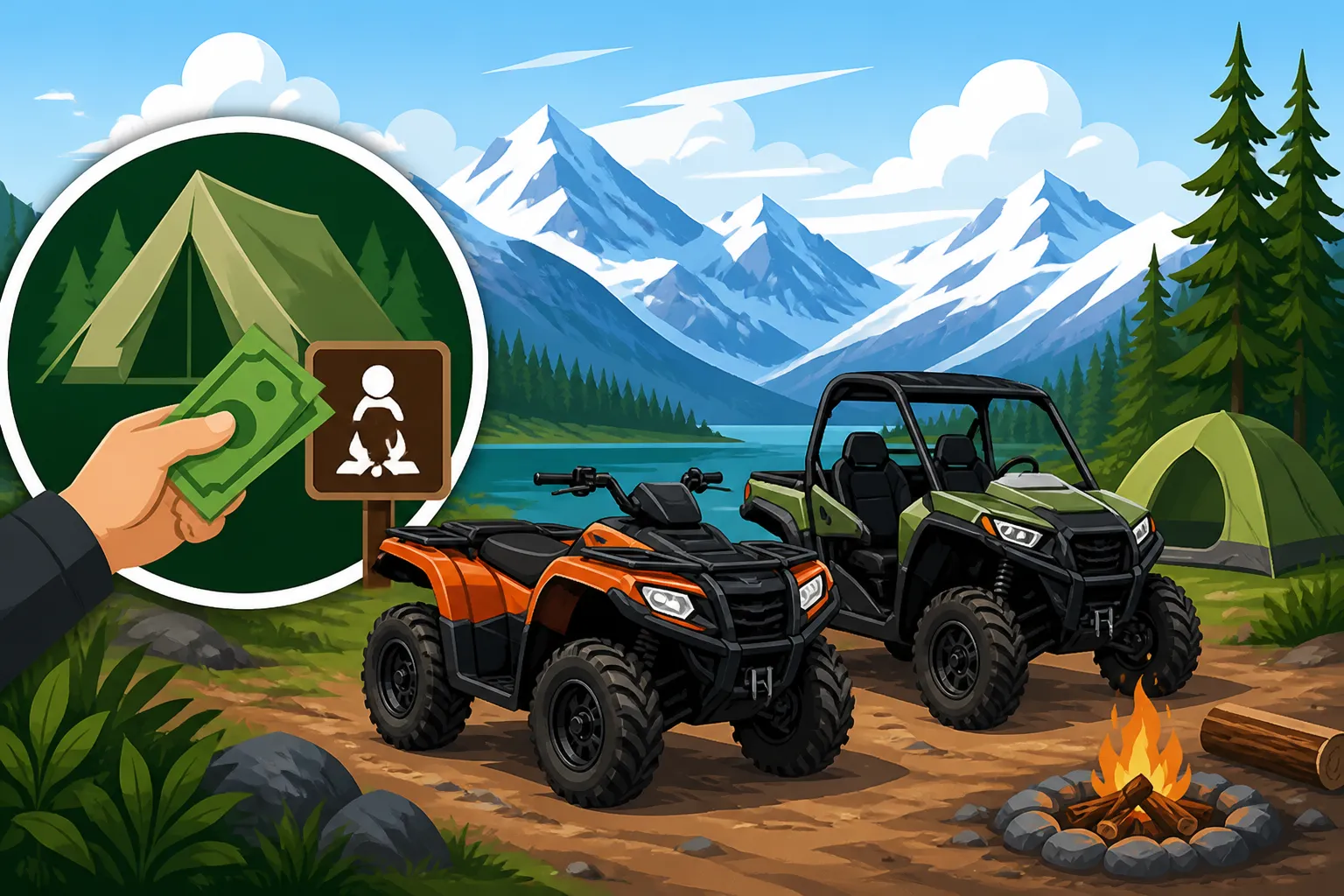
There is no single statewide campground fee for Alaska riders. Charges and payment methods depend on who manages the campground, what facilities it offers and how long you plan to stay. A developed campground may charge for an overnight site, while a dispersed camping area may have different rules or no campsite fee. Neither possibility should be assumed without checking the location’s current information.
Fees can be tied to different parts of a trip. Before setting a budget, identify each one separately:
| Possible charge | What it generally covers | What it does not automatically cover |
|---|---|---|
| Campground fee | Use of a designated campsite or campground facilities | Trailhead parking or permission to ride elsewhere |
| Day-use fee | Access to a recreation area for the day | Overnight camping unless the site says so |
| Trailhead pass | Parking or use of a particular trailhead | Campground lodging or land-use permission |
| Land-use permit | Certain types of travel on land covered by that permit | Access to land managed by another agency or private owner |
| Private campground charge | A site and amenities offered by the operator | Public-land riding access beyond the property |
A camping fee may apply per site, per person, per vehicle or by another method set by the manager. Some places use a fee station or kiosk; others require advance reservations or payment through a different process. Check the current instructions before leaving home, especially if you expect to arrive after office hours or without reliable cell service.
Also check what the fee includes. A basic site may provide little more than a place to camp, while a developed campground may offer facilities such as toilets, water access or a designated fire area. Availability and rules can vary. Do not assume a site has potable water, a dump station, a secure place to leave a trailer or room for a large side-by-side.
For a broader look at places where a campsite and a riding area may fit together, see Alaska Campgrounds Near a Trailhead. The key planning question is not just whether a campground is nearby, but whether it is open, accepts your type of vehicle and gives you lawful access to the route you intend to ride.
Keep campsite, trailhead and riding costs separate
A common budgeting mistake is to see a campground fee or a parking pass and assume it covers the rest of the trip. It may not. Camping, parking, and permission to ride can be controlled by separate rules, even when they apply to places close to one another.
A trailhead pass usually concerns parking or use of a specific trailhead. It is not a campsite reservation, and it does not necessarily authorize travel across every parcel beyond the trailhead. Alaska Trailhead Fees and Passes explains why these charges need to be checked separately. If your route uses a managed Mat-Su trailhead, review Alaska Mat-Su Trailhead Parking Passes rather than assuming an overnight booking includes parking.
Likewise, a land-use permit applies only where its terms and land boundaries allow. Alaska’s statewide general permit does not act as universal access to every public or private parcel. Start with Alaska’s Statewide General Permit for ATV Use, then check land ownership and any rules that apply to the campground, trail and destination. A campground receipt is proof of a camping transaction, not necessarily proof that you may ride on nearby land.
Jim Creek is a useful example of why separate charges matter. Visitors may need to distinguish between the campground and day-use arrangements. The details for Alaska Day Use Fees at Jim Creek and Jim Creek Day Use Fee Per Person are not interchangeable with a campsite booking. Confirm which charge applies to your visit and whether your plan involves overnight camping, day use, or both.
Before paying, ask the site manager or land manager:
- Is the charge for a campsite, day use, parking, or more than one of these?
- Is the fee assessed per site, person, vehicle or another unit?
- Does a reservation include parking for a truck and trailer?
- Are ATVs and UTVs allowed in the campground, and where may they be parked?
- Does camping there authorize riding from the campground, or must you use an approved route?
- Are there seasonal closures, capacity limits or quiet-hour rules?
- What payment method is accepted, and is payment possible when staff are not present?
Those questions are especially useful when camping near a recreation area managed by more than one agency. A campground can sit near a trail without being the authority for that trail. Confirm boundaries rather than relying on a map pin, a social post or the fact that other riders have used a route.
Planning an overnight ride at Jim Creek
Jim Creek, in the Knik River area, is a popular example of a campground connected with riding plans. The campground has 26 sites, but that does not guarantee an open space on your preferred date or that every site will suit a truck, trailer and machine. Check current availability, site dimensions and access rules with the manager before you travel. Alaska’s 26-Site Campground at Jim Creek and Booking a Site at the Jim Creek Campground are useful starting points for understanding the campground and its booking process.
Do not build a budget around an old fee figure found in a forum or saved itinerary. Rates, payment instructions and reservation conditions can change. Check the current information from the agency or operator responsible for the site, and confirm whether a reservation charge is separate from the actual camping charge. If you are arriving with a group, ask whether one reservation covers the intended number of tents, vehicles and machines.
The campground’s own rules matter too. For example, Alaska’s 5 mph Campground Limit addresses low-speed travel within the campground. That is a reminder that the riding rules do not stop at the trailhead: campground speed, parking, vehicle movement and noise restrictions can all affect how you use the site. Keep machines on designated access routes and avoid riding across grass or between campsites unless the manager specifically allows it.
A useful pre-trip check is to confirm these details in one call or message:
- The site is open for your dates and can accommodate your group and equipment.
- The current fee and payment method are clear.
- You know whether a reservation is required and what it includes.
- The campground permits the vehicles and trailer arrangement you plan to bring.
- You know where to park, unload and ride out.
- You have checked the applicable trail and land rules beyond the campground.
- You have a backup plan if the site is full, closed or inaccessible.
At Jim Creek, campground camping and day use should be treated as separate items unless the manager confirms otherwise. Check current campground information and day-use requirements before setting out. Conditions around the Knik River can also affect access and route safety, so a camping reservation should not be treated as a promise that every riding route will be passable.
If a kiosk or fee station is part of your plan, find out whether you need exact payment, a completed envelope or another form of proof. What You Need at a Trailhead Pay Kiosk can help with kiosk preparation, but campground payment instructions may be different. Keep any receipt, reservation confirmation or permit where you can reach it. A waterproof document pouch bought from an outdoor retailer or Amazon can help protect paper records from rain and mud; it does not replace having the required authorization.
Build a realistic campground budget
To estimate the full overnight cost, list every stop and every type of charge rather than choosing one generic “camping” amount. The final total depends on your route, the campground, the number of nights, your group and the access rules at each riding area. Check current figures with the responsible manager because fees and payment processes can change.
Use a simple planning sheet:
- Overnight stays: Note the campground, dates, number of sites and reservation requirements.
- Parking: Check whether the truck, trailer and riding machines require separate or site-specific arrangements.
- Day use: Identify any recreation-area fee that applies even if you have reserved a campsite.
- Land access: Verify whether your planned riding area requires permission or a permit beyond the campground.
- Optional services: Ask about charges for extra vehicles, additional occupants or amenities rather than assuming they are included.
- Payment backup: Have an accepted alternative if a kiosk, card terminal or online service is unavailable.
For a multi-day trip, keep a separate line in your budget for each campground and trailhead. A reservation in one place does not normally resolve payment or permission questions for the next stop. If your route crosses different ownership or management boundaries, confirm the rules for each section rather than carrying over assumptions from the previous area.
Pay attention to your arrival and departure times, too. A campground may set check-in and check-out windows, and late arrival can affect whether you can claim a reserved site. Ask what happens if weather, a road closure or a mechanical problem delays you. If the site is first-come, first-served, have a backup campground or a lawful alternative instead of counting on a space after a long ride.
Keep records accessible, but do not rely on a phone alone. Save reservation details offline, note the campground’s contact information and carry any required paper proof in a protected place. If you pay at a kiosk, follow its instructions and retain the receipt. If something is unclear, ask the campground manager or the agency responsible for that specific land before you ride.
The practical rule is simple: pay the campground for the stay, check separate charges for day use or parking, and verify land permission for the ride itself. That approach makes costs easier to compare and reduces the risk of arriving with the wrong pass or an incomplete plan.
Disclaimer
This article is for general informational purposes only and does not constitute professional advice. Laws, prices and regulations vary by location and change over time. Consult a qualified professional for guidance on your specific situation.