Alaska Tundra Travel Permits
Alaska tundra travel permits are not one-size-fits-all. A permit that allows riding on some state land may not cover a state park, federal land, or a private parcel. Before heading out, identify who manages the ground, check whether your route is allowed, and consider whether the tundra is firm enough to ride without causing damage.
Why tundra riding may need more than one permission
“Tundra” describes a landscape, not a landowner or a single permit area. A route across tundra might cross state land, federal land, Native corporation land, private property, or more than one jurisdiction. Rules can change at a boundary even when the terrain looks the same.
Alaska’s statewide general permit for ATV use may apply to certain state land, but it is not a blanket authorization to ride anywhere that looks open. Its conditions and geographic limits matter. It also does not give permission to cross land managed by someone else. For the distinction between a general permit and broader access, see What Alaska’s Statewide General Permit Actually Authorizes and Alaska’s General Permit Covers State Land.
A separate trailhead pass or day-use fee is another common source of confusion. A pass may pay for parking or use of a recreation area, while a land permit addresses permission to operate on particular ground. One does not automatically replace the other. A Trailhead Pass Is Not a Land Permit explains why riders may need to check both.
| Question | Why it matters | What to verify |
|---|---|---|
| Who owns or manages the ground? | Different owners and agencies set different access rules. | Land status along the full route, not just at the trailhead. |
| Does a permit cover this place? | A statewide permit has limits and exclusions. | The current permit terms and any area-specific restrictions. |
| Is the route open to your machine? | Access can depend on vehicle type, route, or season. | Whether your ATV or UTV is allowed on the route. |
| Is the ground suitable for travel? | Soft or wet tundra can be damaged by tires and repeated passes. | Current ground conditions and any seasonal closures. |
| Are there added fees or permissions? | Recreation fees and land access permission serve different purposes. | Trailhead requirements and any separate landowner authorization. |
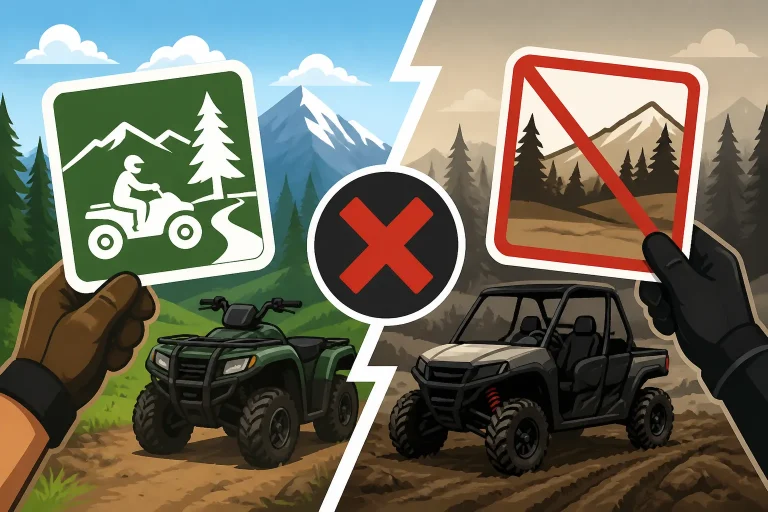
Some areas are specifically outside the statewide general permit. State parks and designated areas can have their own rules or restrictions; do not assume that a general permit applies just because the area is state-owned. Check Alaska’s Permit Excludes State Parks and Alaska’s Permit Excludes Designated Areas before planning a route through those places.
Federal land is also not automatically covered by a state permit. A route that leaves state land may enter ground managed by a federal agency, with different access rules. Native corporation and village lands require particular care: being near a public trail or community does not itself establish permission to cross. Start with Alaska Land Ownership and Who to Ask if the route’s ownership is unclear.
Identify the land and route before you go
A useful first step is to map the route, then check the status of the ground it crosses. A trailhead sign or a route shown on a general map may not tell you who owns every parcel along the way. Use land-status information as a planning tool, and confirm uncertain boundaries with the relevant land manager. Alaska Land Status Maps and Checking a Land Status Map cover that process.
Do not check only the destination. A route may begin on land where riding is permitted and then cross a private parcel, a restricted area, or land managed by another agency. Permission to reach one point does not necessarily authorize travel across every parcel between you and it. If a route crosses land you do not control, contact the owner or manager before riding. Asking Who Owns the Ground First and Buying a Land Use Permit From a Native Corporation are useful starting points for those situations.
When contacting a land manager, make your question specific. Share the route or parcel, the type of machine, the intended travel dates, and whether you plan to ride across tundra, use an established trail, or cross a wet area. Ask whether access is open, whether an application or separate permission is needed, and whether conditions or closures have changed. A general question such as “Can I ride in this area?” may not be enough to resolve a boundary or route issue.
Also distinguish travel permission from permission for a particular activity. A land manager may treat a day ride differently from a commercial tour, organized event, or repeated use. If your ride involves a group or paid activity, ask whether additional authorization applies rather than relying on the rules for an individual recreational trip.
Finally, check the route again close to departure. A map or an old trip report can help with planning, but it cannot confirm that a route remains open or that ground conditions are safe today. Closures, boundary information, permit conditions, and local access arrangements can change. If you cannot confirm a section of the route, plan around it rather than treating uncertainty as permission.
Tundra condition can affect whether travel is appropriate
Permission is only part of the decision. Tundra can be vulnerable when the surface is soft, saturated, or only partly frozen. Tires can break vegetation and disturb the ground, and repeated traffic can leave tracks that persist after the ride. A route that was firm on one visit may not be suitable under different weather or seasonal conditions.
Pay attention to the surface under the machine. Deep ruts, standing water, soft ground, or vegetation that gives way under the tires are reasons to stop and reconsider. Do not widen a trail to avoid a wet or damaged section; that can multiply the area affected. If the route is impassable without driving across undisturbed tundra, turn back or choose a route that is clearly open and suitable. See Alaska Tundra and Wetland Conditions, Alaska Tundra Damage and Riding, and Alaska Wetland Travel Restrictions Explained for related considerations.
A permit does not necessarily mean that every surface or route within its area is appropriate at every time. Check for seasonal conditions and any local restrictions before riding. Where conditions are uncertain, ask the land manager what kinds of travel are allowed and whether the ground is currently firm enough. Be prepared to delay the trip if the answer is unclear or the surface is too soft.
Avoid treating visible tracks as proof that travel is authorized. Tracks may be old, may belong to a permitted user, or may cross land where access has since changed. Following them can also create additional damage if the original route is already becoming soft or rutted.
A practical check before a tundra ride
Use this process to sort out access and conditions before loading the machine:
- Draw the route. Mark the trailhead, intended destination, and any likely crossings. Include the return route; access permission needs to cover the whole trip.
- Check land status along the route. Identify state, federal, private, Native corporation, and other managed parcels. If the ownership or boundary is uncertain, ask before riding.
- Match the permit to the ground. Read the current statewide permit terms and confirm whether the route is covered. Check separately for parks, designated areas, or other exclusions.
- Confirm local access rules. Contact the relevant land manager or owner about closures, seasonal limits, machine restrictions, and any required permission or fee.
- Assess the surface. Check recent conditions and look for soft, wet, or damaged ground. If the route requires leaving an established track across vulnerable tundra, turn around.
- Carry the information you may need. Keep relevant permits, permissions, and route details accessible. A phone may not have service, so save maps and contact information before leaving coverage.
- Change plans when conditions change. A legal route can become unsuitable, and a permitted route can be closed. Be willing to postpone or use another confirmed route.
If you are unsure which agency or landowner to contact, ask the relevant local land manager to identify the correct office or owner. Describe the specific route rather than relying on a broad area name. That makes it easier to check the right boundary and avoid mistaking a trailhead pass, a state permit, or a visible track for permission to cross land.
Tundra travel is simplest when the route is clear, the land status is known, and the ground is firm. If any of those pieces is missing, stop to verify before riding. A little route checking can prevent an access problem and help protect terrain that recovers slowly from damage.
Disclaimer
This article is for general informational purposes only and does not constitute professional advice. Laws, prices and regulations vary by location and change over time. Consult a qualified professional for guidance on your specific situation.