Alaska’s Permit Excludes State Parks
Alaska’s statewide general permit can make riding on eligible state land simpler, but it does not give you permission to ride in an Alaska state park. That distinction is easy to miss because both may be public land. Here’s how to understand the permit’s limit, check whether a route enters a park, and find out what permission and rules apply before unloading your ATV or UTV.
What it means that state parks are excluded
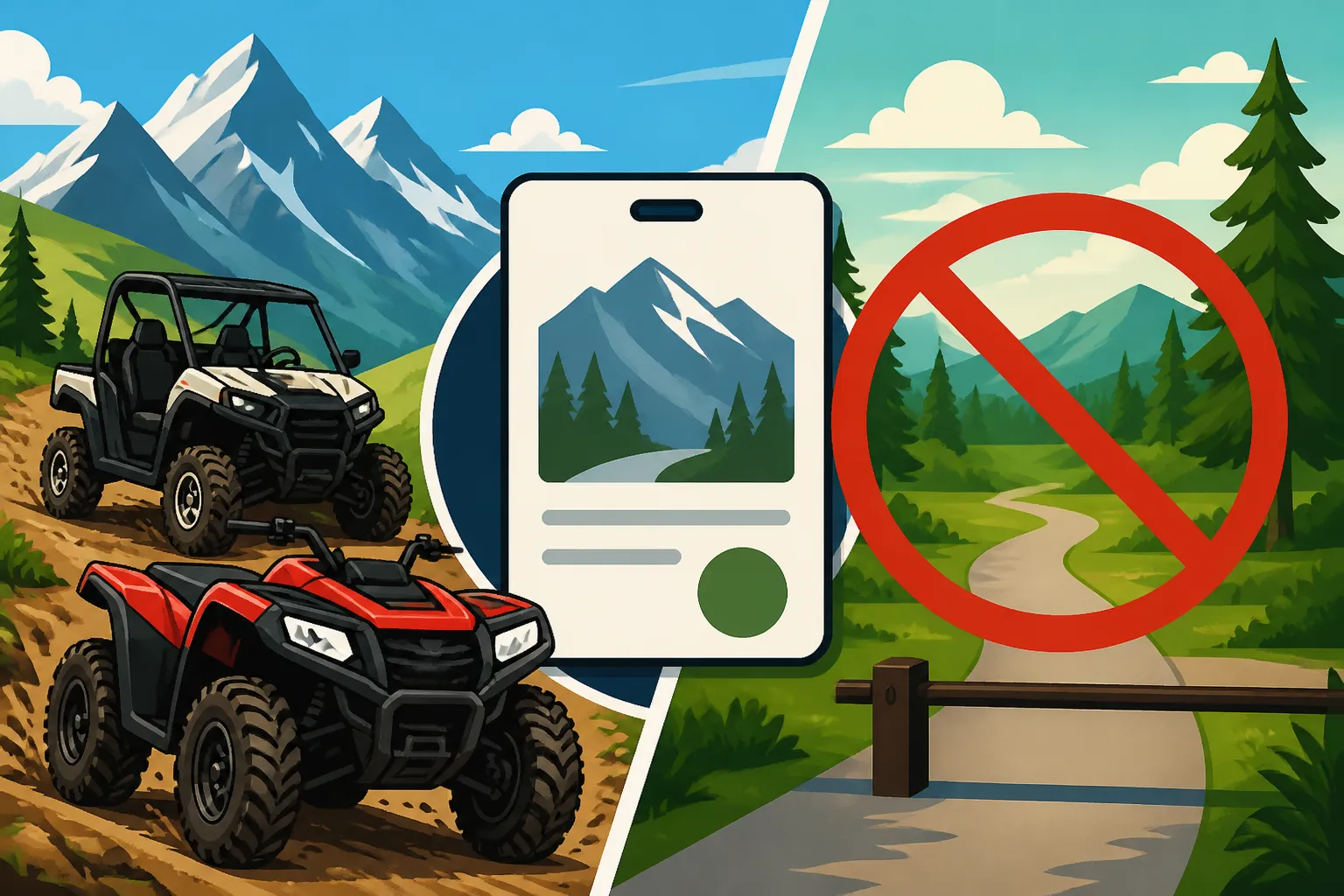
Alaska’s statewide general permit for ATV use covers certain riding on state land, subject to the permit’s conditions and the rules for the land you are using. State parks are an important exception: the general permit does not authorize ATV or UTV use inside a state park.
That does not mean that every state park is closed to every off-highway vehicle. It means the statewide permit, by itself, is not the permission you need to rely on there. A particular park may allow riding on designated routes, under local conditions, or through a separate authorization. Another park may restrict motorized use more broadly. The answer depends on the specific park and the route.
The distinction is about land management, not simply who owns the ground. State parks are state-owned, but they are managed as a separate category with their own boundaries, purposes, rules, and access decisions. A permit that applies to eligible state land does not automatically apply to every parcel owned by the state. Think of the general permit as covering a defined set of places and uses, not as a statewide pass to ride wherever the land is public.
For a fuller explanation of what the general permit authorizes outside parks, see Alaska’s Statewide General Permit for ATV Use. For park-specific riding rules and access restrictions, start with Alaska State Park Riding Rules.
A few practical distinctions help:
- Having the general permit is not the same as having park permission. If your planned route enters a state park, verify the park’s own rules.
- A trailhead or parking pass is not land-use permission. Paying to park or use a trailhead does not necessarily authorize riding on the land beyond it. A Trailhead Pass Is Not a Land Permit
- Vehicle registration and land access are separate issues. A registered machine may still be prohibited from a particular park or trail.
- A route that appears open on a general map may cross land with different rules. Boundaries and management designations matter.
- Permission to ride does not automatically mean permission to use every route, cross every stream, or ride in every season. Local restrictions and temporary closures can still apply.
It is safest to treat the state permit and park access as two separate questions. First ask whether your machine and intended activity are covered by the relevant statewide authorization. Then ask whether the particular park allows that activity on the route you intend to ride.
Why a statewide permit does not cover every state-owned parcel
“State land” sounds like one consistent category, but land can be state-owned and still be subject to different management rules. A state park, a designated recreation area, a habitat area, and other state land may have different purposes and restrictions. A general permit does not erase those distinctions.
Parks are managed to protect the features and uses for which they were established. That can mean protecting sensitive vegetation, wildlife habitat, cultural resources, waterways, or recreation areas where motorized traffic is limited. The statewide permit’s exclusion preserves the park manager’s ability to set rules for the particular park instead of treating the park like any other eligible state parcel.
This matters on the ground because boundaries are not always obvious. A route may begin on land where your statewide permit applies and later cross into a park. A river, road, trail, or parking area may make the transition seem seamless, but the legal land status can change without a dramatic sign at the boundary. Conversely, a ride near a park does not necessarily mean you have entered it. Confirm the boundary rather than guessing from nearby landmarks.
It also helps to separate three questions that riders often bundle together:
- Who owns or manages the land? It may be state land, park land, federal land, municipal land, Native corporation land, or private property.
- What permission applies to your planned use? A general permit may cover some state land, while a park or other land manager may require a separate authorization or may not allow the use.
- What other restrictions apply? Route closures, seasonal limits, vehicle requirements, trailhead fees, and local ordinances can apply even when you have permission to be in the general area.
The answer to the first question does not settle the other two. A map showing state ownership does not prove that the statewide permit covers a specific parcel. Nor does a general permit prove that the route is currently open.
For an overview of the different land categories and who to contact, see Alaska Land Ownership and Who to Ask. If you want the park-specific distinction explained directly, Why State Parks Sit Outside Alaska’s General Permit is also useful.
How to check whether your ride enters a state park
Do the land-status check before you load the machine. A route that looks straightforward on a recreational map may cross several jurisdictions, and a trail line alone does not tell you which rules apply.
Start with the exact route, not just the destination
Mark your intended start point, trail, turnarounds, and destination. Include any access road, river crossing, campsite, or alternate route you might use if conditions change. Then compare the route with current land-status information and park maps.
Checking only the trailhead is not enough. Your parking area might be outside a park while the trail enters one shortly afterward. The reverse can also happen: a route may pass near a park boundary without crossing it. If a route follows a river or an informal track, allow extra time to resolve uncertain boundaries instead of assuming the visible path defines the legal route.
Checking a Land Status Map offers a practical way to approach that task. A map is a starting point, not a final answer if the boundary or access status is unclear. Look for information from the agency that manages the park or parcel, and confirm that the map or notice applies to the route and current conditions.
Confirm access with the park manager
If your route touches or enters a state park, ask the relevant park office or land manager a specific question. “Can I ride here?” is often too broad to get a useful answer. Instead, explain:
- The park or area you plan to visit
- The route or trail you intend to use
- Whether you will ride an ATV or UTV
- The season or approximate date
- Whether you plan to camp, cross water, or use a road
- Whether you are asking about a personal ride, organized event, or commercial activity
Ask whether motorized riding is allowed on that route, whether it must stay on designated trails, whether a separate permit or fee applies, and whether any temporary closure is in effect. If the answer depends on a map, ask which map or posted notice to use. Keep a note of the office you contacted and the date, especially if the trip is planned well in advance.
Park rules can be specific. Permission to ride one designated trail does not necessarily allow cross-country travel or access to another part of the park. An authorization for a particular activity may also have conditions about dates, machine types, group size, or route. Read the conditions rather than treating a yes to one question as blanket access.
Check again before departure
Conditions can change between planning and riding. A closure, erosion, fire restriction, wildlife concern, or other management decision may affect access. Recheck notices shortly before the trip, especially if you are traveling a long distance or planning a multi-day ride.
Keep the information usable in the field. A waterproof sleeve can help protect a printed park map or permit information from rain, mud, and wet gloves. Amazon is one place to compare sleeves, but check the size against the map you plan to carry. A sleeve bought on Amazon does not make an outdated map current, and an Amazon product listing is not an official land-status source. If comparing Amazon listings, look for room for folded papers and a closure that will stay shut in wet conditions. Whatever you buy from Amazon or elsewhere, carry the current official information separately from the gear-shopping details.
If cell service is unreliable on your route, save official maps or notices for offline use and carry a paper backup where practical. A phone screen can be useful for checking your location, but it is a poor substitute for a map you can still read if the battery dies, the device gets wet, or you lose reception.
What permission may be needed inside a park
There is no single park-wide answer that applies to all Alaska state parks. Depending on the location and activity, the park may allow motorized use on designated routes, require a separate authorization, impose conditions, or prohibit the ride. The park’s own current rules control; the statewide general permit does not fill in that answer.
When you contact the park manager, clarify whether you need any of the following:
- A separate park permit or written approval
- Permission for a specific route or activity
- A fee or reservation for a relevant facility
- An event or commercial-use authorization
- Approval for an activity that differs from ordinary trail riding
These are possibilities to ask about, not a claim that every park requires each item. Some may not apply to your trip. If you are organizing a group ride, leading a paid tour, filming, or conducting another activity beyond an individual recreational ride, say so at the outset. The rules for organized or commercial activity may differ from those for a personal outing.
Also be precise about what “access” means. Being allowed to enter a park does not necessarily mean you may ride anywhere within it. A manager could allow vehicle use on one designated corridor while restricting other trails, campsites, sensitive areas, or cross-country travel. Ask what route is allowed and whether you must stay on it for the entire trip.
A park authorization, if required and granted, does not necessarily resolve other obligations. You may still need to follow vehicle registration requirements, safety and equipment rules, fire restrictions, water-crossing rules, and any local restrictions that apply to your machine or route. Similarly, permission to ride in the park does not necessarily authorize you to cross private or other agency land to reach it.
The safest rule is to get the right permission from the manager responsible for the specific ground, then check the route on both sides of the park boundary. If you are unsure which agency manages a parcel, use Alaska Land Ownership Lookups or ask the appropriate land office to identify the manager before you ride.
Common mistakes and a practical pre-ride checklist
The most common mistake is treating the statewide permit as a universal pass because the park is public and state-owned. The second is checking only whether a permit was obtained, without confirming where the route goes. A third is assuming that a paid trailhead pass, a machine registration decal, or an old trail map answers the park-access question.
Other avoidable assumptions include:
- “The trail is on the map, so it must be open.” A mapped route can be closed, restricted, or subject to conditions.
- “The route was open last season.” Access and closures can change.
- “A friend rode there.” Their route, machine, date, or authorization may have been different.
- “The boundary is not marked, so the general permit applies.” An unclear boundary is a reason to confirm land status, not to assume.
- “A park is only a park near the visitor facilities.” The boundary may extend beyond the developed area.
- “If I can legally ride on nearby state land, I can use the park as a shortcut.” The permit’s coverage does not automatically extend through the park.
- “A park office gave me permission for one route, so I can explore nearby tracks.” Permission should be understood within the route and conditions actually approved.
Before you leave, use this checklist:
- Identify the full route. Include access roads, alternate tracks, planned crossings, and the return route.
- Check land status. Determine whether any part crosses a state park or land managed by another owner or agency.
- Separate the permissions. Confirm the statewide permit applies where you intend to use it, and ask the park manager about park access.
- Ask about route-specific conditions. Verify designated routes, closures, dates, vehicle limitations, and any required authorization or fee.
- Check other requirements. Registration, equipment, safety, and local rules are separate from land-access permission.
- Recheck near departure. Look for updated closures or advisories, particularly for a long or remote trip.
- Carry the information. Keep relevant permits, maps, and contact details accessible, with an offline or paper backup if service may be limited.
- Turn around if access is uncertain. A short delay is preferable to riding into a restricted area or relying on a guess at a boundary.
If you discover that a planned route enters a park where your ride is not allowed, do not assume that a brief crossing or shortcut is acceptable. Choose a route that stays on land where your use is authorized, or obtain the required permission before you go. If you cannot confirm access in time, changing the plan is the responsible choice.
The key idea is simple: Alaska’s statewide general permit and state park access are separate matters. Use the general permit only where it applies, and let the specific park’s manager answer whether, where, and under what conditions you may ride inside park boundaries.
Disclaimer
This article is for general informational purposes only and does not constitute professional advice. Laws, prices and regulations vary by location and change over time. Consult a qualified professional for guidance on your specific situation.