Alaska Penalties for Riding a Closed Area
Riding into a closed area in Alaska can mean more than being told to turn around. The consequences depend on who manages the land, why it is closed, and what happened while you were there. Knowing how closures work—and what to do if you reach one by mistake—can help you avoid a citation, a trespass complaint, or damage that makes the situation worse.
What counts as riding in a closed area
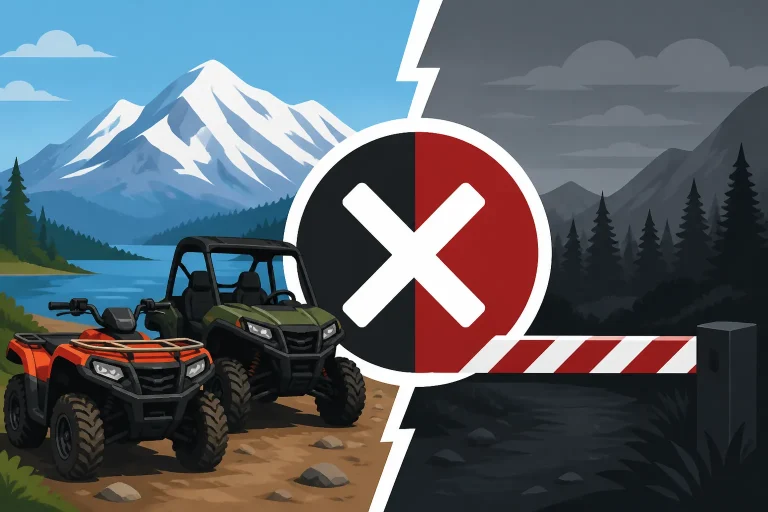
A closure is a restriction on entering or traveling through a particular place. It may apply to all motorized use, only to certain machine types, or only during a defined season or condition. A trail might be closed while the surrounding area remains open, for example, or a route could be open to some users but not ATVs and UTVs.
Closures can come from different land managers, including state, federal, municipal, and private landowners. The reason may be seasonal ground conditions, wildlife protection, fire danger, trail damage, construction, or another management concern. A closure can also be tied to a specific route or activity rather than to every kind of use in the area.
That distinction matters because there is no single penalty that applies to every Alaska closure. The manager, the governing rule, the location, and the facts of the incident all affect what may happen. A rider who reaches a clearly marked gate and turns back is in a different position from someone who drives around the barrier, continues after a warning, or damages land.
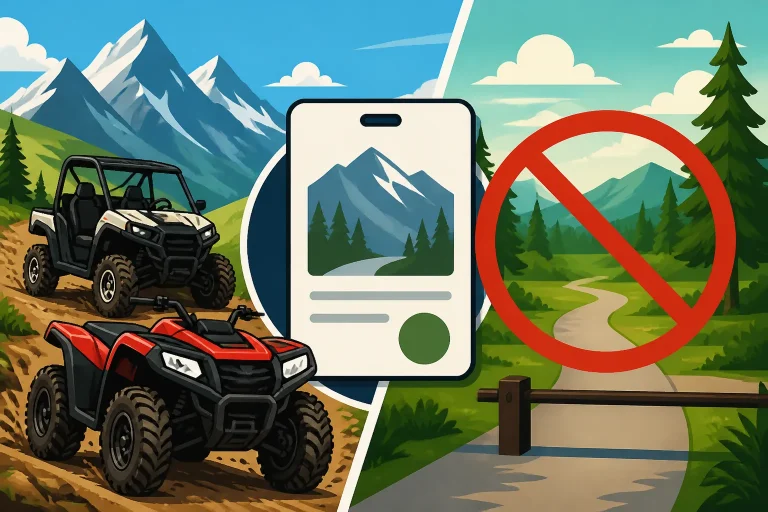
A statewide permit is not permission to ride everywhere. Alaska’s general permit applies only where its terms allow riding; it does not override a separate closure or grant access to land managed by someone else. Review Alaska’s Statewide General Permit for ATV Use and Alaska’s Permit Excludes Designated Areas before assuming that a permit covers a route.
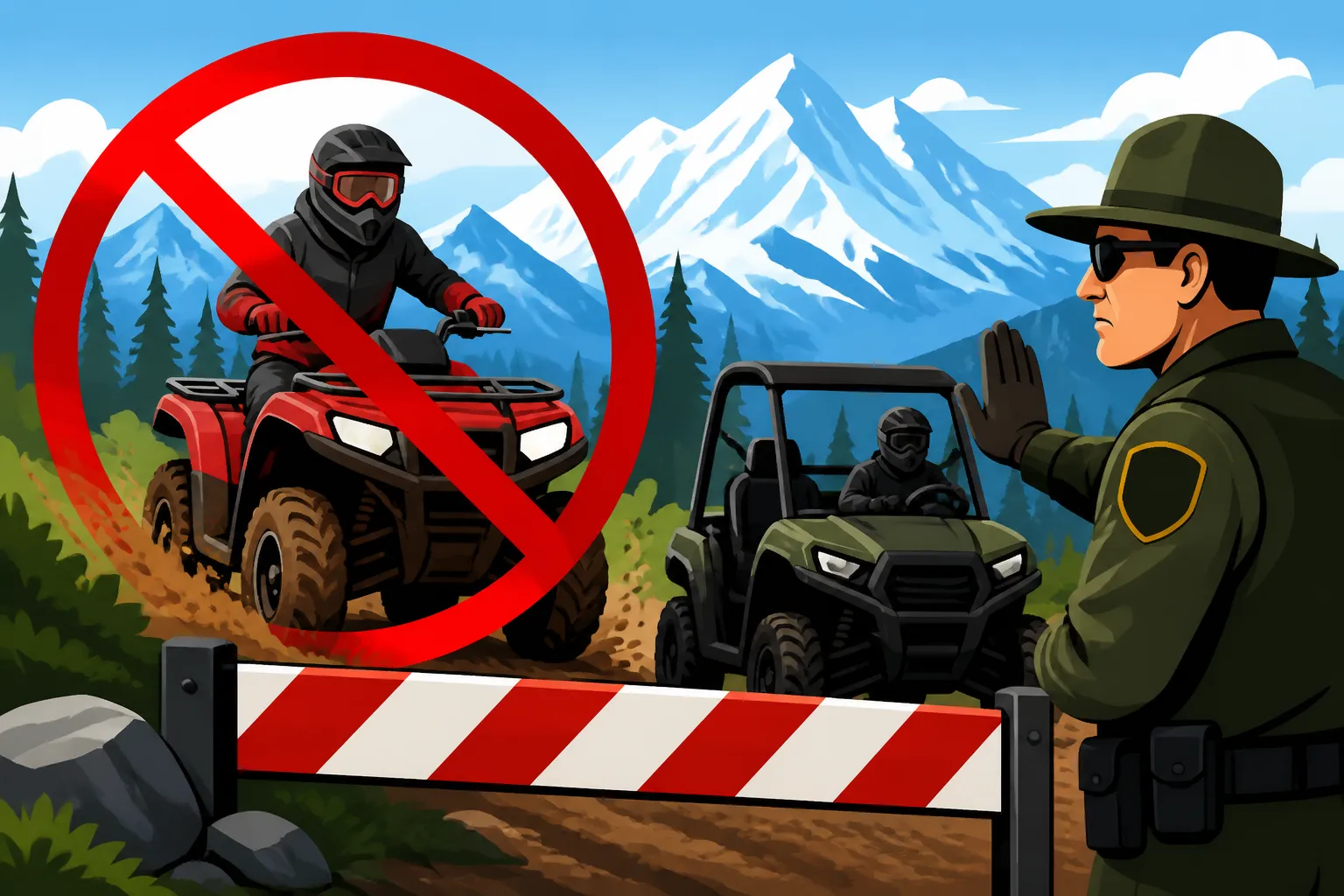
A closure may be marked with a sign, gate, barrier, map notice, or other information from the land manager. Markings are not always easy to see in remote country, and a gate may be left open for reasons unrelated to public access. If the route’s status is unclear, check with the land manager rather than treating the absence of a barrier as permission. Signs That Mark a Closure explains what to look for on the ground.
Penalties and other consequences
The consequences of riding in a closed area can range from a warning or direction to leave to formal enforcement. The outcome is not determined by the word “closed” alone. It can depend on whether the restriction was legally established, which authority manages the site, whether the rider knew or should have known about it, and whether the incident involved other violations or damage.
| Situation | Possible response | Why the details matter |
|---|---|---|
| A rider reaches a closure and turns back | Often no further action, though a manager may still ask questions | The rider’s response and the closure’s location matter |
| A rider enters a restricted route unintentionally | A warning, a direction to leave, or a citation may be possible | Signage, visibility, route conditions, and the applicable rule matter |
| A rider bypasses a barrier or ignores an instruction | More serious enforcement may be considered | Deliberate conduct can affect how the incident is handled |
| Riding damages soil, vegetation, a trail, or other property | A separate damage or restoration issue may arise | The manager may assess the damage and follow its own process |
| The route is on private land or access was not authorized | A trespass complaint or other action may be possible | Permission from one land manager does not grant access across another owner’s property |
These are general possibilities, not a guaranteed penalty schedule. A land manager may have its own enforcement process, and a citation or complaint may be handled under rules that differ by location. For current details, identify the agency or owner responsible for the ground and ask which rule applies. Alaska Land Ownership and Who to Ask and Alaska Land Status Maps can help you work out who manages the route.
A closure violation may also be only one part of the situation. For instance, a rider could face separate questions about trespass, property damage, vehicle equipment, or compliance with a permit. A valid registration or decal does not automatically make riding in a closed area lawful. Likewise, a land-use permit does not replace permission from a private owner or another agency. For a closer look at the limits of state authorization, see What Alaska’s Statewide General Permit Actually Authorizes.
Do not assume that every closure carries a fixed fine, or that every manager handles an incident the same way. Avoid relying on an old sign photo, a neighbor’s recollection, or a map that may not show temporary restrictions. If you receive a citation or formal notice, read it carefully, note the issuing authority and response instructions, and get qualified legal advice if you need help understanding your options.
What to do if you encounter a closure
The safest response is usually simple: stop before entering the restricted area, turn around where it is safe, and use a route that is clearly open. Do not drive around a gate, move a sign, or follow tracks through a barrier. Tracks show that another machine went through; they do not establish that the route is open.
If you are already inside when you notice the restriction, avoid traveling farther into the area. Turn back along your existing route if doing so will not cause additional damage or create a safety hazard. If a sign or barrier directs riders to a particular exit, follow that direction when it is safe. On unstable ground, near water, or in an unfamiliar area, prioritize a safe exit rather than making a risky maneuver to retrace your exact tracks.
If the right way out is uncertain, contact the land manager or an appropriate local authority when you can do so safely. Explain where you are, what sign or barrier you encountered, and whether anyone or anything is at immediate risk. Do not cross another closure just to find a quicker route. If the route crosses multiple ownership boundaries, check the status of each part; a trail that is open on one parcel may be closed or unauthorized on the next.
If you are stopped by an officer or land manager, stay calm, follow lawful instructions, and avoid arguing on the trail. You can ask which authority manages the area and what rule or closure applies. If you disagree with a citation, use the process stated on the notice rather than trying to resolve the dispute by continuing to ride.
When an accidental entry has caused visible damage, do not make the disturbance worse by attempting an improvised repair or driving repeatedly over the area. Make a note of the location and what happened, and report the damage to the responsible manager if appropriate. Reporting Trail Damage on Alaska State Land covers why prompt, accurate reporting can help the manager assess a problem.
How to check access before you ride
A little route checking before departure can prevent a costly mistake, especially when a ride crosses land managed by more than one organization. Treat a map as a starting point, not as proof that every segment is open today. Conditions and temporary restrictions can change, and maps may not reflect a newly posted closure.
- Identify the land manager. Check the route and surrounding parcels using reliable land-status information. If ownership or management is unclear, ask before riding. Alaska Land Ownership Lookups may help you trace the route.
- Check the rule for that land. Confirm whether ATVs or UTVs are allowed, whether a permit is required, and whether the rule applies to the exact route you plan to use. State land, parks, federal land, municipal areas, and private property can have different access rules.
- Look for current closures. Check the managing agency’s current notices and contact it if the status is uncertain. This is especially important when a route is affected by seasonal conditions, fire restrictions, work, or wildlife management.
- Read signs as you go. A route can change status after you leave the trailhead. Stop at gates and closure signs rather than assuming the restriction applies only to vehicles larger than yours.
- Carry useful information. Keep a route map and the relevant permit or access details available, along with a way to contact someone if service is unreliable. A screenshot can help with navigation, but it may not contain the latest closure notice.
Access rules can differ even within a familiar riding area. State parks have rules separate from the statewide general permit, and federal or private land may be governed by another manager entirely. Review Alaska State Park ATV Rules when your route enters a park, and check the relevant agency’s rules before riding on federal ground. For land managed by a Native corporation, confirm access directly; public-looking ground does not necessarily mean public riding access. Alaska Native Corporation Land Permits explains why permission can be essential.
If you are unsure whether a route is closed, the practical choice is to pause and verify rather than risk entering. A short detour or a call to the land manager is usually easier to deal with than a citation, a trespass complaint, or a damaged trail. When a closure is confirmed, respect it and make a different plan.
Disclaimer
This article is for general informational purposes only and does not constitute professional advice. Laws, prices and regulations vary by location and change over time. Consult a qualified professional for guidance on your specific situation.