Which Alaska State Land the General Permit Covers
Alaska’s statewide general permit can make ATV and UTV access to some state land possible, but it is not a pass for every trail or parcel. The key is knowing who manages the ground beneath your route. Here’s what the permit covers, what it excludes, and how to check before you ride.
What Alaska’s general permit covers
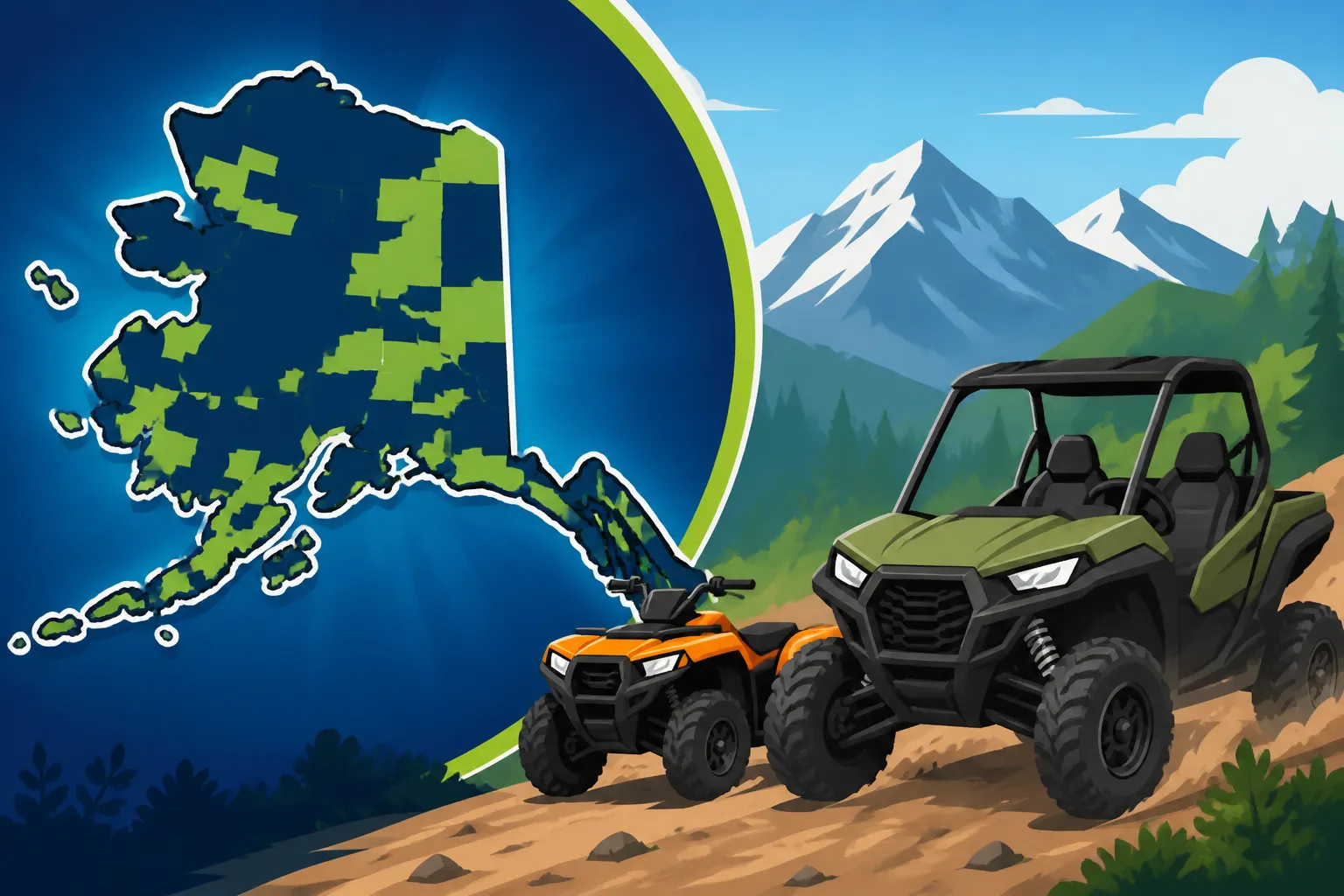
The general permit authorizes qualifying ATVs and UTVs on general state land managed by the Alaska Department of Natural Resources’ Division of Mining, Land & Water. That scope is specific: the permit applies to land in that management category, not every place that belongs to the state. The Alaska Department of Natural Resources explains what the permit authorizes; for more detail, see What Alaska’s Statewide General Permit Actually Authorizes.
The word “general” matters. A parcel may be state-owned but managed as a park, designated for a particular purpose, or managed by a different agency. In those cases, the statewide general permit does not by itself establish that you may ride there. You need to identify the land manager and check the rules that apply to the particular area and route.
| Where you plan to ride | Does the general permit cover it? | What to check |
|---|---|---|
| General state land managed by the Division of Mining, Land & Water | The Alaska Department of Natural Resources says the permit authorizes qualifying ATVs and UTVs there. | Confirm the parcel’s status and check for route-specific restrictions or closures. |
| Private land | No. The Alaska Department of Natural Resources excludes private land from the permit. | Get permission from the landowner. |
| State park land | No. The Alaska Department of Natural Resources excludes state parks from the permit. | Check the park’s rules and allowable uses for the specific trail. |
| Legislatively designated area | No. The Alaska Department of Natural Resources excludes legislatively designated areas from the permit. | Identify the designation and ask the responsible land manager about access. |
| Land owned or managed by another agency | No. The Alaska Department of Natural Resources excludes land managed by other agencies, including the University of Alaska and Alaska Mental Health Trust. | Check the agency’s access rules and any required permission or permit. |
The practical takeaway is that a permit and a legal riding route are not the same thing. The permit describes where qualifying machines may be authorized to travel; it does not make every road, trail, wetland, or crossing on that land an approved route. Before setting out, check both the parcel and the route. For the boundary between general state land and other categories, see Alaska’s General Permit Covers State Land, Alaska’s Permit Excludes State Parks, and Alaska’s Permit Excludes Designated Areas.
Land the permit does not cover
The Alaska Department of Natural Resources says the general permit does not cover private land, state parks, legislatively designated areas, or land owned or managed by other agencies. Those exclusions can affect a ride even when the route looks continuous on the ground. A trail may cross several parcels, and the land manager can change along the way.
Private land
A statewide permit is not permission to cross someone else’s property. If a trail or access road reaches private land, stop and confirm that you have the landowner’s permission to continue. Do not assume that public use of a nearby road, an old track, or a trailhead means the adjoining parcel is open to motorized travel.
Parcel boundaries may not be obvious in the field. A map can help you identify ownership, but it may not tell you whether a particular route is currently open or whether the owner allows vehicle access. For practical steps, use Alaska’s Permit Excludes Private Land, Alaska Land Ownership Lookups, and Looking Up Who Owns a Parcel Before You Ride.
State parks
The Alaska Department of Natural Resources excludes state parks from the general permit. That does not mean ATVs are prohibited throughout every park; it means you must rely on the park’s own rules and the allowable uses for the specific area or trail.
For example, the Alaska Department of Natural Resources says ATVs are allowed in the lower valley of the Bird Valley Trail System during summer. It also says ATVs are allowed on the Bird Creek Trails from April 1 through November 30, with ATV and bike access ending 4 miles up the valley. Those are specific access details, not evidence that the statewide general permit covers the area. Check current park information before riding because access and conditions can change.
The Division of Parks and Outdoor Recreation also provides trail maps for areas including the Anchorage Hillside, Big Lake, Caribou Hills South, the South Denali Highway, the Lower Susitna-Yentna Area, Petersville, Caribou Hills North, Caswell, Lake Louise, and Willow. These snowmachine trail maps can help with planning, but a map showing a trail does not by itself establish ATV or UTV access. Check the map’s stated use and the applicable park rules.
The distinction is important in Chugach State Park. The Alaska Department of Natural Resources identifies the Eklutna Lakeside Trail as allowing ATVs, while the Division of Parks and Outdoor Recreation’s trail information says the Falls Creek Trail is strictly for hiking and does not list ATVs or other off-highway vehicles as an allowable use. Treat each trail separately; do not infer permission for one trail from access on another. See Alaska State Park ATV Rules and Which Permit Covers Riding in an Alaska State Park?.
Designated areas and land managed by other agencies
Legislatively designated areas are also outside the general permit, according to the Alaska Department of Natural Resources. A designation can affect how the land is managed and what uses are allowed. Do not rely on a general land-status label alone if your route appears to enter a designated area. Confirm the boundary and ask the responsible manager about motorized use.
The permit also excludes land owned or managed by other agencies, including the University of Alaska and Alaska Mental Health Trust, according to the Alaska Department of Natural Resources. A route can pass from one agency’s land onto another’s without an obvious change in the landscape. Check the ownership and management information along the entire route, not just at the starting point. Alaska Land Managed by Other Agencies explains why the agency responsible for a parcel matters.
How to check whether your route is covered
A useful check has two parts: determine who manages the land, then confirm that ATV or UTV use is allowed along the route you intend to ride. A general permit may address the first question for qualifying machines on general state land, but you still need reliable information about boundaries, access, and current conditions.
- Mark the complete route. Include the trailhead, connecting trails, access roads, planned crossings, and your intended turnaround point. A route that starts on general state land may later enter a park or private parcel.
- Check land status and management. Use available land-status information to identify state land, private property, parks, designated areas, and parcels managed by another agency. For help with the process, see Checking a Land Status Map.
- Check the route’s allowed uses. Look for information that specifically addresses motorized travel and the type of vehicle you plan to use. A trail appearing on a map is not enough to establish that an ATV or UTV may use it.
- Confirm current access conditions. Contact the responsible manager if the map or posted information is unclear, or if closures, seasonal access, or route changes may affect your plan.
- Get separate permission where needed. If the route crosses private land or land outside the general permit, ask the owner or relevant land manager about access before riding.
The Alaska Department of Transportation & Public Facilities’ comprehensive trail map can be filtered to show motorized trails, including ATV and snowmachine routes. It is a useful way to locate mapped trails, but a map filter does not replace checking land ownership or the rules for a particular trail. The Division of Parks and Outdoor Recreation also offers trail information, including Google Earth trail maps for Chugach State Park, Denali State Park, Kachemak Bay State Park, Caines Head State Recreation Area, and Hatcher Pass Management Area. Use those resources alongside current guidance from the agency responsible for the land.
When the boundary or allowed use is uncertain, ask rather than guess. The Alaska Department of Natural Resources says current conditions and openings should be confirmed with Alaska State Parks for park areas. For a route outside a park, contact the manager responsible for that land. A trailhead sign, an online map, or the statewide permit alone may not answer every question about a mixed-management route.
Common assumptions that can lead to trouble
“It’s state land, so the general permit must cover it.” Not necessarily. The Alaska Department of Natural Resources limits the permit to general state land managed by the Division of Mining, Land & Water and excludes state parks, legislatively designated areas, and land owned or managed by other agencies. Confirm the specific parcel’s management category.
“The trail is on a map, so ATVs and UTVs can use it.” A mapped trail may be for hiking, biking, snowmachines, or another use. The Division of Parks and Outdoor Recreation says Trail Class 1 and Trail Class 5 trails are typically not designed or actively managed for ATVs, although use may be allowed. Check the trail’s stated rules rather than relying on its appearance or presence on a map.
“The general permit lets me ride the whole route.” The permit’s coverage does not automatically carry over when the route enters a park, private parcel, legislatively designated area, or land managed by another agency. Check every part of the route, including access and crossings.
“A snowmachine map confirms summer ATV access.” Not by itself. A snowmachine map is useful for locating trails, but it does not establish that the same trail is open to ATVs or UTVs under current conditions. Verify vehicle-specific access with the land manager.
If you are unsure, pause before entering the disputed segment. Checking ownership and permitted uses before a ride is simpler than discovering at a boundary that your permit does not apply. For the broader boundary between the statewide permit and other land rules, see Alaska Land Ownership and Who to Ask and A Trailhead Pass Is Not a Land Permit.
Sources
- Division of Motor Vehicles, State of Alaska — OFF‑HIGHWAY & ALL‑PURPOSE VEHICLES, Division of Motor Vehicles, State of Alaska (checked November 3, 2026)
- Alaska Department of Natural Resources — birdvalleytrailguide.pdf (checked November 3, 2026)
Disclaimer
This article is for general informational purposes only and does not constitute professional advice. Laws, prices and regulations vary by location and change over time. Consult a qualified professional for guidance on your specific situation.