Riding Onto Another Agency’s Land in Alaska
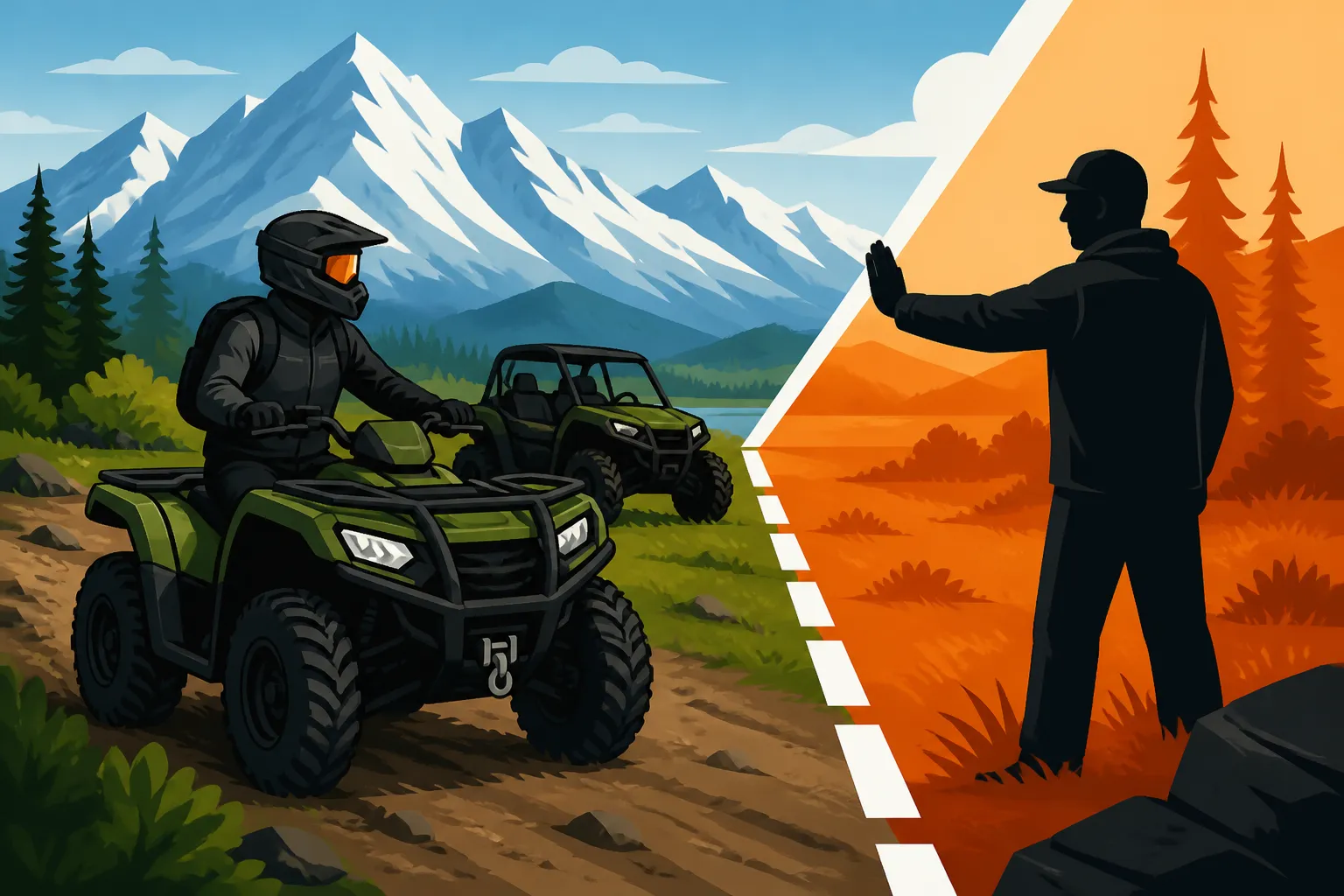
Alaska’s statewide land-use permission does not automatically follow an ATV or UTV across a property boundary. A route can pass from state land onto federal, borough, park, or other agency-managed land, where different rules apply. The safest approach is to identify who manages each part of the route, check that manager’s current requirements, and treat unclear boundaries as a reason to pause.
Why a state authorization may stop at the boundary
Permission to ride on one kind of land does not grant permission on every adjoining parcel. The Alaska Department of Natural Resources says vehicle users crossing from state land onto federal, borough, or other agency-managed land must follow the separate rules, permits, and restrictions set by that jurisdiction. State authorizations, including Generally Allowed Uses and statewide general permits, do not apply beyond state land.
That distinction matters on routes that look continuous on the ground. A trail may cross a boundary without a gate or obvious sign, and a trail map can show a route without answering who owns or manages every segment. A state permit is not a substitute for checking the land status and access requirements along the entire ride. For background, see What Alaska’s Statewide General Permit Actually Authorizes and Which Alaska State Land the General Permit Covers.
| What you are checking | What to confirm before riding |
|---|---|
| Land manager | Who manages each part of the route, including the land beyond a boundary |
| Riding permission | Whether ATV or UTV use is allowed on that specific land and trail |
| Permit or conditions | Whether the manager requires a separate authorization or limits access |
| Current status | Whether seasonal conditions, closures, or other restrictions affect the route |
| Route details | Whether the map reflects the permitted motorized trail, not just a visible track |
Treat the table as a planning checklist, not as a substitute for the applicable manager’s rules. A trail shown on a map is not, by itself, proof that motorized travel is allowed. Likewise, a machine’s registration does not establish access rights. Registration and land permission answer different questions: one concerns the vehicle, the other concerns where you may ride.
When a route crosses into another jurisdiction, stop and verify the next segment before setting out. If the boundary or the manager is uncertain, don’t assume that permission on the land you just crossed continues ahead. See A Trailhead Pass Is Not a Land Permit for another common source of confusion: access payments and land-use authorization are not necessarily the same thing.
Find the manager and check the actual route
Start by identifying the land under the route, not by relying only on a trail name, trailhead sign, or general map. Alaska’s land status resources can help you investigate who manages an area, but map lines and parcel information may need interpretation. Use Alaska Land Status Maps and Alaska Land Ownership Lookups as starting points, then confirm uncertain details with the agency or owner responsible for the ground.
The Alaska Department of Transportation & Public Facilities’ comprehensive trail map can be filtered to show motorized trails, including ATV and snowmachine routes. That can help with route planning, but a mapped motorized trail still needs to be checked against current access rules and land-management information. Use Alaska ATV Trail Map Downloads to explore map resources, and follow up with the manager responsible for the segment you plan to ride.
For land managed by another agency, verify the rules with that agency directly. The question is not just whether an ATV or UTV appears on a map, but whether motorized access is allowed on the specific trail and under the conditions you expect to encounter. Alaska Land Managed by Other Agencies provides related context, while Asking Who Owns the Ground First can help frame the questions to ask.
State park maps need careful reading
A trail map may cover a large park or recreation area without making every trail available to motorized users. The Alaska Department of Natural Resources says Trail Class 1 and Trail Class 5 trails are typically not designed or actively managed for ATVs, although use may be allowed. That wording is a reason to check the route’s specific allowable uses rather than treating a trail class as automatic permission.
The Division of Parks and Outdoor Recreation provides Google Earth Trail Maps for Chugach State Park, Denali State Park, Kachemak Bay State Park, Caines Head State Recreation Area, and Hatcher Pass Management Area. Those maps can help you understand the route, but the map alone may not settle whether an ATV or UTV may use a particular trail. For planning within parks, see Alaska State Park Riding Rules and Which Permit Covers Riding in an Alaska State Park?.
Chugach State Park illustrates why checking the individual trail matters. The park’s trail information lists the Eklutna Lakeside Trail as allowing ATVs. By contrast, ATV or off-highway vehicle use is not listed as an allowable use on the Falls Creek Trail, whose listed use is hiking. Dirt bikes are prohibited in the park area, according to the Alaska Department of Natural Resources and Chugach State Park information. Don’t assume that permission on one named trail extends to another trail in the same park.
Confirm current conditions, not just the map
A route may be allowed in principle but unsuitable or closed under current conditions. The Alaska Department of Natural Resources says to contact Alaska State Parks for current conditions and openings. This is especially useful when a route has seasonal restrictions or when weather and ground conditions may affect access.
For example, the Alaska Department of Natural Resources says ATVs are allowed on the Bird Creek Trails from April 1 through November 30, and ATV and bike access ends 4 miles up the valley. The department also describes 13.2 miles of total trail length in the lower valley. Those details apply to that trail system; they should not be generalized to nearby trails or other land managers’ routes. Check the current park information before relying on a past map or description.
Ask focused questions before crossing onto another agency’s land
Once you know who manages the next part of the route, ask specific questions. A broad question such as “Can I ride here?” may not reveal whether permission applies to your vehicle, the trail you intend to use, or the season you plan to visit. A clear inquiry makes it easier to spot a boundary between what is allowed and what is not.
Ask the land manager:
- Is this exact trail or route open to ATV or UTV travel?
- Does the permission cover the whole segment, or only a particular portion?
- Is a separate permit, land-use authorization, or other permission required?
- Are there seasonal limits, closures, or conditions that could change access?
- Are there restrictions on vehicle type or where a machine may travel?
- Where does the agency’s jurisdiction begin and end along the route?
If the route crosses multiple parcels, repeat the check for each manager. Permission from one agency does not resolve access on land controlled by another agency, a borough, or a private or Native corporation landowner. For private and corporation lands, see Alaska Native Corporation Land Permissions and Land Owned by Someone Else Entirely.
Keep a record of the information you relied on, including the route map, the manager’s contact details, and any permit instructions. If you print a map, mark the relevant boundaries and carry it in a waterproof sleeve; a document sleeve from a local outdoor retailer or Amazon can help keep paper notes legible in wet conditions. A map is a planning aid, not authorization, so keep the manager’s instructions alongside it.
Use a pause-and-verify rule
If you reach a boundary and cannot tell whether the route continues onto land you are authorized to use, stop before crossing. Look for signs or posted directions, check your map, and contact the relevant manager if the rules remain unclear. Do not treat tire tracks, an open-looking trail, or the absence of a barrier as evidence that access is allowed.
This cautious approach is useful even when you have already checked a route. Maps may be difficult to interpret at the point where a trail crosses a parcel line, and access information can change. If you cannot confirm permission for the next segment, turn around or choose a route whose access you can verify.
Keep vehicle requirements separate from land access
An Alaska registration or a road-use authorization does not grant permission to cross onto land managed by another agency. The Division of Motor Vehicles’ rules address vehicle registration and APV use; land managers set access requirements for the ground they manage. Satisfying one set of requirements does not replace the other.
An APV is an ATV used on public roads or highways with a speed limit of 45 mph or less, according to the Division of Motor Vehicles. Operators of an APV must hold a valid Class D or higher driver’s license and carry proof of liability insurance, and APV passengers are required to wear a helmet. Those are vehicle-use requirements; they do not establish that a road, trail, or parcel is open to ATV travel.
Before a ride, check both sides of the question: whether the vehicle is properly registered or otherwise compliant for the way you intend to use it, and whether you have permission to ride on every land segment. For related details, see Alaska APV Registration Requirements and Alaska APV Road Rules Explained.
A practical pre-ride routine is:
- Map the planned route and identify likely land-management boundaries.
- Check whether ATV or UTV use is allowed on each trail segment.
- Contact each relevant manager about permits, seasonal access, and closures.
- Confirm that your machine and riding plans meet applicable vehicle requirements.
- Carry the information you need to retrace the route or turn back if access is uncertain.
The key is to plan for the boundary, not just the trailhead. Knowing where state land ends and another manager’s rules begin can prevent an otherwise straightforward ride from becoming an unauthorized crossing.
Sources
- Division of Motor Vehicles, State of Alaska — OFF‑HIGHWAY & ALL‑PURPOSE VEHICLES, Division of Motor Vehicles, State of Alaska (checked November 3, 2026)
- Alaska Department of Natural Resources — birdvalleytrailguide.pdf (checked November 3, 2026)
Disclaimer
This article is for general informational purposes only and does not constitute professional advice. Laws, prices and regulations vary by location and change over time. Consult a qualified professional for guidance on your specific situation.