Alaska Regional Corporation Land Rules
Riding an ATV or UTV across Alaska can take you from public ground onto land owned by a Native regional corporation without an obvious change in the trail. The key is to identify who controls the parcel and get permission before entering. Here’s how to check ownership, understand access terms, and avoid treating a state permit or familiar route as permission to ride.
What regional corporation land means for riders
Alaska Native regional corporations were established under the Alaska Native Claims Settlement Act. They are private corporations that own and manage land, alongside other assets. Their land is not automatically public recreation land, even when it is undeveloped, looks open, or connects with a public trail.
Each regional corporation has its own land holdings, policies, and access decisions. A corporation may allow certain activities in some places, require a permit, restrict access to designated routes, or close an area. Terms can vary by parcel and may change with land management needs, safety concerns, environmental conditions, or other uses of the land. There is no single statewide recreation permit that grants access to every regional corporation’s property.
Regional corporation land is also different from village corporation land. A regional corporation and a village corporation are separate entities, and their land ownership and access policies should not be assumed to match. A route may cross land owned by either one, as well as state, federal, municipal, or other private property. For details on the distinction, see Alaska Village Corporation Land Rules and Alaska ANCSA Corporation Land Permits.
The practical takeaway is simple: a trail’s appearance does not tell you who owns it or whether motorized access is allowed. A route shown on a map, used by other riders, or remembered from a previous trip may not establish current permission. Confirm the specific parcel and route before you ride.
Ownership does not equal public access
A corporation may manage land for many purposes, including residential or commercial development, resource use, conservation, cultural priorities, or other activities. A rider should not infer that a property is open just because there is no gate, sign, or visible activity. Nor should a lack of posted restrictions be treated as an invitation to cross.
Some land may be open under defined conditions, while nearby land is not. Even within one corporation’s holdings, a permit may apply only to particular areas, routes, dates, or activities. The permitted activity matters: authorization for hiking, hunting access, or travel on foot may not include ATV or UTV use.
Shareholder status should not be treated as automatic permission for every machine, route, or parcel. Rights and access arrangements can depend on the corporation’s policies and the person’s circumstances. Shareholders should check directly with the corporation rather than relying on a general assumption about access.
Keep land access separate from vehicle rules
Landowner permission answers whether you may enter and ride on a particular property. It does not replace other requirements that may apply to the machine or ride. Depending on the route and circumstances, you may also need to consider state land permits, registration, local rules, insurance, equipment requirements, and restrictions imposed by other land managers.
Likewise, having a registration decal or an Alaska land permit does not create a right to cross private property. These are separate questions:
| Question | What it tells you | What it does not establish |
|---|---|---|
| Who owns or manages the parcel? | Which land manager or owner to contact | Whether riding is allowed |
| Does the owner permit ATV or UTV use? | Whether access is authorized and under what terms | Whether the whole route is open |
| Does a state land permit apply? | Whether a covered state-land requirement is met | Permission on corporation, private, or other agency land |
| Is the machine properly registered? | Whether applicable vehicle registration rules are met | Access to any particular parcel |
| Is there a local or area restriction? | Whether additional limits apply | Permission from a private landowner |
A state permit and ownership check are related parts of trip planning, but they are not interchangeable. Alaska General Permit Requirements explains the state permit context, while Does Alaska’s State Permit Cover Federal Land? covers the limits of assuming one permit applies across different ownerships.
Find the owner and confirm the exact route
A reliable access check starts with the ground your machine will actually cross. A trailhead, destination, or nearby landmark is not enough. If the route passes through several parcels, access needs to be checked for each one.
-
Draw the route, including the approach and return. Mark the trailhead, planned track, crossings, alternate routes, and any planned stopping or camping spots. A shortcut or detour can take you onto a different owner’s land.
-
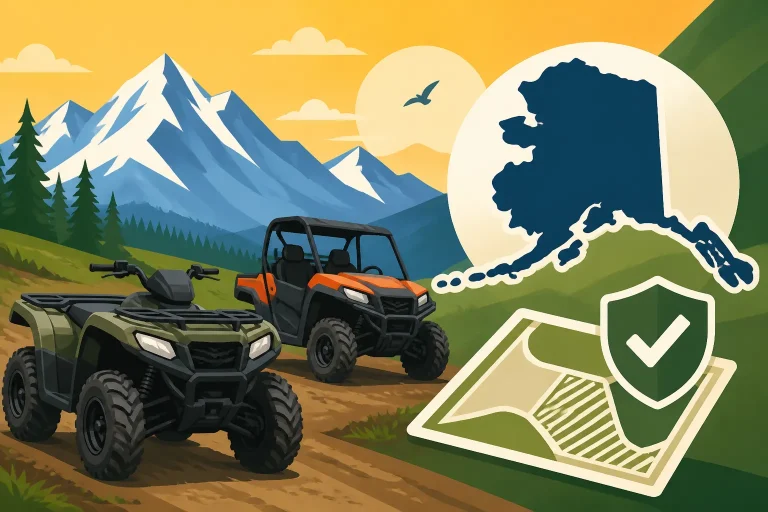
Check land status for the route, not just the destination. Use available land status maps and parcel information to identify who owns or manages the ground. Start with Alaska Land Ownership and Who to Ask and Checking a Land Status Map. Mapping tools can help identify likely ownership, but they are not themselves permission to ride.
-
Look for boundaries and mixed ownership. A route can run across a patchwork of land. It may begin on public land, cross corporation land, pass an inholding, and later enter land managed by another agency. Do not assume a trail stays under one owner’s control just because it appears continuous.
-
Contact the corporation that controls the parcel. Use the corporation’s current official contact channels and ask about the exact route and planned machine use. If the ownership record is unclear, ask the relevant land office or manager to help identify the correct contact. A regional corporation may not control every nearby parcel.
-
Get the access terms in a form you can keep. If permission is granted, save the permit, written confirmation, map, or other documentation supplied by the corporation. Check whether it names the area, route, dates, rider, machine type, and any conditions. If the corporation requires a formal permit, follow its application process rather than substituting an informal conversation.
-
Recheck before departure. Confirm that access remains available and that there are no temporary closures or updated conditions. A past ride or old permit does not necessarily establish permission for the next trip.
Land status maps are useful for narrowing down the right contact, but parcel lines and trail lines may not align neatly. Some maps are generalized, and some routes are difficult to locate precisely. When a boundary is uncertain, ask before crossing it. Looking Up Who Owns a Parcel Before You Ride and Asking Before You Ride Through offer more detail on handling that uncertainty.
Ask about the whole use, not just the word “access”
When you contact a land manager, describe what you plan to do. “Can I access the area?” may not make clear whether you mean walking, driving a truck, riding a quad, operating a side-by-side, hunting, camping, or crossing the land to reach another destination.
Be ready to share:
- The route, trailhead, and destination, preferably on a map
- The dates or general period of the trip
- The type and number of machines
- Whether you expect to camp, stop, hunt, or carry passengers
- Whether the route crosses streams, wetlands, or other sensitive ground
- The names of riders or group organizers, if requested
Ask whether a permit is required, whether the route is limited to designated trails, and whether any closures or seasonal conditions apply. Also ask whether authorization allows travel in both directions and whether it covers a return route or alternate route. If a condition is unclear, seek clarification before you ride rather than guessing in the field.
Permits, restrictions, and responsibilities
A corporation’s access process may differ from one area to another. Some land managers may offer a permit or other written authorization; others may not allow the proposed type of travel. Do not assume that every corporation sells a permit, that a permit is available to every rider, or that authorization in one area applies elsewhere. Check directly with the owner for current requirements and costs.
If a permit is required, read the terms closely. A permit may identify the allowed area or route and set conditions for motorized use. It may also limit the period of access, the number of riders, the type of machine, or where riders can stop. Fees, if any, and application steps are set by the relevant land manager, so confirm current details with that organization. Buying a Land Use Permit From a Native Corporation and Alaska Native Land Access Permits explain the general access process.
Permission to cross a parcel should not be stretched beyond what was granted. For example, authorization for a specified route does not automatically permit side trips, camping, hunting, or travel through neighboring land. If a planned change would take you off the approved route, confirm that the change is allowed first.
Respect conditions even when they are not physically marked along the trail. A permit or written authorization may contain rules about speed, noise, group size, timing, waste, fires, or damage to the land. Follow any posted signs and temporary notices as well. If a sign conflicts with what you understood from an earlier conversation, stop and contact the land manager for clarification instead of riding past it.
A state permit does not substitute for private permission
Alaska’s statewide general permit relates to certain state land, subject to its coverage and exclusions. It does not give riders a general right to use regional corporation land. The same principle applies to trailhead passes: paying for parking or day use at a trailhead does not mean every connected route is open to you.
For any trip that crosses different land types, treat each owner or manager’s rules separately. A practical check looks like this:
- Identify where state land begins and ends, and confirm whether a state permit requirement applies.
- Identify regional or village corporation parcels and ask the relevant corporation about motorized access.
- Check whether federal, municipal, state park, or other agency land is involved.
- Identify private inholdings and obtain permission from their owners if your route crosses them.
- Check for local rules or closures that apply to the route or community.
This can feel like extra work for a short ride, but a short crossing is still a crossing. If the route is not clearly on land where you are allowed to ride, change the route or obtain permission before entering. Alaska Land Managed by Other Agencies is useful when a trip spans more than one land manager.
Riders remain responsible for careful travel
Permission is not a guarantee that every condition on the ground is safe or suitable. Riders are responsible for choosing a route that fits their skill, machine, and conditions. In Alaska, water levels, weather, ground conditions, and visibility can change. A route that was passable earlier may become difficult or unsafe later.
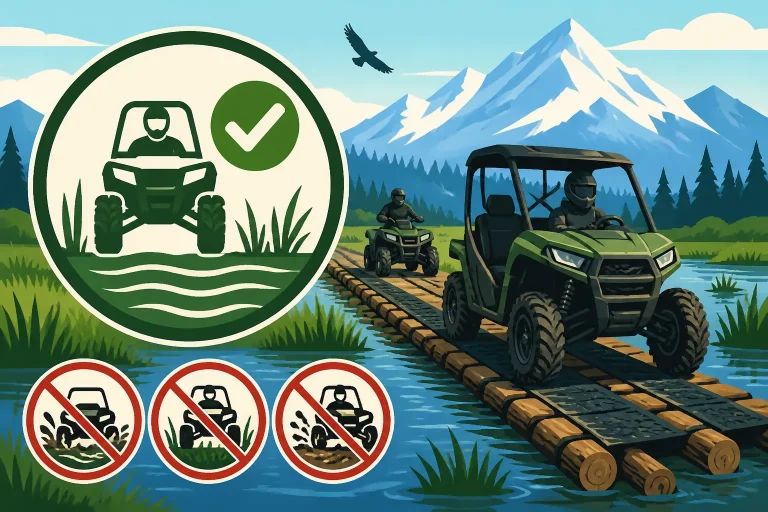
Avoid widening trails or making new tracks to get around mud, standing water, obstacles, or a closure. Detours can cause damage and may take you onto land for which you have no permission. If a route is blocked, stop and use an approved alternative only if one is available. Otherwise, turn back.
Keep machines on the approved route and travel in a way that limits disturbance to vegetation, wetlands, streams, wildlife, and other land users. Carry out trash and leave gates, barriers, signs, and equipment as you found them. Do not assume that a land manager’s permission to ride includes permission to disturb property, access facilities, or use resources on the land.
Common mistakes and a practical pre-ride check
Most access problems come from treating a general indication of access as if it were parcel-specific approval. A little preparation can help prevent a route dispute and reduce the chance of causing damage or being turned back.
Mistakes to avoid
- Assuming a public-looking trail is open. A path can cross private land even if it has no gate or sign.
- Relying on a map line as proof of permission. A route shown on a map helps with navigation, but it does not prove that motorized use is authorized.
- Treating another rider’s access as your own. A person may have separate permission, a permit, or a relationship with the land manager that does not extend to other riders.
- Confusing a regional corporation with a village corporation. The names and land holdings may be related to the same region, but the entities can be distinct. Contact the owner of the parcel in question.
- Assuming a state permit, registration, or trailhead payment covers everything. Each requirement has a different purpose and may apply to different land.
- Using an old approval without checking its terms. The permitted area, route, dates, or conditions may not cover your current trip.
- Taking an unapproved detour. A detour can cross a new parcel or violate a route condition, even if it appears to rejoin the same trail.
- Assuming permission for one activity includes another. Motorized travel, hunting, camping, and other uses can have separate conditions.
If a rider enters corporation land without permission, the owner may ask the rider to leave or take other steps available to address unauthorized use. The outcome depends on the facts and applicable rules. Do not argue over ownership at a gate or continue riding while trying to resolve a boundary dispute. Stop, move to a place where you are authorized to be if it is safe to do so, and contact the land manager. For more on the issue, see What Follows a Trespass Complaint on Alaska Native Land.
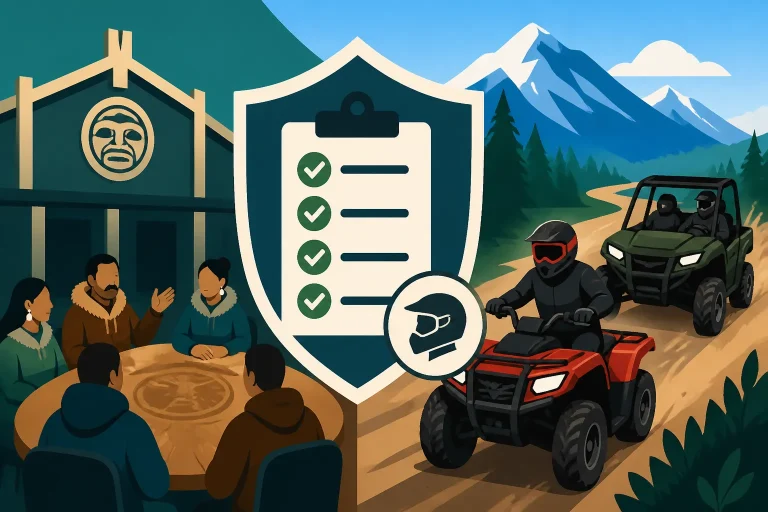
A simple checklist before loading the machines
Before leaving, make sure you can answer these questions:
- Do I know who owns or manages each parcel on my route?
- Have I confirmed that ATV or UTV use is allowed on the exact route?
- Do I have any required permit or written authorization with me?
- Do I understand the authorized area, dates, and conditions?
- Do I know what land the route enters if I need to turn around or use an alternate?
- Have I checked for current closures or route changes?
- Are the machines and riders prepared to meet the applicable registration, safety, and local requirements?
- Does someone outside the riding party know the planned route and return plan?
Keep authorization accessible, such as in a waterproof case or saved offline on a device. Cell coverage may be unreliable in remote areas, so do not rely on being able to contact a land manager once you are already on the trail. If your documents refer to a map, make sure you have the map too.
If you cannot confirm access in time, choose a route with clear permission rather than hoping to sort it out at the boundary. The most useful planning question is not simply whether there is a trail, but whether the owner of every parcel on that trail allows the kind of riding you intend to do.
Frequently Asked Questions
Can I ride on regional corporation land if there is no gate or sign?
Not necessarily. The absence of a gate or sign does not establish that the property is open to public ATV or UTV use. Identify the owner and ask about access for your route and machine.
Does Alaska’s general land permit cover regional corporation land?
No. A state land permit does not grant access to private land owned by a regional corporation. Check each landowner’s requirements separately.
Does permission from a village corporation apply to regional corporation land?
Not automatically. They are separate entities and may own different parcels. Confirm who controls the land you intend to cross and obtain authorization from the appropriate owner.
Is a map enough to prove that I can ride a route?
No. A map can help you identify a route or parcel boundary, but it does not establish current permission for motorized use. Confirm access directly with the land manager and keep any required authorization with you.
Disclaimer
This article is for general informational purposes only and does not constitute professional advice. Laws, prices and regulations vary by location and change over time. Consult a qualified professional for guidance on your specific situation.