What You Need at a Trailhead Pay Kiosk
A trailhead pay kiosk can be easy to overlook when you are unloading an ATV or UTV, especially if you already have a land-use permit. The key is knowing what the kiosk fee covers, how to follow the posted payment steps, and what proof to keep. A trailhead pass, a land permit, and permission to cross private ground are not interchangeable.
What a Trailhead Kiosk Payment Covers
A kiosk payment is generally tied to use of a particular recreation site or its facilities. Depending on the location, it may cover day use, parking, or access to a managed trailhead. It does not automatically give you permission to ride across every parcel beyond the parking area.
That distinction matters in Alaska, where a route can cross land managed by different agencies or owned by different parties. A paid trailhead pass is not a substitute for checking who owns or manages the land you plan to ride. Start by confirming the rules for the specific trailhead and route, rather than assuming one payment covers the whole trip.
For example, a pass or day-use payment associated with a Mat-Su trailhead does not, by itself, establish that you may ride on private land, Native corporation land, a state park, or federal land. The rules can change at a boundary even when the trail looks continuous. Alaska Land Ownership and Who to Ask explains why identifying the land manager is an important part of trip planning.
The statewide general permit is another separate piece of the picture. It may authorize certain travel on eligible state land, but it does not replace a site-specific fee, authorize use of every trailhead, or grant access across land that is excluded from the permit. Check What Alaska’s Statewide General Permit Actually Authorizes and A Trailhead Pass Is Not a Land Permit before relying on a permit or pass for a ride.
| What you have | What it may cover | What it does not automatically cover |
|---|---|---|
| Trailhead kiosk payment or day-use pass | Use of a specified site or facility, as described by its posted rules | Permission to ride across every parcel on a route |
| Alaska statewide general permit | Eligible travel on state land, within the permit’s conditions | State parks, private land, or land managed by another agency |
| Landowner or land-manager permission | Access to the land and route covered by that permission | Kiosk fees, parking fees, or requirements on other parcels |
| Vehicle registration or decal | Required registration for applicable machines and uses | Land access or a trailhead pass |
Do not treat a payment receipt as proof of permission to ride everywhere. Keep it as evidence that you followed the payment process for that site, and separately carry the documents or permissions that apply to your machine and route. For registration details, see Alaska Registration Before Riding Public Land.
What to Check Before You Pay
Read the kiosk instructions before putting money in an envelope, selecting a payment option, or leaving the site. Procedures vary, and instructions at the location should take priority over assumptions based on another trailhead. The kiosk may specify which pass applies, how to identify your vehicle, where to display a pass, and whether payment is required for each vehicle or each person.
Check these details before committing to a payment:
- Which site the fee applies to. Confirm that the sign or kiosk names the trailhead or recreation area you are using. A pass issued for one site may not be accepted at another.
- What kind of use is covered. Look for a distinction between parking, day use, camping, or other activities. Do not assume a parking payment also authorizes riding on a particular trail.
- Who or what the fee applies to. The instructions may define payment by vehicle, rider, or another unit. Follow the local wording rather than guessing.
- How payment must be made. Some locations may use a pay station, while others may provide a fee envelope or a different process. Accepted payment methods can vary, so check the posted directions and bring an alternative if practical.
- Whether a pass must be displayed. If the site requires a tag, receipt, or other proof to be visible, follow the specified placement instructions. Keep any companion receipt or confirmation as well.
- How long the payment remains valid. Confirm the period stated on the sign. A payment for one visit or day should not be assumed to cover a later visit.
- Whether the site has separate rules. Posted notices may address parking, camping, vehicle types, closures, or other restrictions that matter to your trip.
Do not rely on an old photo of a sign or directions from a different trailhead. A kiosk can be moved, replaced, or operated under updated instructions. If the sign is unclear, use the site manager’s contact information when available and avoid assuming that a payment made under uncertain instructions is valid.
Trailhead pass programs also are not all administered in the same way. Some Mat-Su trailheads have their own pass requirements, and procedures can differ between day passes and longer-term passes. The information in Which Mat-Su Trailheads Need a Parking Pass and Alaska Trailhead Passes at Government Peak can help you identify questions to check, but confirm current directions for the location you are visiting.
A Practical Kiosk Routine
A few minutes of preparation can prevent the common problems: arriving without an acceptable payment method, leaving without a required display, or confusing a parking payment with land access.
- Confirm the trailhead and route before leaving. Identify the exact parking area you intend to use and check whether a fee, pass, or other site requirement applies. Then check the route’s land status and access rules. Checking a Land Status Map and Looking Up Who Owns a Parcel Before You Ride can help you plan that second part.
- Read the current instructions at the kiosk. Check the posted fee terms, eligible payment options, pass duration, and display requirements. Use the instructions at that location even if you have paid at a different site before.
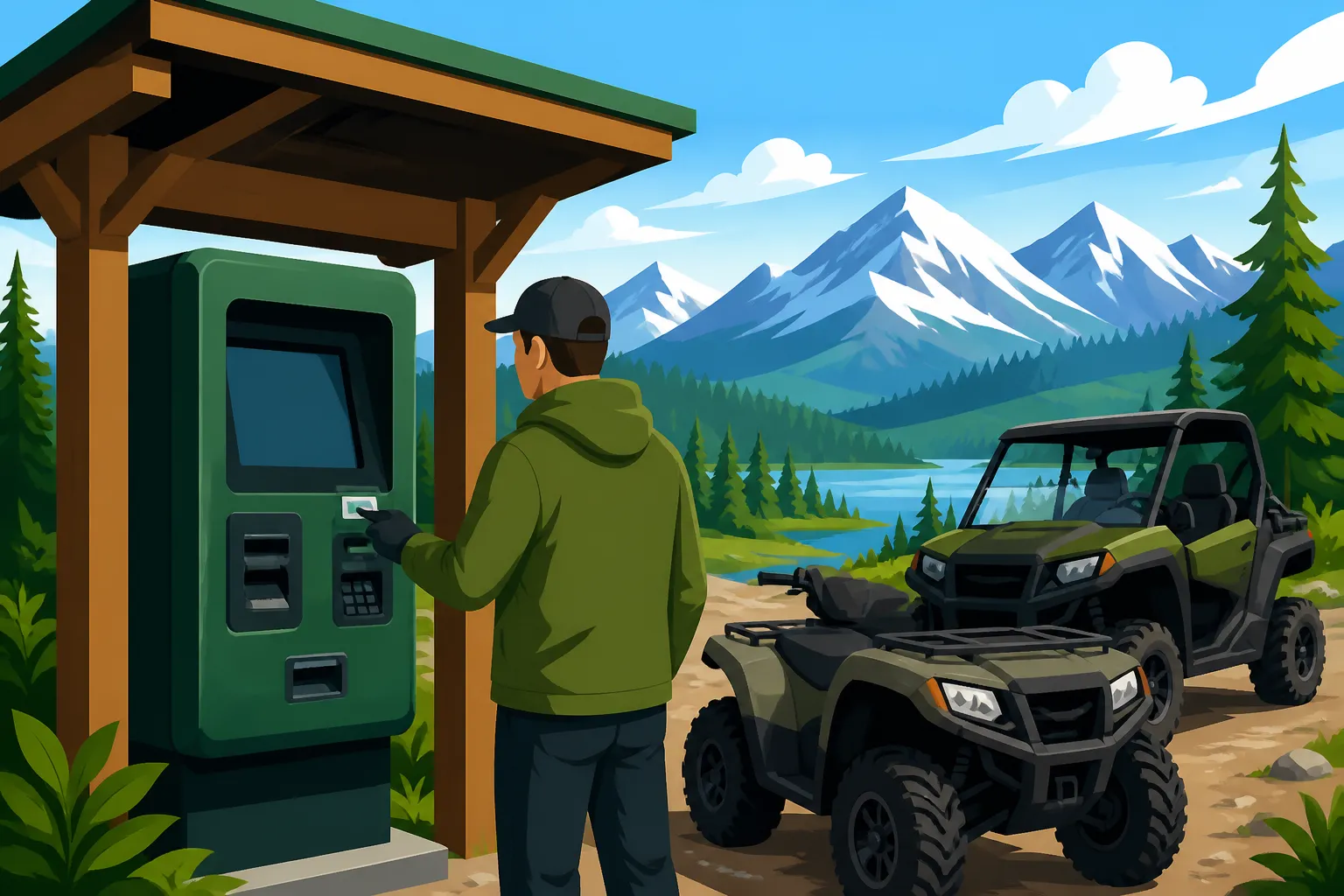
- Complete the payment exactly as directed. If the process uses a fee envelope, provide the requested information and place the payment where the instructions say. If it uses a machine or another system, follow its prompts and check for a confirmation or receipt.
- Keep the proof. Save the receipt, payment confirmation, or any portion of an envelope that the instructions tell you to retain. If a pass or tag must be displayed, put it in the required place before you leave the parking area.
- Check the rest of the trip’s requirements. Make sure the route is open and that your machine, registration, permits, and land permissions are appropriate for the terrain and ownership along the way.
- Recheck before a return visit. A previous payment may not cover another trip. Read the current sign each time, especially if you are visiting a different trailhead or returning after a long interval.
If the kiosk is damaged, out of order, or missing its instructions, do not assume that the fee is waived or that another site’s payment procedure applies. Look for posted alternatives, such as a contact number or another stated payment location. If no clear option is provided, document the problem and contact the site manager as soon as practical. A photo of the kiosk and its posted notice may help explain what happened, but it is not a substitute for following an available payment method.
When an envelope system is used, take a moment to check that you have filled in every requested detail and used the correct envelope or drop box. A payment envelope can be easy to mistake for an optional donation or a different type of fee. Filling Out a Fee Envelope at Jim Creek covers the kind of details to pay attention to at that site; always use the current instructions posted at the kiosk.
Common Mistakes and How to Avoid Them
Treating a trailhead pass like a riding permit
A kiosk payment may cover use of a parking area without authorizing travel beyond it. Before unloading, check whether your intended route crosses state land, a state park, federal land, private ground, or Native corporation land. Each may have different access rules. A site pass cannot grant permission on behalf of a landowner or agency that does not administer the kiosk.
The reverse is also true: holding a land permit does not necessarily mean you can park at a fee-managed trailhead without paying. Think of access requirements as separate checks. Confirm the site payment, land authorization, machine registration, and route conditions individually.
Assuming every machine in the group is covered
If you arrive with several ATVs or UTVs, read the fee wording to see whether it applies per vehicle, person, or visit. Do not infer the answer from the number of passengers or from what another group paid. Ask the site manager if the terms are not clear.
Leaving without proof
A pass that must be displayed is of little use if it stays in a pocket or is placed where it cannot be seen. Conversely, if the instructions say to keep a receipt, do not discard it after displaying a tag. Secure paper proof from rain and mud, and keep a photo of a confirmation when the payment system provides one. A phone image can be useful backup, but it may not replace a required physical display.
Relying on a payment from a different trailhead
Fees and procedures can be site-specific. A pass purchased at one location may not cover another, and the same recreation area may have more than one access point with separate directions. Check the sign at the trailhead you are actually using.
Confusing payment with permission to ride
Paying at a kiosk does not make a closed route open, change a land boundary, or authorize trespass. Confirm closures and restrictions before setting out. If your route includes Native corporation land or private property, get the required permission from the landholder or manager. Alaska Native Land Access Permits and Asking Before You Ride explain why that step can matter even when a route is commonly used.
Ignoring changing site conditions
A familiar trailhead may have new signs, a temporary closure, a damaged kiosk, or different instructions. Conditions can also change after heavy rain, flooding, or other events. Check notices at the site and any official updates available from its manager. Do not assume that a payment process or route condition remains unchanged just because you have visited before.
The simplest reliable approach is to treat the kiosk as one part of your pre-ride checklist: verify what the payment covers, follow the local instructions, keep proof, and separately confirm that your full route is legal and open. That leaves fewer unanswered questions once you are off the road system.
Disclaimer
This article is for general informational purposes only and does not constitute professional advice. Laws, prices and regulations vary by location and change over time. Consult a qualified professional for guidance on your specific situation.