Alaska Stream Crossing Rules
Alaska stream crossings can turn a straightforward ATV or UTV ride into a question of land access, fish habitat, and trail damage. The right approach depends on where the stream is, whether a crossing already exists, and what you plan to do. Here’s how to check the rules, reduce your impact, and know when to stop and ask before riding through.
Start with the land and the route
There is no single permission that makes every Alaska stream crossing lawful. A route may cross state land, a state park, federal or borough land, private property, or Alaska Native corporation land. Each owner or manager may set conditions, and a general land-use permit does not necessarily authorize work in a stream.
If you are relying on Alaska’s statewide general permit, first confirm that the ground is covered. The permit applies to certain state land, but it does not replace the permission or rules that apply on land managed by someone else. It also does not cover state parks. These distinctions matter when a trail reaches a stream or crosses a boundary near the water.
- Check the route and the stream crossing on a current land-status map. A trail line on a map does not, by itself, prove that you have permission to use every parcel along it. Checking a Land Status Map
- Identify the land manager for the crossing and the approaches on both sides. A stream can form a boundary between parcels with different owners or rules.
- Confirm whether the route lies within a designated area, park, refuge, or other place with additional restrictions. Alaska Land Managed by Other Agencies
- Ask what kind of use is allowed: riding through an established crossing, traveling on a marked trail, or making a new crossing may be treated differently.
- Check for temporary closures, seasonal limits, or local trail conditions before leaving.
Alaska’s statewide general permit may authorize certain off-road vehicle travel on eligible state land, but it should not be treated as a blanket stream-crossing permit. Alaska’s Statewide General Permit for ATV Use Review what the state permit covers, and remember that Alaska’s Permit Excludes State Parks. If the route crosses land outside the permit’s scope, contact that land manager directly. Alaska Land Ownership and Who to Ask
Existing crossings are different from making a new one
Riding across an established, authorized trail crossing is not the same as cutting a new approach, moving gravel, placing logs, or changing the streambed. Those actions can disturb habitat, change water flow, or make a crossing unsafe. Don’t assume that permission to ride in an area includes permission to alter a stream.
A stream crossing may also raise fish-habitat questions. Alaska’s Department of Fish and Game reviews certain activities that could affect fish-bearing water, and a permit may be needed for work in or near a stream. Whether a permit applies depends on the location and the activity. For example, passing through an existing authorized crossing is different from installing a culvert or reshaping a channel, but you should not make that distinction on guesswork alone. Ask the relevant land manager and, when the proposed activity could affect fish habitat, contact the department before starting. When Alaska Requires a Fish Habitat Permit
| What you plan to do | Why it matters | Safer next step |
|---|---|---|
| Use a marked, existing crossing | It may be the intended route, but closures and land rules still apply | Confirm the trail is open and authorized |
| Ride through a shallow channel where no crossing is marked | The route may be unauthorized, and repeated traffic can damage banks or the streambed | Check with the land manager before using it |
| Cut a new approach or widen a trail at the bank | Clearing and repeated traffic can cause erosion | Get permission before altering the route |
| Move rocks, logs, or gravel in the channel | Changing the bed or flow may affect habitat and could require review | Do not move material without approval |
| Install a bridge, culvert, or other structure | Construction can affect water flow and fish passage | Ask the land manager and the appropriate permitting agency what approvals are required |
| Cross a stream that appears closed or damaged | Riding may worsen the problem and violate a closure | Turn back and report the issue to the manager |
If you are uncertain whether a proposed change is minor or requires approval, describe the exact location and activity to the land manager and ask for a clear answer before doing the work. A casual trail convention or advice from another rider is not a substitute for permission from the agency or owner responsible for the site.
Also check whether the stream is within a state park or another area with separate rules. The statewide permit is not a substitute for park authorization. Alaska State Park Riding Rules If the crossing is on corporation or private land, ask the owner or authorized contact; permission to reach the stream from one side does not automatically grant access across the other side.
Cross with the least impact
Even where riding through a crossing is allowed, the way you cross matters. Water levels, soft banks, glacial silt, and loose stones can make a route change quickly. A crossing that looked manageable earlier in the day may become deeper or faster after rain or upstream melt. If you cannot judge the depth, current, or exit, don’t commit the machine.
Before crossing, stop well back from the bank and check the route on foot only if you can do so safely. Look for the established entry and exit, the firmness of the bottom, submerged obstacles, and signs of a marked closure. Never create a shortcut through vegetation to avoid a difficult patch of trail. Repeated tire tracks can cut banks and carry sediment into the water.
For an authorized crossing:
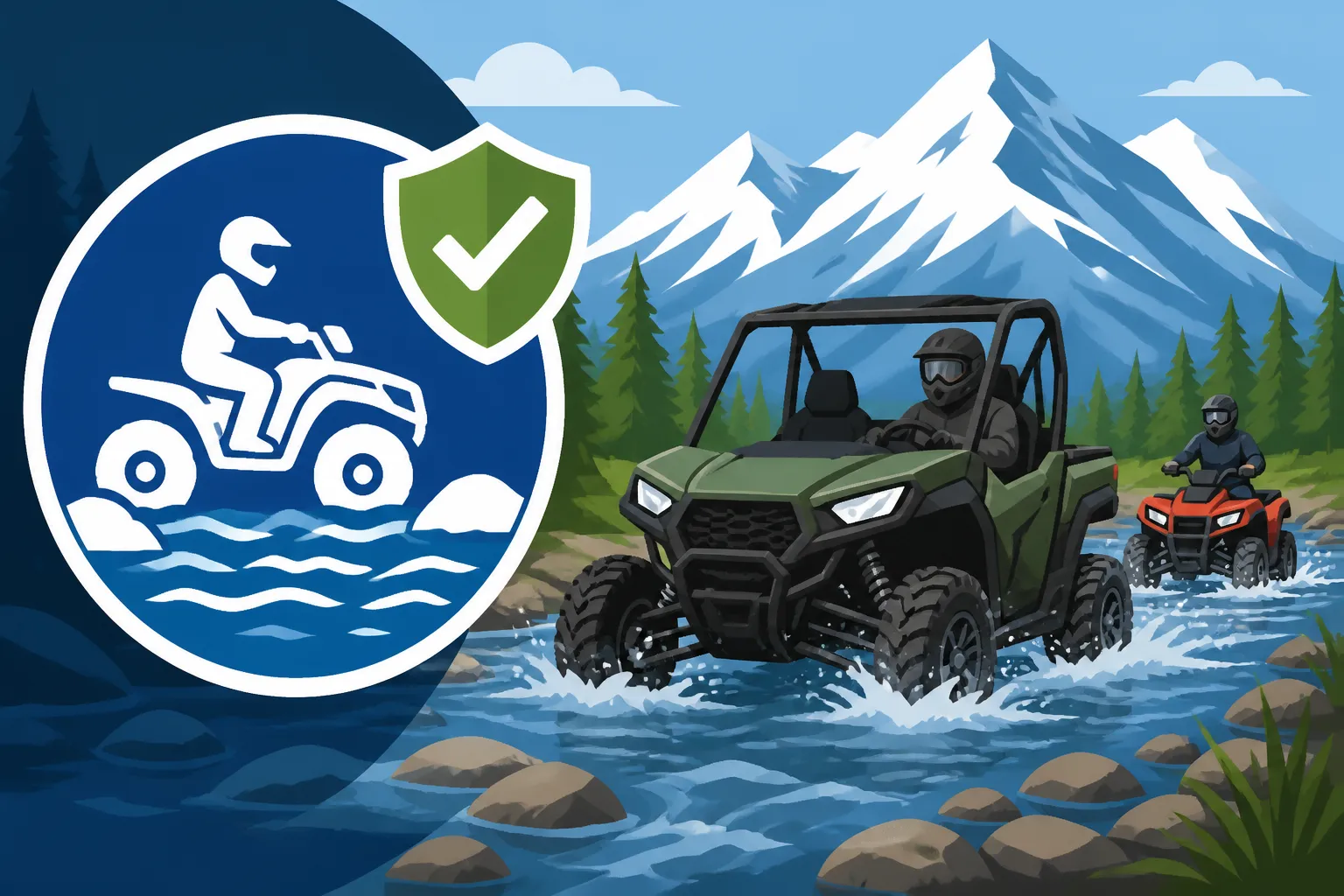
- Use the established crossing and approach it slowly. Avoid spinning the tires or making abrupt turns.
- Cross one machine at a time, keeping enough distance to avoid crowding the vehicle ahead.
- Choose a line you can complete without stopping in the channel. If the depth or footing is uncertain, turn around rather than testing it with the machine.
- Do not drive upstream or downstream through the water to find a more convenient exit.
- Once across, stay on the established trail instead of widening the route around mud or obstacles.
- Stop if the water is rising, the current is strong, or the exit is breaking down.
These are practical impact-reduction steps, not permission to ride wherever you find water. A crossing can still be off-limits because of the land manager’s rules, a seasonal closure, or a habitat restriction. Alaska Tundra and Wetland Conditions has related guidance on why soft ground and wet areas are especially vulnerable to repeated vehicle traffic.
In freeze-up or winter, do not assume a frozen stream is automatically safe or open to motorized travel. Ice thickness, overflow, moving water, and channel changes can create hazards that are difficult to see. Check the rules for the specific route and conditions before traveling. Alaska Rules for Riding a Frozen River
What to do when the crossing is unclear
When maps, signs, and trail conditions do not line up, treat the uncertainty as a reason to pause. A map may show a route without identifying who manages every part of it, and a visible track does not prove that a crossing remains authorized. Likewise, the absence of a sign is not proof that a stream is open to vehicles.
Use this process before making a decision:
- Pinpoint the crossing. Note the trail, nearby landmarks, and which side of the stream you are on. If you can, save the map location while you still have a signal.
- Check the land status. Determine who manages the approaches and the stream area. A boundary may run along the water or cross the route nearby.
- Look for current notices. Check for posted closures, seasonal restrictions, washouts, or repair work. Do not move a barrier or ride around one.
- Ask the responsible manager. Explain whether you want to use an existing crossing or create or repair one. Ask whether separate fish-habitat or construction approvals may apply.
- Choose a legal alternate route or turn back. Do not improvise a new crossing simply because the mapped route is impassable.
For an existing crossing, ask whether it is open to your type of machine and whether there are seasonal or water-condition limits. For any work in the channel or on its banks, ask before moving material or building anything. If you cannot reach the responsible office and the crossing is uncertain, the safest choice is to leave it alone and return when you can confirm the rules.
A damaged bank, freshly cut approach, or altered channel can also be a sign that the crossing is being repaired or has been closed. Avoid disturbing it. If a crossing has become unsafe or appears to be causing erosion, note the location and report it to the land manager rather than attempting a repair yourself.
The key distinction is simple: permission to ride on a route does not necessarily authorize changing a stream, and a route that appears established is not automatically open. Confirm who manages the land, use only an authorized crossing, and turn around when water or ground conditions make the route unsafe.
Disclaimer
This article is for general informational purposes only and does not constitute professional advice. Laws, prices and regulations vary by location and change over time. Consult a qualified professional for guidance on your specific situation.