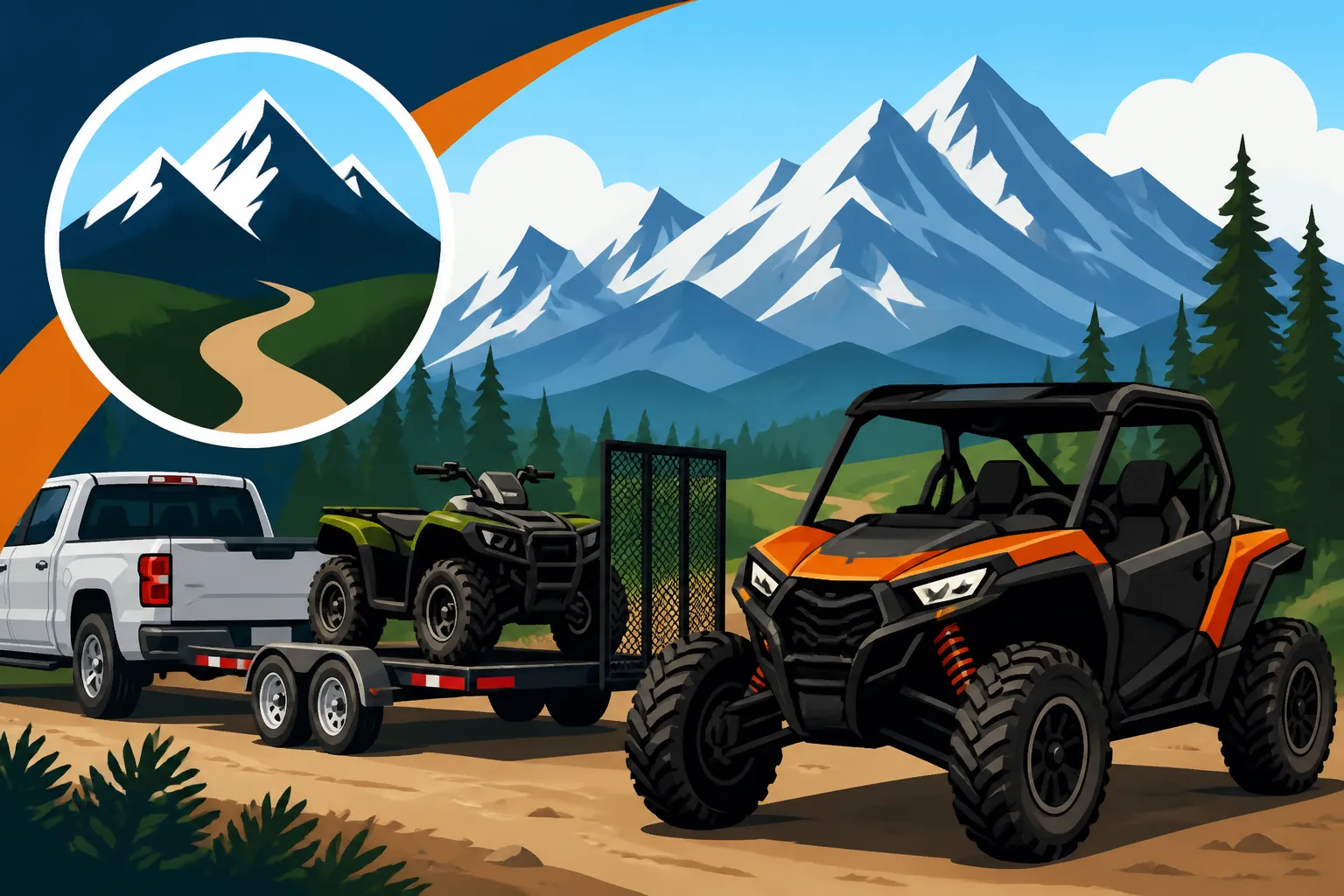
Alaska Trailheads With Trailer Parking
A trailhead can look spacious on a map and still be a headache when you arrive with a truck, trailer, and ATV. In Alaska, parking surfaces, seasonal conditions, access rules, and room to turn around can vary widely. This guide explains how to assess trailer parking and plan a practical launch from Mat-Su trailheads and other riding areas.
How to find an Alaska trailhead that can handle a trailer
Check the whole parking setup, not just the trail entrance
Trailer parking means more than finding an open patch of ground. You need room to pull in without blocking other vehicles, unload safely, and leave your truck and trailer for the length of your ride. A narrow entrance, crowded lot, soft shoulder, or tight turning area can make a location unsuitable even when the trail itself is open.
Look for information about the parking area as well as the riding route. A map may show a trailhead but not whether a long trailer can maneuver in its lot. Recent visitor comments, land-manager updates, and direct inquiries can help fill in that gap. For planning, onX Offroad can help you compare access routes and nearby riding areas, but a mapped trail or point of interest is not confirmation that trailer parking is available or permitted.
Before setting out, try to answer four practical questions:
- Is parking permitted for a vehicle and trailer, rather than only a passenger vehicle?
- Is there enough room to turn around without backing into traffic or onto a trail?
- Can the truck and trailer remain parked while you ride?
- Are there fees, passes, closures, or seasonal restrictions to account for?
If any answer is unclear, contact the land manager or recreation office responsible for the area. Ask specifically about the length and type of trailer you plan to bring. “Is there parking?” may get a yes, while “Can I leave a pickup and a 20-foot enclosed trailer here and turn around?” is much more useful.
Match your trailer to the access road and lot
The approach can be as important as the parking space. A trailhead may be reachable by ordinary vehicles but still be awkward for a long rig because of tight corners, steep grades, narrow bridges, rough surfaces, or limited places to pull aside. Conditions can also change after heavy rain, snowmelt, or maintenance work.
Before you tow, review the route from the main road to the staging area. Check whether the last stretch is paved, gravel, or a rough access road, and whether there are restrictions on vehicle size or road use. If your trailer is wide or low-clearance, consider whether you can manage the road safely without scraping, getting stuck, or forcing another driver to reverse.
Do not treat an informal roadside turnout as a substitute for an approved parking area. A turnout might be private, too small to leave a rig unattended, or positioned where a parked trailer creates a hazard. If the official lot is full, a backup plan should be another confirmed, lawful staging location—not an improvised shoulder.
For a broader look at route options and riding locations, start with [Alaska ATV Trails: Where to Ride]. As you compare destinations, onX Offroad can be useful for tracing the approach and identifying nearby roads or trail networks; confirm access and parking rules separately with the relevant manager.
Mat-Su trailheads to investigate for trailer parking
Government Peak, Crevasse Moraine, and Lazy Mountain
Government Peak, Crevasse Moraine, and Lazy Mountain are Mat-Su-area trailheads worth checking when you are planning a ride with a trailer. They are established recreation locations, but do not assume that a parking pass, a designated parking area, or a trailhead listing automatically means a large trailer can be accommodated. The lot layout, available space, and rules can differ by site and may change with season or use.
Start by checking the specific trailhead’s current parking information and asking whether trailer parking is allowed. Be clear about whether you are bringing an open utility trailer, a longer enclosed trailer, or a trailer with a wide turning radius. Also ask whether the truck and trailer may remain in the lot while you are riding, and whether any pass or fee applies to your visit.
These pages can help you investigate location-specific details: [Alaska Trailhead Passes at Government Peak], [Alaska Trailhead Passes at Crevasse Moraine], and [Alaska Trailhead Passes at Lazy Mountain]. They are useful starting points, not a substitute for confirming the current parking arrangement. If a site has limited space or busy periods, an early arrival may help, but it does not guarantee a suitable trailer spot.
A practical backup is to choose a second trailhead in the same general area before leaving home. Confirm that the alternate location is open to your machine, has suitable parking, and is reachable with your trailer. It is frustrating to arrive at a full lot and then discover that the nearest alternative has a different access rule or no safe place to stage.
Jim Creek and the Knik River area
The Jim Creek area near the Knik River is another major Mat-Su riding destination to consider. The trailhead is on Sullivan Road, and the riding area can involve changing terrain and conditions. Before towing there, check the current access and parking details for your intended starting point rather than relying on assumptions based on the size of the broader recreation area.
Review [Jim Creek's Trailhead on Sullivan Road in Alaska] and ask about trailer space, parking limits, and any applicable day-use requirements. A large riding area does not necessarily have a large staging lot, and busy days can make space tighter. If you plan to camp or ride for an extended period, confirm whether the parking rules differ from those for a short visit.
When asking about parking, explain whether your trailer will remain attached to the truck or whether you intend to unload and leave the trailer separately. That detail can affect how much space you need and whether the arrangement is permitted. Also ask about the road surface and whether recent weather or maintenance has affected access.
The Knik River area can involve braided channels, soft ground, and other changing conditions beyond the trailhead. Parking well is only one part of a safe outing: plan your route, know when to turn around, and avoid treating a map line as a guarantee that a crossing or trail is passable. [Alaska's Braided Glacial River Crossings] and [Reading a Glacial River Before You Cross] offer useful context for understanding why conditions can change during a ride.
Compare the main parking considerations before you tow
The most useful comparison is not simply which trailhead is closest. It is which location fits your trailer, riding plans, and comfort level with the approach. Use this table as a planning worksheet, then confirm site-specific details with the land manager.
| Planning factor | What to check | Why it matters |
|---|---|---|
| Trailer dimensions | Length, width, height, and turning radius | A lot may fit a small utility trailer but not a long enclosed rig |
| Lot layout | Entrance width, turning space, and pull-through options | Tight maneuvering can create hazards or block other users |
| Parking permission | Whether trucks and trailers may stay while you ride | A place to unload is not always a place to leave a trailer |
| Surface and approach | Pavement, gravel, ruts, grades, and seasonal condition | Rough or soft access can be difficult when towing |
| Passes and fees | Required vehicle or trailhead passes and payment method | Rules can differ by location and may affect where you can park |
| Busy periods | Peak use, events, and seasonal crowding | A suitable lot may fill before you arrive |
| Backup location | A second confirmed trailhead or staging area | Prevents a last-minute search for somewhere lawful to park |
Confirm passes, fees, and use rules
Parking passes and trail access are separate questions. A pass may cover use of a parking area without granting permission to ride on every nearby parcel, road, or trail. Conversely, permission to ride in an area does not necessarily mean that you can park wherever you find open ground.
For Mat-Su locations, review [Alaska Mat-Su Trailhead Parking Passes] and [Alaska Trailhead Fees and Passes]. Check whether the pass applies to the specific site you plan to use and whether you need to buy it before arrival. If payment is made at a kiosk or through another method, confirm that process in advance so you are not trying to solve it while blocking the entrance with a trailer.
Also identify who manages the land beyond the parking area. Public land, a state park, borough-managed recreation land, and privately owned or Native corporation land can have different access rules. A trail shown on a map does not, by itself, establish that you may ride it. For help distinguishing land ownership and access permissions, see [Alaska Land Ownership and Who to Ask].
When contacting an office, keep the questions concrete: “Can I park a pickup and trailer here while riding?” “Is there a separate pass for the parking lot?” “Are there seasonal closures?” “Is the access road suitable for a long trailer?” Writing down the answers and the office you spoke with can be helpful if you are coordinating a group or making a longer drive.
Choose a staging area that suits your group
A solo rider with one compact ATV has different parking needs from a group arriving with several machines and multiple trailers. For a group, confirm how many rigs can fit, whether trailers can be parked together, and whether unloading will interfere with other visitors. Agree on a meeting point before departure, especially if drivers are coming from different parts of the Mat-Su Valley.
Look for basic amenities and operational details that affect the day. A restroom, room to load and unload, nearby fuel, or a place to regroup can make a trailhead more practical, particularly when children or less experienced riders are with you. The guides [Alaska Trailheads With Toilets], [Alaska Trailheads With Fuel Nearby], and [Alaska Trailheads With Group Space] can help you think through those needs while comparing options.
Have a simple arrival plan. One driver can assess the lot before the rest of the group commits to entering, or the group can agree to meet at a separate, confirmed staging point. If the lot is crowded, do not unload in a traffic lane or block a gate while deciding what to do. Move to a lawful safe spot, then contact the appropriate office or use your prearranged alternative.
onX Offroad can support that planning by helping you review routes and nearby access points before the trip. Use it alongside official land-manager information: map details can help you prepare, but they do not confirm that a particular lot has room, that a trail is open, or that a route is legal for your machine.
A step-by-step plan for towing to an Alaska riding area
Before you leave home
Choose the riding area first, then verify the parking area and approach. Check current notices, restrictions, and seasonal conditions; identify the land manager; and confirm trailer parking directly if details are incomplete. If your route depends on a specific bridge, gate, or narrow access road, ask about that section rather than only asking whether the trailhead is open.
Measure your trailer and note whether it is attached to the truck or will be left separately. Bring the dimensions when you call. Make sure your vehicle, hitch, lights, tires, and safety chains are ready for the route, and consider whether your trailer is suitable for gravel or rougher surfaces. Allow extra time so you are not trying to maneuver quickly in a busy lot.
Save a backup option and share the plan with everyone in your group. Include the destination, alternate staging area, expected return time, and a contact who is not riding. A route plan is especially valuable if you are traveling beyond reliable cell coverage; [No Cell Coverage Off the Road System] and [Filing a Trip Plan With Someone] cover related backcountry planning concerns.
When you arrive
Approach slowly and look for signs, gates, posted rules, and the available turning space before committing the whole rig to the lot. If another vehicle is leaving, wait in a safe place rather than blocking the access road. Park only where permitted, keep entrances and emergency access clear, and avoid unloading where other drivers need to pass.
Once parked, secure the truck and trailer, keep valuables out of sight, and make sure the rig does not intrude into a trail or neighboring parking space. If you are meeting others, leave enough room for them to maneuver. Before riding, check that everyone knows the agreed return point and understands that trail and weather conditions can change.
If the parking area is full or the trailer will not fit safely, use your backup plan. Do not assume you can leave the rig on the roadside, in a private lot, or beyond a gate simply because it is convenient. A short delay to find an approved alternative is better than an avoidable parking problem or a blocked access route.
Before heading home
Return to the same parking area and check for changing traffic or congestion before loading. Keep machines and gear organized so you can secure the trailer without spilling into the road or blocking another user. If mud or debris has accumulated, avoid washing it into a drain, stream, or sensitive area; follow any posted cleaning or disposal guidance.
Finally, make a note of what worked: how easily the trailer turned, whether the lot was crowded, and whether the access road suited your setup. That firsthand information helps you plan the next ride more realistically. For general staging and route ideas, [Alaska ATV Trails: Where to Ride] can help you compare destinations, while current local rules should guide the final decision.
Disclaimer
This article is for general informational purposes only and does not constitute professional advice. Laws, prices and regulations vary by location and change over time. Consult a qualified professional for guidance on your specific situation.