Alaska Trail Etiquette Locals Expect
An Alaska ride can go sideways before the first mile if a group blocks a trailhead, spins tires through soft ground, or assumes a track crosses public land. Good trail etiquette helps protect access, wildlife, and other riders—and it can prevent an enjoyable day near the Mat-Su Valley or Kenai Peninsula from turning into a conflict. This guide covers practical habits for riding considerately.
Plan a Ride That Respects the Land
Confirm access before following a track
A line on a map is not proof that you can ride it. Alaska trails may cross state, federal, municipal, private, or Native corporation land, and each land manager or owner may have different rules. Before setting out, check who manages the area, whether motorized use is allowed, and whether seasonal closures or local restrictions apply. A nearby road or trailhead does not automatically mean the route beyond it is open to ATVs or UTVs.
Mapping tools, including onX Offroad, can help you study a route and notice possible land boundaries or access points. Treat that information as a planning aid, not permission. Verify important details with the relevant land manager, and ask before crossing private property or land where permission is required. If a route’s status is unclear, choose a route you can confirm rather than making the uncertainty someone else’s problem.
This is especially important when a familiar track appears to continue beyond a public area. A route around Knik River or near a community such as Willow may look straightforward on a screen, yet land ownership and access can change along the way. A little checking before you leave is far easier than explaining to a landowner why your group crossed a boundary.
For a broader look at permits and ownership, read [Asking Who Owns the Ground First] and [Alaska Land Ownership and Who to Ask]. If you’re planning to ride state land, also review [Alaska's Statewide General Permit for ATV Use]. A permit or trailhead pass may address one part of your trip, but it does not necessarily cover every parcel or area on your route.
Give closures and conditions real weight
A closed trail is not a suggestion to find a clever way around the barrier. Closures may protect wildlife, prevent damage to wet ground, allow maintenance, or keep riders away from a hazard. Do not move signs, drive around gates, or create a new bypass through brush. A shortcut that seems harmless to one rider can become a wider, damaged track after repeated use.
Alaska’s conditions can change quickly. A route that was firm in one section may become saturated, flooded, or deeply rutted farther along. In breakup or after heavy rain, turning around may be the most responsible choice, even when it means cutting a planned ride short. Tracks left in soft tundra or wetlands can persist long after the machine is gone.
Use onX Offroad or another mapping tool to help prepare, but check local notices and current land-manager guidance for closures and conditions. The map helps you think through where you intend to go; it cannot tell you that a route is safe or open on the day you arrive. For practical background, see [Alaska Riding Seasons and Breakup] and [Alaska Wetland Travel Restrictions Explained].
Share Trails Without Creating Friction
Yield calmly and leave room to pass
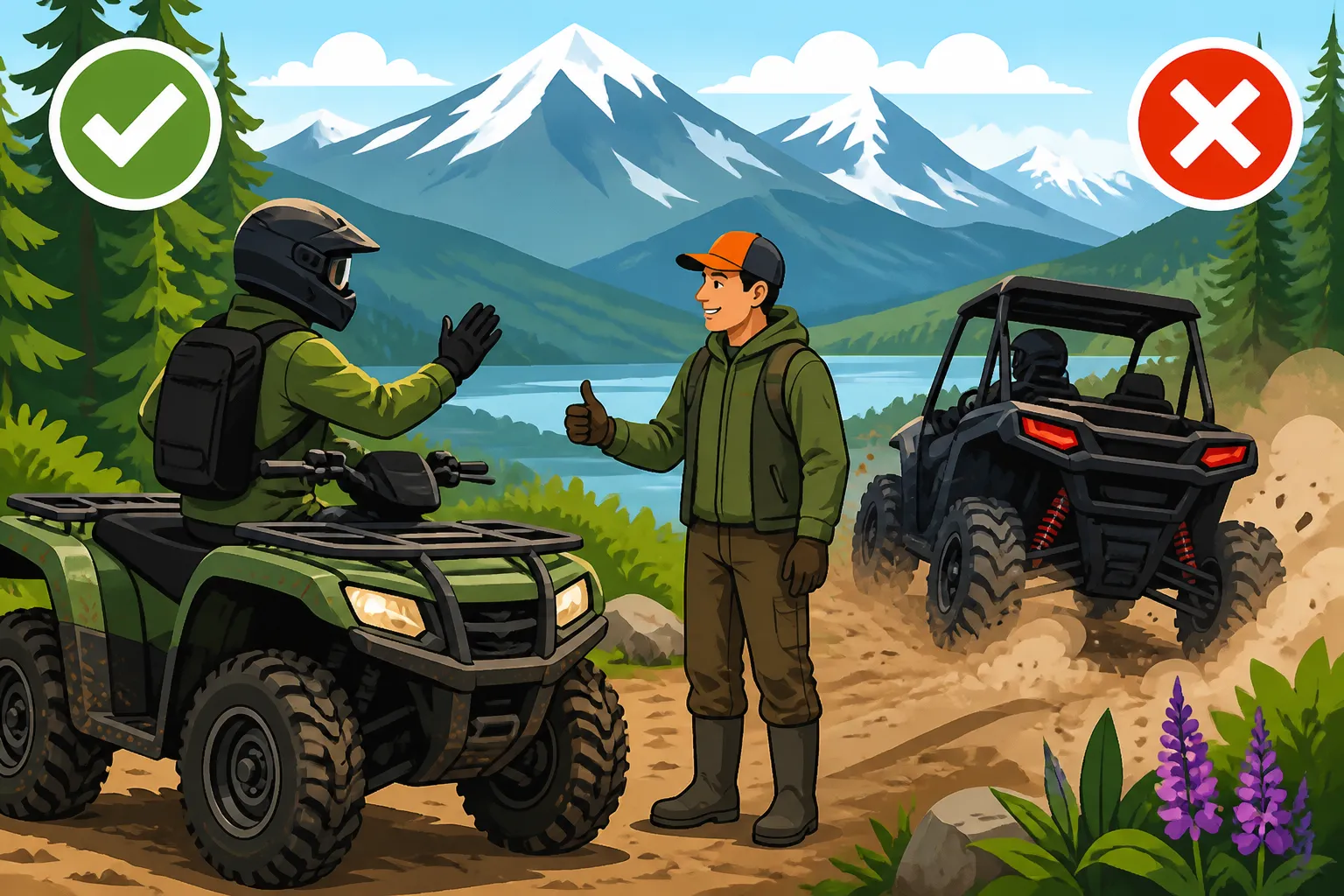
When you meet another rider, slow down early and communicate clearly. On a narrow trail, the rider with the safer, more stable place to stop can pull over when practical. Avoid rushing toward a blind corner or forcing another group to back up on a slope. If you are on a side-by-side, remember that your machine may take up most of the usable trail; look for a wider place before trying to squeeze past.
Let other trail users know what you’re doing with a friendly wave or a brief verbal signal. Keep the conversation simple and avoid assuming that everyone knows which direction your group is headed. If you encounter hikers, cyclists, people on horseback, or workers, slow to a crawl or stop as appropriate, give them space, and wait until they have passed safely. Dust, engine noise, and a sudden approach can feel intimidating even when you believe you have plenty of room.
If you are riding in a group, keep the lead rider and the last rider in contact, and make sure everyone knows what the group will do when it meets traffic. A short pre-ride conversation can prevent a whole line of machines from crowding an oncoming group. For more guidance on sharing space and planning together, see [Alaska Trail Etiquette Locals Expect] and [Alaska Group Ride Planning].
Keep group size and staging under control
Trailheads are shared spaces, not overflow parking lots for a ride group. Park trailers and trucks so other visitors can get in and out. Keep loading, unloading, and machine checks out of the travel lane, and avoid idling in a way that fills nearby vehicles or tents with exhaust. If the staging area is busy, be patient rather than spreading your group across the entrance.
Before riding, assign a lead and a sweep rider, agree on where the group will regroup, and make sure every rider knows the planned route. Give slower riders room without leaving them isolated. A group that stretches too far apart can miss a turn, lose sight of a rider who has stopped, or create an unpleasant stream of dust and noise for others.
A useful rule is to pause the group only where there is room to stop safely without blocking the trail. Don’t gather around a narrow crossing or stop at the crest of a hill where approaching riders cannot see you. If a group ride needs a formal event arrangement, check the land manager’s requirements beforehand. See [Alaska Group Size on Public Land] for more on group limits and planning.
| Situation | Considerate choice | Avoid |
|---|---|---|
| Meeting another group on a narrow trail | Slow down, communicate, and pass at a safe, wider spot | Racing to claim the narrow section |
| Stopping to regroup | Move fully out of the travel path where possible | Gathering around a blind corner or crossing |
| Parking at a busy trailhead | Keep access lanes and nearby spaces clear | Blocking the entrance with trailers or machines |
| Reaching a closure or uncertain boundary | Stop, check the route, and turn back if needed | Going around a gate or following an unverified track |
| Riding over soft ground | Use durable, authorized routes and avoid making new tracks | Spinning tires or widening a muddy route |
Ride Lightly Around Wildlife and Other Visitors
Keep noise, speed, and dust under control
A considerate rider doesn’t treat every open stretch as a chance to accelerate. Slow near homes, cabins, campgrounds, trailheads, and other places where people may be resting or working. On a dry or dusty route, increase your following distance and reduce speed so you are not sending a cloud of dust into the group behind you. If visibility drops, ease off until you can see the route and the people ahead.
Noise carries farther than it seems in Alaska’s open landscapes. Keep your machine in good working order and do not rev the engine unnecessarily while stopped. Avoid repeated passes near a cabin or campsite, and don’t use a quiet stretch of trail as a place to test how loud an exhaust sounds. If you want to understand equipment and sound expectations before a trip, review [Alaska Muffler and Noise Rules].
Wildlife encounters call for patience, not a closer look. If you see a moose, bear, or other animal, slow down, leave plenty of space, and do not surround it with machines. Never pursue wildlife for a photo or block its path. If it is safer to stop and wait, do so; if the animal remains near the route, turn around when appropriate. The same respectful approach applies to people watching wildlife from the trail.
Protect fragile ground and water crossings
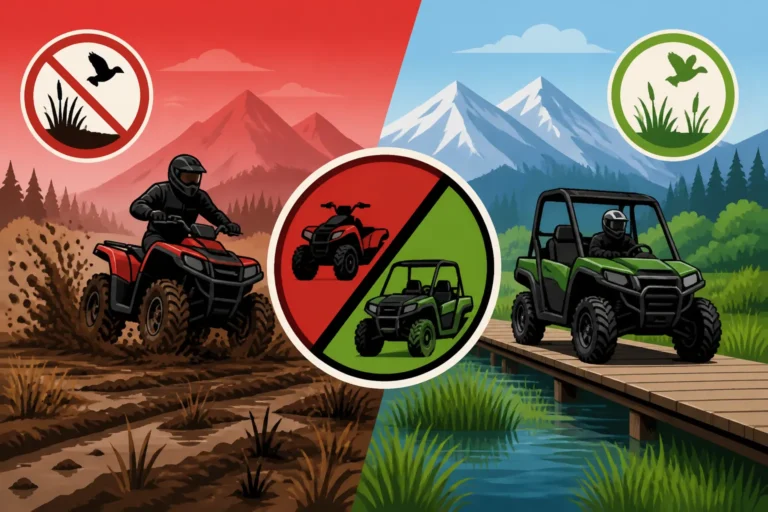
Soft tundra, wetland edges, and streambanks can be damaged by repeated traffic. Stay on routes where motorized use is authorized, avoid cutting new lines through vegetation, and don’t widen a muddy section by driving around it. If the trail is becoming deeply rutted, stop and reassess rather than treating more throttle as the solution. Turning back is often better than leaving behind damage for other riders and land managers to deal with.
Water crossings deserve particular care. Check conditions before entering, and do not assume a crossing is safe because another machine made it through earlier. Water levels and channels can change, especially around glacial rivers. If the depth, current, bottom, or exit is unclear, don’t pressure the group into crossing. Wait, choose another route, or turn back. Guidance on reading a crossing is available in [Reading a Glacial River Before You Cross].
Carry out what you bring in, including food scraps and small pieces of gear that can easily get lost in mud. Don’t dump fluids, wash mud into a stream, or leave broken parts at a trailhead. A simple pre-departure check for loose trash, fuel leaks, and equipment left behind is a small effort that makes the riding area better for the next visitor.
Make Courtesy Part of the Ride Routine
Prepare your group before reaching the trail
Trail etiquette works best when everyone knows the plan before the machines start moving. Tell your group where you intend to ride, where you will stop, and what to do if someone becomes separated. Agree that anyone can call for a pause if the route looks unsafe, access is uncertain, or conditions have changed. That makes it easier for a newer rider to speak up without feeling that they are holding everyone back.
A practical pre-ride check can include:
- Confirm the route is open to your type of machine and identify who manages the land.
- Review local rules, closures, and weather or ground conditions.
- Choose a lead and sweep rider, then agree on regrouping points.
- Check that each machine is in sound working condition and carries basic safety gear.
- Set expectations for speed, passing, noise, wildlife encounters, and turning back.
- Make sure someone outside the group knows the route and expected return time.
onX Offroad can be useful for organizing a route and sharing a plan with riders, especially when a group is unfamiliar with an area. Still, keep an offline backup and use land-manager information to confirm access. A phone battery can run low, coverage can disappear, and a map layer cannot replace sound judgment in the field.
Leave the place easier for the next visitor
The best measure of a ride is not just how far you went. It is also whether another person can use the trail without finding a blocked entrance, fresh damage, scattered garbage, or a group that treats every encounter as an inconvenience. Small choices add up: waiting your turn, giving people space, staying on authorized routes, and accepting that conditions may change your plans.
If you notice a damaged sign, a blocked trail, or a hazard that could affect others, report it through the appropriate land manager’s channel when possible. Don’t attempt to repair infrastructure or remove a barrier unless you are authorized to do so. And if someone points out a concern about your group’s riding, listen before getting defensive. They may know a local restriction or land boundary that is not obvious from the trail.
Local etiquette is not about making riding complicated. It is about keeping access respectful and reducing avoidable problems for riders, residents, landowners, and wildlife. Plan carefully, ride at a pace that lets you respond, and be willing to change course when the land or the people sharing it call for a different choice.
Disclaimer
This article is for general informational purposes only and does not constitute professional advice. Laws, prices and regulations vary by location and change over time. Consult a qualified professional for guidance on your specific situation.