Turning Back at a Deep Channel
A channel that looked manageable on the way out can become deeper, faster, or harder to read by the time you return. In Alaska, glacial rivers and braided streams can shift quickly, and a mistake can leave a rider stranded or sweep a machine downstream. This guide explains how to assess a crossing, recognize when to turn around, and make a safer plan.
Why a deep channel deserves a hard stop
Alaska water can change while you ride
A braided river is made up of multiple channels separated by gravel bars and islands. The route across it may not be a single, predictable crossing: a rider might pass through several channels, each with its own depth, current, and bottom. A gravel bar that gives you a place to pause can also hide the next channel’s drop-off or a faster flow.
Glacial water adds another challenge. It can be opaque with silt, making it difficult to judge depth, footing, and submerged obstacles. A surface that looks calm may still have a strong current, and a firm-looking entry can turn into soft gravel or a hole under the water. The practical takeaway is simple: if you can’t confidently assess the whole crossing, don’t ride into it.
Conditions can also change during the day. Rain, warm temperatures, snowmelt, and upstream glacial melt can raise or alter flows. A crossing that seemed reasonable earlier may be less safe on the return trip. That’s why [Water That Rises by Afternoon] is more than a planning detail: build the possibility of changing water into your route decision before you leave.
A deep channel can create several risks at once
Water can destabilize an ATV or UTV, push it off its line, or make its tires lose grip on a loose or uneven bottom. If a machine stalls, water may enter parts that are difficult to dry or repair in the field. A rider who steps off to help may also be at risk of slipping or being knocked off balance by the current.
The hazard isn’t limited to the machine. A strong flow can separate a rider from their group, carry loose equipment downstream, or turn a routine recovery into a rescue situation. Cold water can quickly make the problem worse: soaked clothing, wet gloves, and wind can impair coordination and judgment. Even a crossing that looks short can leave little room to respond if something goes wrong.
Consider a group riding toward a familiar trail area. They crossed a shallow-looking channel in the morning, but the water is higher on the return. The first machine makes it across, which can create pressure for everyone else to follow. That first crossing is not proof that the next machine—or the same machine on a different line—will be safe. Each rider needs to make an independent decision.
A map cannot tell you what the water is doing now
A route map can help you understand the general layout of an area, but it cannot confirm today’s water depth, current, or bottom conditions. Even a recent track from another rider only shows that someone traveled a particular line at a particular time. It does not guarantee that the channel is passable now or that it will remain passable for your return.
Tools such as onX Offroad can help with route planning and understanding your broader location, but treat that information as one planning input—not a crossing assessment. Look at the terrain and access information available to you, check for closures or restrictions, and use local knowledge where possible. Then make the final decision based on conditions at the channel itself.
For a braided river, the route may include multiple crossings rather than one obvious obstacle. [Crossing a Braided Channel] explains why a gravel bar between channels should not be mistaken for a safe endpoint. If the first channel is already beyond your comfort level, don’t count on the next one being easier.
How to assess a channel before committing
Stop well back and observe the whole crossing
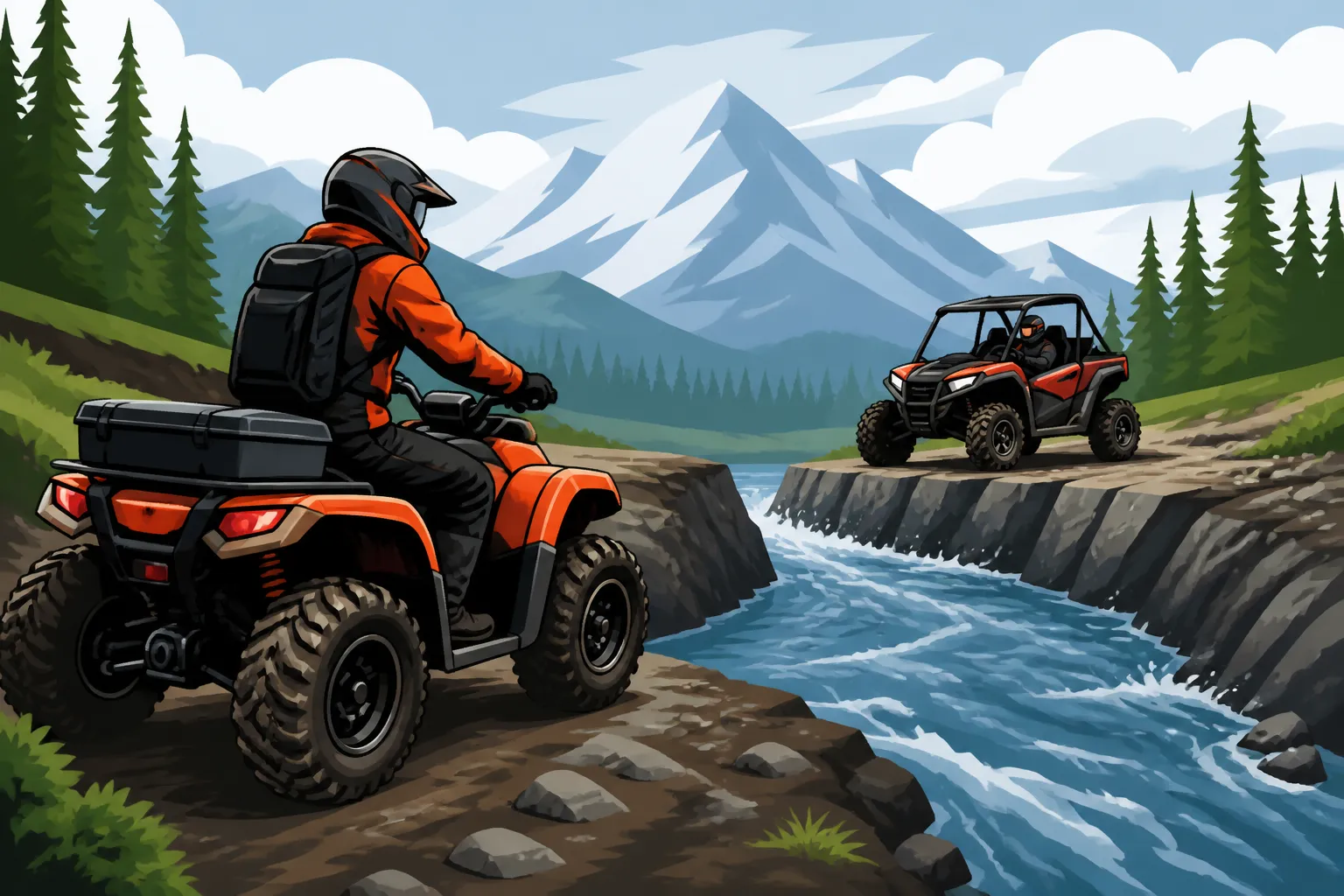
Approach slowly and stop on stable ground well before the water’s edge. Don’t ride right up to a soft bank where the machine could slide, sink, or become difficult to turn around. Take a moment to look at the full crossing: the entry, the line through the water, the exit, and any channels or obstacles beyond it.
Check for signs that the route is changing or unstable. These may include fast-moving water, a steep or undercut bank, submerged debris, a soft-looking exit, deep water that hides the bottom, or a current that could push a machine sideways. Also look for downstream hazards. A safe-looking entry does not help if the current leads to a steep bank, submerged logs, or another channel you cannot safely cross.
If you can’t see enough to judge the depth and route, that uncertainty is itself a reason to turn back. Don’t try to solve it by riding in a little way to “test” the water. On a glacial stream, the bottom may change within a short distance, and a small test can put a rider or machine in a difficult position before there is room to retreat.
Don’t confuse a visible surface with a safe crossing
The appearance of the water is only one clue, and it can be misleading. A smooth patch may still be deep or fast. A rippled surface might indicate a change in the bottom or a submerged obstacle, but it does not tell you exactly what lies beneath. If the water is cloudy, you may not be able to see rocks, holes, or a safe tire path at all.
Listen to the group, but don’t let group pressure replace your judgment. Ask each rider whether they can see the route clearly, whether they are comfortable with the current and depth, and whether the machine is suitable for the conditions. If one person is uneasy—or the group cannot agree on a safe route—turn around. There is no shame in choosing a different trail or ending the ride early.
| What you observe | Why it matters | Safer decision |
|---|---|---|
| You cannot see the bottom or judge the depth | Hidden holes and obstacles may change the route | Do not enter |
| The current looks strong or pushes debris downstream | A machine or rider could be moved off line | Turn back |
| The entry or exit is steep, soft, or undercut | The machine may lose traction or become stuck | Find another route |
| Several channels lie ahead | Each one must be assessed, including the return | Don’t assume the gravel bar is a safe stopping point |
| Water appears higher than earlier | The return may be more hazardous than the outbound crossing | Reassess and retreat if conditions have worsened |
| Your group is split on whether it’s safe | A single rider’s hesitation can signal a real concern | Stop and choose the conservative option |
Keep your machine’s limits in mind
A machine’s size, weight, tires, ground clearance, and load can affect how it handles rough or wet terrain. A side-by-side with passengers and gear may behave differently from a lightly loaded quad. Tires can lose grip on smooth rock or loose gravel, and added cargo can make a machine harder to maneuver. None of these details turns an unassessable channel into a safe one.
Do not assume that a snorkel, winch, or another accessory makes deep water safe. Equipment may help with particular recovery or water-exposure problems, but it does not remove the risk of current, a hidden drop-off, a submerged obstacle, or a rider being swept away. A winch also needs a suitable anchor and a safe recovery plan; it is not a reason to attempt a crossing you would otherwise avoid.
Your decision should account for the least capable machine and rider in the group, not just the strongest machine or most experienced person. If a family member, passenger, or newer rider would be exposed to a risk they cannot manage, turn around. Alaska’s backcountry is not the place to use another person as a test of whether the route is passable.
When turning back is the right decision
Treat uncertainty as a reason to retreat
You do not need to prove a channel is dangerous before deciding not to cross. If you can’t tell how deep it is, can’t see a firm route through it, or can’t identify a safe exit, you have enough information to stop. The same applies if the current seems stronger than expected, the water is rising, or a machine has already struggled on the approach.
It helps to agree on a turnaround rule before the ride. For example, your group can decide that anyone may call a stop, that no one crosses water they cannot assess, and that the group will turn around rather than split up. A clear rule makes it easier to resist the familiar “we’ve come this far” feeling when a route becomes difficult.
Pay particular attention to the return journey. It’s easy to focus on getting to a destination and forget that the same channel may be worse later. [Why the Knik River Changes Channels Within Hours] is a useful reminder that a route across a braided river is not a fixed road. If you have doubts about returning safely, don’t travel farther into the area.
Choose a retreat route that does not create another hazard
Turning back should be a deliberate maneuver, not a rushed U-turn beside the water. Make sure there is enough stable space to turn the machines around without approaching a steep edge or soft bank. Keep riders together and communicate clearly, especially if engine noise, wind, or distance makes it hard to hear each other.
If you are on a gravel bar between channels, reassess before moving. The channel behind you may have changed, and the next channel ahead may not be any safer. Don’t assume that the route you crossed earlier is still passable. If you can’t safely retrace your route, avoid improvising a new crossing under pressure; contact appropriate local help if needed and prioritize keeping people out of the water.
Be mindful of other hazards while retreating, too. A wetland, a soft bank, or tundra that appears to offer a shortcut may be vulnerable to damage or restricted travel. [Alaska Tundra and Wetland Conditions] offers useful context for why ground conditions matter beyond the immediate riverbank. Stay on a route you are permitted to use and avoid creating a second problem while trying to escape the first.
Avoid risky recovery attempts
If a machine becomes stuck near or in water, keep people safe before thinking about the vehicle. Don’t wade into a strong or unclear current to reach a machine, attach a strap, or retrieve loose gear. A person’s footing can be less secure than it looks, and cold water can make a short recovery attempt dangerous.
A recovery plan should not depend on someone standing downstream or in the current. Don’t use a tow strap in a way that puts a person in the water or in the path of a moving machine. If the situation is beyond what the group can manage from stable ground, stop attempting recovery and seek help. Protecting a machine is never worth putting a rider at risk.
If someone is already in the water, focus on getting help and keeping others from entering the channel. Follow the instructions of emergency responders, and don’t create additional casualties by launching an unplanned rescue. After the immediate danger has passed, inspect the machine carefully before attempting to ride it again; water exposure can affect components even when the vehicle appears to start normally.
Plan for water hazards before you leave
Build a route with alternatives and a turnaround point
Before setting out, identify the main route, potential water crossings, and reasonable alternatives. A track that ends at a river is not necessarily a complete route plan. Decide where you will turn around if the channel is too deep, if water is rising, or if the group is moving more slowly than expected.
Use onX Offroad or another mapping tool to help review your route and understand where you are headed, but pair that planning with current local information and on-the-ground judgment. Save the route details you need before leaving areas with service, and don’t rely on a phone or map app to tell you whether a crossing is safe. Conditions at the water are the deciding factor.
Tell someone who is staying behind where you plan to ride and when you expect to return. Make sure the group has enough time, fuel, and supplies to retreat without rushing. [Carrying Extra Fuel Safely] is especially relevant when a conservative decision may mean taking a longer route back or turning around before reaching your planned destination.
Check conditions and closures before the ride
Look for recent weather, stream or river information where available, and notices from the land manager responsible for the area. A storm can change access and trail conditions, while a seasonal closure may mean that a route is not available at all. [Alaska Trail Closures After a Storm] is a useful reminder to check more than the map line before heading out.
Ask people who know the local area about the specific route, not just whether “the river is usually fine.” Useful questions include: Has the channel changed recently? Are there reports of rising water? Are any crossings known to be difficult? Is there a safer turnaround point? Local information can help you plan, but it still cannot guarantee conditions when you arrive.
As you prepare, remember that different land managers may have different access rules. A trailhead pass or permit does not automatically mean every nearby trail or river crossing is open to motorized travel. Check land ownership and access requirements for the route, and respect signs and closures. A legal route can still be physically unsafe, so permission to ride is not a reason to cross questionable water.
Make the conservative choice before fatigue sets in
Fatigue, cold, hunger, and pressure to get home can make a risky option feel more reasonable than it did earlier in the day. Set a turnaround time and keep enough daylight or weather margin for a slower return. If conditions are deteriorating, don’t wait until the group is tired, wet, or short on fuel to reconsider the route.
A good ride is not measured by how far you get. Turning around at a deep channel protects the people in your group, avoids a potentially expensive machine recovery, and leaves the option to return when conditions are more suitable. Before every crossing, ask whether you can assess the water, identify a safe line and exit, and confidently make the return trip. If any answer is no, stay on solid ground.
Disclaimer
This article is for general informational purposes only and does not constitute professional advice. Laws, prices and regulations vary by location and change over time. Consult a qualified professional for guidance on your specific situation.