First Aid Hours From a Hospital
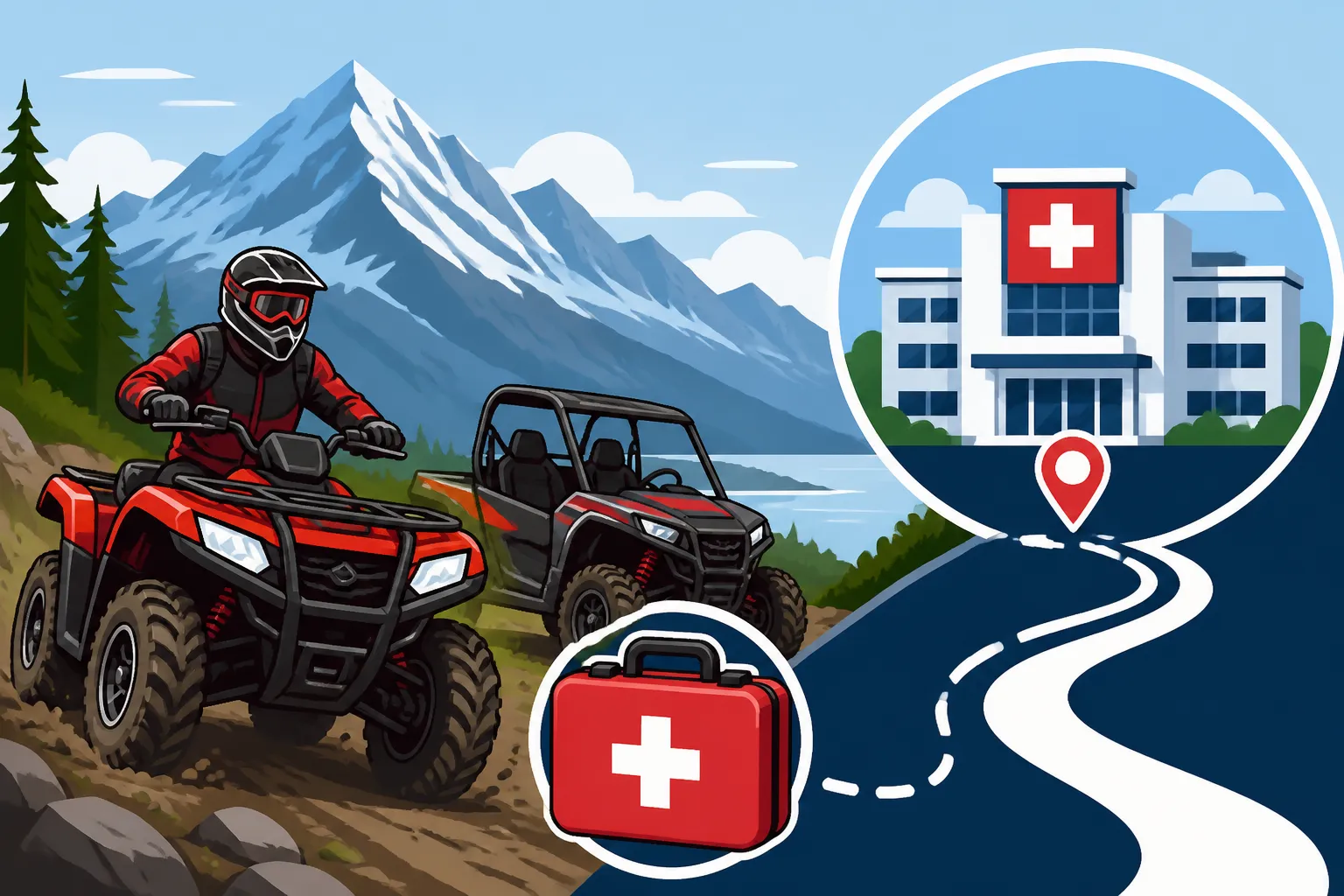
A minor injury can become a serious problem when your Alaska ATV ride is hours from the nearest hospital, cell service has disappeared, and the trail back is rougher than it looked on the map. This guide helps you estimate your real distance from medical care, prepare a practical first-aid and communication plan, and make safer decisions if someone is hurt.
What “hours from a hospital” really means on an Alaska ride
Measure the whole trip to care, not just the trail distance
A map may show a trailhead or road within a few miles, but that does not mean help is close. A rider who is injured deep in the Knik River area, on a remote stretch of the Denali Highway, or beyond a road-system community on the Kenai Peninsula may need to travel slowly over uneven ground before reaching a vehicle-accessible location. From there, the trip to medical care can involve another drive, a call for assistance, or a longer evacuation.
Think in stages rather than one mileage number: time to reach the injured rider, time to make the person safe enough to move or wait, time to travel to a pickup point, and time for that person to reach professional care. Weather, water crossings, trail conditions, darkness, and the injured person’s condition can change every stage. A route that feels manageable in dry daylight may be much more difficult after heavy rain or late in the evening.
It is also worth distinguishing between a hospital, a clinic, and emergency response. A nearby clinic may not be equipped to handle every serious injury, while an ambulance or other response may take time to reach a remote location. Before riding, identify the communities and facilities along your route, but do not assume that a place shown on a map offers the services you may need. For a remote trip, the practical question is not simply “How far away is a hospital?” It is “How would we get an injured rider to appropriate care from the place we plan to ride?”
Use realistic estimates, not best-case travel times
When estimating travel time, use the slowest likely part of the route—not the average pace you expect on a smooth section. A machine may need to turn around, detour around a washout, or wait while the group checks a crossing. If one rider is injured, the rest of the group may need to stop, provide care, and keep the injured person warm while someone seeks help. That changes the travel plan immediately.
A useful planning exercise is to write down three locations: the farthest point you intend to reach, the nearest practical place where a vehicle or responder could meet you, and the nearest community with medical services. Then consider how you would get from one point to the next if your machine could not carry the injured person. If you cannot answer that clearly, shorten the route, ride with a more capable group, or choose a trip with easier access.
| Planning question | What to check before you leave | Why it matters |
|---|---|---|
| Where is the farthest point on the route? | Mark the intended turnaround or destination | Helps you assess the longest return or evacuation leg |
| Where can a truck or responder meet the group? | Identify accessible roads, trailheads, or agreed pickup points | A trail location may not be reachable by ordinary vehicles |
| What communications work there? | Check expected coverage and carry a backup communication option | A phone may not connect once you leave the road system |
| What could slow the route? | Note crossings, steep sections, weather exposure, and seasonal closures | A short distance can take much longer in difficult conditions |
| Who knows the plan? | Share route, group details, and a return time with someone staying behind | Gives others a clear starting point if you do not check in |
An offline map can help you follow your planned route and locate a trailhead or road when service drops. Tools such as onX Offroad can be useful for route planning and offline navigation, but a mapped line is not a guarantee that a route is open, passable, or authorized for riding. Save maps before leaving service, and confirm access and conditions through the appropriate land manager or local authority.
Build an emergency plan before the first ride
Choose communication that fits the route
Do not make a cell phone your only emergency plan. In many Alaska riding areas, coverage can be weak or absent beyond developed roads and communities. A phone is still useful for navigation, contacting someone when service is available, and calling for help in reachable areas, but it may not connect from a remote trail. Review No Cell Coverage Off the Road System and Choosing a Satellite Messenger for a Backcountry Ride when deciding what communication option fits your trip.
A satellite messenger or other emergency communication device can offer another way to request help beyond ordinary cell coverage, depending on the device, subscription, sky visibility, and conditions. Learn how to use it before the ride, keep it charged, and carry it where an injured rider or companion can reach it. Do not bury it in a packed cargo box that could be inaccessible after a rollover. A device is only part of the plan: your group should know who will send the alert, what information to provide, and where to wait after requesting help.
Share a route and return time with someone who is not riding. Include the trailhead, intended route, group members, vehicle details, and the time you will check in. Agree on what that person should do if you miss the check-in, rather than leaving them to guess whether you are simply delayed. Filing a Trip Plan With Someone can help you make that handoff clear. For trips with limited communication, also discuss a backup meeting point in case the group becomes separated.
Carry first aid supplies you know how to use
A first-aid kit should match the trip, the group, and the time it may take to reach professional care. A compact kit for a short ride near a road may not be enough for a remote all-day route. Bring supplies for basic wound care, bleeding control, bandaging, gloves, and personal medications, and keep them protected from mud and moisture. If anyone in the group has a known medical condition or allergy, make sure the person and at least one companion know where the relevant medication is stored.
Just as important, practice using the equipment before an emergency. A kit filled with unfamiliar items can create extra stress when someone is hurt. Consider taking a recognized first-aid course that includes practical scenarios, especially if your group regularly rides far from immediate help. Training does not replace professional medical care, but it can help riders respond more calmly while help is being arranged.
Avoid packing supplies without thinking about access. Put essential items where a companion can reach them quickly, and tell the group where they are. In a side-by-side, that might mean a clearly marked, secured location in the cab; on a quad, it may mean a dry bag that can be opened without unloading everything else. Check the kit before the season and after each use so that missing or damaged items do not go unnoticed.
Responding when someone is injured far from care
Stop, assess, and communicate
When an accident happens, first make the scene safer. Stop other machines, look for hazards such as unstable ground, traffic, moving water, or fire risk, and avoid creating a second injury while trying to help. If the person is in immediate danger where they are, move them only when necessary to escape that danger. Otherwise, unnecessary movement can make some injuries worse.
Check whether the person is responsive and breathing normally, and look for serious bleeding. If the injury appears severe, or you are unsure how serious it is, contact emergency services or your emergency communication provider as soon as possible. Give a clear location, the nature of the problem, the number of people involved, and any hazards that may affect responders. GPS coordinates are especially useful when trail names are unclear. If using a communication device, follow its prompts and keep it available for follow-up.
While one person communicates, another can provide basic first aid within their training and keep the injured rider warm and protected from the weather. Assign one group member to remain with the injured person and another to guide responders from an agreed meeting point if that is safe and practical. Do not send everyone away to find help; the injured person may need observation, reassurance, and protection while assistance is arranged.
Decide whether to wait, move, or turn back
There is no universal rule that says an injured person should always be carried out or always stay put. The right choice depends on the injury, the surroundings, the route, available equipment, and advice from emergency responders. A person with a potentially serious injury may be made worse by an improvised carry or a rough ride on a machine. When possible, get professional guidance before moving them.
If the location itself is dangerous, such as an exposed crossing or unstable slope, move only as far as necessary to reach a safer place and do so carefully. Keep the person warm and monitor their condition while waiting. If you must travel to reach communication, leave a companion with the injured rider when possible and take a clear route to a known contact point. Do not separate the group without telling everyone what is happening and where each person is going.
After the immediate response is underway, make a note of the time, what happened, and any changes in the person’s condition. This information can help responders understand the situation. If the incident involved a crash, review Alaska Accident Reporting for an ATV Crash after the immediate safety and medical needs are handled. A report or paperwork question should never delay contacting emergency services for a serious injury.
Make the route and group safer before you ride
Match the ride to the least experienced person
A group’s pace is set by more than its fastest rider. Consider the experience, fitness, and comfort of every person, along with the capability of each machine. A route with steep grades, deep mud, or water crossings may add risk and make an evacuation harder. New riders may benefit from a shorter route with clear turnaround points and easier access to a road or trailhead.
Agree on a lead rider and a sweep rider, and establish a simple regrouping plan before the group spreads out. Keep riders within sight or use planned stopping points, particularly where the trail forks or visibility drops. If someone becomes separated, a known regrouping location is safer than several riders searching in different directions. Why Alaska Riders Travel in Pairs offers another reason to avoid riding alone: a companion can help communicate, provide basic support, and make decisions if a rider cannot.
The best route is not always the longest or most remote one. If conditions are changing, a turnaround can be the smartest decision of the day. Set a time or condition that will trigger turning back—such as worsening weather, rising water, an unexpected delay, or a rider who is no longer comfortable. Make that decision before the group is tired and committed to reaching a destination.
Check access, conditions, and navigation separately
Route planning involves more than locating a trail. Confirm that the land is open to the type of machine you are riding and that you have the required permission or permit. A route shown on a map may cross land managed by different agencies or private owners, and access rules can change across a short distance. Alaska Land Ownership and Who to Ask is a useful starting point for understanding why checking who manages the ground matters.
Use a map app for navigation, but treat it as one tool among several. onX Offroad can help riders prepare an offline route and orient themselves when cell service is unavailable. Before leaving, download the area, check that the map is accessible in airplane mode, and tell another person which route you intend to follow. Keep a second navigation option if the trip is remote, such as a separate map or a device suited to backcountry navigation. A phone can be damaged, run out of power, or be difficult to use in cold or wet conditions.
Finally, check the basics that can affect travel time and emergency access: weather, daylight, trail or road closures, water levels where relevant, and the condition of the machine. Carry enough food, water, warm layers, and power for a delay. For more on planning rides beyond easy road access, see Alaska Riding Off the Road System and Carrying a Messenger Off the Alaska Road System. The goal is not to predict every problem; it is to make sure a delay or injury does not leave the group without a way to communicate, stay safe, and explain where help is needed.
Disclaimer
This article is for general informational purposes only and does not constitute professional advice. Laws, prices and regulations vary by location and change over time. Consult a qualified professional for guidance on your specific situation.