Riding Out of Willow
Riding out of Willow can look simple on a map, but a nearby trail may cross land with different owners, access rules, or seasonal closures. This guide explains how to plan an ATV or UTV ride from the Willow area, check where you’re allowed to travel, prepare for changing conditions, and avoid the common mistake of treating every visible track as an open trail.
Planning an ATV or UTV ride from Willow
Willow sits along the Parks Highway in the Mat-Su Valley, making it a convenient place to start exploring by off-highway vehicle. But “riding out of Willow” does not point to one single trail system with one set of rules. Routes may involve public land, private parcels, roads, or land managed by different agencies. Planning starts with identifying the specific route, not just the general area.
If you’re comparing nearby options, Alaska Riding Near Willow and Alaska Trails Near Wasilla can help you think about the broader regional choices. Before leaving, confirm the current access conditions for the exact route you intend to ride.
Start with a route, not a destination name
A general search for “ATV trails near Willow” can show roads and tracks that look connected. That doesn’t mean they form a legal or maintained riding route. A route may cross private land, reach a closed area, or lead onto a road where OHV use is restricted. Even a trail that appears well traveled may not be open to the public.
Pick a proposed route on a map and check the individual segments. Ask: Where does the ride begin? Which land manager controls each section? Is the track open to motorized use? Does it connect to a road, a trail, or a private access corridor? If you can’t answer these questions, treat the route as unconfirmed rather than assuming it is okay to ride.
A mapping app such as onX Offroad can help you examine route lines and land boundaries while planning. Use it as a planning aid, not as the final word on access. Map layers and visible tracks can help you spot questions to investigate, but the relevant land manager, posted signs, and local rules are what you need to check before riding.
Check who owns and manages the ground
In the Willow area, a short ride can pass through more than one type of land. State land, borough land, federal land, Native corporation land, and private property can have different access requirements. Boundaries may not be obvious from the seat of a machine, so checking them in advance matters.
Use Alaska Land Ownership Lookups to understand how to investigate ownership, and compare that information with the rules for the land you plan to cross. Alaska’s statewide general permit does not automatically authorize riding everywhere. It applies only to qualifying state land, and it has important exclusions. Read Alaska’s Statewide General Permit for ATV Use and Which Alaska State Land the General Permit Covers before relying on that permit for a trip.
If you find a stretch that appears to be privately owned or managed by an organization, don’t assume a public trail crosses it just because tire tracks are visible. Find out whether permission is required and whether motorized use is allowed. When land status or access remains unclear, contacting the responsible land manager is safer than discovering the issue at a gate or after entering the property.
Choosing a route and checking local rules
A useful ride plan balances access, trail conditions, machine capability, and the experience of the group. A short outing close to Willow may still be demanding if the route is muddy, rutted, or difficult to navigate. A long route can become a much bigger commitment when there is no easy way to turn around or get help.
Use maps and local information to narrow your options, then verify each route before you go. Alaska ATV Trail Map Downloads can be a useful starting point for map research, but make sure the map applies to the route and land you’ll actually be using.
Match the route to your group and machine
Be honest about the least experienced rider in your group. A route that feels easy to a confident local rider may be stressful for someone who has never driven an ATV, especially if it includes uneven ground, standing water, narrow passages, or exposed crossings. Choose a route with room to stop, regroup, and turn back if needed.
Think about the machine as well as the rider. A side-by-side may be comfortable for carrying passengers and gear, but its width can limit where it can travel. A quad may fit through narrower sections but offer less room for supplies. Before committing to a route, consider ground clearance, tires, fuel range, load, and whether the machine is appropriate for the conditions you expect.
If children or first-time riders are coming along, set expectations before the engine starts. Explain where to wait, how to communicate when separated, and what to do if the group stops. Keep the pace comfortable and leave enough daylight and fuel for a slow return. It’s far better to end a ride early than to push on because the group feels committed to reaching a particular landmark.
Confirm access, permits, and road rules
A trail ride and a road ride are not interchangeable. A route may include a section of public road, and road access rules can differ from trail access rules. Don’t assume that an ATV or UTV may use a road simply because the road appears quiet or connects to a popular riding area. Check the applicable rules for the specific community and road.
Also confirm whether your ride requires a permit, pass, or permission from a landowner. A trailhead parking pass, where required, is not the same as permission to ride across land. Similarly, a state land permit does not grant access to private property or areas managed by another agency. Keep any required documents accessible and make sure everyone in the group understands the route’s limits.
A map app such as onX Offroad can help you notice when a proposed route approaches a boundary or a road. Before relying on a route line, compare it with land manager information and posted signs. If there’s a mismatch, pause and resolve it before riding rather than treating the map’s line as proof of permission.
| Planning question | What to check before riding |
|---|---|
| Where does the route go? | Review each segment, not just the starting point and destination |
| Who manages the land? | Identify public, private, and agency-managed parcels along the route |
| Is motorized use allowed? | Confirm the rules for the exact area and route |
| Does the ride use a road? | Check local road rules and restrictions |
| Are there fees or permissions? | Confirm any required pass, permit, or landowner approval |
| Can the group complete the route safely? | Consider rider experience, machine capability, fuel, weather, and daylight |
Seasons, terrain, and ride preparation
Conditions around Willow can change quickly, and a route that was passable on one visit may be difficult or inappropriate on another. Spring breakup, rain, drainage, and freeze-up can all affect the ground. A route’s appearance on a map tells you little about its condition on the day you arrive.
For a broader picture of how timing affects rides, review Alaska Riding Seasons and Breakup. Before setting out, check for current closures and conditions from the land manager responsible for the area.
Plan for wet ground and changing weather
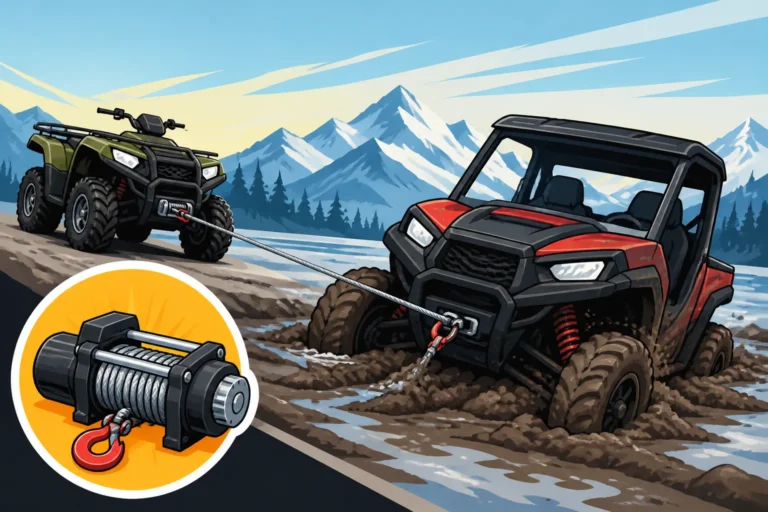
During breakup and wet periods, soft ground can rut easily. A rider may be tempted to keep moving after the machine sinks or spins, but repeated wheelspin can deepen damage and make a difficult section worse for everyone. If the surface is soft or the route is clearly deteriorating, turn around rather than trying to force a passage.
Rain can change drainage and visibility, and it can make familiar ground slippery. Pack a waterproof layer even when the sky looks clear at the start. If the route includes a low area or water crossing, consider how conditions could change during the ride. Don’t enter moving or unfamiliar water just because another machine has made it across.
Tundra and wetlands can be especially vulnerable to vehicle damage. Stay on established routes where motorized travel is permitted and avoid creating a new track to bypass mud or standing water. The guidance in Alaska Tundra Damage and Riding is helpful background for understanding why a shortcut can leave damage that lasts well beyond one ride.
Pack for delays, not just the planned ride
A ride can take longer than expected because of a stuck machine, a navigation mistake, a mechanical issue, or a slow-moving member of the group. Bring enough water, food, warm layers, and basic repair supplies for the possibility of a delay. Carry a first-aid kit and a way to communicate that is suitable for the areas you’ll travel; cell service should not be assumed once you leave developed areas.
Tell someone who is not riding with you where you plan to go and when you expect to return. Share the route as specifically as possible, including a point at which you’ll turn back. If the plan changes, update that person when you can. On longer or more remote outings, riding with another machine provides a practical backup if one vehicle becomes disabled.
Before leaving the parking area, check fuel, tires, brakes, lights, and controls. Secure loose equipment and make sure every rider knows the planned route and regrouping points. A quick check at the start is easier than troubleshooting an avoidable problem far from the trailhead.
Trail etiquette and common Willow-area mistakes
Good trail behavior helps preserve access and makes rides safer for everyone. Willow’s roads and recreation areas may be used by other riders, residents, workers, and visitors. Give people space, respect posted signs, and avoid assuming that a quiet area has no other users.
For more practical guidance, see Alaska Trail Etiquette Locals Expect. Small choices—such as slowing down near other users or staying on an established track—can make a meaningful difference.
Avoid shortcuts and unverified tracks
One of the most common planning mistakes is treating a visible track as an invitation. Tracks can be old, private, or created by someone who had permission that you don’t have. A line on a screen may also lead to a dead end or cross a boundary that isn’t obvious while riding.
Before you follow an unfamiliar spur, stop and check it against your route plan. If the land status is unclear or signs indicate that access is restricted, do not continue. Turning around can be frustrating, especially after a long approach, but it is better than creating a trespass problem or damaging a sensitive area.
Another mistake is riding around a muddy or blocked section by making a new path. That can widen the disturbed area and encourage other riders to do the same. If a section is impassable, turn back or use a route that is known to be open and suitable. Don’t leave trash, damage gates, or assume that a closed route is open simply because there are no people nearby.
Leave room for other users and changing conditions
Reduce speed when approaching people on foot, other machines, or activity near a trail. Give others time and space to move safely. On narrow sections, agree on a clear stopping point before attempting to pass, and avoid surprising people from behind. Keep noise and dust in mind, especially near homes, trailheads, and shared recreation areas.
Respect closures and posted instructions even when the route seems passable. A closure can reflect a safety issue, seasonal restriction, landowner decision, or protection of vulnerable ground. If you’re unsure whether a sign applies to your route, stop and clarify before proceeding.
Before you head out, take one final look at the plan: route, land ownership, permissions, road sections, weather, fuel, and turnaround time. Use onX Offroad or another mapping tool to support that check, then confirm important access details with the relevant land manager. That extra preparation helps make a Willow ride more enjoyable—and makes it easier to return to the same area responsibly.
Disclaimer
This article is for general informational purposes only and does not constitute professional advice. Laws, prices and regulations vary by location and change over time. Consult a qualified professional for guidance on your specific situation.