Riding Out of Palmer
Palmer is a practical base for ATV and UTV rides in the Mat-Su Valley, but nearby roads, trails, and public lands do not all share the same access rules. The biggest frustrations are arriving at a closed or unsuitable route, guessing where private land begins, or underestimating glacial water. This guide helps you plan a ride from Palmer with safer destinations and smarter checks.
Start With a Ride Area, Not a Road Route
Treat Palmer as your staging point
Palmer puts you within reach of several different kinds of riding, but that does not mean you can simply ride from town to a trailhead. Many public roads have restrictions on all-purpose vehicles, and local rules can differ from one community to another. In practice, many riders haul their machine on a trailer to a legal access point, unload there, and stay on routes where riding is allowed.
Before you set out, decide what kind of day you want. A relatively short outing near a designated riding area is a different proposition from a long route toward a glacier or a remote backcountry ride. Consider the skill and comfort of everyone in your group, your machine’s ground clearance and fuel range, and how easily you can turn around if conditions change.
For an overview of nearby options, start with Alaska Riding Near Palmer and Alaska ATV Trails: Where to Ride. Use them as planning leads, then confirm access and conditions for the specific place you intend to visit. A route that appears close on a map may involve private property, a road that is not open to ATVs, or a trail that is unsuitable for your machine.
Compare nearby riding options
The Knik River area is one of the better-known places riders investigate from the Palmer and wider Mat-Su area. The Knik River Public Use Area in Alaska and Jim Creek Riding in Alaska are useful starting points for understanding the area and its riding opportunities. Conditions there can vary substantially, so do not assume every visible track is an established route or that every route is appropriate for every ATV or UTV.
| Ride-planning factor | What to check before leaving Palmer |
|---|---|
| Access point | Confirm where you can legally unload and begin riding |
| Route status | Look for closures, seasonal restrictions, and current local notices |
| Land ownership | Check whether the route crosses state, federal, borough, or private ground |
| Machine fit | Consider width, ground clearance, tires, and towing or recovery equipment |
| Water crossings | Assess depth, current, channel changes, and a safe way to turn back |
| Return plan | Set a turnaround time and tell someone where you are going |
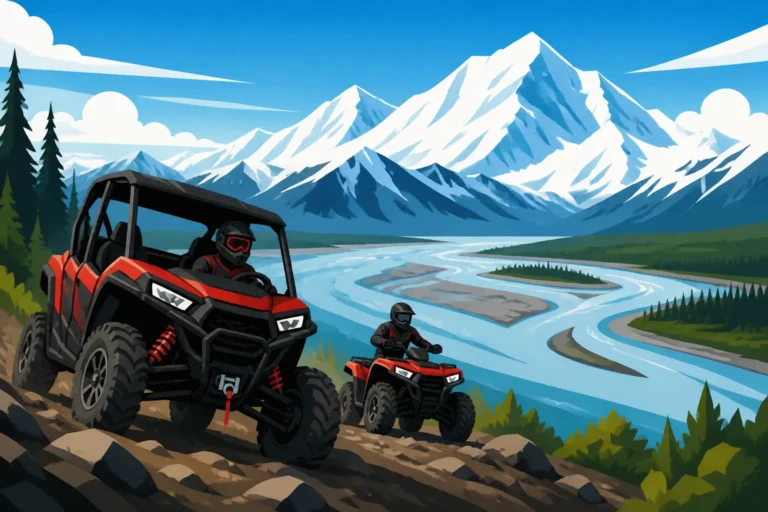
A route toward the Knik Glacier can look straightforward on a map, but the landscape is not static. The Alaska’s Knik Glacier Trail is associated with braided glacial channels and changing water conditions; a track that was passable on one visit may not be safe later. If a crossing looks uncertain, turning around is a sound decision—not a failure to complete the ride.
Check Access, Land, and Local Rules
Verify who manages the ground
A trail’s presence on a map does not, by itself, establish that you have permission to ride it. Public use areas can include land with different managers, and private parcels may sit inside or alongside a larger public boundary. Before leaving Palmer, identify the land you expect to cross and check whether riding is allowed there.
A mapping tool such as onX Offroad can help you review routes and land-status information while planning. It can be useful for spotting a possible boundary or identifying a route to investigate, but treat map information as a planning aid rather than final permission. For a more careful land check, read Alaska Land Ownership and Who to Ask and Alaska’s Statewide General Permit for ATV Use. Different land types can have different requirements, and a permit for one area does not automatically authorize riding everywhere nearby.
When a route reaches a fence, gate, posted sign, or obvious change in land use, pause rather than assuming the route continues as public access. If you cannot establish that riding is allowed, choose another route or contact the relevant land manager. A few minutes of checking beforehand can prevent a frustrating encounter—or a trespass problem—far from your vehicle.
Do not assume roads are open to ATVs
The trip from Palmer to a riding area may involve ordinary roads, but road access and trail access are separate questions. An ATV being registered or equipped for certain uses does not mean it can be ridden on every road. Rules can depend on the road, community, speed limit, and machine. Check the specific route and local rules instead of relying on what another rider did on a different road.
The same caution applies to trailhead parking. Confirm where trailers can be parked, whether a fee or pass applies, and whether the parking area is intended for your destination. For instance, a recreation-area parking pass is not necessarily a land-use permit, and a land-use permit does not automatically cover a separate trailhead fee. When a route description mentions a pass, read what it covers before you go.
onX Offroad can help you keep a planned route and nearby boundaries in view, particularly when you are comparing possible access points. Save the map information you need before leaving reliable service, and carry a backup plan. Mapping apps are helpful, but signs, land-manager information, and the rules for the specific place still matter.
Plan Around Palmer-Area Conditions
Season and weather can change the ride
In the Mat-Su Valley, the riding experience can change quickly with the season and weather. Spring breakup can leave low areas soft, muddy, or vulnerable to damage. Riding through wet ground can deepen ruts and widen a trail, so a route that looks passable is not always a responsible choice. Check for closures and avoid pushing through soft terrain just because you have already driven to the trailhead.
Summer brings longer daylight, but it does not make every crossing predictable. Rain, glacial melt, and shifting channels can alter water conditions. On a warm afternoon, a crossing may be different from what you saw in the morning. Before entering water, assess it from a safe position, consider the strength and direction of flow, and make sure there is a workable exit. If the route requires a crossing beyond your experience or equipment, turn around.
Fall and winter bring different concerns, including colder temperatures, shorter daylight, snow, and changing surface conditions. Read Alaska Riding Seasons and Breakup as part of your seasonal planning. Carry clothing for a longer-than-expected day, and avoid letting a tight schedule convince you to take a route you would otherwise reject.
Set a realistic route and turnaround point
A good day ride starts with a route that matches the least-experienced rider in the group. Share the plan before you leave: where you intend to unload, which area you plan to explore, when you expect to return, and what you will do if the group separates or conditions worsen. If your plan changes, make sure someone outside the group knows.
Do not base your turnaround decision only on fuel. Allow room for slow terrain, a stuck machine, a mechanical issue, or a detour. A route that seems short on a screen can take much longer when it includes mud, rocks, water, or frequent stops. Set a turnaround time early, and stick to it even if the group is close to a hoped-for viewpoint.
For navigation, onX Offroad can be one part of your preparation: review the route at home, save the information you will need offline, and note alternate exits or stopping points. Bring a charged phone, but do not make it your only navigation or emergency plan. In areas with weak or absent cell coverage, tell someone your itinerary and expected return time.
Ride Considerately and Be Ready to Turn Back
Keep your group and equipment prepared
Before unloading near Palmer, walk around each machine and check the basics: tires, brakes, throttle, lights, fuel, and visible damage. Carry water, warm and waterproof layers, a first-aid kit, a tool kit suited to your machine, and a way to communicate if you lose cell service. For remote rides, consider a satellite messenger and make sure the group knows how to use it.
Bring recovery equipment appropriate to the route and your machine, but remember that a winch or tow strap does not make a risky crossing safe. A UTV and a quad may behave differently in mud or uneven terrain, and a passenger changes how a machine handles. Keep enough distance between riders to avoid dust, thrown debris, and sudden stops, and agree on a signal for regrouping before the ride begins.
If you are travelling with children or new riders, choose a shorter, easier route and build in frequent breaks. Keep everyone within sight or agreed communication distance. A ride can become stressful quickly when one person is uncomfortable, tired, or worried about the terrain, so treat those concerns as a reason to pause and reassess.
Protect trails and respect other users
Use established routes where riding is allowed, and avoid creating new tracks around mud or obstacles. Going around a wet section can widen the disturbed area and damage vegetation. Keep speeds appropriate for visibility and surface conditions, yield courteously, and be especially careful near pedestrians, other riders, wildlife, and parked vehicles.
The Alaska Trail Etiquette Locals Expect offers useful reminders for sharing riding areas. Pack out trash, avoid unnecessary noise, and leave gates as you found them unless signs or the land manager direct otherwise. If you find a closure sign or a damaged section, do not treat the lack of a barrier as permission to continue. A posted restriction or a fragile trail surface deserves respect even when other tracks appear to go through.
Finally, be willing to change plans. A creek that is higher than expected, a route blocked by weather, or uncertainty about land access is enough reason to choose another destination. Palmer offers several ways to plan a ride, but the best day is not necessarily the one that covers the most ground. It is the one where everyone returns safely, the machine comes back in good shape, and the trail is left ready for the next rider.
Disclaimer
This article is for general informational purposes only and does not constitute professional advice. Laws, prices and regulations vary by location and change over time. Consult a qualified professional for guidance on your specific situation.