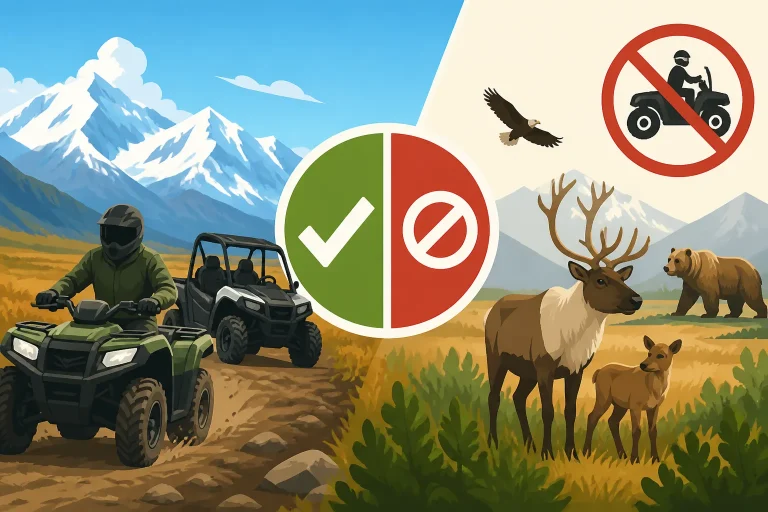
Alaska Hunting Access by Machine
Alaska’s ATV or UTV can make a remote hunting area reachable, but a machine does not grant permission to cross land or use every trail. The key is to check three things separately: who owns the ground, whether motorized travel is allowed there, and what hunting rules apply to the species and unit. This guide explains how to work through those questions before a hunt.
Separate land access, machine use and hunting permission
A common planning mistake is to treat “I can hunt there” as meaning “I can ride there.” Those are different permissions. A hunting license or tag does not, by itself, authorize travel across land. Likewise, permission to ride a route does not mean you can hunt the surrounding area or transport game by machine.
Before choosing a route, answer three questions:
- Can you legally access the land? Identify the owner or manager and check for closures, access conditions, and any required permission.
- Can you use an ATV or UTV on that specific route? A public trail, road, or parcel may have seasonal or vehicle-specific restrictions.
- Can you hunt and retrieve game there under the regulations for your species and hunt area? Rules can differ by species, unit, season, and location.
Treat these as separate checks, even when the route looks open and other riders are using it. A road on a map may cross private or Native corporation land. A trail open to foot travel may not allow motorized travel. A permitted machine route may pass near a hunting area where motorized access or game retrieval is restricted.
It also helps to distinguish the kinds of land you may encounter. Alaska includes state land, state parks, federal land managed by different agencies, municipal land, private property, and Alaska Native corporation and village corporation lands. The rules attached to one parcel do not automatically apply to the next. The practical starting point is Alaska Land Ownership and Who to Ask, followed by a current land-status map and the land manager’s information.
| Question | What it tells you | What it does not tell you |
|---|---|---|
| Do I have a valid hunting license and any required permits or tags? | Whether you may hunt under the applicable hunting rules | Whether you may ride across a parcel |
| Is this land open to public access? | Whether the public may enter, subject to conditions | Whether motorized travel is allowed |
| Is this route open to my type of machine? | Whether the ATV or UTV may travel there | Whether hunting is allowed from or near the route |
| Do the hunting regulations allow motorized access or retrieval here? | Whether machine use fits the applicable hunting rules | Whether you have permission from a private landowner |
| Do I need a separate land-use permit or permission? | Whether another access authorization is required | Whether a hunting season or harvest limit is open |
For a broad introduction to the hunting side of the problem, see Alaska Hunting Regulations and Machines. For the machine-use side, Alaska Hunting License and Machine Access covers the important distinction: being licensed to hunt does not settle where or how you may ride.
Find out who manages every part of the route
A hunting plan often includes more than the spot where you hope to see game. It may involve a public road, a staging area, a trail, a stream crossing, and several miles of travel across land with different owners or managers. Check the whole route, not just the destination.
State land and the statewide general permit
Alaska’s statewide general permit is relevant to certain types of off-road vehicle use on eligible state land. It is not a universal riding permit for every place in Alaska. It does not convert private property, state parks, or land managed by another agency into open riding ground. The permit’s own terms, the land designation, seasonal conditions, and any local restrictions still matter.
Start with Alaska General Permit Requirements and Alaska’s General Permit Covers State Land. Check Alaska’s Permit Excludes State Parks before assuming that a state-land authorization covers a state park route. A general permit also does not replace permission from a landowner or another agency’s access rules.
The important practical step is to verify the permit’s current scope for the land and activity you have in mind. “State land” is not always a simple category on the ground. Designations and boundaries can affect whether travel is allowed, and the machine rules may vary by area or season. If the route follows a named corridor, crosses a wetland, or leaves an established trail, look for area-specific conditions rather than relying on a general description.
Federal, municipal and other agency land
Federal land is not one uniform riding area. Different agencies manage different parcels, and a road or trail may have rules that are not the same as nearby state land. Check the unit or field office responsible for the exact route. Confirm whether the route is open to ATVs or UTVs, whether the use is limited to a designated trail, and whether seasonal or wildlife-related closures apply.
Municipal land can have its own ordinances and access arrangements. A trail that is open for one activity may be closed to motorized use, or a vehicle route may be limited to certain locations. Do not assume that an established track is legal simply because it appears on a recreational map.
On Native corporation or village corporation land, public access may require permission, a land-use permit, or compliance with other conditions. Some routes may be open under specific terms; others may not be. Confirm directly with the relevant landholder or its authorized permit provider. Alaska Native Corporation Land Permits and Alaska Village Land Permission explain why a state permit should not be treated as permission to cross corporation land.
Build a route map that shows boundaries
Use a land-status map to identify ownership and management boundaries along your proposed route. A trail line alone is not enough: the map should help you see where ownership changes and where an access corridor may narrow or end. Alaska Land Status Maps is a useful starting point for understanding what to look up.
For each part of the route, record:
- The landowner or managing agency
- The route or access point you intend to use
- Whether your machine type is allowed
- Whether a permit, pass, or written permission is required
- Any seasonal, weather, wildlife, or area closure
- A contact or official source for confirming uncertain details
Maps are planning tools, not permission documents. Boundaries can be hard to identify in the field, and a visible track does not prove that public motorized access is allowed. If the route is close to a boundary, choose a route you can verify rather than relying on a guess at a fork or crossing.
Confirm machine access for the exact species and hunt area
Hunting regulations can place limits on how a machine may be used during a hunt. The details may depend on the species, hunt area, season, and local conditions. Do not rely on a rule you remember from another unit or a previous trip.
Read the current regulations for the hunt you plan to do, including area-specific notes and any conditions attached to a permit or registration. Look for rules about motorized access, vehicle use, hunting from a vehicle, transporting hunters or equipment, and retrieving game. The label “ATV” or “UTV” does not answer every question: a rule may apply to a category of motorized vehicle or a specific type of activity.
Riding to an area is not the same as hunting from the machine
An ATV can be a way to reach a legal staging point, but that does not mean you may use it to pursue, locate, or take game. Rules may distinguish travel to an area from using a vehicle in connection with the hunt. They may also restrict shooting from a vehicle or taking game from a vehicle. Check the wording for the specific hunt rather than interpreting the rule from a general summary.
Plan your route and hunting activity separately. Mark where you will park or leave the machine, then decide how you will proceed on foot or by another permitted method. If the regulations limit motorized travel to an established route, do not treat a short detour to get closer to game as harmless. Off-route travel can damage land, cross a boundary, violate a closure, or create a hunting-rule problem.
Check restrictions that apply only in particular areas
Some motorized restrictions are tied to specific units, species, or seasons. A route that is open for general travel may still be subject to a special hunting restriction. Conversely, a rule that applies in one hunt area may not apply in another. Read the area descriptions and exceptions carefully, and call the relevant agency if the rule is unclear.
Pay close attention to:
- Whether motorized travel is limited to designated roads or trails
- Whether travel off an established route is prohibited
- Whether the rule changes during a season or when ground conditions are poor
- Whether the restriction applies to hunters, equipment, game retrieval, or all of these
- Whether a specific permit or hunt authorization includes additional conditions
Use current official regulations and land-manager information together. A land manager can clarify access to a route, while the hunting authority can explain the hunt-specific rule. One source may not answer both questions.
Account for aircraft-related rules separately
The same-day airborne restriction is a separate issue from ATV access. If your trip involves an aircraft, do not assume that riding in an ATV after landing changes the rule. Check how the current regulation applies to your species, hunt area, and circumstances. The Same-Day Airborne Rule for Alaska Hunters explains why this needs its own check.
The safest planning method is to list every way you will travel during the hunt: aircraft, road vehicle, ATV, boat, or on foot. Then check the relevant rule for each activity. A machine may be legal on a route while a separate restriction still affects when you may hunt or take game.
Check how game may be transported and retrieved
Getting to a hunting area and getting harvested game out are different problems. A route may be legal for riding, while the rules for transporting a hunter, equipment, or game impose additional limits. Plan retrieval before the hunt, especially where a route crosses land with special conditions or the terrain makes an alternate route tempting.
The key is to read the regulation for your species and hunt area, rather than assuming that any machine that can carry the load may be used to retrieve it. Rules can address the way the animal is taken, where a vehicle travels, what part of the animal is transported, or how the meat is handled. Alaska Game Transport by Machine and Transporting Meat by Machine are helpful starting points, but confirm the current official rule for your exact hunt.
Plan retrieval around the route you are allowed to use
Before you leave, consider whether your machine can reach the legal route without crossing a closed area or leaving an authorized trail. A large load may tempt a hunter to take a shortcut, use a wetland, cross a stream at an unapproved location, or ride across ground that was not suitable on the way in. Build a retrieval plan that does not depend on doing any of those things.
Think through:
- Where the animal can be processed without blocking a trail or creating a safety problem
- How meat and equipment will be secured on the machine
- Whether the machine’s load capacity is appropriate for the terrain and distance
- Whether a trailer or sled changes the route, width, or turning limitations
- What you will do if the route is flooded, muddy, damaged, or closed
- Whether you can leave part of the load and return without violating a hunting or access rule
If the rules require specific meat-care or salvage steps, make sure your equipment and schedule allow you to complete them. A machine can help with hauling, but it does not remove those responsibilities.
Do not let retrieval become unauthorized hunting
A retrieval trip should stay focused on recovering and transporting game. Do not treat the return route as permission to continue searching for animals from the machine or to pursue new game in a restricted area. Where rules limit how motorized vehicles can be used in connection with hunting, the details matter.
If weather or trail conditions make your planned route unusable, stop and reassess. A difficult recovery does not automatically authorize travel across a different parcel or a closed route. Contact the land manager or appropriate hunting authority when you need to clarify a rule; if you cannot confirm that an alternate route is allowed, do not assume it is.
For quad-specific recovery considerations, see Alaska Game Retrieval by Quad. The practical lesson is not simply to choose a strong machine. It is to choose a route and load plan that remain legal and safe when the animal is ready to come out.
Prepare for Alaska terrain, weather and machine limits
A legal route can still be a poor route for your machine or your group. Alaska conditions can change quickly. A trail that was firm in the morning may become soft or flooded later. A stream crossing can become more difficult as water rises, and a loaded machine handles differently from an empty one. Choose routes based on current conditions and your experience, not just distance.
Tundra, wetlands and soft ground
Wetlands and tundra can be fragile, difficult to cross, and subject to specific restrictions. A track that looks like an existing trail may not be an authorized route. Repeated riding over soft ground can leave damage that lasts well beyond the trip. Check Alaska Tundra and Wetland Conditions and the land manager’s current direction before planning cross-country travel.
If a route is wet, rutted, or beginning to break apart, turning around is often the better choice. Going around a flooded section can widen the damage and may take you outside the permitted corridor. Avoid riding in a way that creates new tracks across vegetation or drainage areas.
Stream crossings and changing water
Do not assume that a crossing is safe or permitted because another rider used it. Water level, current, depth, bottom conditions, and the route on the far bank all matter. A crossing that appears manageable with an empty machine may be unsafe with a passenger, trailer, or game load.
Before a crossing, identify a suitable exit on the far side and consider what you will do if the machine loses traction. Do not enter if you cannot see enough of the crossing to judge it, if the current is pushing the machine off line, or if the return route depends on water staying at its current level. A legal trip plan should include a turn-around point, not just a destination.
Carry recovery and communication equipment
Choose equipment for the route and season, then keep it accessible. Depending on the trip, that may include a first-aid kit, repair tools, tire-repair supplies, recovery strap, winch, extra layers, water, food, navigation tools, and a way to communicate outside cell coverage. Do not rely on a phone as your only navigation or emergency option when service is uncertain.
Retailers such as Amazon can be one place to find practical items such as a waterproof map case, dry bags, or basic repair supplies. Check dimensions, durability, and compatibility with your machine before buying, and test gear at home. A product listing is not a substitute for knowing how to use the equipment or confirming that the route is open.
A second Amazon-related consideration is organization: a small waterproof pouch can keep permits, maps, and emergency contact details together. Keep documents protected but reachable, rather than buried under camp gear. If you use a digital map, carry a backup that works without a signal.
For longer remote trips, consider carrying a satellite messenger or other communication device suited to your route. Amazon may offer a range of outdoor accessories, but compare devices based on coverage, battery life, and the service needed to send messages. Do not assume a device will work everywhere; check its coverage and test it before departure.
Make a hunt-day checklist and a backup plan
Good planning does not end when you find an open route on a map. Before riding, confirm the current conditions and make sure everyone in the group knows where the boundaries and closures are. Keep the plan simple enough to follow when weather, visibility, or trail conditions change.
Before leaving home
- Confirm your license, tags, permits, and any hunt-specific requirements.
- Read the current regulations for the species, hunt area, and season.
- Check land ownership along the full route, including the staging area and any planned crossings.
- Confirm whether each segment is open to your type of machine.
- Obtain any required land-use permission or permit.
- Check for closures, seasonal limits, and current trail or weather conditions.
- Make a retrieval plan that follows an authorized route.
- Tell someone where you plan to ride, when you expect to return, and what to do if you are overdue.
- Identify a reasonable alternate route or a point where the group will turn around.
At the trailhead
Before unloading, look for posted signs, gates, closures, and route changes. Check that the machine is suitable for the load and that everyone understands the route and regrouping points. If a sign conflicts with what you expected from a map, treat the sign as a reason to stop and verify rather than ride through and sort it out later.
Carry required documents in a protected, accessible place. Depending on the trip, you may need to show hunting credentials, access authorization, or information about the machine. Do not rely on a screenshot that is difficult to read or a document stored only on a device that may lose power.
If conditions change
Use the backup plan when water rises, a trail becomes impassable, visibility drops, or a closure affects the route. Do not improvise a shortcut across land you have not confirmed is open. If the group is uncertain whether travel is allowed, stop before crossing the boundary or entering the restricted area. Contact the land manager or the relevant hunting authority when possible.
Be especially cautious when a route passes through a mix of public and private land. The most convenient detour may cross a different owner’s parcel. A map that showed one route at home may not reflect a temporary closure or a damaged trail in the field.
Ask precise questions when a rule is unclear
A useful question gives the agency or landowner enough detail to answer. Instead of asking, “Can I ride here?” provide the land unit or parcel, the route or access point, the type of machine, the season, and whether you are asking about travel, hunting activity, or game retrieval.
Keep a note of the information you receive, including who provided it and what area it covered. A general answer about public access may not resolve whether your specific machine can use a particular trail. If you receive conflicting guidance, seek clarification from the agency or landholder responsible for the exact parcel.
Common mistakes to avoid
Small assumptions can create large problems once a trip reaches a boundary, a closed trail, or a successful harvest. These are the mistakes most worth checking before you load the machine.
- Assuming a hunting license grants land access. It does not replace a land-use permit or private permission.
- Assuming a public road makes nearby ground public. A road can cross or border land with different ownership and access rules.
- Treating the general permit as statewide permission for every kind of land. Check the land designation and permit conditions.
- Relying on a trail shown on a map without confirming vehicle access. A mapped route may be closed, limited to a different use, or subject to seasonal conditions.
- Applying a rule from another unit to your hunt. Verify regulations for the species, location, and season you are actually using.
- Assuming a legal ride automatically means legal game retrieval. Check transport and salvage rules separately.
- Riding around a closure or difficult section. A detour may take you off an authorized route or onto land where you do not have permission.
- Forgetting that aircraft-related restrictions are separate. An ATV ride after a flight does not automatically settle a same-day airborne question.
- Planning only for the trip in. A loaded machine may need a different route, more time, or a safer turn-around plan.
A reliable hunting-access plan is specific: it names the land manager, route, machine, hunt area, and retrieval method. If any part is uncertain, resolve that before the trip rather than at the trail junction.
Disclaimer
This article is for general informational purposes only and does not constitute professional advice. Laws, prices and regulations vary by location and change over time. Consult a qualified professional for guidance on your specific situation.