Alaska Registration Before Your First Ride
There’s a unique thrill that comes with owning an ATV or UTV in Alaska, a sense of boundless possibility as you picture traversing vast landscapes, chasing the midnight sun, or hunting far off the beaten path. But before you even think about hitting that throttle for your first Alaskan adventure, there’s a crucial step many riders overlook or simply don’t understand: getting your machine properly registered. Skipping this step can quickly turn that dream ride into a costly headache, leaving you with fines, frustration, and a real damper on your Alaskan spirit. This guide is all about cutting through the confusion, helping you understand exactly why and how to register your all-purpose vehicle before you ever leave your driveway.
Why Getting Registered Matters So Much in Alaska
For many Alaskans, their ATV or UTV isn't just a toy; it's a vital tool for subsistence, hunting, fishing, or simply enjoying the unparalleled backcountry. But no matter how you use it, the state has clear rules. Ignoring them won't just spoil your fun; it can hit your wallet hard and complicate your ownership down the line.
Avoiding Fines and Frustrations
Let's be real: nobody wants to get a ticket. In Alaska, riding an unregistered ATV or UTV on public land is a ticket waiting to happen. The Alaska Division of Motor Vehicles (DMV) and state troopers are out there, and they're familiar with the rules for all-purpose vehicles. Imagine you've finally got that weekend free, the weather's perfect, and you've hauled your quad all the way out to Jim Creek or up the Denali Highway. You're just starting to feel the wind in your face when suddenly, flashing lights appear in your rearview mirror. A trooper approaches, asks for your registration, and you realize you never got around to it.
This isn't just a slap on the wrist. An unregistered machine on public land can lead to a citation, and those fines can add up, potentially costing you far more than the registration fee itself. Plus, there are court costs to consider if you have to challenge the ticket. It's not just the monetary cost, either. It's the wasted time, the disruption to your trip, and the lingering frustration of a preventable mistake. Many riders assume that because they're "off-road," the same rules don't apply, but that's simply not true when it comes to operating on public lands in Alaska. The law is clear: if you're riding a designated all-purpose vehicle on public ground, it needs to be registered.
Protecting Your Ownership and Investment
Beyond avoiding legal trouble, registering your ATV or UTV provides a crucial layer of protection for your investment. Think about it: your machine is likely a significant purchase. When you register it with the state, you're officially documenting your ownership. This is incredibly important for several reasons. For one, if your machine is ever stolen – a heartbreaking scenario that unfortunately does happen – having it registered makes it significantly easier for law enforcement to track and potentially recover. Without a state registration, proving your ownership to authorities can become a much more drawn-out and difficult process.
Secondly, if you ever decide to sell your machine, a clear and up-to-date registration history makes the transaction smoother for both you and the buyer. It provides an official record that can be linked to other ownership documents, like a bill of sale or a title (if one has been issued). Buyers are naturally more confident when they see a clean record of ownership, ensuring they're not inheriting someone else's legal headaches. It's about establishing a clear chain of custody for your machine, which protects its value and ensures peace of mind. Without this official registration, your machine, while yours in practice, lacks that crucial state-level acknowledgement, making it harder to prove rightful possession or transfer it later.
Understanding Alaska's All-Purpose Vehicle APV Classification
Alaska has specific definitions for what constitutes an All-Purpose Vehicle (APV), and understanding these distinctions is key to knowing whether your machine needs to be registered in the first place. It's not just about having an engine and wheels; it's about how the state categorizes your ride.
What Machines Qualify and What Don't
When Alaska talks about an All-Purpose Vehicle, or APV, they're generally referring to machines designed for off-road use, often equipped with an engine of a certain size and specific features. This classification includes the vast majority of what you'd think of as an ATV (All-Terrain Vehicle) or UTV (Utility Task Vehicle, often called a side-by-side). So, if you've got a quad with handlebars, a side-by-side with a steering wheel, a six-wheel machine for heavy hauling, or even a dirt bike, it most likely falls under Alaska's APV definition and will require registration for public land use. The state is essentially recognizing these common off-highway machines as a distinct category requiring specific regulations.
However, it's just as important to know what machines don't qualify as an APV, because these exclusions can catch new riders or those new to Alaska by surprise. For instance, while they are also off-highway vehicles, snowmobiles (often called snow machines in Alaska) are not classified as APVs; they have their own separate registration system. Tracked vehicles, meaning those with continuous tracks instead of wheels, are also excluded from the APV classification, as are three-wheelers, which the state specifically does not register due to safety concerns. Even homemade quads, no matter how robust, won't typically be registered by the state as an APV. These distinctions are crucial because trying to register a snow machine or a three-wheeler as an APV simply won't work and can cause delays in getting your actual ride legally ready for the trails. [Machines Alaska Will Not Register as an APV]
The "Public Land" Trigger for Registration
Here's the critical piece of information that often trips up new riders: you only need to register your APV in Alaska if you plan to operate it on "public land." But what exactly constitutes public land in the vastness of Alaska? It's generally defined as any land that is not privately owned. This includes state-managed lands (like many of the recreational areas and trails across the state), federal lands (such as those managed by the Bureau of Land Management or the U.S. Forest Service), and sometimes even borough-owned properties. If you're heading out to popular riding spots like the Knik River Public Use Area, Jim Creek, or anywhere along the Denali Highway, you are absolutely on public land, and your APV must be registered. This also applies if you're simply using a public road shoulder or crossing a highway where permitted, as that is considered public thoroughfare.
The flip side of this is the "private land exemption." If your machine only ever operates on land that you privately own, or on land that is privately owned by someone who has given you express permission, then you are generally exempt from the state registration requirement. This might apply to a farmer using their side-by-side solely on their own property in the Mat-Su Valley, or a remote cabin owner who only rides their quad on their personal land parcel. However, this exemption is very specific. The moment a wheel touches a public trail, a state-maintained gravel road, or even just the public right-of-way, that exemption vanishes, and you need to be registered. It's essential to know exactly where you're riding and whose land you're on, as assuming all land is private can lead to an unwelcome surprise. [When a Quad on Private Land Needs No Alaska Decal]
The Step-by-Step Process to Register Your APV
Navigating government paperwork can feel like a trek through deep snow, but registering your APV in Alaska is a straightforward process once you know the steps. It primarily involves gathering the right documents and knowing where to go.
Gathering Your Essential Paperwork
The foundation of a successful APV registration is having all your ducks in a row when it comes to documentation. The specific documents you'll need depend on whether your machine is brand new or used, and where you acquired it. For a new machine purchased from a dealership, you'll generally need the Manufacturer's Certificate of Origin (MCO), which is basically the birth certificate for your ATV or UTV. The dealer should provide this to you at the time of purchase. They often handle initial registration, but always confirm. If you're buying a used machine from a private seller, the most common proof of ownership is a bill of sale. This document should clearly state the buyer, seller, date, purchase price, and a full description of the machine, including the Vehicle Identification Number (VIN). [Alaska Bills of Sale for a Used Machine]
If you're in a situation where you've purchased a used machine and the previous owner has lost some of the paperwork, or you need to formalize a private sale without a pre-printed form, tools from providers like LawDepot can be incredibly helpful. You can often find templates for a robust bill of sale or an affidavit that can serve as proof of ownership. An affidavit, particularly an [Alaska Affidavits Naming a Seller], can be vital if the standard bill of sale is missing or incomplete, allowing you to swear under oath to the details of the transfer. Always ensure that any document you use clearly identifies the machine by its VIN. If you're missing critical documents and can't obtain them, Alaska does have a "No Title Issued" (NTI) process for registration, but it has specific requirements and a waiting period. It's far better to have a clear chain of ownership documented from the start. [Alaska Registration Paperwork Checklist] [Registering a Quad When the Paperwork Is Lost]
Where to File Your Registration
Unlike many other states that have embraced online portals for vehicle registration, Alaska keeps it traditional for APVs. You cannot register your Alaska OHV online. This means a visit in person is your primary option. You have two main avenues: the Alaska Division of Motor Vehicles (DMV) offices themselves, or one of their authorized partner offices. DMV offices are located in larger communities like Anchorage, Fairbanks, and Juneau. While they can often have longer wait times, they are equipped to handle all registration scenarios.
Alternatively, many smaller communities and even some larger ones have DMV partner offices, often found within local city halls, public safety buildings, or designated private businesses that offer vehicle services. These partner offices can be a fantastic, often quicker, alternative, especially if you live outside a major urban hub. Just be sure to call ahead to confirm their hours and that they process APV registrations, as services can vary. Whichever location you choose, be prepared with all your gathered paperwork, your driver's license, and payment for the registration fee. The clerks are generally very helpful and can guide you through the process, but having your documents in order will make the experience much smoother. [You Cannot Register an Alaska OHV Online] [Registering in Person at a Counter] [Registering an OHV at a DMV Partner Office]
Understanding the Decal, Not a Plate
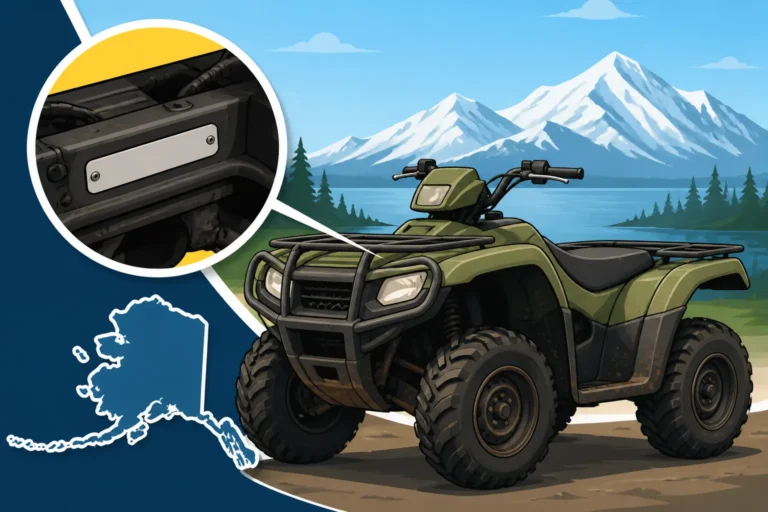
When you successfully register your APV in Alaska, you won't be issued a metal license plate like you would for a car or truck. Instead, you'll receive a distinctive decal. This decal serves as your official proof of registration and contains your unique registration number, along with the expiration date. It's a small but mighty piece of vinyl that tells anyone looking – including law enforcement – that your machine is legally compliant for public land use. [Alaska Issues a Decal, Not a Plate]
The placement of this decal is crucial for visibility and compliance. For most ATVs, the decal needs to be affixed to the tunnel side, usually on the left-hand side if you're sitting on the machine, making it visible when you're seated. For side-by-sides (UTVs), the placement is typically on the side of the tunnel or the exterior body panel, in a location that is easily seen. The key is to choose a clean, flat surface where the decal won't be easily obscured by mud, snow, or your riding gear, and where it's protected from damage. If the decal becomes damaged or unreadable, you'll need to apply for a replacement. Ensuring your decal is correctly placed and visible is just as important as having it in the first place, as an obscured or missing decal can still draw unwanted attention from authorities. [Alaska Decal Placement on the Tunnel Side] [Alaska Decal Placement on a Side-by-Side]
Choosing Your Registration Term and What to Expect
Once you've got your paperwork in order and understand the APV classification, the next step is deciding how long you want your registration to last and understanding the payment structure. Alaska offers some flexibility, but there are fixed dates to keep in mind.
Two, Four, or Six Years? Making Your Choice
Alaska offers the convenience of choosing your registration term for an APV. You can opt for a two-year, four-year, or even a six-year registration period. This flexibility is great for different budgets and plans. The cost, of course, varies with the length of the term. A two-year registration is the most affordable upfront. [Alaska Charges $10 for Two Years] This might be a good option if you're uncertain about how long you'll keep the machine, or if you're on a tighter budget.
However, many long-term Alaskan riders find value in choosing a longer term, even though the upfront cost is higher. A four-year registration provides a good balance, offering convenience without being too far into the future. [Alaska Charges $20 for Four Years] The longest option, a six-year registration, is the most cost-effective over time. [Alaska Charges $30 for Six Years] This is often preferred by those who know they'll keep their machine for many years and want to minimize the hassle of frequent renewals. When making your choice, consider your riding habits, your machine's age, and your plans for its future. If you anticipate selling it relatively soon, a shorter term might be less complicated for the next owner. On the other hand, a longer term means less paperwork and fewer trips to the DMV for you. [Two, Four or Six Years at a Time]
The September 30th Expiration and Renewal
Regardless of whether you choose a two, four, or six-year term, there's one universal truth about APV registrations in Alaska: they all expire on September 30th. This means that if you register your machine in the middle of a year, your first "year" might be less than 12 months, but the expiration will still align with that September 30th date in your chosen future year. It's a system designed for administrative simplicity, ensuring all APV renewals are due at the same time. [Every OHV Registration Term Expires on September 30]
This fixed expiration date is crucial to remember for planning your renewals. You don't want to be caught off guard with an expired registration when the fall hunting season or winter riding opportunities open up. The state will typically send out renewal notices closer to the expiration date, reminding you to re-register. The renewal process is similar to the initial registration, requiring updated forms and payment. You'll apply for the renewal either in person at a DMV or partner office, just as you did for your initial registration. Keeping an eye on that September 30th deadline will ensure your machine is always legal and ready for your next adventure. [Alaska ATV Registration Renewal]
Beyond Registration: Titles and Other Considerations
While registration is your immediate priority for legal riding on public lands, it's worth understanding that Alaska also has specific requirements regarding titling for APVs. Since 2022, Alaska has required titling for all-purpose vehicles. This is a separate, although often concurrent, process from registration. A title proves legal ownership, similar to a title for a car, whereas registration permits operation on public lands. When you register your machine, the DMV will also process the titling application, provided you have the necessary documentation. If you're using a document like a bill of sale from LawDepot, ensure it has all the details needed for both registration and titling. [Alaska APV Titling Required Since 2022]
Beyond registration and titling, there are other important considerations for Alaskan APV owners. If you ever plan to operate your APV on any public road or highway where it's permitted (and many areas in Alaska have very strict rules about this), you will also need to carry liability insurance. [Alaska Insurance Requirements for an APV] Furthermore, there are specific road rules, equipment requirements, and licensing rules that apply if you take your APV onto public roadways, even if it's just to cross a highway or ride a short distance on a shoulder. Always check local ordinances and state statutes before attempting road use. While this guide focuses on getting your machine registered for off-road public land use, being aware of these additional layers of regulation is part of responsible APV ownership in the Last Frontier. [Alaska APV Road Rules Explained]
Here's a quick overview of the APV registration terms and general costs:
| Registration Term | General Cost (Approx.) | Ideal For | Convenience Factor |
|---|---|---|---|
| Two Years | $10 | Short-term ownership, uncertain plans, tight budget | Low renewal frequency |
| Four Years | $20 | Mid-range ownership, good balance of cost/convenience | Medium renewal frequency |
| Six Years | $30 | Long-term ownership, minimizing renewal hassle | High renewal frequency |
Disclaimer
This article is for general informational purposes only and does not constitute professional advice. Laws, prices and regulations vary by location and change over time. Consult a qualified professional for guidance on your specific situation.