Does Running a Trapline Grant Access Across Land?
A registered trapline can identify where you trap, but it does not automatically give you a route to reach it. In Alaska, machine access depends on who owns or manages each parcel and what rules apply to your travel. The practical answer is to check the land along your entire route, not just the location of the trapline, and get permission where required.
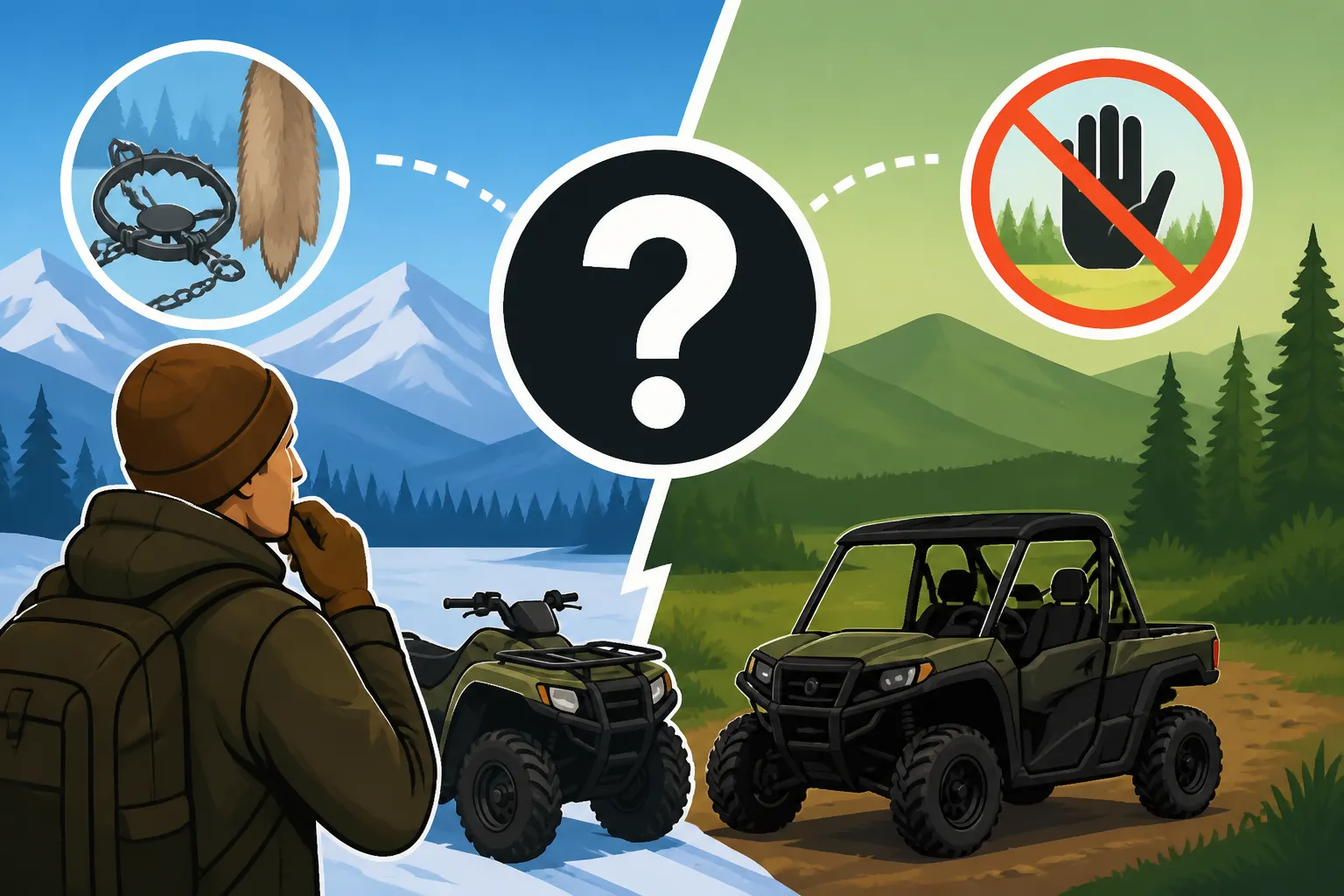
A trapline does not grant a right to cross land
A trapline registration or trapping authorization is not the same as a land-access permit, easement, or permission from a landowner. It does not, by itself, give you the right to ride an ATV or UTV across someone else’s property, use a private road, or travel through land managed by a different agency.
That distinction matters even when you have a legitimate reason to reach your line. A route may cross several types of land, each with its own access rules. A trapline can be in an area where trapping is allowed while the most convenient route to it crosses private, restricted, or otherwise closed land.
Nor does having used a route before necessarily establish continuing access. A trail may be on private land, cross a temporary closure, or be usable only with the owner’s permission. A cabin, old trail, or set of tracks does not necessarily show that the public has a right to pass.
Treat these as separate questions:
- Can you trap in the area? Check the applicable trapping regulations, seasons, and any location-specific restrictions.
- Can you ride to the area? Check the land status and the rules for motorized travel along your planned route.
- Can you cross a particular parcel? Confirm that public access is allowed or obtain permission from the landowner or manager.
- Can you leave a machine, build a camp, or store equipment there? Those activities may have separate requirements from simply traveling through.
A trapping authorization does not settle the last three questions. For broader background, Alaska Hunting Regulations and Machines and Alaska Land Ownership and Who to Ask help separate trapping rules from access rules.
Check every parcel along the route
Start with a map, but do not treat a map as final permission. Your route may cross state land, federal land, a state park, private property, or Alaska Native corporation land. Boundaries can be difficult to identify on the ground, and a public-looking trail may pass through land with specific restrictions.
Use a land-status map or other reliable parcel information to identify the owner or manager of each section. Then contact the relevant office or landowner to confirm motorized access, closures, and any conditions. Alaska Land Status Maps and Checking a Land Status Map are useful starting points; verify important details with the manager before relying on a route.
| Land or route type | What to confirm before riding |
|---|---|
| State land | Whether the activity and machine use are allowed in that location, and whether a permit or conditions apply |
| State park | The park’s own rules; a general state-land permit may not cover park land |
| Federal land | The managing agency’s motorized-use rules, route designations, and closures |
| Private land | Permission from the owner, including permission to cross any private road or trail |
| Alaska Native corporation land | The corporation’s access rules and whether a land-use permit or other permission is needed |
| Village or other local land | Who manages the parcel, whether local permission is required, and which routes are open |
| Easement or public right of way | The exact route and permitted uses; an easement may not allow travel beyond its stated scope |
On eligible state land, a statewide general permit may authorize certain personal uses of off-highway vehicles, subject to its terms and to area-specific restrictions. It is not blanket permission to ride anywhere in Alaska. It does not turn private, park, or other-agency land into open riding land, and it does not override a closure or a more specific rule. Check Alaska’s General Permit Covers State Land and Alaska’s Permit Excludes Private Land before assuming the permit covers a route.
If a route crosses land managed by more than one agency, you may need to check with more than one office. A permit or approval from one manager does not necessarily apply to the next parcel. When you contact an office, describe the actual route, machine type, purpose, season, and whether you plan to travel on an established trail, road, or cross-country. A general question such as “Can I reach my trapline?” may not provide enough detail for a useful answer.
For Native corporation land, do not assume that a trapping purpose gives you access. Confirm the rules with the landowner or the appropriate corporation office. Alaska Native Corporation Land Permissions and Buying a Land Use Permit From a Native Corporation cover the permission question in more detail.
ATV and UTV access has its own rules
Even when you can legally be on the land, motorized travel may be limited by the land manager, a designated route, seasonal conditions, or the type of machine. Permission to trap is not necessarily permission to use an ATV or UTV to reach the line. Likewise, permission to cross a parcel on foot does not automatically allow motorized access.
Check for:
- Route limits: A road or trail might be open to certain vehicles but not to an ATV or UTV. Confirm whether travel is allowed on the route you intend to use.
- Seasonal closures: A route may be open in one season and closed in another. Ground conditions can also make travel damaging or unsafe even when no closure sign is visible.
- Cross-country restrictions: Permission to use a trail does not necessarily allow you to ride off it, create a new route, or detour around an obstacle.
- Machine and activity limits: Rules can differ for an ATV, side-by-side, snowmachine, or other vehicle, and for recreational travel versus work-related use. Confirm how the land manager classifies your trip.
- Water and wetland crossings: A route across a stream, wetland, or other sensitive area may have additional restrictions. Do not assume that a crossing is allowed just because an existing track is present.
- Camping and equipment storage: Permission to travel through does not automatically cover leaving a machine, fuel, a trailer, or other gear on the land.
Winter travel can change what is physically passable, but frozen ground does not create a legal right to cross land. Snow and ice also make boundaries, signs, and hazards harder to see. Check current closures and conditions before departure, and avoid assuming that a route used in a previous winter remains open. Alaska Winter Travel on Frozen Ground and Alaska Trapline Access by Machine offer more context on machine access.
If your intended route uses an old road, mining track, or trail across land you do not own, identify who controls it and whether public motorized access is authorized. The existence of a road on a map does not prove that it is open to the public or to your machine. If a gate, sign, or closure blocks the route, do not bypass it based on your trapline registration. Ask the manager or landowner whether another route is permitted.
A practical access check before leaving
Work through the access question before hauling a machine or setting traps. Sorting it out in advance can prevent trespass problems, wasted travel, and damage to land or equipment.
- Mark the destination and the full route. Include trailheads, alternate routes, crossings, and any place where you expect to leave the machine. A route that looks direct may pass through several ownership boundaries.
- Identify the land managers. Use land-status information to determine who manages each parcel. If a boundary or road status is unclear, ask the relevant office rather than relying on a trail app or a line drawn on a general map.
- Check the trapping rules separately. Confirm that your trapping activity is allowed in the intended area and season. A land manager’s approval to travel does not replace any trapping requirements.
- Ask about the exact machine and purpose. Explain whether you will use an ATV, UTV, or another machine, and whether the trip involves access to traps, a cabin, or equipment. Ask whether the route is open to motorized travel and whether the permission covers the intended activity.
- Get private-land permission before crossing. If any part of the route is private, contact the owner or authorized representative. Ask about the route, dates, vehicle, and any conditions. Keep a record of the permission and follow its limits.
- Confirm permits and closures. Check whether an access permit is required and whether the route is currently open. Recheck shortly before travel if conditions or closures can change.
- Plan for a lawful alternate route. If a crossing is not authorized, do not presume that an alternate track is public. Verify the backup route in the same way.
- Carry relevant information. Keep any permits or written permission with you, along with a route plan and contact details for the land manager. Documents help explain your authorization, but they do not replace following posted restrictions.
When asking a land manager or landowner, be specific: “I plan to ride this machine along this route on these dates to reach this area. Is motorized access allowed, and do I need written permission or a permit?” This makes it easier to distinguish permission to trap from permission to travel.
If you cannot establish who owns or manages a parcel, or whether a route is open, treat access as unconfirmed. Do not cross simply because the line is registered, the route appears established, or another rider has used it. The safest approach is to get a clear answer from the person or agency with authority over the land.
Disclaimer
This article is for general informational purposes only and does not constitute professional advice. Laws, prices and regulations vary by location and change over time. Consult a qualified professional for guidance on your specific situation.