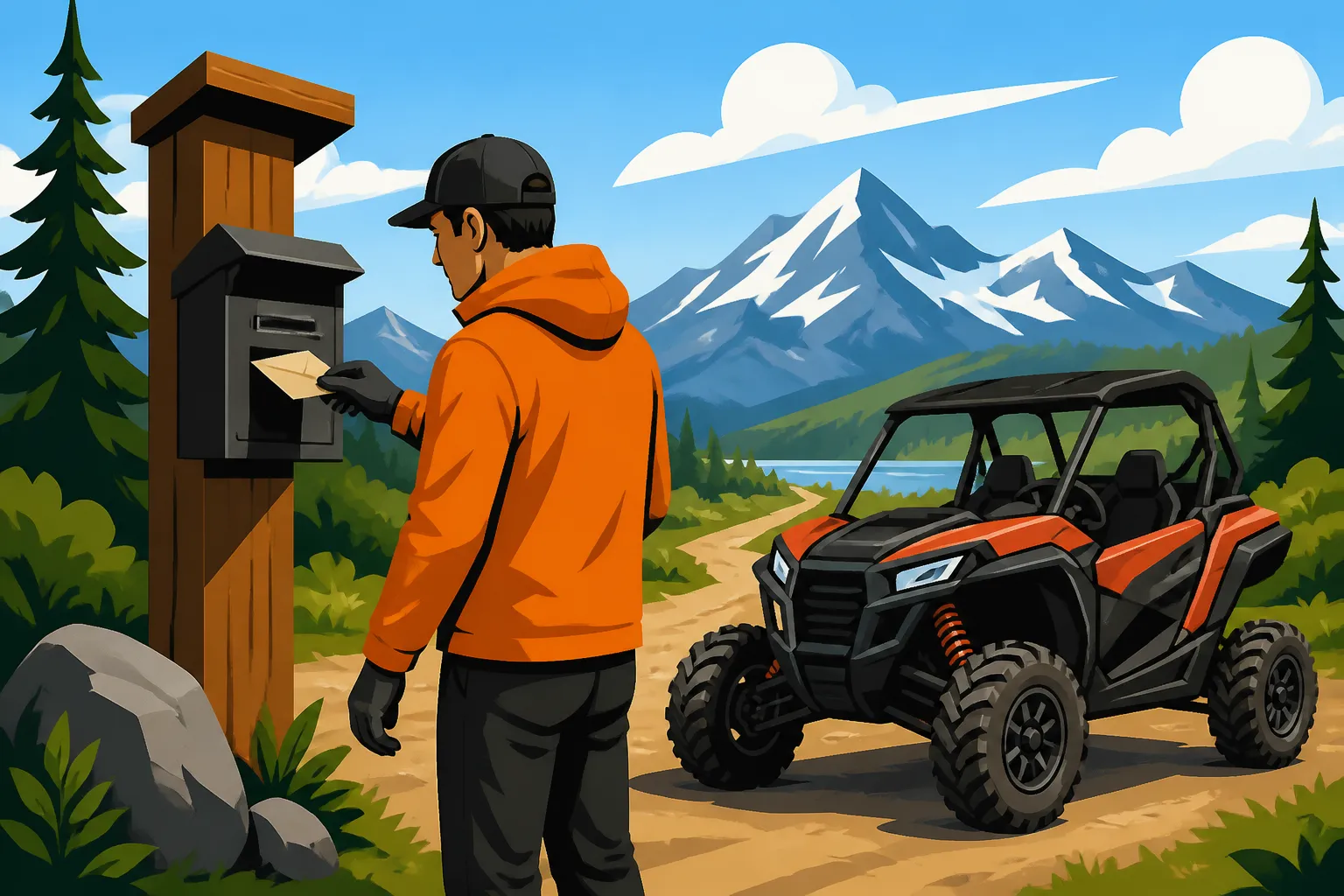
Paying at a Trailhead When Nobody Is There
An empty trailhead booth can leave you unsure whether to pay, where to pay, or whether you can ride at all. In Alaska, the right answer depends on the land manager and the posted instructions: some areas use kiosks or fee envelopes, while others require a pass arranged elsewhere. Here’s how to handle an unattended trailhead without guessing about payment or access.
First, identify what the fee covers
A fee notice at a trailhead may cover parking, day use, camping, or another specific service. It does not necessarily grant permission to ride across every parcel beyond the parking area. Likewise, an Alaska land-use permit and a trailhead pass are not interchangeable: one concerns land-use authorization, while the other may pay for access or facilities at a particular recreation site.
Read the signs at the entrance and payment station before unloading. Look for the managing agency, which areas the fee applies to, accepted payment methods, and whether a pass must be displayed on the vehicle. If the fee notice refers to a specific lot or recreation area, do not assume it covers other lots, routes, or nearby land.
This distinction matters especially if the trailhead sits near a boundary. State land, state parks, federal land, private property, and Alaska Native corporation land can have different access rules. A statewide permit does not automatically cover every type of land. For a broader check, see Alaska Land Ownership and Who to Ask and A Trailhead Pass Is Not a Land Permit.
If there is no fee notice or payment station, that alone does not establish that riding is allowed or that no payment is due. Check for separate signs about closures, restricted routes, seasonal conditions, permits, or private land. The trailhead may be unattended because payment is self-service, because fees are handled online, or because the site has no fee collection at that location. The instructions—not the absence of an employee—are what matter.
What to do when the payment station is unattended
Start by locating the full set of instructions. A small sign at the entrance may direct visitors to a kiosk farther into the lot, an envelope station, a website, or a different payment point. Walk over and read the posted details before deciding what to do. If a sign is damaged, missing information, or appears to conflict with another notice, avoid guessing about the fee or where to leave payment.
Use this process:
- Confirm the managing agency and location. Make sure the instructions apply to the trailhead you are using, not a neighboring campground or recreation area.
- Read the payment directions carefully. Check whether payment is made at a kiosk, by envelope, online, or by another method. Follow any directions about writing down your vehicle information or selecting a permit type.
- Pay only through the stated method. Do not leave cash loose on a counter, under a sign, or in an unofficial container. If there is no clearly marked payment method, do not improvise.
- Keep proof of payment. Save a receipt, confirmation screen, or the portion of a pass the instructions tell you to retain. If payment is made online, make sure the transaction is complete before relying on it.
- Display the pass if required. Follow the directions about where it belongs. If no display is required, keep the proof accessible in case a site manager asks to see it.
- Recheck the ride route. A paid parking pass does not by itself confirm that the route is open or that your machine is allowed there.
Some locations use a fee envelope and a collection box. If so, use the envelope and complete the information requested, then place it in the designated box. Keep any receipt or tear-off portion as directed. Do not leave an envelope outside the box, and do not assume that an envelope method is available just because a fee station has an opening.
Other locations may use a kiosk or require an online pass. If the kiosk is out of order, the payment instructions are unclear, or there is no reliable cell service for an online purchase, look for a posted alternative. A dead screen is not permission to skip a fee, but neither is it a reason to put money somewhere the agency has not designated. If there is no stated alternative, consider contacting the land manager or choosing a site with clear payment instructions.
Procedures can differ between trailheads, even in the same region. For example, Mat-Su trailhead passes may have separate rules for day and annual passes, and some payment options may only be available through a particular channel. Check Which Mat-Su Trailheads Need a Parking Pass, Day Passes Only at a Kiosk, and Annual Passes Only Online before traveling. For a fee station that uses an envelope, Filling Out a Fee Envelope at Jim Creek explains the kind of details to check in the posted directions.
| What you find | What to do | What not to assume |
|---|---|---|
| A staffed or clearly marked kiosk | Follow its instructions and keep the receipt or pass | That one payment covers nearby sites |
| A labeled fee-envelope station | Complete the envelope and use the designated collection box | That cash can be left loose at the station |
| A sign directing visitors online | Use the stated official payment route and save confirmation | That an online purchase is optional because staff are absent |
| A broken kiosk with no alternative posted | Look for contact information or confirm with the manager before relying on access | That the fee is waived |
| No payment notice or collection point | Check other access, permit, and closure signs; confirm site rules if uncertain | That the area is necessarily free or open to riding |
If you cannot pay or cannot confirm the rules
When instructions are incomplete, the safest choice is to pause before riding. The practical options depend on what the sign says and whether another approved payment method is available. If a number, office, or agency contact is posted, use it to ask what visitors should do when the station is unattended. If you cannot reach anyone, consider moving to a trailhead with clear instructions rather than making up a payment method.
Avoid treating another visitor’s advice as the official rule. A rider may have an annual pass, may be using a different part of the site, or may have paid online before arriving. A vehicle with no visible pass also does not prove that payment is unnecessary; some passes may be electronic or displayed in a location you cannot see.
Keep a record of reasonable steps you took, such as a photo of the station’s instructions and a payment confirmation, if applicable. This does not replace a required pass, but it can help you explain what happened if a manager asks. Do not photograph or share information that could expose someone else’s personal details.
If a fee is clearly required and no accepted payment route is working, do not assume that riding first and paying later will be accepted. Contact the land manager or use another site. You can also check What You Need at a Trailhead Pay Kiosk and Paying at a Trailhead When Nobody Is There for the specific payment setup described for a location, rather than applying one trailhead’s process everywhere.
Access permission still needs its own check. On state land, understand what the general permit authorizes and where it stops; state parks and other landowners may have separate requirements. For site-specific questions, Alaska’s Statewide General Permit for ATV Use and Which Alaska State Land the General Permit Covers can help you identify the limits. A trailhead payment is not a substitute for permission to cross private or corporation land.
Make the next visit easier
Before leaving home, check the trailhead’s current information with the managing agency. Confirm whether a fee applies, whether payment is available on site, and whether a day pass or annual pass is appropriate. If an online purchase is required, complete it before reaching a location with poor reception and save the confirmation where you can access it offline.
A short pre-ride check can prevent the most common mix-ups:
- Know the exact trailhead. A pass for one parking area may not apply at another.
- Check what the fee covers. Parking, camping, and land-use permission are separate questions.
- Bring the payment method the site accepts. Do not rely on cell service or assume a card reader will work.
- Keep proof accessible. Store a receipt or confirmation where it will not get soaked or lost.
- Read closure and route signs. Payment does not override a seasonal closure or machine restriction.
- Ask before crossing uncertain land. A route that begins at a public trailhead can still approach land with different access rules.
If you regularly use a particular recreation area, note its process after a successful visit: where the station is, how payment works, and whether the pass needs to be displayed. Recheck the instructions on later trips, since facilities and procedures can change. A little preparation is more reliable than trying to infer the rules from an empty booth.
Disclaimer
This article is for general informational purposes only and does not constitute professional advice. Laws, prices and regulations vary by location and change over time. Consult a qualified professional for guidance on your specific situation.