Alaska Hunting Regulations and Machines
Alaska Hunting Regulations and Machines
An ATV or UTV can make a long Alaska hunting approach manageable, but it does not make every trail, parcel, or hunting method legal. The rules depend on the species, hunt area, land manager, and purpose of the trip. Use this guide to separate access from hunting and game retrieval, then check the current regulations for the exact hunt before unloading your machine.
Separate machine access from hunting
Owning or registering an ATV does not give you permission to ride across every part of Alaska, and permission to ride does not automatically authorize using a machine to hunt. These are separate questions: where the machine may travel, what hunting methods are allowed, and whether a machine may be used to retrieve harvested game.
A machine can be useful for carrying camp, reaching a permitted trailhead, or traveling on an open route. But if a rule closes an area to motorized vehicles, or restricts motorized access for a particular hunt, the machine may not go beyond the permitted point. The fact that a route is visible, established, or used by other riders does not prove it is open for your hunt.
Likewise, a general land-use authorization is not a hunting permit. Alaska’s statewide general permit addresses certain use of qualifying state land; it does not replace hunting licenses, tags, harvest tickets, landowner permission, or area-specific restrictions. What Alaska’s Statewide General Permit Actually Authorizes explains the permit’s scope. For the separate question of whether a machine can be used to access a hunt, see Alaska Hunting Access by Machine.
Before planning a route, keep these permissions distinct:
- Hunting authorization: The license, harvest ticket, locking tag, permit, or other documentation required for your species and hunt.
- Land access: Permission from the appropriate landowner or manager to enter and travel through the parcel.
- Motorized access: Whether the specific machine may use the route, trail, or area for the intended purpose.
- Hunting method: Whether using, carrying, or operating a motorized vehicle in connection with the hunt is restricted.
- Game retrieval: Whether you may use the machine to reach or remove an animal after it has been legally taken.
The distinction matters on mixed-ownership routes. A road or trail can cross state, federal, municipal, Native corporation, and private land in a short distance. The authorization that applies on one section may not carry over to the next. Use Alaska Land Ownership and Who to Ask to understand why confirming the manager and boundaries is part of route planning.
| Question | What to verify | Why it matters |
|---|---|---|
| Can I hunt this species here? | Current regulations for the hunt area and species | Seasons, legal methods, and harvest requirements vary |
| Can I ride this route? | The land manager’s access rules and current closures | A public route may still have limits on motorized travel |
| Can I use the machine while hunting? | Rules about motorized vehicles, pursuit, and access | Riding to an area and using a machine to hunt may be treated differently |
| Can I retrieve an animal with the machine? | The applicable retrieval rules and land restrictions | Retrieval may have separate conditions from the hunt itself |
| Can I cross the parcel? | Ownership, easements, and permission | A trail’s presence does not itself grant access |
Check the hunt area and restrictions before riding
The first useful document is the current hunting regulation that covers the species and area you plan to hunt. Do not rely on a general statement about ATV use in Alaska. Restrictions may differ by hunt area, season, species, land status, and the particular route. A rule that applies to one hunt cannot safely be assumed to apply to a neighboring unit.
Start by identifying the exact hunt area and any special conditions printed for that hunt. Look for limits on motorized vehicles, aircraft, access routes, land closures, retrieval, and the required handling of harvested game. Also check whether a separate land manager controls the ground you intend to cross. A hunting regulation and a land-use restriction can both apply to the same trip.
Use current official information rather than an old screenshot, a saved map, or an online discussion. Closures and access conditions can change. If a map shows an open route but the current regulation or land manager says otherwise, resolve the conflict before riding. Hunting Regulations That Limit Machines is a useful starting point for understanding why hunt-specific limits matter, while Alaska Land Status Maps can help you identify which boundaries and owners to investigate.
Pay attention to the purpose of the ride
Ask what you will be doing at each stage of the trip:
- Traveling to camp or a trailhead: Check whether the route is open to your machine and whether crossing each parcel is authorized.
- Traveling to a hunting location: Check for rules that limit motorized access in the hunt area or restrict the distance or route from which a hunter may travel on foot.
- Searching for or pursuing game: Confirm whether machine use connected to locating, pursuing, or taking game is prohibited or limited.
- Leaving the hunt area: Check whether the route remains open during the season and whether temporary closures or conditions apply.
- Retrieving an animal: Confirm the retrieval rule separately; do not assume that a machine allowed for approach is also allowed for retrieval.
The legal answer can turn on the activity, not just the vehicle. A machine used only to transport camp to an open trailhead may raise different issues from one used to travel across hunting country while searching for game. If the regulation’s wording is unclear, contact the agency responsible for the hunt or land before you ride. Do not treat a verbal assumption from another rider as a substitute for checking the rule.
Understand the same-day airborne rule
Alaska has restrictions concerning taking big game on the same day a hunter has been airborne. This is a hunting rule, not an ATV rule, but it matters when a trip combines flying and riding. A plane trip to a remote area followed by an ATV ride does not make the aircraft rule irrelevant; the relevant restriction may still apply to the hunt.
Do not guess at what counts as airborne, which species or circumstances are covered, or whether an exception applies. Definitions and exceptions can be specific, and the current regulation is the authority. Review the rule for your hunt before booking or flying, and ask the appropriate wildlife office if the itinerary is unusual. The Same-Day Airborne Rule for Alaska Hunters covers this issue in more detail.
An ATV is not an aircraft, but changing from a plane to a machine does not erase restrictions connected to the flight. Keep the travel timeline accurate and make sure everyone in the hunting party understands the rule. This is particularly important when one member flies in while another travels by road or boat, or when a party plans to move between locations during the hunt.
Plan motorized access around land and route rules
A route that looks suitable on a map may cross land with different access rules. Before the trip, identify the land manager for each section, confirm that motorized use is permitted, and look for restrictions tied to season, ground conditions, wildlife, or the type of vehicle. A route may be open to foot travel but closed to ATVs, or open only on a designated trail.
State land, state parks, federal lands, refuges, Native corporation lands, and private parcels do not all share one set of rules. A statewide permit does not authorize riding on every category of land. In particular, check separately for state parks, federal lands, and private or Native corporation property. Alaska State Park Riding Rules explains why park rules need a separate check, and Alaska Native Corporation Land Permits addresses access where a corporation controls the land.
Do not assume that land is open because it appears unoccupied or because there is no gate. Permission can be required even where a route is physically passable. Similarly, a landowner’s permission to cross does not necessarily override wildlife regulations or a closure imposed by a public land manager.
Check closures and conditions close to departure
Conditions in Alaska can change a route quickly. A trail may be closed to protect habitat, an area may be restricted during a particular season, or soft ground may make travel damaging even where a machine was previously allowed. Recheck notices before leaving and again at the access point when possible.
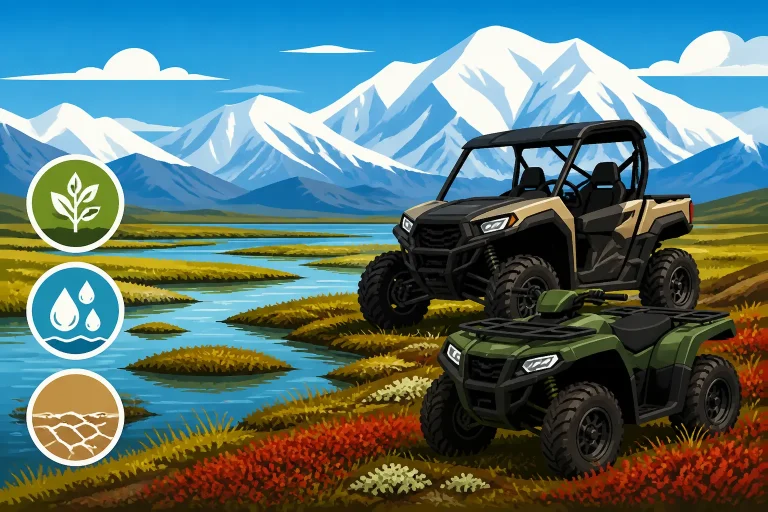
Be especially cautious with wetlands, tundra, stream crossings, and routes that leave an established trail. A machine can create damage that persists long after the ride, and a route that is passable is not necessarily authorized. If a closure sign or barrier is present, do not ride around it to continue the trip. When the route or boundary is uncertain, turn back and contact the land manager.
Build an alternate plan before the hunt. That might mean staging at a permitted trailhead, continuing on foot, using a different authorized route, or postponing the trip. An alternate plan is more useful than trying to resolve a land-access question after reaching a remote trail junction.
Do not confuse hunting access with land access
Hunters often focus on whether a hunt is open and overlook whether they can legally reach it by machine. A valid hunting authorization does not grant a right to cross someone else’s land, and an open public trail does not necessarily allow hunting from the machine or off the trail. Check access and hunting rules as separate parts of the plan.
If your route crosses a parcel where permission is required, get that permission before entering. Clarify whether it covers the machine, the route, the season, and the people in your party. Ask about conditions such as staying on a designated trail, avoiding certain areas, or not parking near a residence or work site. Asking Who Owns the Ground First offers a practical approach to confirming access before a ride.
Use the machine without crossing into prohibited hunting activity
A machine can make a hunt safer and more practical by moving supplies, helping a party reach an authorized area, or carrying equipment on a route where motorized use is allowed. The risk is treating it as permission to cover more ground, search more efficiently, or follow animals. Hunting rules may restrict motorized travel connected to locating, pursuing, or taking game even when ordinary travel on a route is allowed.
Read the language of the applicable regulation carefully. Terms such as motorized vehicle, off-road vehicle, pursuit, and retrieval may have defined meanings or special conditions. Do not assume that a quad, side-by-side, snow machine, or other vehicle is treated identically in every rule. If the rule’s application to your machine or planned activity is not clear, confirm it with the appropriate agency before the hunt.
A conservative plan is to travel only on an authorized route, park where permitted, and continue the hunt on foot where required. Do not use the machine to push an animal toward another hunter, circle ahead to intercept it, or keep pace with an animal unless the applicable rules clearly allow the conduct. The fact that the machine is not carrying a firearm at that moment does not automatically settle whether the activity is permitted.
Make a safe transport plan for firearms and equipment
Hunting parties should plan how firearms, ammunition, fuel, and other gear will be carried before setting out. Follow the current rules for the area and the requirements that apply to the vehicle and the firearm. Secure equipment so it cannot shift or interfere with controls, passengers, or safe handling of the machine.
Avoid handling a firearm while riding or carrying it in a way that could cause it to discharge if the machine tips, hits a rut, or stops suddenly. Keep a firearm pointed in a safe direction and handle it only when the machine is stationary and the hunter can do so safely. Where rules or land manager conditions specify how firearms must be carried, those requirements take priority.
Fuel and gear should also be secured. Keep fuel containers stable and away from hot components, and make sure cargo does not block lights, controls, or the operator’s view. If the hunt involves a remote route, plan for communication, weather, and recovery needs rather than relying on the assumption that a second vehicle or a cell signal will be available.
Keep the hunting party on the same plan
A group can unintentionally create problems when members assume different routes or different rules apply. Before departure, agree on where the machine may travel, where it will be parked, how the group will continue the hunt, and what to do if someone harvests an animal or the route becomes impassable.
Make sure every rider knows the boundaries and any no-go areas. A passenger should not direct the operator to cross a closure or follow game simply because another person in the party wants to continue. If the group includes different hunters with different permits or hunt areas, verify each person’s requirements rather than treating the party as one authorization.
For trips involving children or inexperienced riders, keep the machine’s role simple and conservative. A hunting outing is not a good time to test a young rider’s limits in unfamiliar terrain. Confirm that each operator is legally permitted and capable of operating the machine, and use suitable protective equipment.
Retrieve and transport harvested game carefully
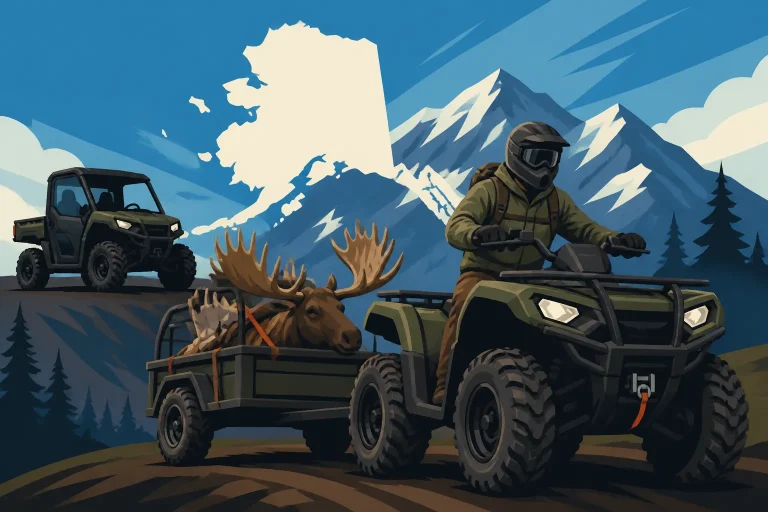
A legal harvest does not mean every method of retrieval is allowed. The hunt rules may distinguish between taking an animal and transporting or retrieving it, and land restrictions may continue to apply after the shot. Before the hunt, find out whether a machine may be used to reach the animal, remove it from the area, or carry meat along the planned route.
The regulations may also set requirements for salvaging meat, retaining evidence of sex or species, reporting a harvest, or completing a sealing process. Those requirements depend on the species and hunt. Do not cut, discard, or pack an animal in a way that makes required inspection or identification impossible. Review the current instructions for the exact hunt and carry the relevant documentation.
A useful distinction is:
- Taking the animal: Whether the hunting method and circumstances of the harvest were legal.
- Approaching the animal: Whether the route and vehicle use are allowed after the harvest.
- Removing the animal: Whether motorized retrieval is permitted and under what conditions.
- Transporting the meat: How the meat, identifying parts, and required documents must be handled.
- Reporting the harvest: What reporting, sealing, or other post-harvest steps apply.
Check each stage instead of treating “retrieval” as a single blanket permission. If a machine cannot legally enter the location, do not drive in simply because the animal is already down. If the rule permits retrieval only under certain conditions, follow those conditions precisely. Alaska Game Retrieval by Quad and Transporting Meat by Machine cover the practical questions that arise after a harvest.
Protect meat and comply with handling requirements
A machine can help move a heavy load, but rough terrain, heat, mud, and poor packing can damage meat or contaminate it. Carry clean bags or coverings, keep meat away from fuel and dirty machine parts, and secure the load so it cannot drag, fall, or block the operator’s view. Avoid overloading the machine or exceeding its carrying capacity.
Plan for the full distance from the harvest site to a place where the meat can be cared for properly. A short ride on a map may take much longer through wet ground, steep terrain, or a crowded trail. If the machine breaks down, the party still needs a way to protect and move the meat. Consider whether the route is safe for a loaded machine and whether a second trip, foot carry, or alternate exit is necessary.
Keep required identifying parts and documents with the meat as directed by the applicable regulation. Separate loads clearly when more than one hunter harvests an animal, and record who harvested each animal. Good organization helps avoid confusion during transport, inspection, or reporting.
Do not let retrieval become a reason to enter closed land
A wounded or harvested animal can create pressure to take a shortcut, cross a boundary, or ride into a restricted area. Stop before making that decision. A difficult retrieval does not automatically create permission to cross private property or a motorized closure. Contact the land manager or relevant agency for direction if the lawful route is unclear.
If retrieval cannot be completed without violating a restriction, do not assume that the shortest route is acceptable. Ask about an authorized option and document the instructions you receive. In remote country, it is better to plan recovery routes before the hunt than to face a boundary decision in poor weather with a loaded machine.
Build a pre-trip checklist
A few checks before departure can prevent a lost hunt, an access dispute, or a difficult retrieval. Keep copies of relevant documents where they can be protected from rain and mud, and make sure the entire party can find them. A waterproof pouch can help keep paperwork readable; a simple pouch from an outfitter or a retailer such as Amazon may work, but it does not replace carrying the required documents.
Use this checklist for the route and the hunt:
- Confirm the hunt. Verify the current season, area, species, legal method, and required hunting documents.
- Check machine restrictions. Look for rules governing motorized access, hunting activity, pursuit, and retrieval.
- Map land ownership. Identify public and private parcels, agencies, boundaries, and any permission requirements.
- Confirm the route. Check current closures, designated trails, seasonal limits, and ground conditions.
- Plan the harvest process. Review meat salvage, evidence, reporting, and sealing requirements for the hunt.
- Plan firearm and cargo transport. Secure firearms, fuel, tools, and supplies without obstructing safe operation.
- Prepare for recovery. Consider the machine’s range, load limits, communication gaps, weather, and a backup exit.
- Tell someone the plan. Share the route, party details, expected return, and a time to raise concern if you are overdue.
If the machine is from outside Alaska, confirm the applicable registration and documentation rules separately from hunting access. Does an Out-of-State Machine Need Alaska Registration? addresses that question, and Alaska Proof of Ownership on the Trail is useful when considering what records to carry. A registration record or decal does not grant access to land or authorize a hunting method.
Finally, check the machine itself. Test brakes, lights, throttle, tires, and steering; carry appropriate recovery and repair equipment; and make sure the load is secure. For routes where fire restrictions or land manager rules make equipment relevant, check that the machine meets applicable requirements, including any spark arrester conditions. Alaska Spark Arrester Checks provides more on that equipment issue.
The safest approach is to make decisions in this order: confirm the hunt, confirm the land, confirm the route, and then decide whether a machine can be used for each part of the trip. If any answer is uncertain, ask the agency or land manager responsible before riding. The time spent checking is small compared with the consequences of an illegal harvest, trespass, closed-area violation, or spoiled meat.
Frequently Asked Questions
Can I use an ATV to hunt in Alaska?
It depends on the hunt area, species, land manager, route, and purpose of the machine use. Check the current hunt regulations and land-access rules. Riding to an authorized location does not necessarily mean you may use the machine to search for, pursue, or take game.
Can I use a quad to retrieve an animal?
Possibly, but retrieval can be subject to separate hunting and land-use restrictions. Confirm whether motorized retrieval is allowed for the specific hunt and route, and follow the rules for meat salvage, evidence, reporting, and transport.
Does Alaska’s statewide general permit let me ride anywhere while hunting?
No. A general permit has a defined scope and does not replace hunting authorization, private land permission, or rules administered by other land managers. Check the rules for each parcel and route.
Does the same-day airborne rule apply if I ride an ATV after flying?
Changing to an ATV does not remove a restriction connected to flying. Check the current same-day airborne rule for your species, hunt, and itinerary, including any definitions or exceptions that may apply.
Disclaimer
This article is for general informational purposes only and does not constitute professional advice. Laws, prices and regulations vary by location and change over time. Consult a qualified professional for guidance on your specific situation.