Alaska Game Transport by Machine
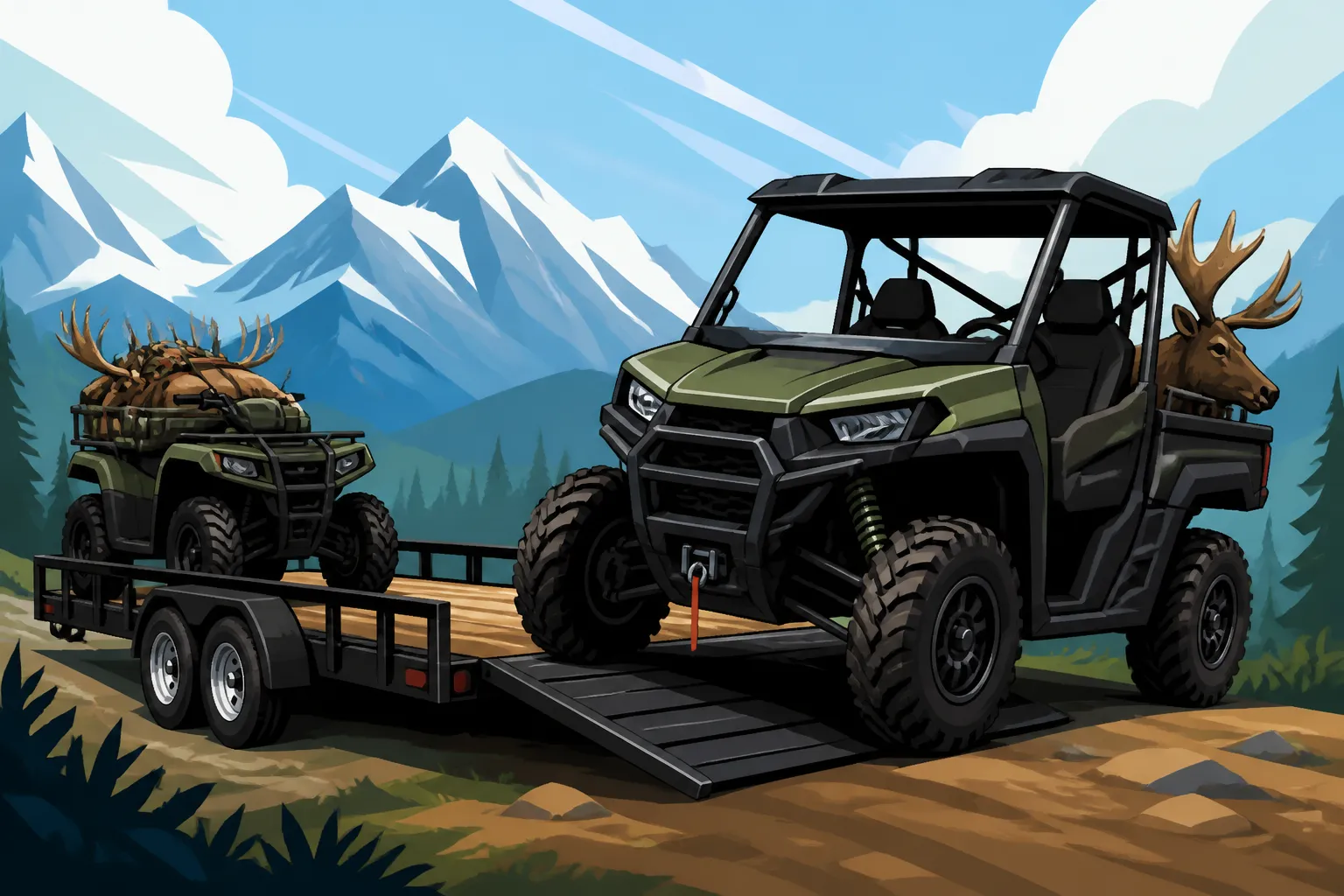
Transporting harvested game by ATV or UTV in Alaska can save a difficult pack-out, but it does not automatically make motorized travel legal. The rules depend on the species, hunt area, land manager, route and timing. Check those details before the hunt, then plan a recovery route that protects the meat, your machine and the ground.
Check the rules before relying on a machine
Alaska does not have one simple rule that makes every ATV or UTV route available for hunting or hauling game. State hunting regulations can restrict motorized access in particular areas, and land managers may apply separate rules to their land. A route that is open for ordinary travel may not be open for hunting access or game retrieval.
Start with the current regulations for the species and hunt area. Confirm whether the rules allow an ATV or UTV for access, hunting-related travel, retrieving game, or transporting meat. Those uses are not necessarily treated the same way. Also check for seasonal closures, vehicle-size or weight restrictions, and limits on where a machine may travel. A restriction may apply to a road, trail, drainage, or specific boundary rather than to the entire area.
A few useful distinctions:
- Riding to a hunting area means using a machine to reach the place where you plan to hunt. Access rules may limit this even if the route looks like a public trail.
- Hunting from or with a machine can be more restricted than simply riding to a location. Regulations may limit shooting from a vehicle, hunting from a road or trail, or using a vehicle to pursue game.
- Retrieving game means reaching a harvested animal and bringing it out. Rules may allow some forms of retrieval while restricting other motorized activity.
- Transporting game means carrying harvested meat or other parts on a machine. The rules can specify which parts must be salvaged, how they must be handled, and when transport is allowed.
Do not assume that permission for one activity covers the others. For a broader overview, see Alaska Hunting Regulations and Machines and Hunting Regulations That Limit Machines. For specific retrieval concerns, Alaska Game Retrieval by Machine is also relevant.
Confirm the land status and manager
The legal route can cross more than one kind of land. A trail may start on state land, cross private or Native corporation land, and continue onto land managed by a federal agency. Each segment may have different access requirements. A state permit does not necessarily authorize travel on another owner’s land or override a closure.
Before departing, identify who manages the ground where you intend to ride. Check current maps and ask the relevant land manager when boundaries or access rules are unclear. The overview in Alaska Land Ownership and Who to Ask can help you work out which agency or landowner to contact.
If you plan to ride on state land, understand what the statewide permit does and does not authorize. It is not a substitute for checking the hunting regulations, land status, or area-specific restrictions. State parks, private land and land managed by other agencies may fall outside its coverage. See Alaska’s Statewide General Permit for ATV Use and Alaska’s General Permit Covers State Land for context.
| Question | What to verify before the hunt |
|---|---|
| Is the area open to ATV or UTV use? | Check the current hunting regulations and land-manager rules for the exact hunt area. |
| Is the machine allowed for this purpose? | Confirm whether the rule covers access, hunting, retrieval and transport separately. |
| Can you follow the planned route? | Check land ownership, trail status, seasonal closures and any route-specific restrictions. |
| What must you salvage? | Review the species-specific requirements for meat and other required parts. |
| Does timing affect the plan? | Check restrictions involving aircraft, hunting dates, seasons or transportation. |
| What documents and permissions are needed? | Confirm permits, access permission, licenses and any proof required for the area. |
Treat timing rules as part of the route plan
Hunting regulations can restrict the relationship between air travel and hunting or taking game. These rules are often described as same-day airborne restrictions, but their application depends on the details of the regulation and hunt. Do not assume that using an ATV to retrieve or carry game resolves a timing issue involving an aircraft. Read the rule for the species and area, and ask the relevant authority if the wording is unclear. The Same-Day Airborne Rule for Alaska Hunters explains why this issue needs separate attention.
Build the schedule around the rules, not around a hoped-for interpretation in the field. If weather, a delayed flight or a changed route could affect the timing, know what you may legally do before the trip begins. A machine can make a pack-out faster, but it does not change the hunting regulation.
Understand what the machine may and may not do
An ATV or UTV is useful for carrying gear and moving harvested game, but its presence can change how a hunting activity is regulated. In some places, motorized use is limited to designated routes or allowed only during certain conditions. In others, rules distinguish between travel on an established route and cross-country travel. The exact terms matter.
Read the regulation for the hunt area instead of relying on a general statement such as “ATVs are allowed.” That phrase does not answer whether the machine may be used to reach a hunting site, follow a particular trail, pursue an animal, or retrieve a carcass from off the route. Nor does it tell you whether the trail is open during the season you plan to hunt.
Do not use the vehicle to pursue or take game
A machine should not be treated as a tool for chasing, cornering or pressuring an animal. Hunting rules may prohibit using a motor vehicle to pursue game or shooting from or across a vehicle or road. Even where a machine is allowed for access, that does not make every hunting method lawful.
Keep the distinction clear in the field:
- Use the machine only for purposes allowed in that area.
- Stop and secure it before beginning a lawful stalk, where required.
- Do not use the machine to drive an animal toward another hunter.
- Do not shoot from a moving or stationary vehicle unless the regulations clearly authorize the specific conduct.
- Avoid riding close to wildlife simply to improve a shot or force an animal to move.
The safest interpretation is not to let the vehicle influence the chase or shot. If the rule’s wording leaves room for doubt, check with the appropriate wildlife or land-management office before hunting.
Retrieval permission is not permission to ride anywhere
A rule allowing some form of game retrieval does not necessarily open every slope, wetland, streambank or tundra area to vehicle travel. The permitted activity may have limits on the type of machine, route, timing or distance. A recovery route can also cross ground where the vehicle is not allowed, even when the harvested animal lies somewhere that can be reached on foot.
This is a common planning trap: the hunter checks that an ATV can be used in the general region but does not check whether the exact route to the animal is permitted. Plan a legal route before the hunt, and have a non-motorized backup if the animal falls beyond the accessible area.
Where regulations require travel to remain on an established trail or designated route, do not create a new track to save time. A short detour through soft ground may widen into a permanent rut, damage vegetation or cross a closed area. Turn back when the lawful route ends.
Know what counts as required salvage
Hunting regulations may require certain portions of an animal to be salvaged, and those requirements can vary by species, hunt area and season. They may also address how meat must be separated, protected or transported. Do not rely on a general packing method from another hunt or another part of Alaska.
Before leaving home, identify:
- Which meat or other portions must be salvaged.
- Whether the meat must remain attached to particular bones or be separated in a specified way.
- Whether evidence of sex or species must remain with the meat.
- Whether the required portions must be kept separate from other game.
- What documentation, tags or harvest information must accompany the animal.
- Any restrictions on leaving parts in the field or at a temporary camp.
Use the current regulation and carry any required license, permit or harvest document in a condition that can withstand rain and handling. If the machine is stopped by a breakdown, the salvage obligations do not disappear. Have a plan for carrying the required portions out by hand or with help.
Plan the pack-out before the shot
A realistic recovery plan begins before the hunt, not after an animal is down. Estimate how much gear and meat the machine can safely carry, how far the route is, and whether the terrain will still be passable when loaded. A light ATV on a firm trail behaves differently from a heavily loaded machine on wet ground, loose rock or a steep side slope.
Start with the manufacturer’s load limits for the machine, racks, tires and any trailer. Do not treat a vehicle’s ability to move an oversized load as proof that the load is safe. A high or uneven load can make steering, braking and side-hill travel less stable. Keep cargo low, balanced and secured, and leave room for the operator to shift position and control the machine.
Prepare a practical recovery kit
The exact kit depends on the hunt, distance and weather, but consider packing:
- Clean game bags or other suitable coverings for meat.
- Straps that can secure a load without cutting into it.
- A tarp or protective layer for keeping gear and meat separated.
- Gloves, a sharp knife and basic field-dressing supplies.
- A small repair kit suited to the machine.
- A tire repair method, pump and tools compatible with the tires.
- A winch or recovery equipment where it is appropriate and safely rated.
- First-aid supplies, navigation tools and a way to communicate beyond cell coverage.
- Dry bags or waterproof containers for permits, licenses and harvest documents.
A winch is not a guarantee that a machine can be recovered safely. Use only properly rated equipment and suitable anchor points, keep people clear of a loaded line, and avoid pulling from unstable ground. If a machine is stuck in a dangerous position or the anchor is uncertain, unloading or walking out for help can be safer than forcing a recovery.
Inspect the machine before the trip. Check tires, brakes, steering, lights, throttle return, fluid levels and cargo tie-downs. If the route includes water or mud, know the vehicle’s limits and do not rely on modifications to make an unknown crossing safe.
Keep meat clean and protected
Game meat needs protection from dirt, fuel, exhaust, mud and contact with contaminated cargo. Keep knives and meat-handling supplies clean, and place meat in clean game bags or other suitable coverings. Avoid setting meat directly on a rack, trailer floor or wet ground. Separate it from fuel cans, oily tools, dirty recovery gear and personal equipment.
Secure the load so it cannot shift into tires, exhaust components or controls. Avoid covering hot parts or blocking the machine’s lights. If the load is too large for one safe trip, make multiple trips if legal and practical, or arrange another carrier. Do not overload a vehicle to avoid walking an additional distance.
Heat, rain and insects can complicate meat care. Plan for airflow where needed, protection from contamination, and a timely route to suitable cooling. A tightly wrapped load left warm for an extended period can be a poor solution. Follow sound field-care practices and applicable food-safety guidance; if conditions make safe transport uncertain, prioritize getting the meat to appropriate cooling rather than continuing a long detour.
Expect the animal to be farther from the trail than planned
A shot animal may move before it falls, and the terrain may prevent a machine from reaching the location. Do not ride blindly toward the animal. First determine where it is, what the legal route allows and whether the ground can support the vehicle without damage or risk.
If the animal is beyond the machine-accessible route, consider a hand pack-out or help from another hunter. If the route is unsafe, steep, flooded or too soft, wait, change plans or turn back. The cost of an extra carry is generally preferable to injury, a damaged machine or a prohibited track across closed ground.
For longer trips, decide ahead of time how many people can safely help, how the load will be divided and what happens if the machine cannot return. Transporting Meat by Machine offers a related look at the practical transport side of the job.
Choose a route that protects people, meat and ground
A route that is legally open may still be a poor recovery route. Alaska conditions can change quickly, and a path that was firm on the way in may be soft or flooded by the time the machine is loaded. Glacial streams can change, and wet ground may be difficult to cross without leaving damage. Evaluate the route on the return trip as if you had never seen it before.
Use a current map and mark:
- The permitted trail or access corridor.
- Land boundaries and any restricted areas.
- Likely crossing points and places where a detour would be impossible.
- A safe place to turn around or stage a second trip.
- The best route to a road, camp, cache or cooling location.
- A backup route that is also legal.
Do not assume that a visible track on the ground is an authorized trail. Tracks may be old, informal or left by someone who did not have permission. If you cannot confirm that a route is open, ask the land manager or choose a route you can verify.
Be conservative at water and on soft ground
A loaded machine is harder to control in water, mud and loose terrain. A crossing that looked manageable on foot or on the way in may become hazardous with added weight. Water depth, current, hidden channels, soft banks and changing flow can make a crossing unsafe. Never let the pressure to save meat turn an uncertain crossing into a rushed decision.
Before crossing, evaluate whether the route is permitted and whether the machine can pass without creating unacceptable damage. Avoid streambanks and wetland areas where travel is prohibited or likely to cause lasting rutting. If the crossing cannot be assessed safely, do not attempt it. Move the meat by a permitted alternate route, use a hand carry, or wait for conditions to improve.
When the ground is soft, keep to established routes and avoid repeated passes over the same vulnerable patch. Spinning tires can deepen ruts, damage vegetation and make later travel worse. A machine that loses traction may need more power, but aggressive throttle often worsens the problem. Stop, reduce the load if possible and reassess rather than digging in.
Set a turnaround point
Before leaving camp or the trailhead, agree on a point where the group will stop and reconsider. That point might be a difficult crossing, a slope, a route boundary or a time limit. If the load, weather or machine condition makes the next section unsafe, turn around or use the backup plan.
Everyone in the group should know:
- The intended route and return time.
- Who is carrying navigation and communication equipment.
- What to do if the group becomes separated.
- How the meat will be divided if the main machine cannot continue.
- Which conditions require a turnaround.
- Who has authority to stop the recovery effort.
For remote travel, share the route and expected return time with someone who is not on the trip. Cell coverage may be absent, so plan communications accordingly. The riding plan should not depend on a rescue arriving quickly.
Keep permits, hunting documents and access permission together
When transporting game, make it easy to show that the hunt and travel are authorized. Carry the required license, permits, harvest records and any access permission applicable to the land. Keep them protected from water and mud but accessible, rather than buried beneath cargo.
If a landowner, corporation, agency or local authority requires permission or a use permit, carry proof in the form they accept. A trailhead pass, state land permit and hunting authorization serve different purposes. One does not automatically replace another. Review Alaska Hunting Access by Machine and A Trailhead Pass Is Not a Land Permit when sorting out those separate requirements.
If more than one person is transporting portions of an animal, make sure each person understands which documents and parts must accompany the load. Do not separate required identifying information from the meat unless the regulations allow it. If the harvest involves multiple animals or a shared load, label and organize the cargo so the origin and required documentation remain clear.
When an officer or land manager asks about the trip, answer plainly and follow lawful instructions. A clear route plan, current documents and properly handled meat make it easier to resolve questions. If you discover that your intended route is closed or not authorized, do not continue simply because the game is already harvested. Contact the relevant authority for lawful options and protect the meat while arranging a permitted way out.
The most dependable approach is to decide the recovery plan before the hunt: confirm the regulation, identify the land manager, choose a route you are allowed to use, and plan for a hand pack-out if the ATV or UTV cannot reach the animal safely. A machine is valuable support, not a substitute for permissions, salvage duties or sound judgment.
Frequently Asked Questions
Can I use an ATV to retrieve game anywhere in Alaska?
No. Rules depend on the species, hunt area, land manager, route and timing. Check the current regulations and access rules for the exact location before relying on a machine.
Does permission to ride a trail mean I can hunt from it?
Not necessarily. Access, hunting methods, pursuit, retrieval and transport can be regulated differently. Confirm what the rule permits rather than treating trail access as hunting authorization.
Can I ride off trail to reach a harvested animal?
Only if the applicable regulations and land rules allow it. Some areas restrict motorized travel to designated routes or prohibit cross-country use. If you are unsure, use a hand pack-out or confirm the rule with the land manager.
What should I check before transporting meat on a UTV?
Confirm required salvage and documentation, keep meat clean and protected, secure the load within the machine’s limits, and verify that the return route is legal and safe under current conditions.
Disclaimer
This article is for general informational purposes only and does not constitute professional advice. Laws, prices and regulations vary by location and change over time. Consult a qualified professional for guidance on your specific situation.