What Alaska’s Statewide General Permit Actually Authorizes
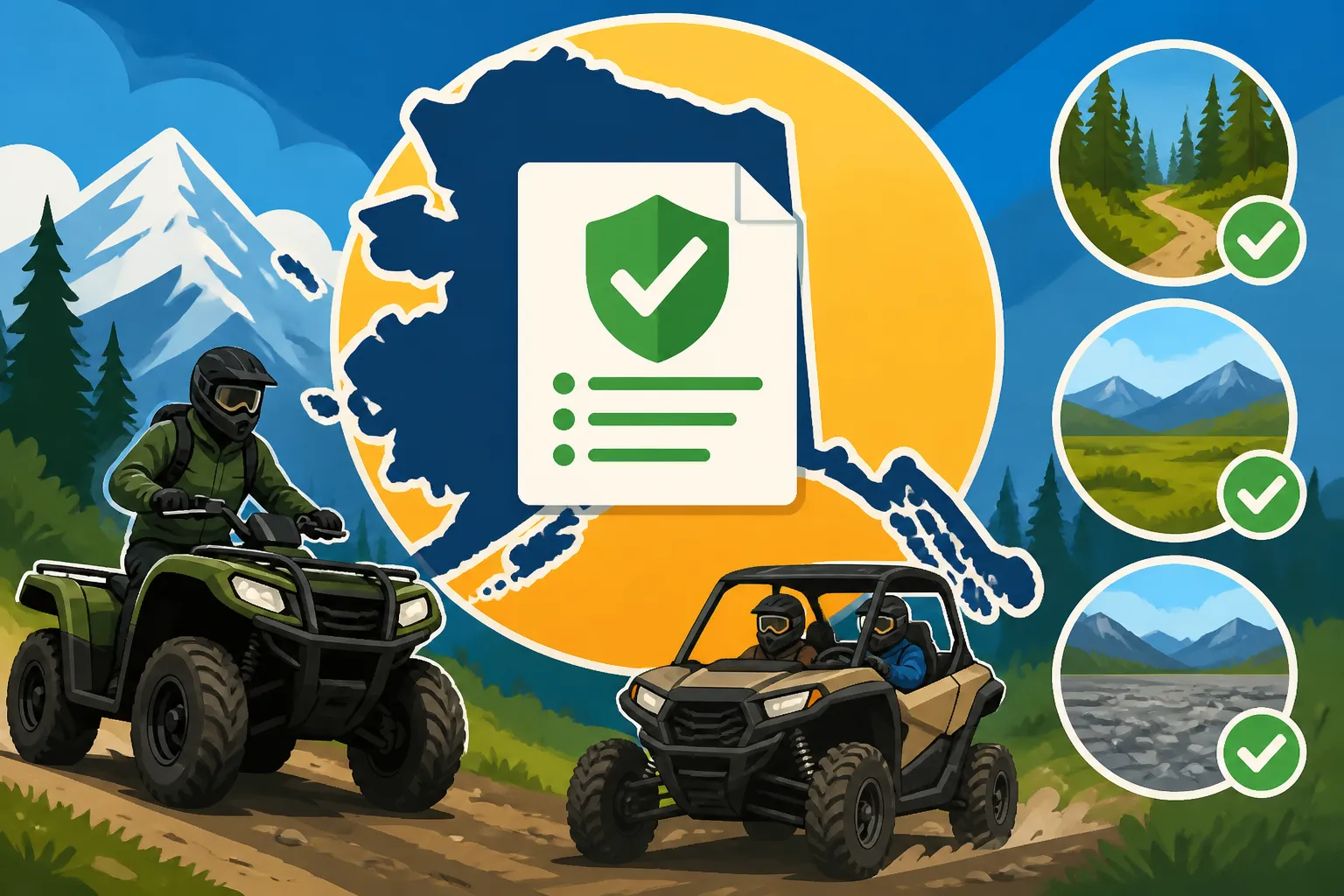
Alaska’s statewide general permit can make some recreational ATV and UTV use on state land permissible without a separate individual permit. The important question is where its authorization applies—and where it stops. Use it as one part of your ride plan, not as proof that every trail, parcel, or crossing is open.
What the statewide general permit authorizes
The statewide general permit is a broad authorization for certain vehicle use on eligible Alaska state land. It can cover recreational travel by qualifying off-highway vehicles without requiring each rider to obtain a separate, site-specific permit for every trip. It is not a blanket authorization to ride anywhere in Alaska.
The distinction is between permission to use a particular kind of vehicle on land managed by the State of Alaska and permission to travel across any land you can reach. The general permit addresses the first question, subject to its conditions. It does not settle land ownership, private access, local road rules, or every other permit requirement.
Before riding, read the current permit terms and confirm that your machine and planned activity fit them. A permit may define which vehicles or uses are covered and set conditions intended to prevent damage to land and resources. A quad, side-by-side, tracked machine, motorcycle, or other vehicle should not be assumed to qualify just because it is commonly called an ATV or UTV. Check the permit’s definitions rather than relying only on a dealer’s description or a machine’s marketing category.
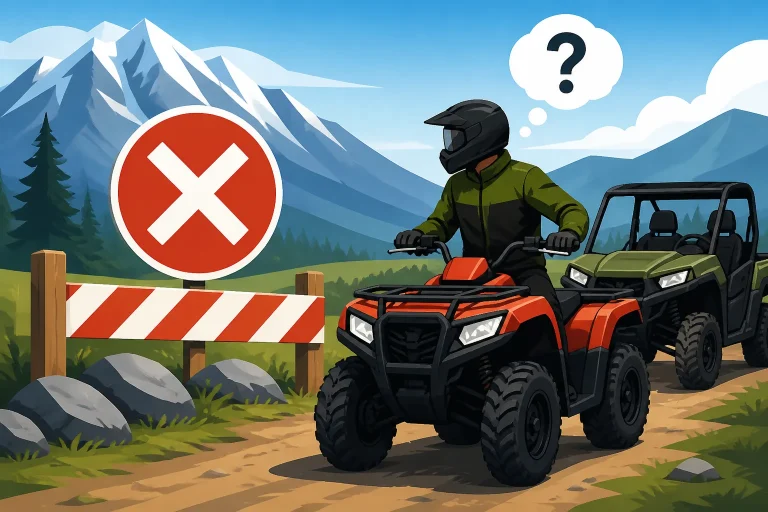
The general authorization is also conditional. It does not mean that every part of state land is open at all times. A closure, restriction, seasonal condition, or special designation may limit or prohibit travel in a particular area. If a route crosses land managed by more than one agency, the state permit cannot grant rights on the other agency’s land.
| Question | What the general permit may do | What it does not establish |
|---|---|---|
| Is this recreational vehicle use allowed on eligible state land? | Provide broad authorization for qualifying use under the permit’s conditions | That every vehicle, activity, or parcel is covered |
| Is a route open today? | Offer permission where no stricter restriction applies | That there is no seasonal closure, sign, or land-manager restriction |
| Can I cross land to reach state land? | Apply to eligible state land within its scope | Permission to cross private, Native corporation, federal, or other land |
| Can I ride in a state park? | Nothing unless the applicable park rules separately allow it | That the statewide permit overrides park rules |
| Can I use a trailhead or facility? | Potentially cover vehicle travel on eligible land | That a parking pass, day-use fee, or facility rule is unnecessary |
For a closer look at the basic conditions, see Alaska General Permit Requirements and Alaska’s General Permit Covers State Land. Those details matter because the permit’s reach depends on both the land and the proposed use.
The land has to be eligible state land
The permit’s geographic limit is one of its most important boundaries. “State land” does not mean all land within Alaska, all land that looks undeveloped, or all land outside a town. Land ownership and management can change across a short distance. A trail may begin on state land, cross a private parcel, enter Native corporation land, and later reach federal or municipal land.
A map, trail name, or trailhead sign may help orient you, but it is not necessarily proof that the entire route is on land covered by the state permit. Check parcel and land-manager information for the route you intend to ride. If the route crosses multiple ownerships, identify each one and get any additional permission or authorization required before entering it. Alaska Land Ownership and Who to Ask and Alaska Land Status Maps can help you plan that check.
The permit also does not create a right of access across land that is not covered by it. A trail that has traditionally been used, appears on a public map, or provides the most convenient route does not automatically give riders permission to cross someone else’s land. When access depends on an easement, a private landowner’s permission, a Native corporation land-use permit, or a route managed by another agency, confirm that permission separately.
State parks and designated areas
State parks and other specially designated areas need particular attention. Some areas have rules that differ from the general authorization, and some may restrict or prohibit motorized vehicle use. Do not assume that the statewide permit applies inside a park simply because the land belongs to the state or because the approach route is open.
The relevant boundary may not be obvious on the ground. Look up the area’s manager and current rules, and check signs at access points. If you are near a park boundary or a named conservation area, confirm whether the permit applies there before unloading. Alaska’s Permit Excludes State Parks and Alaska’s Permit Excludes Designated Areas explain why those boundaries matter.
A similar check is needed where another public agency manages land. Federal, municipal, and other agency rules do not become state rules just because they are close to state land. Alaska Land Managed by Other Agencies is useful when a route moves between different jurisdictions.
Private and Native corporation land
Private land is outside the statewide permit’s authority. The same is true for land held by Native corporations: state permission does not substitute for the landowner’s or corporation’s access requirements. Some routes may have specific access arrangements, but riders should verify the applicable terms rather than assume that public use is allowed.
This matters especially in rural areas, where a route can cross land that has no fence, gate, or obvious marker. Lack of a visible boundary does not change ownership. If you cannot establish that the route stays on eligible state land, pause and check before riding through.
Alaska’s Permit Excludes Private Land covers the basic distinction. For land held by a Native corporation, see Alaska Native Land Access Permits and Alaska ANCSA Corporation Land Permits. Ask the relevant land manager or corporation about current access conditions, permitted routes, and any required fee or pass.
Permission to ride still depends on conditions
A statewide permit is not a promise that riding is safe or harmless in every season. Ground conditions can change quickly, especially in Alaska. Soft soil, saturated wetlands, thawing tundra, streambanks, and areas of exposed vegetation can be damaged by tires even when there is no posted closure.
The permit’s conditions matter on the ground, not just on paper. If the surface is too soft to support the machine without rutting or tearing vegetation, staying on a different route—or postponing the ride—may be the responsible choice. Deep ruts, widening tracks, and damaged plants can have lasting effects and may prompt restrictions or enforcement.
A route that was firm on a previous visit may be wet after rain, snowmelt, or a change in water levels. Likewise, a trail that looks passable from the trailhead may become fragile farther along. Check current conditions, respect signs, and do not treat the absence of a gate or official closure notice as proof that the ground can withstand traffic. For more on this issue, see Alaska Tundra and Wetland Conditions.
Seasonal and local restrictions
Seasonal restrictions can apply even when the broader area is generally available for riding. Freeze-up, breakup, water levels, wildlife concerns, fire conditions, or trail maintenance can affect whether a route is open or suitable. Local land managers may post temporary restrictions, and conditions can change between the time you plan a trip and the time you arrive.
Before setting out:
- Identify who manages the land along the entire route.
- Check the current permit and any area-specific rules.
- Look for current closure notices, signs, and seasonal restrictions.
- Assess the ground and water conditions at the trailhead and along the route.
- Turn around if travel would cause damage or if a restriction applies.
The safest interpretation is that the permit gives conditional authorization, not a guarantee of access in every season or condition. If a route crosses a wetland, tundra, stream, or frozen waterway, determine whether there are additional restrictions and whether conditions are suitable. A general permit should not be treated as a substitute for checking specific rules for those environments.
Water crossings are not automatically authorized
A stream or river crossing can raise issues beyond whether the adjacent land is covered by the permit. The crossing may involve a different land manager, a sensitive habitat, a posted closure, or conditions that make travel unsafe. A permit for recreational vehicle use does not establish that every water crossing is allowed.
Check the route and the applicable land or habitat rules before attempting a crossing. Do not ride through a channel simply because tracks are visible or another vehicle has crossed. Water depth, current, soft banks, and changing channels can make a familiar crossing hazardous. If the crossing is uncertain, turn back rather than testing it with a machine.
The same care applies to frozen rivers and lakes. A land-use permit cannot tell you that ice is safe. Conditions vary with current, snow cover, temperature, and other local factors. Verify the relevant access rules and make a separate safety decision about the ice. See Who to Ask Before Riding a Frozen River for the land-access side of that question.
The permit is not a trailhead pass or a road-use authorization
Riders often use “permit” to describe several different things. A land-use authorization, a trailhead pass, a facility fee, and permission to operate on a road are not interchangeable. Carrying one does not automatically satisfy the others.
A trailhead pass or day-use payment generally concerns a particular recreation site or facility. It may help pay for parking or site maintenance, but it does not grant permission to ride across land beyond the area covered by that pass. Conversely, having statewide land-use authorization does not necessarily mean you can park at a fee area without paying its required charge. A Trailhead Pass Is Not a Land Permit explains the difference.
Road use is another separate issue. The statewide land permit does not make an ATV or UTV street legal, authorize riding on a public road, or override local restrictions. A route may pass through a community with its own rules, or it may include a road segment that requires separate legal authority. Check the applicable road and local rules rather than assuming that permission to ride state land carries over to roads.
A practical way to keep the permissions straight is to ask four questions:
- Land: Who owns or manages the ground under each part of the route?
- Use: Does the statewide permit cover this machine and this recreational activity?
- Site: Is there a trailhead pass, fee, or facility rule at the starting point?
- Route: Are roads, local ordinances, closures, or other agency rules involved?
If any answer is unclear, resolve it before the ride. A single route can involve several layers of permission. For example, a rider may have statewide authorization for an eligible stretch of state land but still need separate permission to cross private land, comply with a local road restriction, and pay a trailhead fee.
A practical check before you ride
The permit is most useful when you treat it as one document in a broader route check. Start with the land status, then confirm the vehicle and use, and finally check for restrictions and separate requirements.
Check the document and the machine
Read the current permit terms before relying on them. Confirm the effective conditions, vehicle definitions, activity limits, and any requirements for avoiding damage. If your vehicle is modified, unusually heavy, tracked, or not clearly within the permit’s definition, ask the land manager before assuming it qualifies.
Do not rely on a general claim that “ATVs are allowed” as the final answer. A statement like that may refer to a particular road, trail, season, or parcel. The permit’s own terms and the rules for the area you plan to visit control.
Trace the route parcel by parcel
Use land-status information to check the full route, not only the trailhead. Mark where ownership or management changes, and identify any crossings over non-state land. If a route depends on permission from another owner or agency, obtain it before the ride.
Keep in mind that a mapped trail may not follow a single type of land. A route’s name does not establish its legal status, and a track line on a map may be incomplete or out of date. When map information is unclear, contact the relevant land manager or landowner.
Check for closures and changing conditions
Look for current notices and signs at the access point. Check with the responsible land manager when conditions, boundaries, or restrictions are uncertain. Do not assume that last season’s access still applies, or that a route is open because it is absent from a closure list you found elsewhere.
Use the surface as a real-time guide. If the machine is sinking, rutting, or pushing aside vegetation, stop and reassess. Continuing because the permit exists does not make damaging travel acceptable.
Keep relevant information accessible
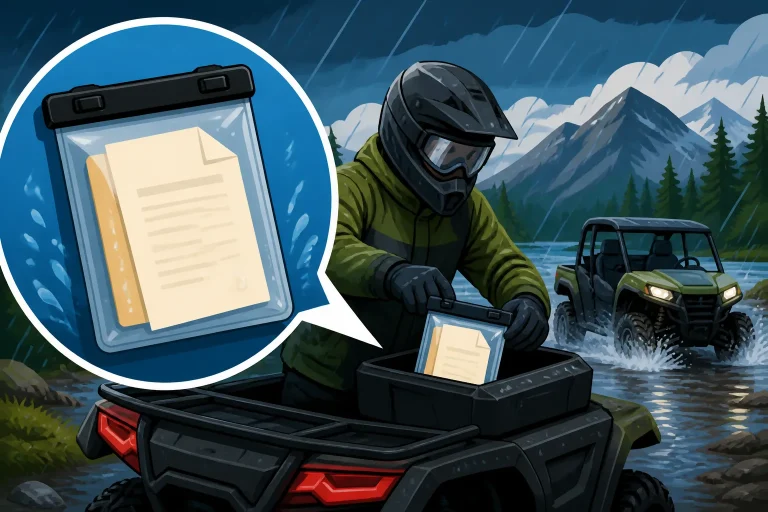
Carry a copy of the permit or a reliable way to view its current terms, along with any separate access permission, pass, or payment confirmation you need. Keep those records available in case you need to verify your authority or explain which route you planned to use. Paper or offline copies are useful where phone service is unavailable.
It also helps to record the route and the land managers you checked before leaving. That preparation does not replace permission, but it can help you avoid wandering onto a different parcel when a trail is blocked or a crossing is impassable.
If you cannot confirm that a route is covered, do not treat uncertainty as permission. Choose a route that you can verify or contact the responsible office before riding. A short check in advance is better than an access dispute or damage to land that cannot quickly recover.
Frequently Asked Questions
Does the statewide general permit let me ride anywhere in Alaska?
No. It applies only within its stated scope, on eligible land, and subject to its conditions. It does not grant access to private, Native corporation, federal, municipal, or other land outside that scope.
Does it automatically cover state parks?
Do not assume so. State parks and designated areas can have separate rules or restrictions. Check the specific park or area rules before riding.
Do I still need a trailhead pass?
Possibly. A trailhead pass or site fee is separate from land-use authorization. Check the requirements for the trailhead or recreation facility you plan to use.
Does the permit authorize riding on public roads?
No. Land-use permission does not make a machine street legal or override road and local rules. Check road access requirements separately.
Disclaimer
This article is for general informational purposes only and does not constitute professional advice. Laws, prices and regulations vary by location and change over time. Consult a qualified professional for guidance on your specific situation.