Alaska Wetland Crossing Rules
Alaska wetlands can look like open ground, but a route that seems passable may damage soft soil, cross a protected area, or violate a land manager’s rules. The answer depends on who owns the land, what permits apply, and how wet or frozen the ground is. Here’s how to check before taking an ATV or UTV across.
Why wetland crossings need extra care
A wetland is not simply a marsh with standing water. Alaska has many kinds of wet ground, including tundra, bogs, wet meadows, and areas that flood seasonally. Some may look firm in winter or during a dry spell but become soft and vulnerable when snowmelt or rain saturates the soil.
That matters for two reasons. First, tires and tracks can leave deep ruts, crush vegetation, and change how water moves across the ground. Damage can persist after the surface dries. Second, the land may be subject to rules that depend on its ownership, designation, and use. A route across a wetland on one parcel may be allowed under specific conditions while a similar-looking route nearby is not.
There is no safe assumption that every wetland crossing in Alaska is either legal or prohibited. The key questions are:
- Who manages the ground?
- Is the route open to motorized travel?
- Does a permit or local rule apply?
- Are the current surface conditions suitable for travel?
- Would the crossing disturb soil, vegetation, or water?
A permit to travel on certain land does not necessarily approve every route or every kind of ground disturbance. Likewise, a wetland’s appearance alone does not tell you who owns it or what rules apply. For background on the conditions that make wet ground especially vulnerable, see Alaska Tundra and Wetland Conditions and Alaska Wetland Travel Restrictions Explained.
Check land status and access rules before riding
Start by identifying the land manager for the exact area you plan to cross. Public land may be managed by the state, a municipality, or a federal agency. Other ground may belong to a private owner or an Alaska Native corporation. Boundaries can be close together, and a familiar trail does not automatically grant permission to cross every parcel it touches.
An Alaska land-status map can help you identify ownership and management boundaries, but treat it as a starting point. Maps may not show every seasonal closure, travel restriction, or route-specific condition. Confirm the route with the responsible land manager, especially if the wetland lies near a park, refuge, recreation area, stream, or private inholding. For a practical starting point, see Alaska Land Ownership and Who to Ask and Checking a Land Status Map.
A statewide permit is not blanket approval
Alaska’s statewide general permit for ATV use applies to certain state land, subject to its conditions and exclusions. It does not automatically authorize travel across every wetland, every parcel, or land managed by someone else. State parks and designated areas can have different rules, and private land requires permission from the owner. Learn what the permit covers through Alaska’s Statewide General Permit for ATV Use and Alaska’s General Permit Covers State Land, then check Alaska’s Permit Excludes State Parks if your route is near a park boundary.
A trailhead pass is also different from permission to ride across land. A pass may cover a specific fee or facility, but it does not by itself establish access rights over the entire route. Before setting out, confirm both the land-use permission and any fee or trailhead requirements.
| Situation | What to confirm before crossing |
|---|---|
| State land | Whether the general permit covers the parcel and whether the route or wetland has a restriction |
| State park or designated area | The agency’s specific motorized-use rules and any closure or designated-route limits |
| Federal land | The managing agency’s rules for motorized travel and wetland disturbance |
| Private land | The owner’s permission and any conditions attached to access |
| Alaska Native corporation land | The corporation’s access rules, permit requirements, and any restrictions on the route |
| Land near a stream or other waterway | Whether the crossing has additional resource protections or permit requirements |
A land-status map can also reveal that a route crosses several ownership types. Check each section rather than assuming that permission at the trailhead carries across the full ride. If you cannot establish who manages the ground or whether the route is open, choose another route until you can confirm.
Ask about the specific route, not wetlands in general
When contacting a land manager, describe the place and the proposed crossing as precisely as you can. Share a map or coordinates if available, the type of machine, the time of year, and whether you intend to make a one-time crossing or use the route repeatedly. Ask whether there is an established route, a seasonal closure, a ground-condition restriction, or a permit requirement.
A general answer about ATV access may not settle whether a particular wetland crossing is appropriate. Route details matter: a maintained trail is different from creating a new track, and a brief crossing is different from repeated travel that widens or deepens ruts.
Choose the right time and route
Conditions can change quickly between seasons and even over the course of a day. A route that appears firm from a distance may contain saturated soil, hidden water, or a soft layer beneath a crust. Snow cover can conceal drainage channels, thin ice, and existing ruts. Spring breakup is especially important because thawing ground may be unable to support a machine without lasting damage.
Frozen ground may reduce the risk of rutting in some places, but it does not prove that a route is open or that travel is harmless. Snow and ice can hide sensitive vegetation, water, and hazards. A frozen surface can also be uneven or weak. Follow local closure notices and land-manager guidance instead of treating a cold temperature as permission to ride.
Before leaving:
- Check the land status and confirm access with the responsible manager.
- Look for current notices about seasonal closures, wet conditions, and approved routes.
- Ask whether the intended crossing is allowed for your machine and at that time of year.
- Check weather and recent thaw or rainfall, and be prepared to turn around.
- Plan a route that stays on an established trail where one is available.
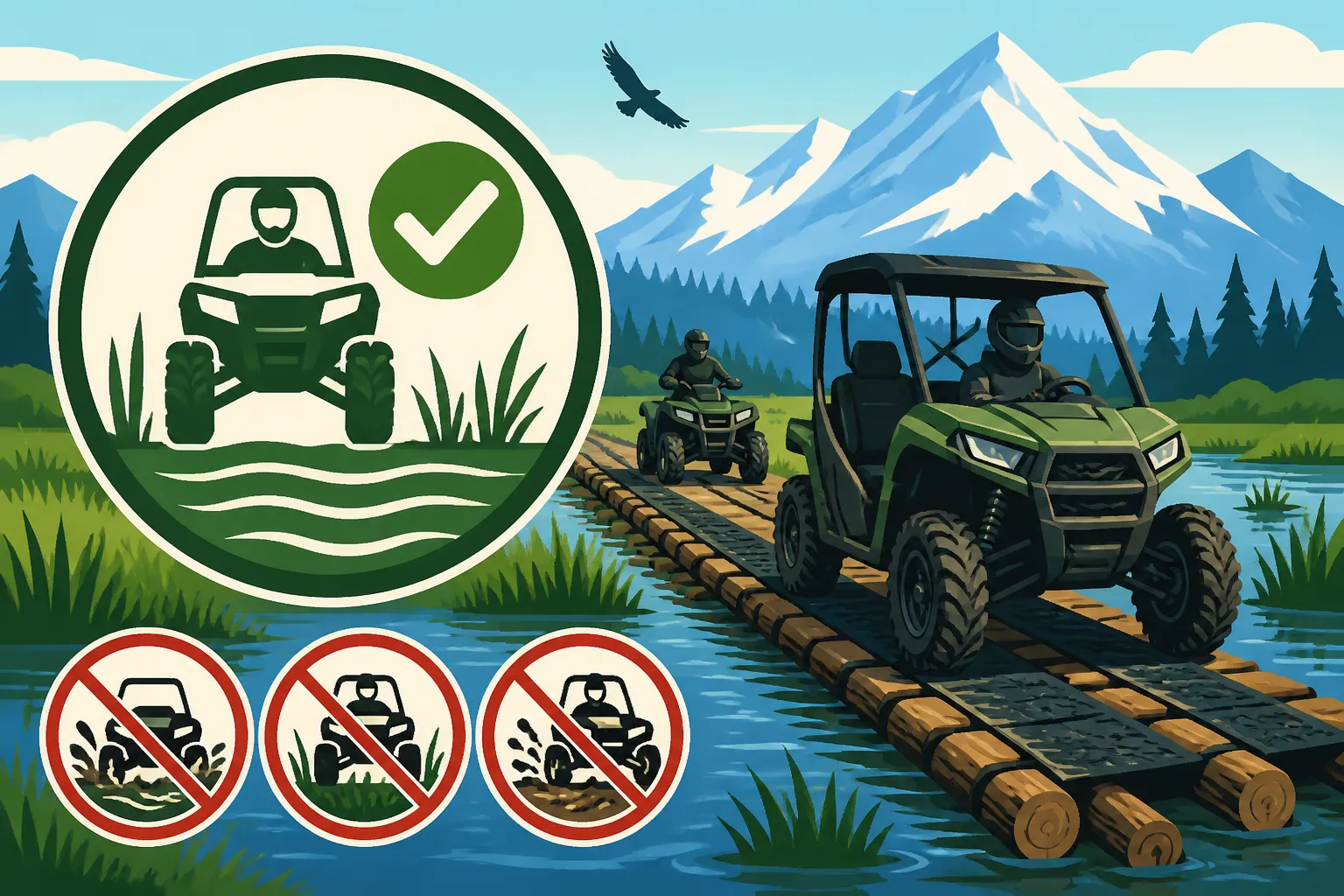
On the ground, do not assume that a dry-looking patch will support the machine. If the surface is soft, waterlogged, or already showing deep tire marks, stop and reconsider. Repeated wheelspin, sinking tires, and a growing rut are strong signs to turn back rather than push through. A winch can help recover a stuck machine, but it does not make a damaging route acceptable.
Where the route is unclear, avoid cutting a new line through vegetation to get around a wet section. Detours can enlarge the disturbed area and may lead onto land with different ownership or rules. Turn around, use an approved alternate route, or ask the land manager for guidance. Alaska Tundra and Wetland Conditions explains why surface conditions are a practical part of route planning, not just a comfort issue.
What to do when a crossing involves water or damage
A wetland crossing may also involve a stream, lake margin, or other waterbody. Do not treat the rules for riding over wet ground as identical to rules for entering or crossing water. Some waterways and fish habitats have separate protections, and an activity that alters a stream crossing can raise different permitting questions from ordinary travel across a trail. Before making a new crossing, placing material, or changing a stream bank, check with the relevant land manager and resource agency. See When Alaska Requires a Fish Habitat Permit for context on that separate issue.
There is also a difference between traveling over a route and doing work that alters the ground. Filling a wet area, grading it, building a causeway, digging drainage channels, or placing material to make a crossing passable can require additional authorization. Do not treat a travel permit as permission to construct or improve a route. If you are planning anything beyond riding an existing route, ask the land manager what approvals are needed before starting.
If you encounter a closure sign, blocked route, or fresh damage, do not ride around the restriction. A bypass may cross a wetland or enter a different parcel, and it can make the impact worse. If a machine becomes stuck, avoid repeated acceleration that churns the ground. Recover it with minimal disturbance if that can be done safely; otherwise, seek help and report damage when appropriate. Reporting Trail Damage on Alaska State Land offers further guidance on that situation.
When a rule is unclear, keep a record of the information you relied on: the route location, the agency or owner you contacted, and any conditions they gave you. Carry access or permit documents in a way that protects them from rain and mud. If conditions change after you receive guidance, such as a thaw or heavy rain, check again rather than assuming the earlier answer still fits.
The most reliable approach is to treat wetland travel as route-specific. Confirm ownership, verify that motorized access is allowed, check seasonal conditions, and stay on an established route where possible. If you cannot confirm access or the ground is too soft, turning back is usually the safer choice for both the machine and the land.
Disclaimer
This article is for general informational purposes only and does not constitute professional advice. Laws, prices and regulations vary by location and change over time. Consult a qualified professional for guidance on your specific situation.