When a Landowner Charges You to Cross Their Land
If an Alaska landowner asks you to pay before crossing their property on an ATV or UTV, the key question is whether your route really crosses private land and what access rights apply there. A statewide permit or trail map may not answer that. Verify the land status, clarify the fee and route terms, and don’t ride through while permission is uncertain.
First confirm whose land the route crosses
A route can look public on a map and still pass over private ground. Alaska has a mix of state, federal, municipal, Native corporation, and other private land, sometimes close together or interspersed. A trailhead, road, or established track does not by itself prove that the public has a right to cross every parcel along it.
Start by identifying the exact segment where the landowner says a fee is due. Check a land-status map or parcel information, then confirm uncertain boundaries with the relevant land manager or owner. Map layers can be incomplete, generalized, or difficult to interpret on the ground, so use them as a starting point rather than conclusive proof. Checking a Land Status Map and Alaska Land Ownership and Who to Ask explain how to approach that check.
Pay particular attention to the difference between these situations:
| Situation | What it may mean for your ride |
|---|---|
| The route crosses private land with no public access right | You generally need the owner’s permission to cross. The owner may set conditions, including a fee. |
| The route uses a public road or recorded access easement | A private parcel may border or underlie the route, but a public right of way or easement could provide access. Confirm its location and permitted uses. |
| The route is on state land covered by Alaska’s statewide general permit | That permit may authorize certain travel on eligible state land, but it does not grant permission to cross private land. |
| The route enters a state park or another restricted area | Separate rules or permissions may apply; the general permit is not a universal access pass. |
| The route crosses Native corporation land | Check with the corporation or its designated land-access program. A state permit does not substitute for its authorization. |
Alaska’s statewide general permit is relevant only to the land and uses it covers. It does not create a right to cross private property, and a trailhead pass is not a land-use permit. Review Alaska General Permit Requirements and Alaska’s Permit Excludes Private Land if your route includes state land as well as a private crossing.
Look for an easement or established public right
A landowner’s request for payment does not automatically prove that the owner has the right to charge for the particular route. There may be a public road, recorded easement, legal access route, or other right that applies to that crossing. Conversely, a track that has been used for years is not necessarily a public easement.
Ask what land the fee covers and whether the owner believes the crossing is private access. If you think the route is a public road or easement, verify that independently through appropriate records or the agency responsible for the route. Don’t rely only on a line shown in a general recreation map, old tracks in a mapping app, or another rider’s account.
If the boundary or access right remains unclear, avoid treating the dispute as something to settle by riding through. Contact the relevant land manager or seek qualified legal advice when the access question has meaningful consequences. Private Ground Inside a Boundary is also useful when private parcels lie within a larger public area.
What a crossing fee can cover
When a crossing is private and no public access right applies, the owner may offer permission on terms. A charge might be for one crossing, a trip, a season, a group, or a particular route. It may also come with limits on dates, vehicle types, group size, or where riders may stop. Don’t assume that paying once gives you unrestricted or permanent access.
The exact arrangement depends on the owner and the route. Before you pay, ask enough questions to understand what you are buying:
- Which segment does permission cover? Make sure the permitted route reaches the place you need to go and does not leave you uncertain at another boundary.
- Which machines are allowed? Confirm that the permission covers your ATV or UTV and any trailer, support vehicle, or other machine in your group.
- When is access allowed? Permission may be limited to certain dates, hours, seasons, or conditions.
- Is the fee per rider, machine, group, or trip? Clarify how the owner counts the charge so the total is clear before departure.
- Are there limits on stopping, camping, or side trips? Permission to cross does not automatically include permission to hunt, camp, fish, or leave the designated route.
- What happens if conditions change? Ask about gates, closures, fire restrictions, flooding, trail damage, or a request to turn back.
- How should you handle the gate? Confirm whether it must be closed or left as found and whether access is limited to a specific entrance.
- Does the permission cover the return trip? Don’t assume that “one crossing” means a round trip unless the terms say so.
A fee could be a simple access charge, but it could also be part of a broader permit or agreement. Read the terms rather than relying on an informal description like “you’re good to go.” For Native corporation lands, check the corporation’s own access process and conditions; Alaska Native Corporation Land Permits and Buying a Land Use Permit From a Native Corporation cover that situation.
Ask about the basis of the charge without escalating
It is reasonable to ask whether the fee is required for permission to cross, what it includes, and how it is collected. Keep the conversation focused on the route and terms. A landowner may be managing access, protecting land from damage, or limiting traffic; those concerns can matter even when a rider is mainly trying to get between two public areas.
If the owner says the fee applies to a road or trail you believe is public, don’t argue at the gate or rely on a guess. Ask for the location of the claimed private segment and the name of the agency or record that can clarify access. If you can’t resolve it before the ride, choose another route or postpone the trip.
How to get permission and keep useful proof
The safest arrangement is one you can explain clearly to every rider in your group. Get permission directly from the owner or an authorized representative, and keep a record of the terms. A text, email, permit, or receipt can help confirm what was agreed, though it does not replace checking that the person granting permission is authorized to do so.
A practical process:
- Identify the owner or manager. Use land-status information as a starting point, then contact the owner or the agency responsible for the parcel. If a corporation or organization manages access, ask for its official process.
- Describe your planned crossing. Give the route, date or period, machine types, number of riders, and whether you expect to return the same way.
- Confirm the fee and limits. Ask how payment works, what the charge covers, and whether there are special restrictions or closure conditions.
- Get the terms in a record. Save the permit, receipt, message, or written instructions. Keep contact details for the person or office that issued them.
- Brief your group. Make sure everyone knows the approved route, gate instructions, and activities that are not included.
- Recheck before leaving. Confirm that access remains open, especially when weather, seasonal conditions, fire restrictions, or land-use changes could affect the route.
Carry the permission record in a way that will still be readable after rain, mud, or a long ride. A waterproof document pouch from a retailer such as Amazon can help protect a printed permit or receipt, but keep a digital copy as well if you can do so reliably. Don’t depend on cell service to retrieve an online message in a remote area.
For a crossing managed by a Native corporation, a local village entity, or another organization, contact the office responsible for access rather than assuming that one person’s informal approval covers the entire route. Permission from one owner also does not grant access across neighboring parcels. Asking Before You Ride Through offers more on confirming access before setting out.
If you encounter a fee or closure on the route
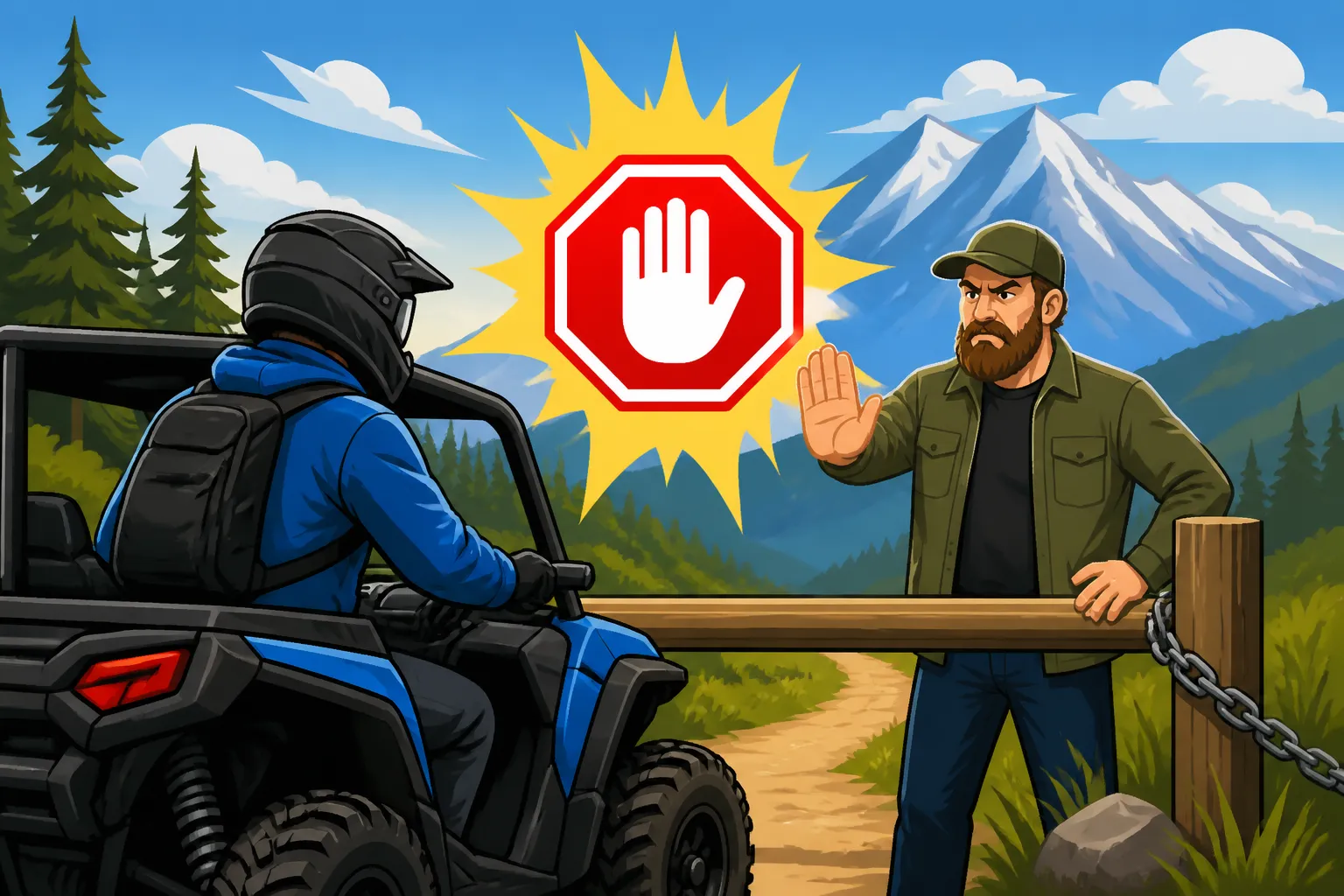
A surprise payment request can leave you with a difficult choice, particularly if you have already ridden a long distance. The safest response is to stop before entering the disputed land, ask what the charge covers, and contact the owner or manager if possible. Don’t threaten, force a gate, go around a barrier, or continue simply because the route appears on an app.
If you believe you have permission or a public right, explain that calmly and show the relevant record if it is safe and appropriate. If the owner does not accept your explanation, avoid turning the encounter into a confrontation. Record the location and details from a lawful place, then check the access issue with the responsible agency or a qualified professional before returning.
A fee and an access denial are different issues. Paying a requested amount may still leave questions about whether the person collecting it can authorize access, whether the payment covers the whole route, or whether another owner’s land lies ahead. Ask for clarity before treating payment as a complete solution.
If there is a gate or posted closure, follow the instructions while you verify the access right. A gate may protect livestock, property, sensitive ground, or a route that is temporarily closed. Even where you believe an easement exists, forcing passage can create a safety problem and make the dispute worse. If an alternative route is available, use it until the issue is resolved.
Before future trips, build access checks into your route planning:
- Mark private parcels and possible access points before leaving.
- Contact owners or land managers ahead of time rather than waiting until you reach a gate.
- Save current permissions and contact information offline.
- Make a backup route that avoids the disputed crossing.
- Tell someone at home which route you plan to use and when you expect to return.
Good preparation matters even more in remote areas, where turning back can mean extra fuel, changing weather exposure, or a late return. The goal is not just to avoid a dispute; it is to know that your group has lawful access along the entire route.
Disclaimer
This article is for general informational purposes only and does not constitute professional advice. Laws, prices and regulations vary by location and change over time. Consult a qualified professional for guidance on your specific situation.