Alaska Trailhead Fees and Passes
Trailhead fees in Alaska can be confusing because a parking pass, a land-use permit and permission to ride are different things. The right answer depends on where you park, what land you plan to cross and whether you’re bringing an ATV or UTV. This guide explains how to check for a fee, choose the right pass and avoid treating a paid parking spot as permission to ride anywhere.
What a trailhead fee or pass actually covers
A trailhead fee is generally a charge for using a particular parking or recreation site. A pass may cover parking at one location or a group of specified sites. It does not automatically grant permission to ride an ATV or UTV on every trail nearby.
That distinction matters in Alaska, where a parking lot, an access road and the ground beyond the trailhead may be managed by different owners or agencies. A pass might let you park your truck and trailer at a recreation site while the riding route itself crosses land with separate rules. Or the trailhead may serve hikers and cyclists rather than motorized riders.
Before paying, identify what the charge is for:
- Parking or trailhead use: The fee applies to using a lot or recreation site. Check whether it covers a vehicle, a group, a day or a longer period.
- Day use: A charge may apply to entering or using a recreation area, not just leaving a vehicle in a parking space.
- Camping: Overnight stays can have separate rules and charges. A trailhead pass does not usually double as a campsite reservation or camping fee.
- Land access: Permission to ride on land is a separate question. A parking pass does not replace landowner permission or a required permit.
- Vehicle registration: An Alaska OHV registration decal is not a trailhead pass, and a trailhead pass is not vehicle registration.
For a broader explanation of the statewide land permit and its limits, see Alaska’s Statewide General Permit for ATV Use and Trailhead Pass Is Not a Land Permit. These are separate checks: one concerns permission to use certain land, while the other concerns a particular trailhead or recreation site.
The four questions to answer before you go
- Where will you park? Identify the specific trailhead, campground or day-use area, not just the nearest town.
- Who manages that site? A borough, state agency, federal agency or private landowner may set different rules.
- What will you do after parking? Walking a trail, unloading an ATV and riding onto public land are not interchangeable uses.
- What does the fee cover? Check the current instructions for vehicle type, pass duration, display requirements and any separate use charges.
If you have a trailer, a passenger vehicle and more than one machine, do not assume a single pass covers every part of the setup. Read the site’s current terms or ask the managing office. A pass may be tied to a vehicle, a location or a particular type of use.
Which Alaska trailheads require a pass?
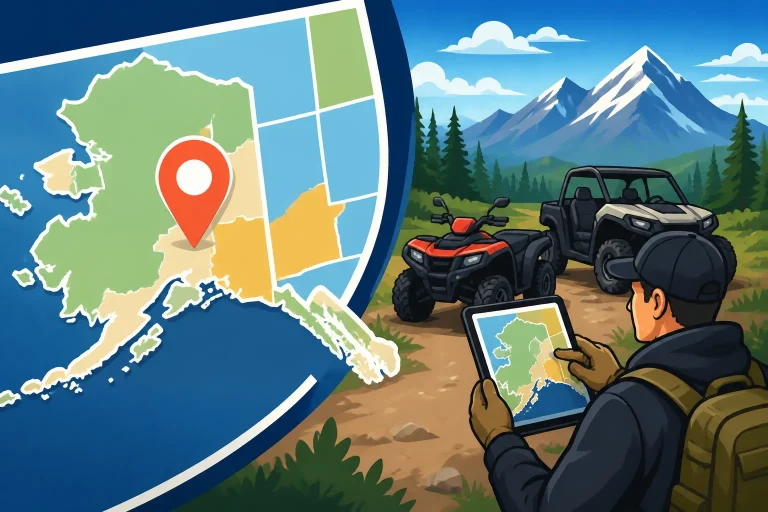
There is no one statewide trailhead pass that automatically covers every Alaska recreation site. Some trailheads charge for parking or day use; others do not have a posted fee. Some use a day-pass kiosk, while others direct visitors to purchase an annual pass through an online system. Rules and payment methods can vary even between locations managed by the same local authority.
The Mat-Su area has several trailhead pass locations that riders may encounter while planning outdoor trips. The reference pages for Alaska Trailhead Passes at Government Peak, Alaska Trailhead Passes at Crevasse Moraine and Alaska Trailhead Passes at Lazy Mountain cover specific sites. Check each location’s current guidance before assuming that a pass bought for one trailhead will work at another.
A site’s name can also be misleading. “Trailhead pass” may refer to a parking authorization, not a pass to ride an OHV on the associated trail. Some trailheads are designed for hiking, biking or other non-motorized activities. An ATV parked nearby does not mean that the trail is open to motorized travel.
Use this quick comparison as a starting point, then confirm details with the site manager:
| What you’re looking at | What it may cover | What it does not establish by itself |
|---|---|---|
| Trailhead or parking pass | Use of a named parking area or listed set of sites | Permission to ride beyond the lot |
| Day-use payment | Entry or day use at a designated recreation area | Camping, overnight parking or access to other land |
| Campground charge | A campsite or overnight use under the campground’s terms | A trailhead pass or permission to ride |
| Alaska OHV registration | Registration of a qualifying machine under state rules | Access to a trail, road or parcel |
| Land-use permit or permission | Use of certain land under its specific conditions | A parking pass at a managed trailhead |
When you are unsure whether a particular lot charges a fee, look up the exact trailhead on the managing agency’s official site or contact its recreation office. Search results and older trip reports can help you find the right name, but they may not reflect current payment instructions or closures.
Don’t infer a fee from the trail alone
A trail can start at a fee area, pass through land with different rules or connect to a public route where the access conditions change. Conversely, a parking fee can apply even when the trail itself does not require a separate permit.
Make a small route plan that lists each relevant point:
- The staging area where the truck and trailer will be left
- The road or trail used to reach the riding area
- The land manager for the route
- Any boundary, gate or posted closure
- The return route and parking location
This is especially useful when a ride begins at a popular recreation site but continues onto a separate parcel or public-land corridor. If you cannot confirm that the ATV route is legal, do not treat the trailhead pass as an answer. Check land status and rules before unloading.
How to find the current fee and buy the right pass
Fees, pass terms and payment methods can change. Rather than relying on a remembered amount or an old photo of a kiosk, check the official instructions for the exact location before leaving. The important details are not only the price; they include what the pass covers and how the manager expects you to show that you paid.
For locations that use both day and annual options, do not assume the annual pass is available at the kiosk or that a day pass can be purchased online. The current instructions may specify different methods. The pages Day Passes Only at a Kiosk and Annual Passes Only Online describe a distinction readers should verify for their chosen site before making the trip.
A practical checking process
- Start with the official site or managing office. Search by the trailhead’s exact name and confirm that the information comes from the agency or organization responsible for it.
- Check the date and any alerts. A page may describe a seasonal operation, temporary closure or payment setup that is not in place year-round.
- Read the scope of the pass. Look for covered locations, vehicle or user limits, dates of validity and whether the pass covers parking, day use or another activity.
- Confirm how to pay. The site may require online purchase, a kiosk payment or another specified method.
- Check what proof you need to display. Instructions may require a receipt, printed permit, dashboard display or another form of proof.
- Save the instructions offline. Cell service can be unreliable, and the payment page may be difficult to reach from the trailhead.
- Keep proof of payment until you leave. A digital confirmation or paper receipt can help resolve a misunderstanding, but follow the site’s stated display rules.
If you are using a kiosk, arrive with enough time to read the posted instructions. A kiosk may be out of service, hard to use in poor weather or located where cell coverage is weak. Do not assume that a payment screen or an unattended lot means you can park without paying. Follow posted directions and contact the managing office if the options are unclear. For a closer look at preparation, see What You Need at a Trailhead Pay Kiosk and Paying at a Trailhead When Nobody Is There.
Day pass or annual pass?
The best option depends on the places you plan to visit and the terms the manager offers. A day pass can make sense for a one-off visit, especially if the parking site is not part of your regular riding plans. An annual pass may be more convenient if it covers multiple trips or locations that you use often.
Before deciding, compare the actual terms rather than just the purchase cost. Ask:
- Does the pass cover one trailhead or several?
- Is it valid for a calendar year, a season or a period starting on the purchase date?
- Does it cover the vehicle, the occupants or a specific activity?
- Must you still pay a separate day-use or camping charge?
- Does it apply to a trailer as well as the tow vehicle?
- Is a pass transferable if you switch vehicles?
- Is there any refund or replacement process if plans change?
Do not buy an annual pass based on the assumption that “annual” means the same thing everywhere. A pass may be limited to named facilities or have a validity period that differs from what you expect. If the terms are not clear, ask the issuer before purchasing.
Using a pass when you arrive
Once you reach the site, follow the posted directions even if you have already paid. A payment confirmation alone may not satisfy a display requirement, and a valid pass may not cover the use you intend.
At some sites, the instructions may say to place a receipt or permit where it can be seen from outside the vehicle. At others, payment may be recorded electronically or handled in another way. Follow the specific directions at that trailhead rather than copying what another visitor has done.
For a clear sequence when arriving at a pay station:
- Park where the signs direct you, without blocking a lane, gate or turnaround.
- Read the full notice, including any conditions printed separately from the payment instructions.
- Pay using an accepted method and confirm that the transaction completed.
- Keep the receipt or digital confirmation.
- Display proof exactly as instructed.
- Check that the pass applies to the location and activity you are using.
- Take a photo of the posted rules if you need a record, but do not rely on a photo instead of the required pass.
If you buy a small weather-resistant document pouch on Amazon or elsewhere, use it only to protect paper proof; it does not substitute for whatever display method the site requires. A phone screenshot can be useful as a backup, but it may not count as visible proof if the rules call for something displayed on the vehicle.
If the kiosk is closed or the machine will not work
A broken kiosk does not automatically mean the fee has been waived. Look for a posted alternative, such as an online payment option, another payment station or a phone number for the manager. If the instructions direct visitors to use a fee envelope, follow them carefully and retain any stub or receipt provided.
If there is no clear payment option, document what you found: note the time, photograph the kiosk or sign if appropriate, and contact the managing office as soon as practical. Avoid leaving cash where it is not explicitly requested. Also avoid assuming you can pay later unless the posted terms say that is allowed.
If the payment page will not load, try the options named in the official instructions. A screenshot showing an error can support your explanation later, but it is not a pass. Keep the vehicle in a legal parking area and do not block access while trying to resolve the issue.
Keep your setup within the parking rules
A truck-and-trailer combination can use more space than a standard car. If the lot has marked stalls, a loading zone or special instructions for trailers, follow them. Do not occupy additional spaces unless the site allows it, and do not unload an ATV in a way that blocks other visitors.
A parking fee does not reserve a space unless the manager specifically says that it does. During busy periods, have a backup plan for a legal staging area. Never park at a gate, access road or private driveway simply because the designated lot is full.
A parking pass is not an ATV riding permit
The biggest mistake is paying a trailhead fee and assuming that the payment makes the whole ride legal. It does not. Before riding, you still need to confirm that the machine is allowed on the route and that you have whatever registration, land access or permission applies.
Check the route separately
Start by identifying who owns or manages the land beyond the parking area. Public land can have site-specific restrictions, and some routes cross private property or land held by an organization that requires separate permission. A road that looks open is not proof of access.
For a ride on state land, check the conditions of the relevant permit and make sure the route is within the area it covers. State parks and other designated places may have separate rules. Federal land, municipal land and private parcels can each require a different check. See Alaska Land Ownership Lookups and Checking a Land Status Map for ways to establish who manages the ground.
Before setting out, verify:
- Whether OHVs are allowed on the route
- Whether the trail is open to your vehicle type and width
- Whether a permit or landowner permission is required
- Whether the route crosses a park, refuge, private parcel or restricted area
- Whether seasonal conditions or temporary closures apply
- Whether your ATV or UTV is registered as required for the intended use
The permit rules may be different for a road, trail, river corridor or other route. If the route crosses multiple jurisdictions, check each part rather than treating the first access point as authority for the entire trip.
Registration and trailhead access are separate
An ATV registration decal proves something different from a trailhead payment. Registration addresses the machine under applicable vehicle rules. It does not show that you have paid a parking charge or obtained permission to enter a specific piece of land. In the same way, a parking pass does not replace registration.
Check the current requirements for your machine and planned use, particularly if you are visiting from outside Alaska or the ATV is registered elsewhere. The place where you intend to ride, not merely where you store the machine, may affect which rules you need to review. A general starting point is Alaska APV Registration Requirements.
Also remember that a trailer, tow vehicle and ATV may each be treated differently by a site’s parking rules. Confirm the pass terms for the entire combination rather than assuming that vehicle registration or a pass attached to one part covers everything.
Don’t confuse trailhead fees with Jim Creek charges
Jim Creek is a useful example of why it pays to identify the exact kind of charge. The area has separate day-use and campground information; those charges should not be assumed to be the same as a pass for a different Mat-Su trailhead. Check Alaska Day Use Fees at Jim Creek and Alaska Campground Fees for Riders for the distinctions involved.
If you plan to ride at Jim Creek, confirm current access conditions, permitted use, payment methods and camping rules with the managing authority. A charge for day use does not automatically include an overnight campsite, and a campground payment does not by itself authorize riding beyond the areas open to OHVs.
Common mistakes and how to avoid them
A little preparation can prevent an unnecessary drive, a parking citation or a ride onto land you were not allowed to use. These are the problems that most often catch visitors and newer riders.
Assuming every trailhead is free
Alaska has many different land managers and recreation sites. A fee at one location does not prove that nearby lots charge, and a free lot does not mean all adjacent land is open to motorized use. Check the exact trailhead and current official instructions.
Assuming one pass covers every site
A pass may be limited to named locations. Read the list of covered sites before relying on it elsewhere. If you are visiting more than one trailhead, verify whether each requires its own pass or whether the pass is valid across a defined group of locations.
Buying the wrong pass for the vehicle or activity
The terms may distinguish parking from day use, or specify which vehicle the pass applies to. A truck towing a trailer, a second vehicle in the group or a vehicle left overnight may require a different arrangement. If the terms are ambiguous, ask the issuer before purchase.
Treating a kiosk receipt as permission to ride
A receipt is proof of payment for the charge named on it. It is not a land-access permit, OHV registration or approval to use a closed route. Keep those documents and permissions separate.
Relying on an old online post
A blog, social media post or photo can show how a site worked at one time, but it may not reflect a changed fee, payment method, parking layout or closure. Use informal reports to help identify questions, then confirm the answers with the current official source.
Forgetting that conditions change by season
A trailhead can be open while a route beyond it is closed or unsuitable. Spring breakup, flooding, snow, fire restrictions and maintenance can affect access. Check for alerts before travel, and be ready to turn back if signs or conditions indicate a closure.
Failing to keep proof of payment
Phones can lose power, receipts can get wet and confirmation emails can be difficult to find without service. Save a screenshot, keep any paper receipt and follow the required display procedure. A simple waterproof pouch can help protect documents; if you look for one on Amazon, choose a size that fits your setup and keep it separate from anything you need to display visibly.
A simple checklist before leaving home
Use this list for any Alaska trailhead where you plan to park and ride:
- Identify the exact parking or staging area.
- Confirm who manages it.
- Check whether a trailhead, parking or day-use fee applies.
- Verify the current payment method and accepted payment types.
- Confirm the pass’s dates, covered locations and vehicle conditions.
- Find out whether the pass must be printed or displayed.
- Check whether trailers and multiple vehicles are covered.
- Confirm that OHVs are allowed on the route beyond the lot.
- Check land ownership, permits and any required permission.
- Review closures, seasonal restrictions and current conditions.
- Confirm your machine’s registration requirements.
- Save the official instructions and proof of payment offline.
- Carry a backup plan for parking if the lot is full.
- Keep enough phone power to access saved documents; a compact power bank from Amazon can be useful on a long day, but it cannot replace a paper copy if the site requires one.
- Leave the area if access is unclear rather than guessing.
If you are traveling with a group, share the payment and access details before departure. Decide who is responsible for the pass, who will keep the receipt and where the group will meet if the lot is crowded. A group leader should also make sure every rider understands that a parking pass does not make a route legal.
When calling a managing office, give the trailhead name, your planned date, the type of vehicle and whether you will tow a trailer. Ask directly whether the charge covers parking or day use, whether you need a separate permit to ride, and what to do if the kiosk is unavailable. Clear questions are more useful than asking only, “Do I need a pass?”
The safest approach is to verify three things independently: the fee for the place you park, the permission required for the land you ride on and the registration or operating rules that apply to your machine. Once those are settled, keep the proof accessible and follow posted instructions when you arrive.
Disclaimer
This article is for general informational purposes only and does not constitute professional advice. Laws, prices and regulations vary by location and change over time. Consult a qualified professional for guidance on your specific situation.