What a Village Council Can Require of Riders
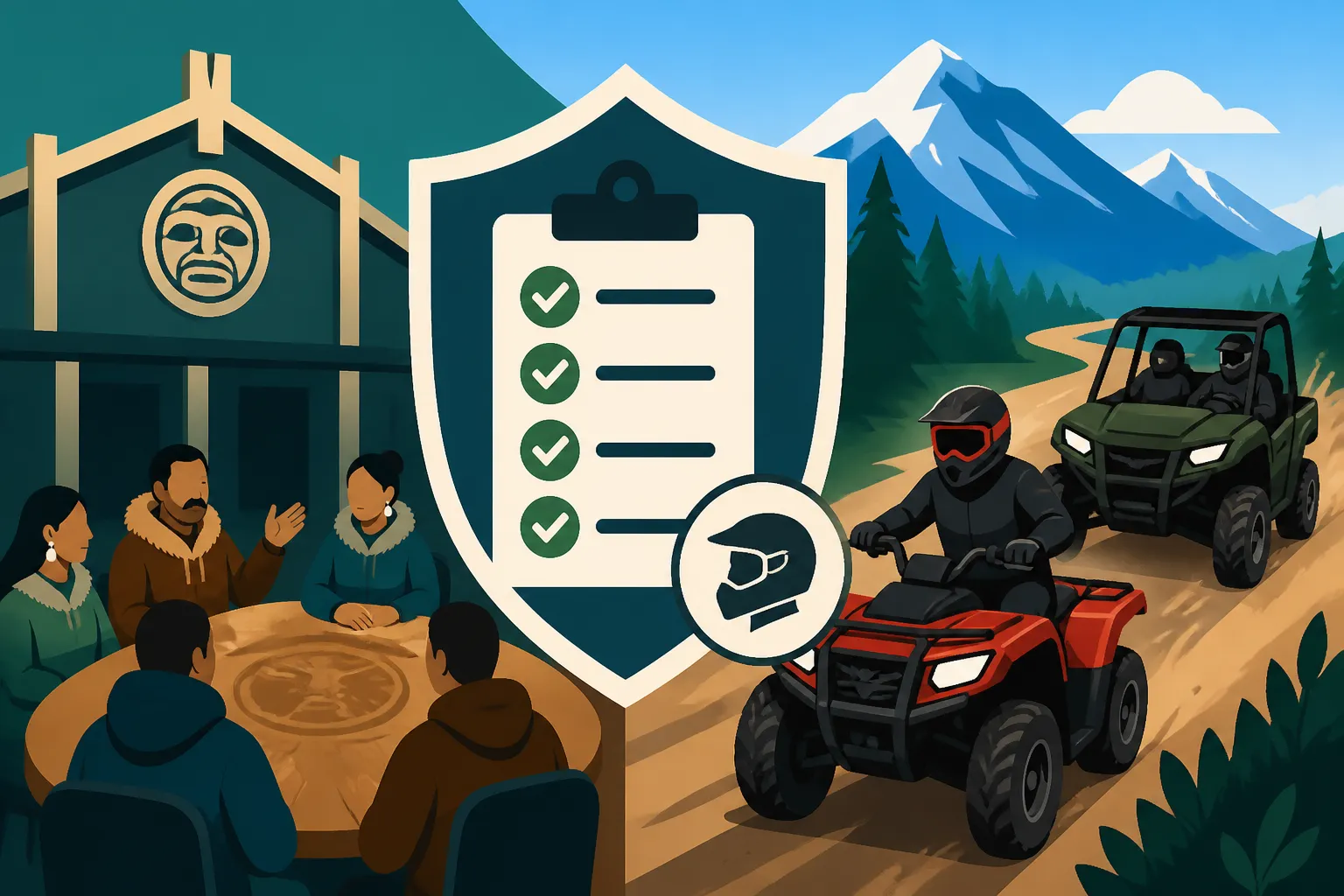
A village council may ask ATV and UTV riders to get permission, stay on designated routes, or follow local safety rules. But “the village” can mean several different things: a tribal government, a village corporation, a municipality, or simply a community. The practical first step is finding out who controls the land and what authority applies to the route you plan to ride.
Why the council’s role depends on the land
There is no single rule that gives every Alaska village council the same authority over every nearby trail. A council’s requirements depend on what body it is, what land it owns or manages, and what laws or agreements apply to the specific route. A trail that starts on state land might cross private or corporation land before reaching town, so one permit or permission may not cover the whole ride.
It also helps to separate three ideas that can sound interchangeable but are not:
- A tribal government is a governing body for a federally recognized tribe. Its powers and relationship to land vary by location and circumstance.
- A village corporation is a private corporation formed under the Alaska Native Claims Settlement Act. It is separate from a tribal government, even when both serve people in the same community.
- A municipal government, where one exists, is a local government with authority defined by applicable law.
A rider who hears “the council requires a permit” should ask which council is meant and what land or activity the requirement covers. The person giving the direction may be speaking for a landowner, a tribal government, a municipality, or another manager. Those roles can overlap in a community, but they are not automatically the same.
Permission is not the same as a statewide permit
Alaska’s statewide general permit for ATV use concerns access to certain state land. It does not, by itself, grant a rider permission to cross land owned by someone else, enter a state park, or ride on land managed under separate rules. Check Alaska’s Statewide General Permit for ATV Use and Alaska’s General Permit Covers State Land to understand the permit’s scope, then confirm who controls the rest of the route.
For example, a rider might have the required authorization for state land but still need permission to cross a private parcel or land held by a Native corporation. A permit for one segment does not create a right of passage over the next one. That is why checking Alaska’s Permit Excludes Private Land and Alaska Native Corporation Land Permissions can be just as important as checking the state permit.
Village corporations may set access conditions for land they own or manage. The conditions could be different from those set by a tribal government or a nearby municipality. See Alaska Village Corporation Land Rules for the distinction, and avoid assuming that an open-looking trail is open to public motorized use.
A route can cross several jurisdictions
In a village or rural area, a route may pass over different kinds of land without obvious signs marking every boundary. A trail used by local residents might cross a public corridor, a private parcel, corporation land, or land controlled by another government or agency. Long-standing local use can be valuable context, but it does not necessarily establish that every visitor has permission to ride the same route.
Before setting out, identify the land manager for each part of the route. Alaska Land Ownership and Who to Ask and Checking a Land Status Map can help with that first step. Maps are useful, but boundaries and access permissions can be complicated; when the route is unclear, confirm it with the relevant landowner or manager rather than relying only on a map or a trail shown online.
The key question is not just “What does the village require?” It is also “Who controls this ground, and which part of the ride does that requirement cover?” Getting those answers before unloading the machine is easier than trying to resolve a misunderstanding at a trailhead or after entering a restricted area.
Requirements a council or land manager may set
Where a council or other authority has a valid role over the land or activity, riders may be asked to follow conditions that protect residents, property, wildlife, or the route itself. The details differ from place to place. Do not treat the examples below as a statewide list or assume every requirement applies in every village.
| Possible requirement | What it may mean for a rider | What to confirm |
|---|---|---|
| Prior permission | Access may require approval before entering a route or parcel | Who grants it, how to request it, and whether visitors need it |
| A designated route | Riding may be limited to specified trails, corridors, or access points | Whether the route is open to motorized use and where it begins and ends |
| Seasonal or temporary closure | Access may change because of weather, ground conditions, hunting, maintenance, or local needs | Current status and how closures are announced |
| Limits on vehicle use | Certain machines, activities, or types of travel may be restricted | Which machine classes and activities are covered |
| Local safety or conduct rules | Riders may be asked to control speed, avoid sensitive areas, or respect community spaces | Where the rules apply and who enforces them |
| A land-use fee or permit | The landowner or manager may require a separate authorization or payment | Who collects it, what it covers, and whether it applies to the entire route |
| Event or group approval | A group ride may need advance coordination | Group size limits, event approval, timing, and any insurance conditions |
Permission, permits, and fees
A local access permit may be different from Alaska’s statewide general permit. It may authorize use of a specific parcel or route, apply only during a stated period, or come with conditions. Ask whether it is required for every rider, whether it covers passengers, and whether it must be carried while riding. If a fee is involved, verify who collects it and what access it buys. Do not assume that a payment to one organization satisfies another land manager’s requirements.
Permission can also be informal or limited. A resident’s invitation to cross a property may not authorize a group ride, repeated trips, overnight parking, or use of a different trail. If the scope is unclear, ask directly. Asking Before You Ride offers a useful approach for getting permission rather than relying on assumptions.
A council may also communicate requirements that come from a landowner or another managing agency. In that case, it is worth asking who made the rule and where it applies. That is not a challenge to local authority; it helps you comply with the right conditions and avoid treating one person’s guidance as permission for land they do not control.
Route, season, and conduct restrictions
A route that is open at one time may close or become unsuitable at another. Local restrictions might address vulnerable ground, community use, hunting activity, or a temporary concern such as trail damage. A council or land manager may also ask riders to stay out of yards, gardens, airstrip areas, or other places where vehicle traffic could interfere with daily life. The precise boundary and enforceability of a request depend on the authority behind it, so seek clear instructions before riding.
Seasonal ground conditions matter especially in Alaska. Wetland and tundra surfaces can be damaged by motorized travel, and some routes are passable only when the ground is sufficiently firm or frozen. A route that is physically rideable is not necessarily authorized for riding. Review Alaska Tundra and Wetland Conditions and Alaska Wetland Travel Restrictions Explained, and ask the local land manager whether a closure or seasonal restriction is in effect.
Local directions can also be more specific than a broad land-access permit. You might be told to use one approach to a trail, avoid a particular crossing, turn back at a certain point, or keep machines away from a community facility. Make sure you understand whether the instruction applies to all riders, a particular parcel, or only a temporary situation.
Rules for groups and special uses
A solo ride and an organized event can raise different concerns. A group may create more noise, traffic, or pressure on a narrow route, and a commercial tour or guided trip may be subject to separate requirements. If you plan to bring several machines, advertise a ride, guide paying customers, or film on the route, ask in advance whether additional approval is needed. Do not assume that permission for personal recreation also covers commercial or event use.
The same applies to other activities connected to riding. Hunting access, carrying game, camping, staging trailers, and leaving fuel or equipment may involve rules beyond permission to travel on a trail. Confirm each activity with the agency or landowner responsible for that ground. A general access permit should not be treated as a blanket authorization for every activity along the route.
How to find out what applies before you ride
A short conversation can prevent a long detour or an avoidable conflict. Start with a clear description of your plan: the route, date, number of machines, machine type, and whether the ride is personal, organized, or commercial. If you only ask, “Can we ride around the village?”, the answer may not cover the land or distance you have in mind.
Use this process:
- Map the route. Mark the start, destination, crossings, and any alternate paths. Include where you will park or unload.
- Identify the land manager for each segment. Check land-status information, then verify uncertain boundaries with the relevant office or landowner.
- Contact the right organization. Ask whether the contact is speaking for the tribal government, village corporation, municipality, private landowner, or another agency.
- Describe the ride. Explain who is riding, what machines you will use, when you plan to travel, and whether you are organizing or charging for the activity.
- Ask for the conditions in practical terms. Find out whether permission is required, which route is allowed, whether there are closures, and what documents or fees apply.
- Keep a record. Save written permission, permit information, and contact details. If approval is given verbally, write down who gave it, when, and what route and conditions were discussed.
- Check again close to departure. Temporary closures and ground conditions can change. Confirm that the route is still open and that your permission remains valid.
If the person you contact cannot answer, ask who manages the land or issues access permission. A general recommendation from a community member can help point you in the right direction, but it is not a substitute for authorization from the responsible party.
Questions worth asking
Keep questions specific and neutral. For example:
- Does this requirement apply to the trail I have described, or to all land in the area?
- Who owns or manages each part of the route?
- Do visiting riders need written permission or a local permit?
- Is the route open to ATVs and UTVs, and are there machine or group restrictions?
- Are there seasonal closures, sensitive areas, or places where riders must turn back?
- Does the permission cover passengers, trailers, staging, or an organized group?
- Is a fee required, and which land or route does it cover?
- Who should I contact if signs are missing or the route condition has changed?
Ask for the name of the relevant office or contact and, if possible, a written description of the permitted route. A saved email or message can help resolve confusion, especially if you are visiting and do not know local landmarks.
For documents you need to carry, keep them protected from rain and mud. A simple waterproof pouch can help keep written permission, permit details, and contact information legible; riders who need one can find options through Amazon. That pouch does not replace the actual authorization, and a photo or copy may not be accepted in every situation, so ask what form of proof is expected.
If two sources give conflicting directions, pause before riding. Explain the conflict to the land manager or organization with authority over the parcel and ask which instruction controls. Avoid treating silence, an unlocked gate, tire tracks, or another rider’s presence as confirmation that access is allowed.
If you are asked to stop or change your route
If a council representative, landowner, or land manager tells you that your route is closed or that you need permission, stop in a safe place and listen. Ask which land or route the instruction concerns, who is responsible for it, and how to request approval or verify the boundary. Do not continue simply because your map shows a trail or because you have permission for a different part of the ride.
Stay calm and avoid an argument on the trail. You can ask for the relevant rule or contact information, but do not assume that an immediate disagreement will be settled roadside. If you think the instruction may come from someone without authority over the land, the safer practical choice is to pause, document the details, and check with the responsible land manager before returning.
Respectful conduct matters as much as paperwork. Keep machines away from homes and community activity unless the route clearly allows access, control speed around people and animals, and do not leave trash, fuel, or equipment behind. Close gates as directed, stay on the approved route, and turn around when conditions or directions make continued travel uncertain.
Before a trip, prepare a compact record of the essentials: the route, the name of the organization that granted permission, the approved dates or conditions, and a contact number. Keep a backup with someone who is not on the ride. This will not resolve every land-status question, but it makes it easier to show that you checked and to contact the right person if plans change.
The safest assumption is that access must be confirmed for each land segment, not inferred from the community’s name or the presence of a trail. A village council may set requirements within its authority, and a landowner or another manager may have separate rules. Identify who controls the ground, ask what applies to your route, and get permission before riding where it is required.
Disclaimer
This article is for general informational purposes only and does not constitute professional advice. Laws, prices and regulations vary by location and change over time. Consult a qualified professional for guidance on your specific situation.