What Follows a Trespass Complaint on Alaska Native Land
A trespass complaint after an ATV or UTV ride on Alaska Native land can be unsettling, especially if you thought the route was open. What happens next depends on who owns or manages the ground, what permission you had, and what the complaint alleges. Knowing how to respond can help you avoid making the situation worse and protect your ability to explain what happened.
What a Trespass Complaint Means
A complaint is an allegation, not proof that you knowingly trespassed or that a court has found you responsible. It may begin with a landowner, land manager, village representative, or another person reporting that riders entered or crossed an area without permission. The next step could be a request to leave, a demand to stop using a route, or a referral to law enforcement. The response depends on the location and circumstances.
“Alaska Native land” is not one uniform category of land with one set of access rules. A parcel may be owned by an Alaska Native regional or village corporation, held by another private owner, or managed by a public agency. A village government and a Native corporation are not interchangeable: they may have different roles, authority, and processes. A route may also pass between land owned by different entities.
This matters because permission from one person or organization does not necessarily authorize travel across every parcel along a route. A trail visible on a map, a customary route, or a track made by other riders does not automatically establish that motorized access is allowed. Start by identifying the landowner and the entity responsible for access. Alaska Land Ownership and Who to Ask and Checking a Land Status Map can help you understand why that step matters.
Land-use permissions may also have limits. Permission could apply to a particular route, purpose, time, or type of travel, rather than granting general access across an area. A hunting-related authorization, for example, should not be assumed to cover every recreational ride. Check the exact terms with the entity that issued the permission. For background, see Alaska ANCSA Corporation Land Permits and Alaska Village Land Permission.
A complaint may be based on a genuine misunderstanding: a boundary was unclear, a trail shifted, a permit did not cover the route, or a rider relied on outdated information. Those details can matter, but they do not mean you should dismiss the complaint. Treat it seriously, keep your response calm, and make a record of what you know.
What May Happen After a Complaint
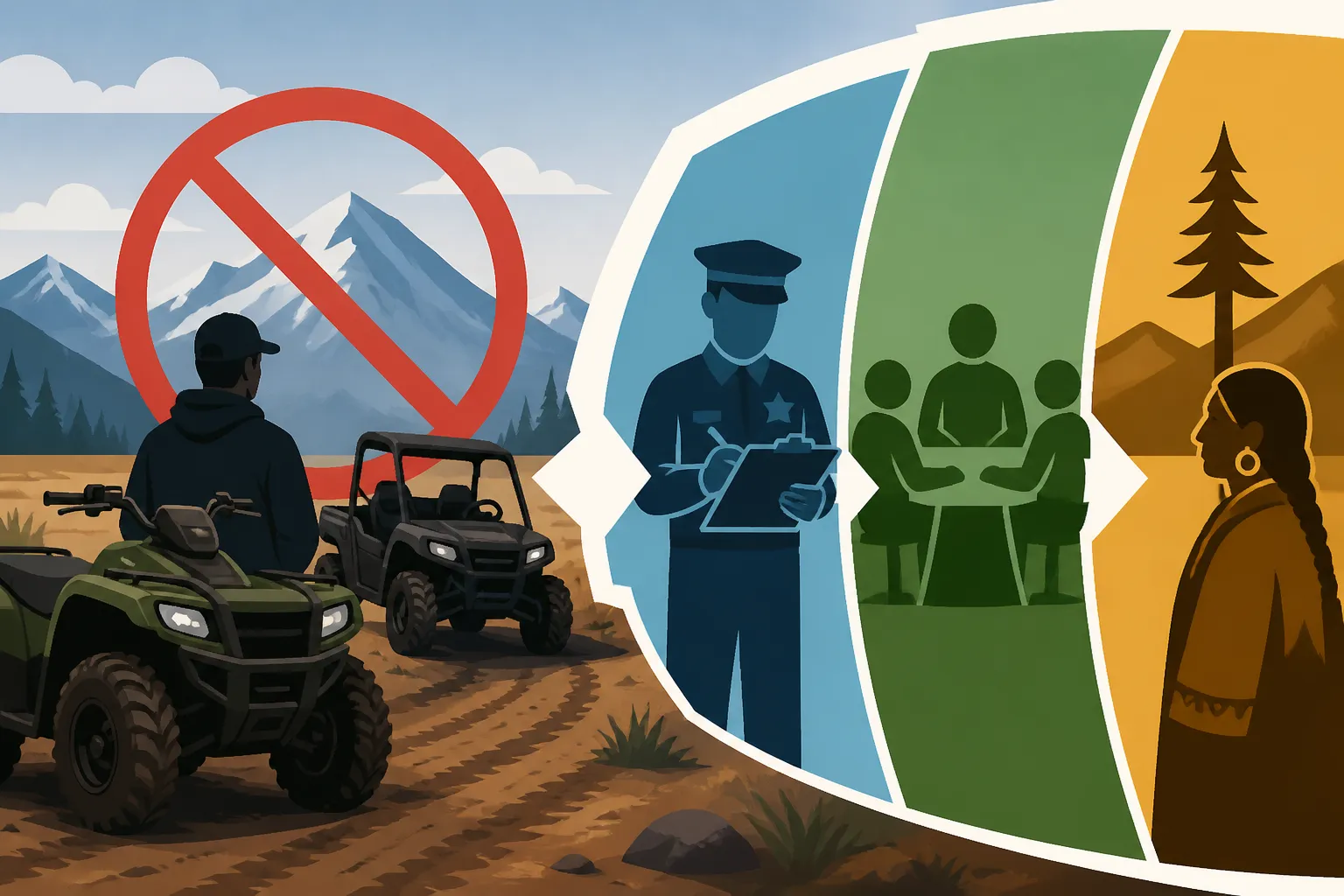
There is no single process that follows every report. The person or organization receiving a complaint may contact you directly, ask you to leave, restrict future access, or refer the matter to an appropriate enforcement agency. If law enforcement contacts you, the questions and possible next steps will depend on the facts, applicable rules, and who has authority in that location.
| Possible response | What it may mean | A sensible first step |
|---|---|---|
| Request to leave or avoid an area | Someone responsible for the land or access wants riding to stop there | Leave safely and ask who can clarify access |
| Request for information | The complainant or an investigator wants to understand the route, permission, or events | Give accurate information; do not guess or alter records |
| Restriction on future access | The landowner or manager may tell riders not to enter or use a route | Follow the restriction while you verify its scope |
| Referral to law enforcement | An agency may look into the report | Stay calm, ask who is contacting you, and consider legal advice |
| Claim for damage or other loss | The complaint may allege harm to land, property, or infrastructure | Preserve evidence and contact your insurer or a lawyer if appropriate |
A request to leave is not the same as a court judgment. Likewise, a complaint does not automatically mean that a person will be cited, charged, or required to pay money. Possible outcomes depend on details such as where the machine traveled, whether the rider had permission, whether signs or boundaries were present, whether damage is alleged, and what local rules apply.
In some situations, the immediate issue may be access rather than punishment. A landowner or manager may tell a rider not to return, close a route, or require riders to use a permission process. Do not assume that a route is open simply because it was open to you before. Ask the entity responsible for the parcel whether access has changed, and get any renewed permission in a form you can keep.
If someone alleges physical damage, avoid agreeing to an amount or accepting responsibility before you understand the claim. That does not mean ignoring a reasonable request or refusing to cooperate. It means separating what you know firsthand from what you are being asked to admit, and getting qualified advice when the potential consequences are serious.
How to Respond if You Are Contacted
Your first priority is to stop any continuing access problem. If you are still on the land and someone with apparent responsibility asks you to leave, do so safely. Do not argue on the trail, ride farther into the area to prove a point, or try to resolve a boundary dispute while operating a machine. If you are unsure where the permitted route begins or ends, pause and seek clarification rather than continuing.
Use these steps to handle the follow-up:
- Stay calm and listen. Ask who is contacting you and what location or route the complaint concerns. Do not interrupt or make threats.
- Clarify what is being requested. Is the request to leave now, avoid a particular route, provide information, or discuss possible damage? If instructions are unclear, ask for them in plain terms.
- Give only accurate information. Say what you remember and distinguish it from what you are unsure about. Do not invent an explanation or speculate about another rider’s actions.
- Keep relevant records. Save messages, permits, maps, receipts, GPS tracks, photos, and any notes about the ride. Keep original files where possible, and do not edit or delete material that could help clarify events.
- Write down your own account. Record the date, approximate time, route, people present, machine involved, and what was said while your memory is fresh.
- Do not return without confirmed permission. A past ride, a familiar trail, or another rider’s assurance is not a substitute for confirmation from the appropriate landholder or manager.
- Get advice if the stakes are significant. If law enforcement is investigating, a formal notice has arrived, damage is alleged, or you may face a legal claim, consult a qualified Alaska attorney.
If an officer or investigator contacts you, be respectful and do not obstruct the inquiry. You can ask which incident or location is involved and whether the contact is a request for information or part of a formal investigation. If you are unsure about your rights or the possible consequences, seek legal advice before providing a detailed statement. Do not make false statements, destroy evidence, or pressure anyone to change their account.
Be careful about relying on a verbal assurance from someone who may not control the land. A local resident may know the area well without having authority to grant access. A village council, corporation, land manager, and individual landowner may each have different responsibilities. Ask which entity can authorize riding on the specific parcel. Who to Ask in a Village Before Riding Through and What a Village Council Can Require of Riders offer useful context for sorting out those roles.
If the complaint appears to involve a mistaken boundary or valid permission, respond with clear supporting information rather than an angry argument. Provide copies of relevant documents if appropriate, but keep your originals. If you obtained permission, check that it covers the exact location, activity, and dates at issue. Alaska Native Land Access Permits explains why confirming the scope of access in advance can prevent confusion.
Avoiding a Repeat Problem
The most reliable way to prevent a complaint is to confirm access before the ride, parcel by parcel where necessary. Do not treat a line on a recreation map, an established track, or a lack of signs as proof of permission. Signs may be absent, boundaries may be difficult to see, and a mapped route may cross land with different owners or managers.
Before heading out, use a practical check:
- Identify the parcels along your planned route and the organization or person responsible for each.
- Ask whether motorized recreational travel is allowed, not merely whether the area is generally accessible.
- Confirm whether written permission or a permit is needed and what conditions apply.
- Check for route closures, seasonal restrictions, and limits on where machines may travel.
- Carry a copy of any permission and make sure it identifies the route or area clearly enough to be useful.
- Have a backup route that stays on ground where access is confirmed.
- If a boundary or instruction is unclear on the ride, stop and contact the relevant land manager before proceeding.
The distinction between land ownership and land access is important. A public road or trail nearby does not mean adjacent land is open to machines. Nor does a permit for one type of land necessarily cover private property, a state park, or land managed by another agency. Riding Onto Another Agency’s Land in Alaska is a helpful reminder to check the manager as well as the map.
If you discover that you crossed onto land without permission, leave by a safe route and do not make a second crossing to retrieve gear or take a shortcut unless the landholder authorizes it. Contact the responsible entity, explain the situation truthfully, and ask how to resolve any immediate access concern. If damage may have occurred, take care not to disturb the area further and preserve relevant photos or location records.
A respectful, prompt response cannot guarantee that a complaint will be withdrawn or that there will be no further action. It can, however, help keep a boundary mistake from turning into a larger dispute. The key is to respect a clear instruction to stop, avoid assumptions about who can grant access, and get confirmation from the right landholder before riding there again.
Disclaimer
This article is for general informational purposes only and does not constitute professional advice. Laws, prices and regulations vary by location and change over time. Consult a qualified professional for guidance on your specific situation.