Alaska Safety Course Options
Alaska riders may hear conflicting advice about whether an ATV or UTV safety course is required. The key distinction is between a statewide rule, a land-access permit, and requirements set by a particular base, employer, rental operator, or riding area. Knowing which applies helps you choose useful training without mistaking a voluntary course for a legal requirement.
Is an ATV safety course required in Alaska?
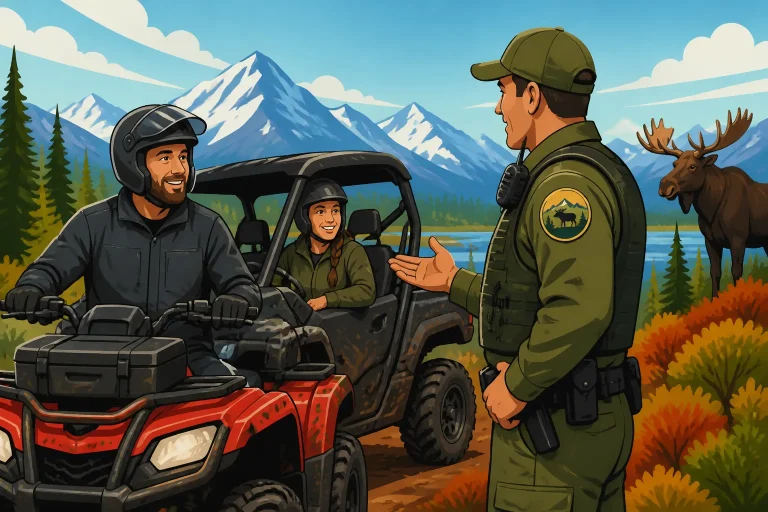
Alaska does not have a general statewide rule requiring every ATV or UTV rider to complete a safety course before riding. A course can still be required by a specific property owner, military installation, employer, event organizer, rental company, or other land manager. Requirements can depend on where you ride and who controls that land, so check the rules for your actual destination.
That distinction matters because several separate requirements can apply to one ride. A rider might need permission to use the land, a registration decal for a machine used on public property, and compliance with local operating rules. None of those automatically means the rider must hold a safety-course certificate. For the registration and land-use questions, see Alaska Has No General Safety Certificate Rule, Alaska General Permit Requirements, and Alaska’s Statewide General Permit for ATV Use.
A statewide general land-use permit, where it applies, is about authorization to use certain land. It is not a rider-training certificate. Likewise, registering an ATV is not proof of training, and completing a course does not authorize riding on land where machines are prohibited. The requirements have different purposes, and one document does not replace another.
Situations where training may be required
A course or proof of training may be required under rules that apply to a particular place or activity. Military installations are one example: access and rider-training requirements can be set by the installation, and they may differ from one location to another. If you plan to ride on a base, contact its recreation, safety, or access office before bringing a machine. Alaska Military Rider Course Requirements explains why base-specific rules need to be checked directly.
Other situations to ask about include:
- Employer or worksite use: A company may require training before employees operate machines as part of their duties. Its standard may apply even when state law does not require a general rider certificate.
- Guided tours and rentals: An operator may require an orientation, a skills check, or a minimum level of experience. These are conditions of using that service, not a universal Alaska course rule.
- Organized events: An event organizer or land manager may require participants to attend a briefing or meet other safety conditions.
- Private property: The property owner can set access conditions. A rider should not assume that the absence of a statewide course rule means there are no conditions for entry.
Ask what the required proof must show. A provider’s completion email, an online quiz result, a recognized course certificate, and an in-person skills assessment are not necessarily interchangeable. If an organization requires a particular course, get the course name and acceptable proof before enrolling.
Rules that still apply without a course
No course requirement does not mean there are no rules for the ride. Depending on the machine, location, and circumstances, riders may need to follow rules for registration, land access, equipment, speed, licensing, insurance, helmets, passengers, and road use. Requirements can also vary by community or land manager.
For example, a rider heading onto state land should check whether the relevant land-use permit applies and whether the intended route crosses land with different ownership. A trailhead pass, where required, is a separate matter from a land permit. See Alaska Land Ownership and Who to Ask and A Trailhead Pass Is Not a Land Permit before assuming that one permission covers the whole route.
Road use is another separate question. A safety course does not make an ATV street legal or grant permission to ride on a road. Check the rules for the road and community, along with applicable machine and rider requirements. Alaska APV Rules by Community and Can You Ride an ATV on the Road in Alaska? cover that issue.
Safety course options for Alaska riders
The right course depends on what you want to learn, the machine you will operate, and whether someone has asked you to provide a certificate. Training options range from a basic online introduction to supervised, hands-on practice. A course that is useful for one purpose may not meet a separate organization’s requirement, so verify acceptance before paying or committing time.
| Option | What it can help with | Main limitation |
|---|---|---|
| Online ATV safety course | Basic operating principles, risk awareness, and preparation for a first ride | Does not provide supervised practice on your machine |
| In-person rider course | Guided instruction and, where offered, practical riding skills | Availability, machine types, and recognition vary |
| Dealer or manufacturer orientation | Controls and features of a particular machine | May focus on that model rather than broad riding skills |
| Employer or installation training | Site-specific procedures and required qualifications | May only satisfy that organization’s requirements |
| Personal practice with a qualified instructor | Familiarity with your machine and local terrain | Informal practice may not produce an accepted certificate |
Online learning
An online course can be a practical starting point, especially for someone who has never operated an ATV. It may introduce safe starting and stopping, basic control use, protective gear, terrain awareness, and common risk factors. The ATV Safety Institute is one provider riders can check for course information and availability. Confirm directly whether a particular course is currently offered in a format that suits you and whether the organization requiring training accepts it.
Online instruction is best treated as preparation, not a substitute for practice. Reading about braking or hill travel does not show how a specific machine handles on loose gravel, mud, snow, or uneven ground. A rider still needs time to learn the controls and build judgment in a suitable, low-risk setting.
Before selecting an online course, check:
- Whether it is intended for ATV riders, UTV occupants, or both.
- Whether it is designed for adults, young riders, or a mixed audience.
- Whether it provides a completion record or certificate.
- Whether the organization asking for training recognizes that certificate.
- Whether the course discusses the type of terrain and riding you expect to encounter.
Some courses use “ATV” broadly, while others focus on a particular vehicle type. A person learning to operate a side-by-side should not assume that a quad-focused course covers all UTV-specific issues, such as passenger communication, seat belts, cab structure, or safe loading.
In-person or hands-on instruction
Hands-on training can fill the gap between knowing a rule and applying it while controlling a machine. An instructor may demonstrate how to use the controls, position your body, stop smoothly, and respond to changes in terrain. If practical exercises are included, the rider can receive feedback before trying similar tasks alone.
Course availability can vary by location and season. Ask local dealers, riding clubs, training providers, employers, or the relevant land manager whether they know of current instruction. Do not assume that a course offered elsewhere in Alaska is available nearby or covers the same machine category.
Before registering, ask a provider:
- Which machines are covered: a single-seat ATV, a UTV, or both?
- Is the course classroom-based, online, hands-on, or a combination?
- Does a participant use their own machine or one supplied by the provider?
- What riding experience and protective equipment are expected?
- Does the course issue a certificate, and who recognizes it?
- Are there age limits or requirements for a parent or guardian?
- What happens if weather, trail conditions, or scheduling affect the practical session?
A course can be worthwhile even when it is not mandatory. For a new rider, supervised instruction can make it easier to recognize poor habits early. For an experienced operator moving to a different machine, training can highlight differences in steering, braking, weight, passenger setup, and rollover risk.
Dealer, manufacturer, and employer instruction
A dealer or manufacturer orientation may help a new owner understand the specific machine: controls, safety interlocks, maintenance checks, passenger arrangements, and recommended operating practices. This is useful at delivery, but it may be brief and focused on one model. Ask whether the session includes riding practice or is only an explanation of the controls and owner’s manual.
Workplace instruction can be more specific. A company may cover the routes, loads, communication procedures, and terrain its employees encounter. That training may be more relevant to a work task than a general online course, but it may not satisfy another organization’s requirements. Keep a copy of any completion record and ask the employer whether retraining is needed after a change in role, machine, or operating conditions.
Choosing training for your machine and experience
A course is most useful when it fits the rider, machine, and riding environment. A first-time rider needs different preparation from someone who has years of quad experience but has just started operating a four-seat side-by-side. A young rider also needs instruction suited to their size, judgment, and the machine’s controls.
Match the course to the vehicle
ATVs and UTVs are not interchangeable from a training perspective. An ATV is generally operated by one rider straddling the machine, while a UTV typically has a seat, steering wheel, and passenger space. A UTV course should address its passenger restraints and operating setup. ATV instruction should focus on the balance, body movement, and control techniques associated with that machine.
The machine’s size and equipment matter too. A larger or heavier vehicle may respond differently from a small youth quad. Attachments, cargo, tracks, and towing can change handling or braking. If the course is intended to satisfy a specific requirement, ask whether it covers the actual vehicle configuration you will use.
Match the course to the rider
A beginner benefits from a clear introduction to controls and basic decisions: when to slow down, when to stop, and when not to attempt an obstacle. Someone with experience may need targeted instruction instead, such as riding with a passenger, operating a UTV on narrow trails, or using a machine for work.
For young riders, training should be paired with adult supervision and equipment suited to the child. A certificate does not mean a child is ready for every machine or terrain. Check the applicable rules for young riders and follow the manufacturer’s age and size guidance. Alaska Rules for Young Riders offers related context, while Teaching a Child to Ride the Valley Trails addresses practical preparation.
A parent or guardian can also ask whether a course has a separate youth track, what adult supervision it expects, and whether its exercises are appropriate for the child’s machine. A young rider should not be placed on a machine simply because a course has been completed.
Match the instruction to Alaska conditions
Alaska riding can involve cold, wet surfaces, loose gravel, mud, snow, glacial silt, water crossings, limited cell coverage, and long distances from help. A general introductory course may not cover every local hazard. Before riding in a remote area, combine basic rider education with route-specific planning and an honest assessment of the machine, weather, group, and conditions.
A useful training plan should include more than how to operate the throttle. Consider whether you can:
- Inspect the machine and identify problems that should stop the ride.
- Choose protective gear appropriate to the weather and riding conditions.
- Communicate with passengers and other riders.
- Recognize when terrain or water conditions are beyond your ability.
- Turn back without pressure to continue.
- Plan for limited communications and delayed help.
- Understand who manages the land and where permission is needed.
A course cannot replace current route information or sound judgment. A rider who was trained on dry ground should not assume that the same skills are enough for a changing river crossing or a slick, rutted trail. Alaska Tundra and Wetland Conditions and Reading a Glacial River Before You Cross discuss hazards that call for condition-specific decisions.
How to check a course requirement before riding
When someone tells you that you need a safety course, ask who is imposing the requirement and what document or skill check they expect. This helps prevent a common mix-up: completing a course that is useful but not accepted for the purpose at hand.
Use this process:
- Identify the riding location. Determine whether the route is on state, federal, municipal, private, military, or other managed land. A route can cross more than one type of property.
- Ask the land manager or organization directly. If the ride involves a base, event, workplace, rental, or guided tour, contact the office or operator responsible for access.
- Get the course requirement in writing if possible. Confirm the course name, provider, vehicle category, age conditions, and acceptable proof.
- Check whether online training is accepted. A general online completion record may not meet a requirement for practical instruction.
- Confirm timing and renewal expectations. Ask whether the certificate must be current, whether retraining applies, and how long processing or recordkeeping takes.
- Keep records with your other riding documents. Save the certificate or completion email, but do not treat it as a substitute for registration, land permission, or other required documents.
If no organization requires a course, you can still choose one voluntarily. A basic online class may suit someone who wants an introduction, while hands-on instruction is a stronger choice for a novice who needs practice and feedback. A machine-specific orientation can help an owner learn the controls, and workplace or installation training is appropriate when access or employment rules demand it. A Safety Course Alaska Riders Take Anyway and What an Alaska Rider Course Covers provide additional context about voluntary training and course content.
Before your first ride, separately verify registration and land access, then check the rules for the place and type of riding planned. Keep those checks distinct from training: a safety course can improve preparation, but it does not make an otherwise restricted ride legal. For registration questions, see Alaska Registration Before Your First Ride.
Disclaimer
This article is for general informational purposes only and does not constitute professional advice. Laws, prices and regulations vary by location and change over time. Consult a qualified professional for guidance on your specific situation.