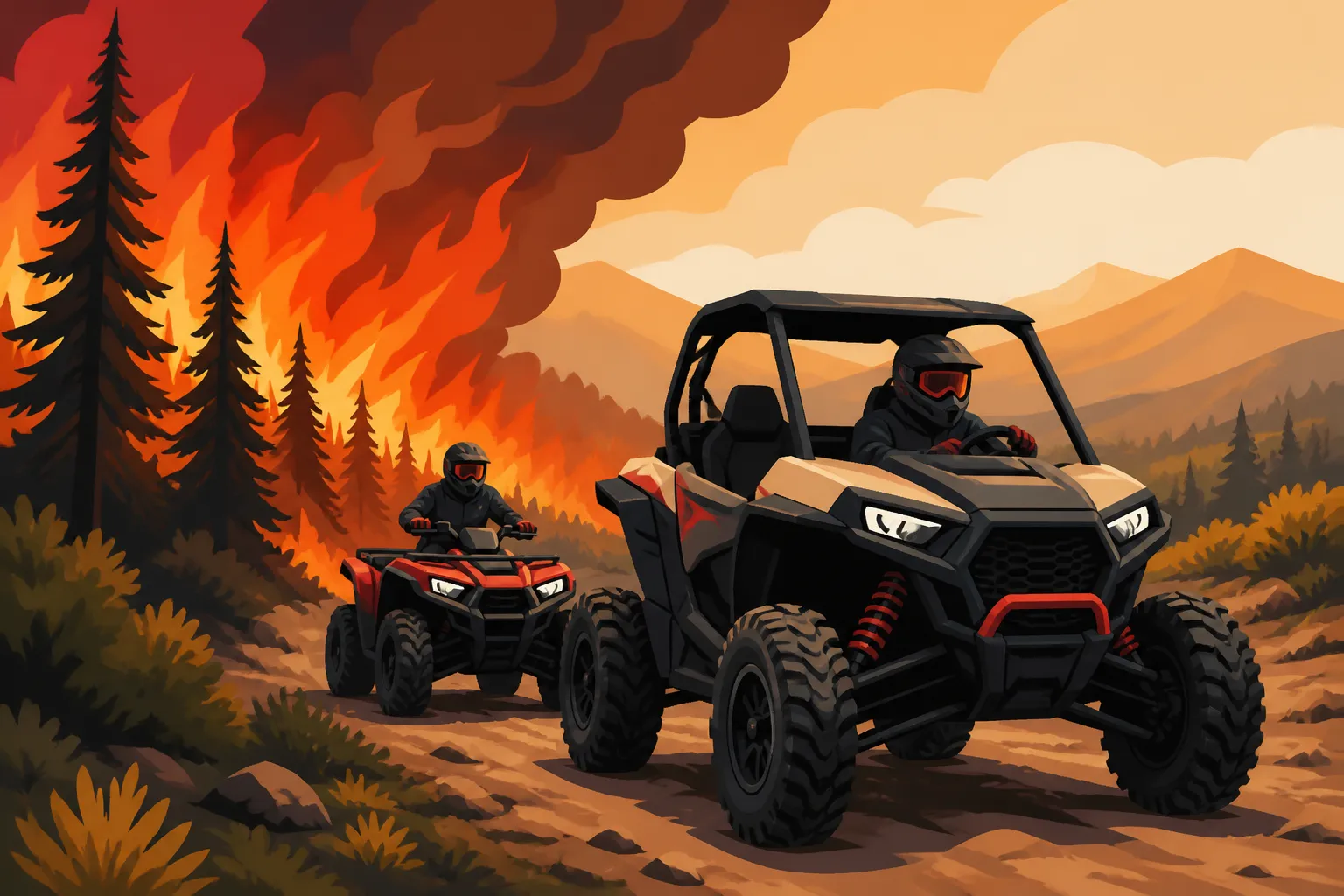
Fire Season in the Interior
Interior Alaska’s dry weather, wind, and fast-changing conditions can make an ATV or UTV ride a fire risk as well as a land-access question. Before heading out, check the rules for the ground you plan to cross, confirm your machine’s equipment is in order, and know what to do if restrictions or conditions change.
Why fire season changes an ATV or UTV trip
In the Interior, fire danger can rise when vegetation and surface fuels dry out. Wind, heat, and the type of ground you travel over all affect how quickly a fire could start or spread. A route that was open and manageable on a previous ride may be a poor choice when conditions are dry or a new fire restriction is in effect.
A machine can create ignition risks through hot exhaust components, sparks, or contact with dry vegetation. Stopping in tall grass, parking over dry material, or dragging a hot machine through brush can add risk even when you are not using a campfire. A spark arrester is an important part of responsible riding, but it is not a guarantee that a route is open or that every fire-related requirement is met. Review Alaska Spark Arrester Requirements and inspect the equipment before the trip.
Fire restrictions are not necessarily the same across all the land on a ride. A route may pass from state land to federal land, a park, private property, or land managed by another entity. Each land manager may issue its own closures or restrictions. A statewide access permit should not be treated as a blanket permission to ride through a closed area or ignore a local fire order. For background on what a permit covers, see What Alaska’s Statewide General Permit Actually Authorizes and Alaska Land Managed by Other Agencies.
Plan around the exact route, not just the general destination. Check who manages the land, whether the trail is open, and whether current fire-related rules limit motorized travel or other activities. An area can remain open to some uses while specific routes or activities are restricted. If information is unclear, ask the relevant land manager before unloading.
Check restrictions for every part of the route
A useful pre-ride check is to identify the land manager for each section of your planned route and look for current notices from that manager. Conditions and restrictions can change, so a map saved earlier or advice from a previous visit may no longer be reliable.
Start by checking the land status. State land, state parks, federal land, Native corporation land, and private parcels do not all follow one access system. Checking a Land Status Map can help you understand where the route crosses different ownerships, but a map alone may not show current closures. Confirm access and restrictions with the land manager responsible for the area.
Use this sequence before you ride:
- Trace the full route. Include trailheads, staging areas, connecting trails, and any likely detours. Don’t assume a familiar trail stays within one ownership boundary.
- Identify the land managers. Make a separate note of the manager for each section rather than relying on a single permit or map.
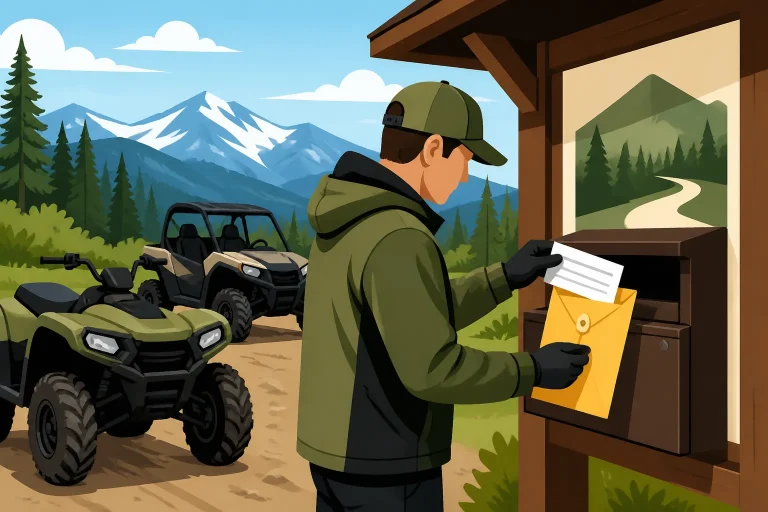
- Check for current notices. Look for fire restrictions, temporary closures, trail advisories, and other access changes from the managers responsible for the route.
- Confirm any unclear point directly. Ask whether motorized travel is allowed on the intended route and whether a restriction changes that access.
- Recheck before departure. Conditions can shift between planning and riding, especially during a prolonged dry spell or when wind changes.
The table below is a practical way to keep those checks organized. It is not a substitute for the current rules from the land manager.
| Route element | What to verify | Why it matters |
|---|---|---|
| Trailhead and staging area | Current access, notices, and any local restrictions | A trail may be open while staging or nearby areas have separate rules |
| State land | Permit coverage, route access, and current restrictions | General access does not automatically resolve temporary closures |
| State park or designated area | Whether motorized use is allowed and whether any restrictions apply | Some areas are outside the statewide general permit |
| Federal or other agency land | The responsible manager’s access rules and notices | Rules may differ from adjacent state land |
| Private or Native corporation land | Permission and any conditions of access | A public route nearby does not establish permission to cross private ground |
| Return route | Whether the planned way out remains open | A closure or changing condition can affect the return as well as the outbound trip |
A trailhead pass, land permit, and fire-related restriction address different questions. A pass may cover a parking or recreation fee; a permit may authorize a defined kind of land use; a closure may prohibit travel in a specific area. Do not treat one as a substitute for another. See A Trailhead Pass Is Not a Land Permit and Asking Who Owns the Ground First when access crosses multiple types of land.
If a ride connects to a road, a mining route, or a corridor used by another organization, confirm who controls that segment too. A route that appears continuous on a map can cross boundaries with different access rules. If a fire notice closes a section, do not assume a nearby detour is legal simply because it is physically passable.
Prepare the machine and reduce ignition risk
Inspect the machine before the ride, with special attention to the exhaust system and areas that can collect dry debris. A damaged or missing spark arrester can create both a safety concern and a compliance problem. Check that components are intact and installed as intended; do not rely on a quick visual glance if the machine has been modified or recently repaired. Checking Your Spark Arrester Before Fire Season offers a focused checklist.
Also clear dry vegetation, grass, and other debris from places where heat can build up. Look around the exhaust, under guards, and near the engine after the machine has been parked in dusty or brushy conditions. Avoid parking over dry grass, brush, or other combustible material. If a machine is unusually hot, smoking, or has a burning smell, stop in a safe place and address the issue rather than continuing into vegetation.
Before departure, check that you have the basic items needed to handle an unexpected delay or problem. The right equipment depends on route length, weather, group size, and how far you are from help. At a minimum, plan for communication, first aid, and a way to manage a small emergency without creating a bigger one. For remote trips, No Cell Coverage Off the Road System and Filing a Trip Plan With Someone cover two planning issues that matter beyond fire season too.
A practical pre-ride machine check can include:
- Inspect the spark arrester and exhaust for damage, looseness, or signs of a recent repair.
- Clear dry plant material and accumulated debris from the machine.
- Check for leaking fuel or oil and fix issues before riding.
- Make sure the machine is in good mechanical condition and carries no unnecessary heat-related defects.
- Carry communication and emergency supplies appropriate to the route.
- Tell someone where you plan to ride and when you expect to return.
Ride in a way that limits contact with dry vegetation. Stay on routes where motorized travel is authorized instead of creating a shortcut through grass or brush. Avoid spinning tires in dry material, and do not leave a hot machine idling or parked where combustible plants can touch hot components. If conditions look worse than expected, turning around is a sensible decision, not a failed trip.
Fire risk can also affect riding practices away from the machine. If a restriction prohibits a particular activity, follow it even if your own ride does not involve a campfire. Read notices carefully and distinguish between what is prohibited, what remains allowed, and where the order applies. For more context on changing conditions, see Fire Restrictions in a Dry Summer and Alaska Tundra and Wetland Conditions.
Make a conservative decision when conditions change
A fire-season plan should include a clear point at which the group will change routes or cancel. Set that expectation before reaching the trailhead, when it is easier to make a calm decision. Examples include a new closure notice, visible smoke near the route, a significant change in wind, a machine problem involving the exhaust, or a trail that would require riding through dry vegetation.
Do not ride toward smoke to investigate. Smoke can hide fire location, reduce visibility, and make a route unpredictable. Move away from the affected area using a known route, notify the appropriate emergency service when there is a fire or immediate danger, and follow instructions from responders or land managers. Do not attempt to fight a wildfire from an ATV or UTV. Your priority is to leave safely and communicate useful information without putting the group at further risk.
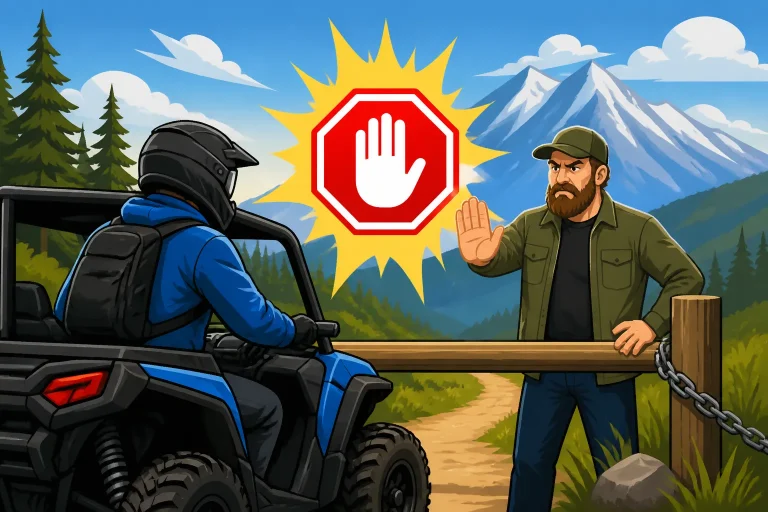
If a closure takes effect while you are out, follow the directions provided by the land manager or emergency personnel. Avoid blocked routes and do not use an unofficial path to bypass a closure. A detour might cross land where you lack permission or lead into unsafe ground. Keep your group together, conserve fuel, and use your planned communication method if the route out is uncertain.
The same cautious approach applies when you cannot verify whether an area is open. A general permit, an old trail map, or a prior trip does not confirm that a route is currently available. Check the land manager’s latest information or choose a route with clear, confirmed access. Alaska Tundra and Wetland Conditions is also relevant when a detour could take you onto sensitive ground that is especially vulnerable to damage.
A useful decision checklist before the ride:
- Is the entire route currently open to the machine and type of use planned?
- Have you checked the restrictions for every land manager along the route?
- Is the spark arrester intact, and is the machine free of dry debris and mechanical problems?
- Does everyone know the route, communication plan, and turnaround conditions?
- Can the group leave promptly if conditions change?
Fire season is not a reason to assume every Interior route is closed, but it is a reason to verify access and ride with extra care. The safest plan is one based on current notices, confirmed land access, a properly maintained machine, and a willingness to turn back when the situation changes.
Disclaimer
This article is for general informational purposes only and does not constitute professional advice. Laws, prices and regulations vary by location and change over time. Consult a qualified professional for guidance on your specific situation.