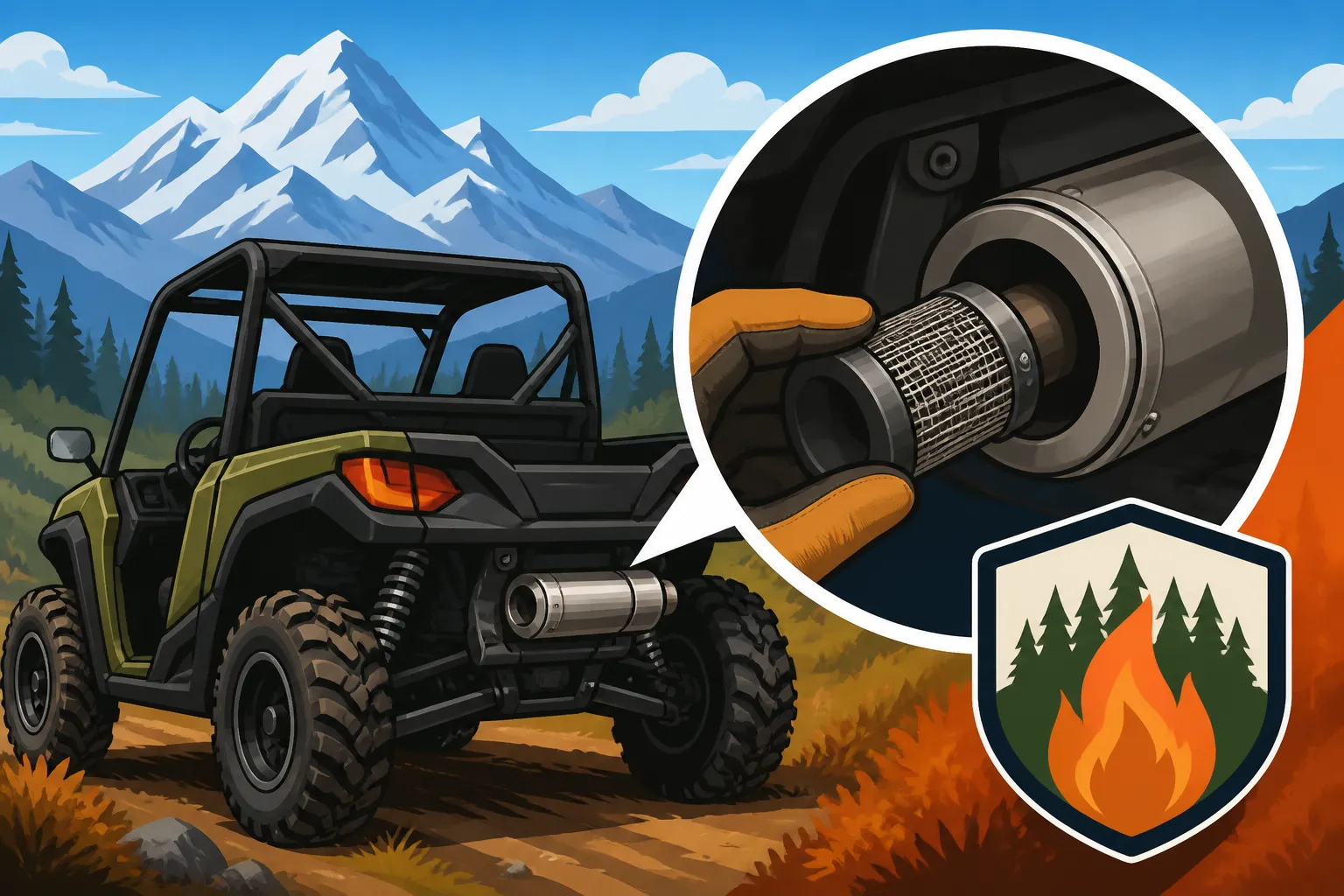
Checking Your Spark Arrester Before Fire Season
Alaska’s dry grass, tundra edges and forest fuels can make a small ignition source a serious concern. Before fire season, check that your ATV or UTV has the right spark arrester, that it is intact and clean, and that it is installed as designed. A good inspection reduces risk, but it does not replace checking current fire restrictions or land-use rules.
What a spark arrester does—and what it does not do
A spark arrester is a device in the exhaust system that helps keep hot carbon particles from leaving the muffler and starting a fire. Many designs use a screen or another barrier to catch particles while exhaust flows through. If the device is missing, damaged or altered, it may no longer do its job.
A spark arrester is not the same as a muffler. The muffler reduces exhaust noise; the arrester addresses escaping particles. Some exhaust systems combine the parts, but they serve different purposes. A machine can have a quiet muffler and still have a missing or ineffective arrester. Conversely, an arrester does not make an exhaust system quiet or bring an otherwise noncompliant machine into compliance.
An arrester also does not make a machine fireproof. Hot exhaust components, a mechanical fault, dry vegetation contacting the machine, or other ignition sources can still start a fire. The device reduces one particular risk; it cannot guarantee that sparks will never escape.
Requirements can depend on the land manager, the area, the machine and current restrictions. Do not assume that a device accepted for one trail or parcel automatically meets the rules somewhere else. Review Alaska Spark Arrester Requirements and check with the agency or landowner responsible for the ground you plan to ride. A land-use authorization is not the same as permission to ignore equipment rules or a temporary fire closure; What Alaska’s Statewide General Permit Actually Authorizes explains why it is important to check what a permit does and does not cover.
| Inspection point | What to look for | What to do if there is a problem |
|---|---|---|
| Correct part | Arrester listed or specified for the machine’s exhaust system | Confirm the exact part with the manufacturer or a qualified shop |
| Screen or barrier | No holes, cracks, missing sections or loose fit | Replace or repair using the specified part; do not ride until resolved |
| Carbon buildup | Openings are not obstructed by heavy deposits | Clean only as directed in the owner’s manual |
| Installation | Fasteners are secure and the device sits in the intended position | Reinstall correctly or have the exhaust system checked |
| Fire restrictions | Current rules for the route and land are known | Follow closures and restrictions even when the arrester is intact |
How to inspect the arrester safely
Inspect the exhaust system when the machine is parked on stable ground and the engine is completely cool. Exhaust parts can stay hot after the engine stops. Do not remove a screen or loosen a fastener to check it while the machine is warm. Let it cool fully, switch off the ignition, remove the key if applicable, and follow the safety steps in the owner’s manual.
You do not need to dismantle the entire exhaust to complete a basic check. The manual should identify whether the machine has a spark-arresting component, where it is located and how the manufacturer expects it to be serviced. On some models, the arrester is reached through a removable end cap; on others, access differs. If the manual does not describe owner servicing, or the parts are difficult to reach, ask a dealer or repair shop rather than forcing components apart.
Use a flashlight to look for visible damage, loose parts or heavy buildup. Check that the screen or barrier is present and seated as designed. Look for:
- Holes, tears, cracks or missing sections in a screen
- A screen that is loose, distorted or pulled away from its seat
- Fasteners that are missing or obviously loose
- Heavy carbon deposits that block openings
- Signs that a previous repair used a substitute screen or improvised material
- Exhaust leaks, soot marks or unusual rattling around the joint
A screen that appears present is not automatically serviceable. A small tear or poor fit can defeat its purpose, while thick deposits can restrict exhaust flow. If you are unsure whether a mark is damage or normal construction, compare the part with the manual or have a qualified technician inspect it.
Do not run the engine with the arrester removed to “see how it sounds,” and do not ride with the device off while waiting for a replacement. Running an engine with exhaust parts removed can create burn, fire and equipment risks. It can also expose you to hot exhaust and excessive noise. Never enlarge screen openings, cut away material or substitute a piece of hardware cloth because it seems close enough.
Cleaning methods vary by machine and arrester design. Follow the owner’s manual for removal, cleaning and reinstallation. Use the recommended tools and method; avoid striking the screen or scraping it in a way that could break wires or enlarge openings. If the manual calls for replacement rather than cleaning, follow that instruction. Let any cleaned part dry completely before reinstalling it, and make sure the fasteners and seals are correctly positioned.
If you need a replacement, start with the machine’s manufacturer or an authorized parts source. Parts may also be listed by independent retailers, including Amazon, but verify the exact model, year, exhaust configuration and part number before ordering. A screen that fits physically may still be the wrong component or fail to meet the requirements that apply to your ride area.
What to do if the arrester is damaged, missing or clogged
Do not treat a questionable arrester as a minor cosmetic issue. If it is missing, cracked, loose or visibly perforated, keep the machine off the trail until it is repaired with the correct part. If the part is badly clogged, follow the manufacturer’s service procedure or have a shop clean or replace it. A restricted exhaust can affect how the engine runs, and a damaged screen may no longer contain particles effectively.
When ordering a part, gather information before contacting a shop or supplier. Record the make, model and year, and note whether the exhaust system is original or has been modified. A clear photo of the exhaust outlet and the part, taken while everything is cold, can help identify the configuration. Do not rely on appearance alone to establish that a replacement is approved or suitable.
After repair, check that the arrester is seated in the correct position and all required fasteners are secure. Keep the receipt, packaging information or manual details with your machine records. These documents are not a substitute for an inspection, and they may not be required at a trailhead, but they can help you identify the installed part later or explain what was repaired if a question comes up.
If the arrester keeps clogging, rattling or loosening, do not keep cleaning or tightening it without finding the cause. The wrong part, an exhaust leak, a damaged mounting point or an engine issue may be involved. A repeated problem calls for a proper diagnosis, not a more open screen or an improvised fix.
A quick pre-ride check is useful after servicing, transport or a hard ride, but it is not a replacement for maintenance at the intervals in the owner’s manual. Mud, water, vibration and impacts can affect exhaust components. Check again if you hear a new rattle, smell exhaust near a joint, notice a change in engine behavior or see damage after a trail incident.
Check fire rules and riding access separately
A correctly installed spark arrester is only one part of preparing for a ride. Fire restrictions can change with conditions and may differ between state, federal, borough, municipal, private and Alaska Native corporation land. Some restrictions may limit vehicle use or close an area entirely; an intact arrester does not create an exception. Before leaving, check current notices from the agency or landowner managing the route, and confirm that the trail itself is open to your type of machine.
Use Alaska Fire Restrictions in a Dry Summer as a reminder to check restrictions rather than relying on the calendar. Fire season conditions can vary across Alaska, and a route that was open during a previous visit may have different rules when you return. If a closure notice or local instruction is unclear, ask the land manager before riding.
Access permission and equipment compliance are separate questions. A general permit, trailhead pass or permission from a landowner may address access or fees, but it may not cover every parcel along a route or replace an equipment rule. Check land status and who manages each part of the route using Alaska Land Ownership Lookups and Asking Who Owns the Ground First. For public-land rules, Alaska Land Managed by Other Agencies is also useful when the route crosses ground managed by more than one agency.
Make a short pre-ride routine:
- Check the arrester and exhaust when the machine is cold, and confirm the device is intact and secure.
- Confirm that the machine is being used on an open route where your access permission applies.
- Check current fire notices and restrictions for the specific land you plan to cross.
- Carry out any additional equipment checks required for your machine and route.
- Turn back if a closure, damaged device or uncertain access makes the ride unsafe or unauthorized.
For related equipment checks, see Alaska Spark Arrester Checks and Alaska Equipment Checks by Troopers. Requirements can vary, so use current directions from the relevant land manager and your machine’s manufacturer rather than assuming that one checklist covers every location.
Disclaimer
This article is for general informational purposes only and does not constitute professional advice. Laws, prices and regulations vary by location and change over time. Consult a qualified professional for guidance on your specific situation.