Riding Only on Your Own Ground
One of the most common questions new ATV and UTV owners in Alaska wrestle with is whether they truly need to register their machine if they only plan to ride it on their own private land. It seems straightforward, but Alaska's rules for All-Purpose Vehicles (APVs) have nuances that can easily trip up even seasoned Alaskans, especially when private property borders public access. This guide will clarify when your personal quad or side-by-side really needs that state decal, even if you rarely leave your parcel.
The Core Rule: Public Land as the Trigger for Registration
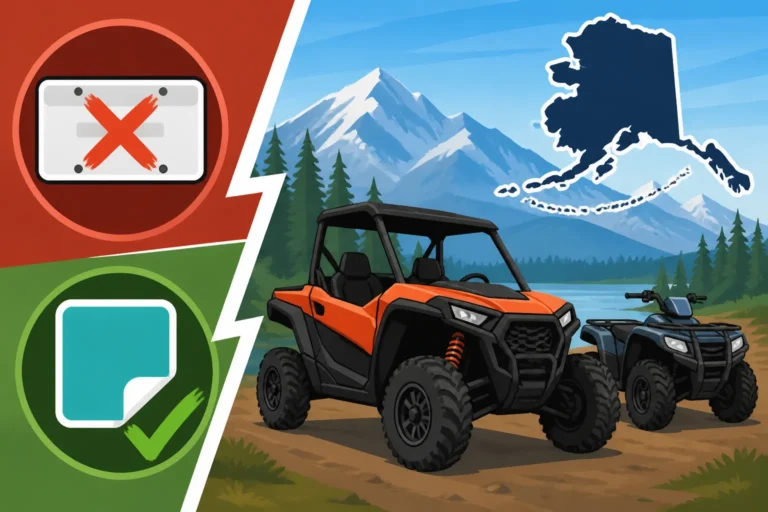
Let's cut right to the chase: Alaska law ties APV registration directly to the use of public land. This is the fundamental principle that determines whether you need to get that decal on your machine. If your quad or side-by-side is strictly confined to land that is unequivocally private, and it never touches so much as a tire on public ground, then generally, registration isn't required. But "unequivocally private" is where things get tricky in Alaska.
Understanding the "All-Purpose Vehicle" Definition
First, it’s important to understand what the state of Alaska considers an "All-Purpose Vehicle" or APV. This isn't just a casual term; it's a legal classification that includes things like ATVs, UTVs (side-by-sides), and even some six-wheelers. The definition usually covers motorized vehicles designed for off-road use, often with three or more tires, and not generally intended for highway use. Snowmobiles, for example, fall under a different category in Alaska and have their own distinct rules, so we're focusing purely on APVs here. The state needs to define what an APV is before it can tell you how to register it. If your machine fits this description, then the next step is to consider where you plan to ride it. The law governing APVs is what triggers the need for a state decal and a registration card in your wallet when you're out and about.
When Your Own Property is Truly "Private"
In Alaska, "private land" can mean a lot of things. For some, it's a small, fenced backyard in town where a kid might zip around on a youth quad. For others, it's a sprawling, remote homestead parcel miles off the nearest road system, perhaps only accessible by air or snowmachine in winter. The key is that the land must be entirely your own, or you must have explicit permission from the private landowner, and it must not involve any public access. What about a property with an easement running through it? Or land that requires you to cross a small section of state-owned right-of-way to reach your front gate? This is where the line between "private" and "public" can blur. If your ATV or UTV is only ever used within the absolute boundaries of your private property, without ever traversing any public roads, trails, or even a public shoulder, then you likely fall under the exemption where [When a Quad on Private Land Needs No Alaska Decal].
The Specifics of "Operating on Public Land"
Alaska Statute defines "public land" quite broadly when it comes to APVs. It doesn't just mean state parks or federal wilderness areas. It includes state, federal, and borough-managed lands, certainly. But it also encompasses public easements, city streets (even if you're just crossing them briefly), shoulders of roads, public trails, and even frozen rivers or sea ice that are considered public access ways. The moment your APV touches any of these areas, even for a short trip to the mailbox or to move your machine to a different part of your property if it requires crossing a road, you are technically "operating on public land." This distinction is critical because it's [Public Property as the Trigger] for requiring an APV registration. Many Alaskans living on the road system or near established trails might think they're only on private land, but a quick jaunt down a gravel road that's maintained by the borough or state instantly puts them into the "operating on public land" category.
What Happens if Your Private Ground Isn't Entirely Private?
This is where the rubber meets the road (sometimes literally!). Many Alaskans have properties that, while privately owned, aren't completely isolated. You might have acres of land, but to get to it, you have to cross a public right-of-way, or perhaps a public trail runs near or through a corner of your parcel. Understanding these gray areas is crucial to staying compliant and avoiding an unexpected conversation with a trooper.
Crossing Public Roads or Trails to Reach Your Property
Imagine your beautiful, sprawling property is just off a public gravel road, and you need to take your ATV just fifty feet down that road to get from your cabin to your shed on the other side of your driveway. Or perhaps your hunting cabin sits at the end of a long, well-used public trail. Even this brief interaction with public infrastructure means your APV is no longer strictly on "private ground." If you’re riding on or even across any public road, even a seldom-used dirt track, or using a public easement or trail to access your property, your APV needs to be registered. This is where many owners get caught out, as they don't realize that even a short hop on a public thoroughfare counts. It's not about the distance; it's about the distinction of the land. Our guide on [Alaska APV Road Rules Explained] delves into more detail about how and when you can legally operate an APV on roads.
Easements, Access Corridors, and Shared Land
Alaska is full of land with unique access situations. You might own a parcel of land, but a utility easement runs across it, or there's a historic public access corridor that people use to get to a lake or river. If you're using your ATV on your private land but happen to be on a section that is also a public easement, or if you regularly use a shared private road that eventually connects to a public trail system, your machine likely needs to be registered. The definition of "public" extends to these areas where the general public has a right to travel, even if the underlying land is privately owned. It's always best to clearly understand the boundaries and legal designations of your property, especially concerning any ingress/egress points or shared access. This complexity often comes up for those with [Alaska Registration for a Cabin Machine] in remote areas.
The Grey Areas: Remote Cabins and Village Access
Life in rural Alaska often blurs the lines between what's considered a "road" or a "trail" and what's just the path you've always taken. For example, if you have a remote cabin accessed by a winter trail that is sometimes maintained by the state or a borough, or if it's a commonly used corridor for locals, then even if it feels private, it likely isn't. Similarly, in many Alaska villages, ATVs and UTVs are the primary mode of transportation, and what might look like a private dirt path could actually be a designated public way or a critical access route for the community. In these scenarios, it’s safer to assume that if you're sharing the "road" or "trail" with others who aren't explicitly your guests on your private land, registration is required. Our article on [Alaska Registration for a Village Machine] covers some of these specific situations.
Here’s a simple way to think about it:
| Scenario | Registration Required? | Explanation |
|---|---|---|
| Riding exclusively within a fenced backyard | No | Machine never touches public ground; purely private use. |
| Large private parcel, no public access | No | As long as no part of the ride crosses public land, no registration needed. |
| Crossing a public road to another part of your property | Yes | Even brief use of a public road or shoulder triggers the requirement. |
| Using a public easement on your private land | Yes | If the public has a right to use the easement, it's considered public ground for APV purposes. |
| Riding on a commonly used village path | Yes | Many village paths are considered public access, even if unpaved. |
| Accessing a remote cabin via a public trail | Yes | Any portion of the trail that is public requires registration. |
Proving Private Ownership and Avoiding Registration Headaches
Even if you firmly believe your riding falls under the "private land" exemption, it’s wise to be prepared. Proving that your use is genuinely private can be important if you're ever stopped or questioned by authorities. Having the right documentation and understanding your options can save you a lot of grief.
Essential Documentation for Private Land Use
If you're riding a machine on your property that isn't registered, and you encounter someone official (like a Fish and Game trooper or a state park ranger, depending on where your land is situated), they might inquire about your APV's registration status. In such a situation, you'll want to be able to clearly demonstrate that your machine is being operated solely on private property. This can include carrying a copy of your property deed, a survey map highlighting your property lines, or even a property tax statement. If you're riding on someone else's private land with permission, a written letter or a signed affidavit from the landowner granting you access would be excellent proof. For those whose ownership records might be a bit murky, especially with older, inherited properties or informal sales, a service like LawDepot can be incredibly helpful. They offer templates for various legal documents, including affidavits of ownership, which can provide a clear, legally sound statement of who owns the property and grants permission for APV use.
Best Practices for Purely Private Operation
To ensure your APV truly remains off the registration radar, you need to be diligent about its use. First and foremost, never, ever let it touch public ground – this includes streets, sidewalks, public trailheads, or even the unpaved shoulder of a public road. If your property is unfenced, consider putting up clear "Private Property" or "No Trespassing" signs to establish boundaries. Confine your riding to well within your property lines. This might mean having designated riding areas that are clearly delineated and separate from any potential public access points. Think of it this way: if a stranger could conceivably wander onto a path you use on your quad and believe it to be public, then you might have a problem. By keeping your operations strictly confined, you minimize any ambiguity.
Understanding the No Title Issued (NTI) Option for Purely Private Machines
Even if you’re not required to register your APV because you only ride it on private land, you might still want a record of ownership, especially for older machines that may not have come with a traditional Manufacturer's Certificate of Origin (MCO) or a clear title from previous owners. Alaska offers a "No Title Issued" (NTI) registration option. This process allows you to get a registration decal and card for your APV without necessarily receiving a physical title document. It's often used for machines where the ownership history is difficult to trace, but you still want some official recognition of your possession. While it doesn't grant you a full title immediately, it creates a record with the state. This can be beneficial for proving ownership in certain situations, even if you never plan to take the machine off your land. If you’re considering this, our guide on [Alaska No Title Issued Registrations] can provide more information, and you can also check out the [Alaska NTI Title Steps].
What About Titling for a Machine You Only Ride Privately?
Registration and titling are often conflated, but in Alaska, they serve different, albeit related, purposes. While registration is primarily about allowing you to legally operate your APV on public lands, a title is fundamentally about proving ownership. Even if your machine never leaves your private parcel, having a clear title can be incredibly valuable.
The Purpose of an Alaska APV Title
An Alaska APV title is a legal document issued by the state that formally establishes who owns a particular All-Purpose Vehicle. Think of it like the deed to your house or the title to your car. It contains vital information such as the vehicle identification number (VIN), make, model, and the owner's name. While registration provides a temporary operating permit (the decal and card), the title provides permanent proof of ownership. Since [Alaska APV Titling Required Since 2022], the state has made it a clearer expectation for APVs to have titles, regardless of where they are primarily ridden. This shift emphasizes the importance of a clear chain of ownership, which protects both buyers and sellers. Even if you're not registering your machine for public use, having a title streamlines future transactions and provides a definitive record of who the rightful owner is.
When an APV Title Becomes Important Off-Road
You might think, "If I'm not riding on public land, why do I need a title?" The truth is, a title offers protection and facilitates transactions that extend beyond public trail use. Imagine you decide to sell your APV to a neighbor. Without a title, proving you're the rightful owner can be a significant hurdle, potentially scaring off buyers or leading to legal complications down the road. If your machine is stolen from your private property, a clear title is usually essential for filing an insurance claim and assisting law enforcement in recovering your property. Furthermore, in situations involving estate planning or inheritance, a title simplifies the transfer of ownership to heirs. For more information on selling your machine, you can look at [Selling a Registered Machine in Alaska], but remember that the title aspect applies even if it's never been registered for public use.
Using Legal Documents for Proof of Ownership
For machines that have never had a formal title, or where the paperwork has been lost over the years, you still have options to establish proof of ownership. A well-drafted bill of sale, for instance, serves as a legal document transferring ownership from one party to another. When buying a used machine from a private seller, always insist on a clear bill of sale, even if it's just a simple handwritten document. Services like LawDepot can provide professional, customizable templates for bills of sale and affidavits, making it easy to create legally sound documents for your private transactions. An affidavit naming the seller, detailing the transaction, can be particularly useful if the original MCO or title is unavailable. Our articles on [Alaska Bills of Sale for a Used Machine] and [Alaska Affidavits Naming a Seller] offer more guidance on creating and using these important documents to protect your ownership interests.
Disclaimer
This article is for general informational purposes only and does not constitute professional advice. Laws, prices and regulations vary by location and change over time. Consult a qualified professional for guidance on your specific situation.