Alaska Bear Encounters While Riding
A bear on an Alaska trail can turn an ordinary ride into a tense decision in seconds, especially when the machine is loud, the terrain is narrow, or there’s no cell service. This guide explains how to reduce the chance of an encounter, what to do when you spot a bear, and how to prepare your group before heading out.
Reduce the chance of a bear encounter
Read the trail and surrounding habitat
Bears can be encountered across Alaska, including on forest trails, river corridors, brushy roads, and open tundra. They may be feeding, traveling, or resting out of sight. A familiar route is not a guarantee that it will be bear-free today. Conditions and animal activity change, and visibility can be poor around bends, dense willow, or a noisy stream.
Pay extra attention in places where bears may be focused on food. These can include berry patches, salmon streams, and areas near a carcass. If you see fresh tracks, scat, disturbed ground, or a strong animal smell, slow down and look carefully rather than pushing on to get a closer view. A bear with cubs or one guarding food may react strongly if surprised.
Think about the season and the route, too. Summer riding can mean thick vegetation and limited sight lines, while a trail beside water may make it difficult to hear an approaching animal. Planning your route with a tool such as onX Offroad can help you review the general area and choose a route that suits the group. Treat any map as a planning aid, not a live report of wildlife activity or current trail conditions. For broader habitat and animal awareness, see [Alaska Wildlife on the Trail].
Ride in a way that gives bears room
An ATV or UTV can be noisy, but engine noise does not guarantee that a bear has heard you or moved away. Wind, water, terrain, and vegetation can mask sound. Reduce speed where visibility is limited, especially on blind corners, near streams, or where brush crowds the trail. Give yourself time to stop without skidding or swerving into someone else in the group.
Avoid riding close to a bear for a photo or trying to herd it off the trail. Don’t follow it to see where it goes. If you see a bear ahead, stop at a safe distance and give it space to leave. If the route doesn’t allow a calm, wide pass, turn around when it is safe to do so. A detour or delayed ride is a better outcome than trapping an animal between machines and a narrow trail edge.
Keep food, rubbish, and scented items secured at breaks. Do not leave snacks or coolers where a bear could reach them, and never feed a bear. A bear that gets food from people or vehicles may return and become a danger to others. Good habits on the trail also mean respecting other riders’ space and not rushing into a sighting; [Alaska Trail Etiquette Locals Expect] offers related guidance for sharing riding areas responsibly.
What to do when you see a bear
Stop, stay calm, and make space
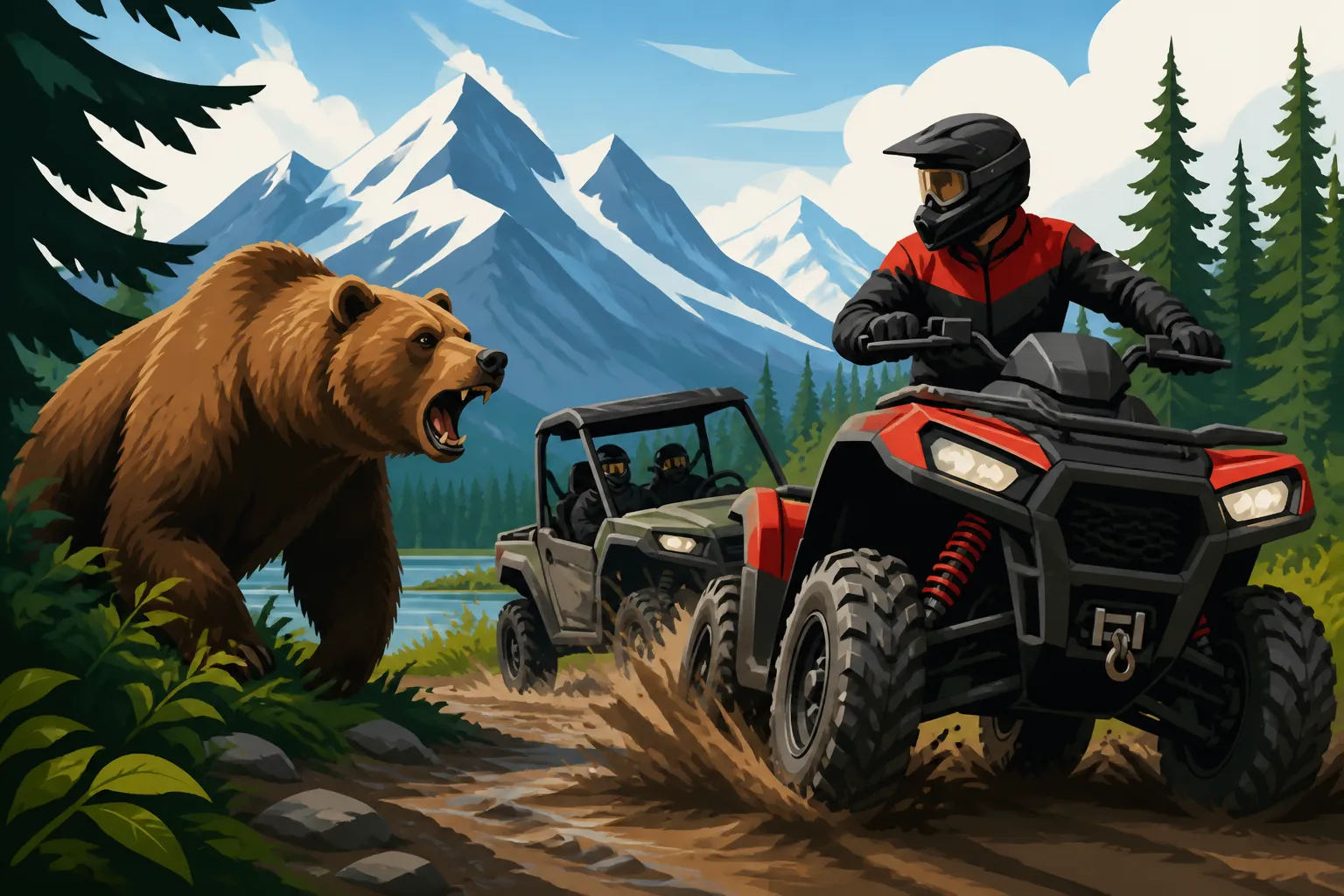
When a bear appears, ease off the throttle and stop if you can do so without creating a collision risk. Keep the group together and speak in a calm, clear voice so the bear can identify you as people. Do not shout, make sudden movements, or rev the engine to intimidate it. Never drive toward the bear, surround it, or block its route away from you.
If the bear is simply moving through the area and has not approached, give it time and room to continue. Back away slowly if the trail permits, keeping the bear in view without crowding it. Do not run. If you’re riding with others, make sure everyone knows the plan before anyone moves: a sudden departure by one machine can startle the bear or split the group.
A bear may stand on its hind legs or sniff the air to learn more about what it sees. That behavior alone does not necessarily mean it is about to attack. Focus on creating space rather than interpreting every movement as a threat. If the bear comes closer, changes direction toward you, or otherwise makes you feel unsafe, keep calm and prepare to use bear spray if you carry it. Follow the canister’s instructions and use it only when the bear is within the product’s effective range.
If a bear approaches or charges
Do not try to outrun a bear on an ATV. The machine may be unable to turn quickly, the surface may be slippery, and an abrupt escape attempt can cause a crash or provoke the animal. Keep people together, avoid sudden movements, and be ready to retreat slowly if there is a safe route. If bear spray is available, it should be easy to reach, not buried in a pack or storage compartment. Know how to remove the safety mechanism before you need it.
A defensive charge can be frightening, and it may stop before contact. Use bear spray according to its instructions when the bear is close enough for it to be effective. Do not wait until the last possible moment to figure out how the canister works. A rider who has never practiced accessing it may lose precious time fumbling with a zipped bag or trying to separate from the machine.
If a bear makes physical contact, the right response depends on the kind of encounter and the bear’s behavior. Defensive attacks by brown bears are different from predatory attacks, and black bear encounters can require a different response. There is no single reaction that is right for every situation. Learn the recommended response for Alaska bear encounters before your trip, and follow current guidance from local wildlife authorities. Do not rely on a short rule of thumb to replace judgment in a life-threatening situation.
| Situation | Safer response |
|---|---|
| Bear seen at a distance | Stop or slow down, keep the group together, and give it room to move away |
| Bear on a narrow trail | Do not squeeze past or approach; wait at a safe distance or turn around |
| Bear comes closer | Stay calm, avoid sudden movement, and prepare accessible bear spray |
| Bear charges | Do not try to race away; use bear spray when appropriate and follow its instructions |
| Bear near cubs or food | Increase distance and do not block its escape route |
Prepare your group before the ride
Carry bear spray where you can reach it
Bear spray only helps if it is accessible and you know how to use it. Carry it in a holster or other position that can be reached quickly, rather than inside a backpack, cargo box, or closed vehicle compartment. Before leaving, check that the canister is in good condition and review its operating instructions. Avoid practicing with a live canister unless you intend to discharge it; understand how it works without wasting the contents.
Wind and close quarters can complicate its use. A narrow trail, a strong crosswind, or a group of riders clustered together may make it harder to deploy spray safely. Talk through how riders will avoid spraying one another and what they will do if the wind is blowing toward the group. If you’re unsure where to carry it on a particular machine or how to make it reachable while wearing your gear, try the setup at home before the ride.
For routes near Anchorage and the Chugach area, [Carrying Bear Spray on a Chugach Ride] is a useful companion topic. Bear spray is not a substitute for keeping distance, staying alert, or knowing when to turn around. Riders should also understand that other hazards can appear suddenly; [Alaska Moose Encounters While Riding] covers a different wildlife situation that calls for careful spacing and controlled riding.
Agree on group behavior and a backup plan
Before starting, decide who will lead, who will bring up the rear, and how the group will stop if someone spots wildlife. Agree that no one will ride ahead to get a better view or pass a bear without checking with the rest of the group. A simple plan helps prevent the confusion that can happen when one rider brakes, another turns around, and a third keeps moving.
Check that everyone knows how to communicate if engines are running or riders are spread out. Hand signals, radios, or a clear stop procedure can help, but the group should not depend on a phone signal in remote country. Share your intended route and expected return time with someone who is not riding with you. For trips beyond reliable coverage, consider how you will call for help; [No Cell Coverage Off the Road System] and [Choosing a Satellite Messenger for a Backcountry Ride] cover planning for that problem.
A map can help the group understand its route, but it cannot tell you whether a bear is on the next bend. You might use onX Offroad to review route options before leaving, then confirm access and trail conditions with the relevant land manager or local contacts. Keep a backup navigation plan and don’t assume an app or phone will work throughout the ride. If you’re heading into remote terrain, [Filing a Trip Plan With Someone] is a sensible part of the preparation.
Decide when to turn around
Do not push through an unsafe sighting
Turning around is the right call when the bear stays near the trail, the route gives you no safe space to pass, or the group is becoming unsettled. It is also wise to reconsider the ride if you see repeated bear sign in a tight, brushy stretch, or if visibility and weather make it hard to watch the trail. The fact that you have already driven a long way to reach a trailhead does not make a close pass safer.
A UTV’s enclosed cab may feel protective, but it should not be treated as permission to approach wildlife. A quad offers even less physical separation. In either case, a bear can move faster than a machine can maneuver in rough terrain, and a close encounter can endanger riders and the animal. Maintain distance and leave a clear path for the bear to move away.
Closures and changing conditions can also affect whether a route is sensible. Check for current notices before you ride and be prepared to change plans if a trail is closed or unsafe. [Alaska Trail Closures After a Storm] explains why conditions can shift; [Alaska Riding in Summer] provides more seasonal context for planning around vegetation, weather, and trail use.
Review the ride afterward
Once you’re safely away, make a note of where the sighting happened and what you observed. Share relevant information with the appropriate land manager or wildlife authority, especially if the bear was injured, behaving unusually, or repeatedly close to a busy riding area. Keep the report factual: location, time, direction of travel, and any behavior you saw. Avoid posting a precise location publicly if it could draw a crowd toward the animal.
After a tense encounter, take a moment to check on everyone in the group. Riders may feel shaken and make poor decisions if they immediately hurry back onto the trail. Confirm that people are ready to continue, that bear spray and other gear remain accessible, and that the group still has enough daylight, fuel, and communication capacity for the revised route.
A cautious ride is not a failed ride. Alaska’s trails pass through wildlife habitat, and part of riding responsibly is accepting that an animal may have the right of way. When you give a bear distance, avoid attracting it with food, and turn back when the situation calls for it, you protect both your group and the wildlife that makes these riding areas distinctive.
Disclaimer
This article is for general informational purposes only and does not constitute professional advice. Laws, prices and regulations vary by location and change over time. Consult a qualified professional for guidance on your specific situation.