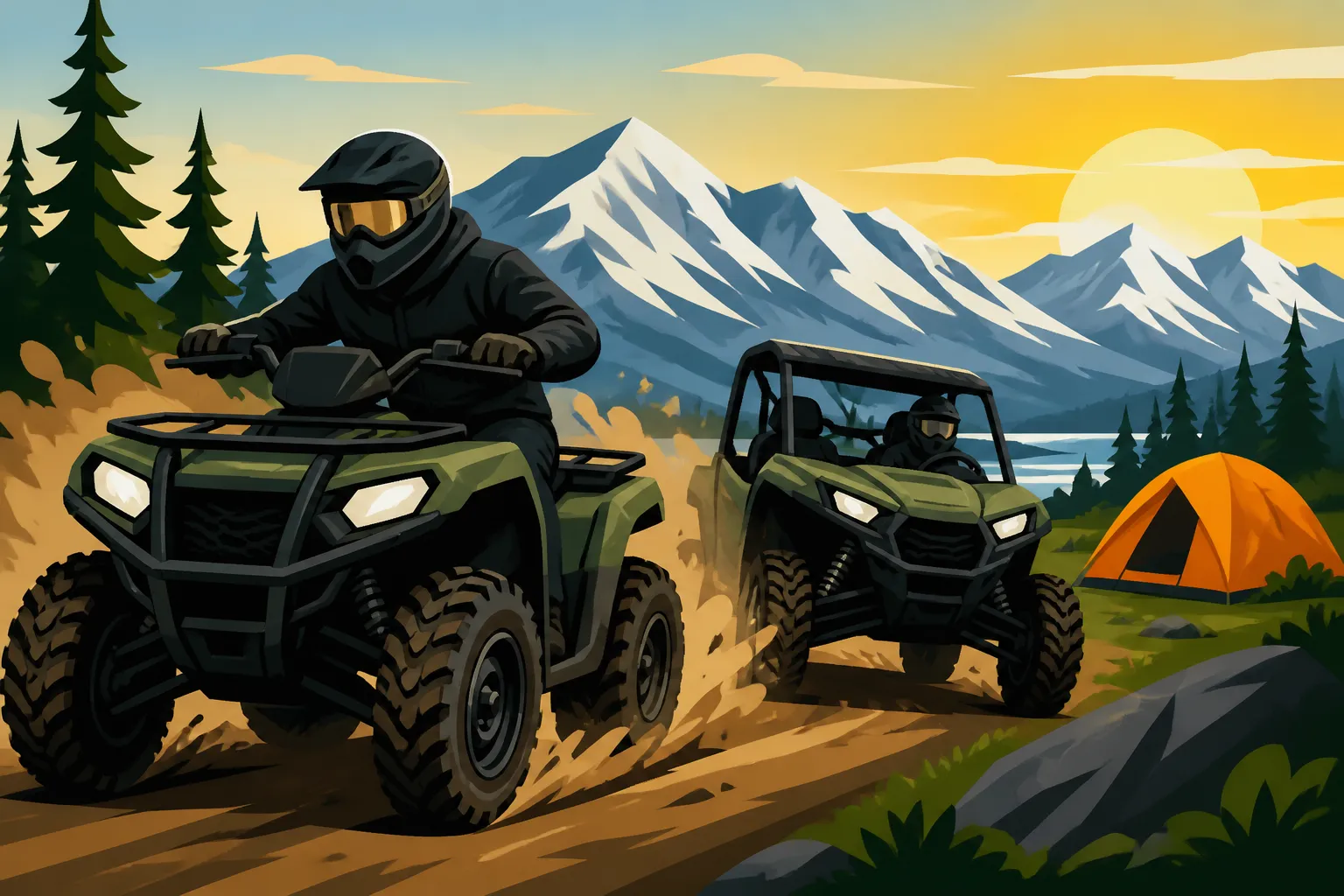
5 mph Past Tents
At Jim Creek Campground, the posted 5 mph limit is easy to underestimate when you’re tired, unloading an ATV, or trying to reach your site before dark. But a campground is not a trail: tents, children, pets, and people moving between vehicles can be close to your tires. This guide explains where the limit matters, how to ride considerately, and what to check before heading out.
What the 5 mph campground limit means
A slow-speed rule for the camping area
The 5 mph limit applies within the campground where the rule is posted, particularly on the roads and areas passing campsites and tents. It is meant to keep vehicle movement slow in a place where people may step into the roadway without warning. A campground road can look open and quiet, but a child might be walking from a tent to a parked truck just beyond your view.
Treat 5 mph as a maximum, not a target you must maintain in every situation. If someone is backing a trailer, a dog is loose, or pedestrians are walking along the road, slow down further or stop and let them pass. At this speed, you have more time to notice what is happening and respond without making the campsite feel like a trail corridor.
The limit is specific to the campground setting. It does not automatically mean that every road or trail in the wider Jim Creek area has the same speed limit. Pay attention to posted signs and instructions wherever you ride, and do not carry a campground speed assumption onto a trail. For broader trip planning, Alaska’s 5 mph Campground Limit covers the posted rule, while Alaska’s 45 mph Road Limit for APVs addresses a separate road-riding context.
Why a campground needs a much lower speed
A vehicle moving even a little faster can create a lot of dust on a dry, busy campground road. That dust can blow into an occupied tent, settle on food, and make an already muddy or sandy campsite less comfortable. Keeping your speed down helps reduce dust and noise for people who came to camp, not listen to repeated acceleration and braking.
Visibility is another issue. Parked trucks, trailers, tents, and trees can block your view of someone walking between sites. A rider may not see a child until the child is already near the roadway. Going slowly gives you a better chance to stop safely, but it does not replace staying alert or watching carefully around blind corners.
Sound carries across a campground, especially when people are trying to rest. A quick pass may seem harmless to the rider, but a stream of vehicles can interrupt a meal, a conversation, or a child’s nap. Think of the limit as part of being a good neighbor: ease off the throttle, avoid unnecessary revving, and give pedestrians room.
The campground is not a place for extra riding
A campsite area may sit close to riding access, but that does not make every open patch of ground a route. Follow designated campground roads and any directions from signs or staff. The posted speed limit does not grant permission to cut between campsites, circle a tent area, or ride off-road wherever the ground looks clear.
This distinction matters at Jim Creek, where campground rules and riding-area access are not the same thing. No Cross-Country Travel in Camp is a useful reminder that the campground should not be treated as an open play area. If you are unsure whether a short connector is an approved route, stop and check rather than guessing.
The campground is one part of a larger recreation area, and its facilities and rules may differ from those on surrounding land. Before planning a ride from camp, review Jim Creek’s Trailhead on Sullivan Road in Alaska and the information for Alaska’s 26-Site Campground at Jim Creek. These references help separate the campground itself from the trailhead and riding areas nearby.
How to ride through camp without disturbing people
Approach campsites as places where someone may be outside
As you enter the campground, assume that someone could be walking out from behind a tent or trailer. Keep your eyes moving between the roadway, campsite openings, parked vehicles, and the ground near your tires. If a site is partly hidden, slow further before passing it rather than waiting until you can see a person.
Use a smooth, steady throttle. Sudden bursts of acceleration are noisy and can kick up dust; hard braking can also surprise people who are walking nearby. If the road is narrow, give pedestrians the right of way and wait until there is room to pass without squeezing between them and their campsite.
A rider carrying gear or towing a small trailer should be especially patient. Extra width and weight can make close passes awkward, and stopping may take longer than expected. If someone is approaching from the opposite direction, pull over only where it is safe and allowed, then let them pass instead of trying to thread through a tight gap.
Make arrivals and departures quiet and deliberate
The busiest time in a campground is not always obvious. One family may be unloading while another is walking to the restroom, and someone at a neighboring site may be putting a child down for a nap. When you arrive, take a moment to identify your site and the safest route to it before driving around looking for the right turn.
If you need to unload an ATV or UTV, do it in the designated area or at your site as directed, and avoid repeated engine starts or unnecessary repositioning. If you can organize straps, helmets, and bags before starting the machine, you may be able to reduce the time spent idling and maneuvering. Keep the path clear for other vehicles and people.
When leaving, check behind and beside the machine before moving. A passenger or family member may be walking behind you, and a parked vehicle can hide someone crossing the lane. A slow departure is usually less stressful than an abrupt stop or a close call. For campground planning beyond speed, Alaska’s 14-Night Camping Limit and Alaska’s 45-Night Annual Cap cover separate stay limits that may matter to a longer trip.
Respect other campers even when the road looks empty
An empty-looking road is not necessarily a clear road. People can be inside tents, behind vehicles, or walking back from another part of the campground. Keep to the posted limit even if there is no one immediately visible, and avoid treating quiet hours or low traffic as permission to speed.
If another rider passes too quickly, do not respond by following or confronting them while driving. Give them room, protect your own campsite, and contact campground staff or the appropriate site manager if there is an ongoing safety concern. A calm response is more likely to keep the issue from escalating.
Good campground etiquette continues beyond speed. Keep noise down, avoid blocking access, and leave other people’s campsite boundaries alone. Alaska Trail Etiquette Locals Expect offers useful habits for sharing riding areas, but the same basic courtesy matters at camp: make space, communicate clearly, and avoid assuming that another person is comfortable with your route.
Campground speed versus trail riding rules
Do not confuse a campground rule with a trail speed limit
The 5 mph rule is tied to the campground environment. It is not a universal speed limit for every road, trail, or piece of land around Jim Creek. Once you leave camp, follow the signs and rules for the route and land you are actually on. Different roads and riding areas can have different restrictions, and some places may not allow APVs at all.
A map can help you plan, but it cannot replace signs or land-manager directions on the ground. Riders sometimes use onX Offroad to look over possible routes before leaving, then confirm access and restrictions with posted information when they arrive. Treat any mapping tool as a planning aid, not permission to enter an area or proof that a route is open.
If your planned route crosses more than one type of land or access point, take time to check the details before starting the engine. A trailhead pass, campground reservation, or parking payment should not be assumed to cover every riding permission. Alaska Trailhead Passes at Government Peak discusses a different recreation area, but it illustrates why it is worth checking what a pass actually applies to rather than assuming one payment covers everything.
Check access, fees, and site rules separately
Before you set out, confirm the campground’s current instructions, including where vehicles may travel, where to park, and whether any areas are closed. The posted rules at the site should guide what you do there. If a sign appears unclear or conflicts with what you expected, pause and ask the campground contact or land manager instead of interpreting it in the most convenient way.
Fees and access requirements may apply to different parts of a recreation trip. A campground fee, day-use fee, parking pass, or land-use permission can serve different purposes. Review Alaska Day Use Fees at Jim Creek alongside campground information so you know which costs and rules apply to the places you plan to use.
For route planning, onX Offroad can be one way to review potential trails and nearby access points before leaving camp. Check the map carefully, compare it with official signs and local directions, and avoid riding into an area just because a line appears on a screen. If the route crosses private land, a closure, or a restricted area, turn around and find an authorized alternative.
Leave room in your plan for changing conditions
Conditions can change how safely you can move through camp. Rain can make roads slick, mud can hide ruts, and parked vehicles can narrow a route. In those conditions, riding below the posted maximum may be the sensible choice. If visibility is poor or the road is crowded, stop and wait until you can proceed safely.
At Jim Creek and other Alaska riding areas, a plan should also include a clear turnaround point and enough time to return before conditions or visibility worsen. onX Offroad may help you prepare by reviewing a route in advance, but do not rely on a phone or map as your only source of direction. Carry the information you need in a way that remains useful if your battery runs down or you lose service.
A flexible plan is better than trying to keep to a schedule at the expense of safety. If a campground road is busy, wait. If a route is closed, choose another authorized option. If you cannot confirm access, do not ride it. Those small decisions help protect other campers and keep your trip from becoming a preventable problem.
A practical checklist for riding past tents
Before starting your machine
Take a minute to prepare before you move through the campground. Confirm your campsite location, check the route you are permitted to use, and make sure passengers know to stay seated and keep hands and feet inside the machine. Secure loose gear so it cannot fall into the road or distract you while riding.
Look over the machine before departure. Check that the brakes respond, the throttle returns properly, and your lights work if you may be moving in low light. If you are towing or carrying a load, account for the extra width and stopping distance. A machine that handles easily on a trail may feel different when maneuvering slowly around parked vehicles and people.
If the campground is crowded, consider whether you need to ride through at that moment. Waiting a few minutes for a family to unload or a group of pedestrians to pass is often the easiest option. The purpose of the limit is not simply to avoid a citation; it is to reduce the chance of someone getting hurt or a neighbor’s stay being disrupted.
While moving through the campground
Keep your speed at or below the posted 5 mph limit, and go slower whenever the situation calls for it. Watch for people emerging from behind vehicles, children near tents, and pets that may move unpredictably. Leave a generous gap when passing, and stop if there is not enough room to pass comfortably.
Avoid abrupt acceleration, repeated revving, and unnecessary laps around the campground. Follow the designated access route and do not ride between sites or across open ground unless the campground’s directions specifically allow it. If someone is walking in your path, stop and let them move through rather than expecting them to step aside.
Stay attentive until you are fully clear of the campground’s posted low-speed area. Do not assume that the rule ends at the first turn or where the tents become less visible. Follow signage as you leave, then apply the rules for the route or riding area ahead.
If you are unsure what a sign means
Stop in a safe place and read the sign carefully. If the wording is unclear, ask campground staff or the land manager before riding farther. It is much easier to clarify a rule while parked than to explain why you rode into a restricted area.
A useful trip-planning approach is to keep campground rules, trail access, and land permissions as separate questions. The campground tells you how to behave around sites; the trail or road rules govern travel beyond camp; and land ownership determines whether you may be there at all. Resources such as Alaska ATV Trails: Where to Ride can help with broader planning, but local signs and official directions should settle questions about a particular location.
| Situation | Safer approach |
|---|---|
| Passing occupied tents | Stay at or below 5 mph and watch for people stepping into the road |
| Dusty or crowded campground road | Slow below the posted maximum or wait for a clear opening |
| Unclear route through camp | Stop and ask before continuing |
| Leaving the campground for a trail | Check the trail’s access rules and posted signs separately |
| Using a map app | Treat it as a planning aid, then confirm conditions and permission on site |
The simplest rule is also the most useful: move slowly around camp, stay on authorized routes, and give people plenty of room. The 5 mph limit is there because tents and vehicles create blind spots, and a quiet campground can become busy in seconds. A patient rider makes the area safer and more pleasant for everyone sharing it.
Disclaimer
This article is for general informational purposes only and does not constitute professional advice. Laws, prices and regulations vary by location and change over time. Consult a qualified professional for guidance on your specific situation.