Alaska Tundra Damage and Riding
A tundra trail can look dry and firm from the seat while hiding soft ground that tires quickly turn into ruts. In Alaska, those tracks may channel water, expose roots and moss, and widen as riders steer around damaged spots. This guide explains why tundra is vulnerable, how to choose a more durable route, and what to do when conditions are too soft to ride responsibly.
Why Alaska tundra is vulnerable to ATV and UTV traffic
A thin surface protects a slow-growing landscape
Tundra is not simply bare ground with a few plants scattered over it. Its surface can include mosses, lichens, sedges, shrubs, and other vegetation growing over shallow soil and seasonally frozen ground. In many places, the growing season is short, and plants recover slowly from disturbance. A tire mark that seems minor on one ride can remain visible long after the machine has passed.
The surface also works as a kind of protective layer. Vegetation helps hold soil in place and slows the movement of water across the ground. When tires crush or tear that cover, the exposed soil can be easier for rain and runoff to move. A rut may deepen as water follows it, especially on a slope or where repeated traffic has made a clear path.
This is why the same machine can have very different effects on different surfaces. A firm, established gravel route may tolerate traffic that would leave lasting damage in wet moss or soft tundra. Machine size matters, too, but it is not the only factor: tire pressure, load, speed, ground moisture, and whether the rider stays on a durable route all play a role.
Ruts can turn a small disturbance into a larger one
Once a tire breaks through the vegetation, the rider faces a tempting choice: steer around the rut. That can feel like the careful option, but repeated detours often widen the damaged area. The next rider may avoid both the original track and the fresh tire marks, gradually creating a broad, braided path across vegetation.
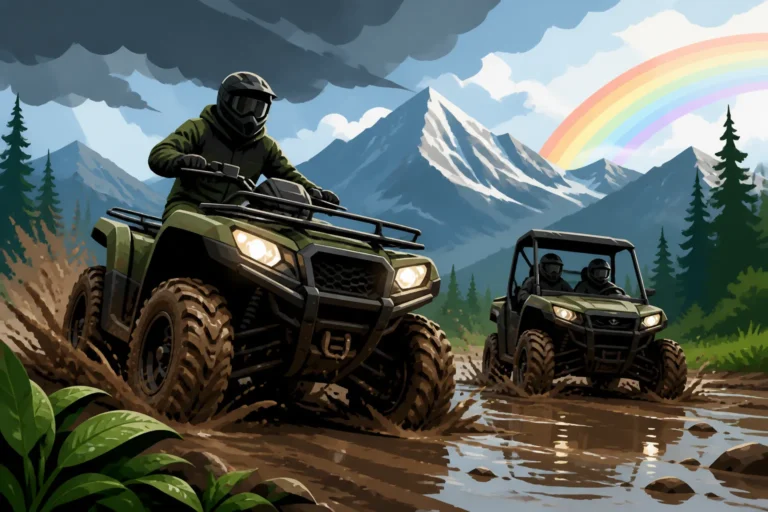
Water can make the problem worse. A rut that catches runoff may become deeper, muddier, and harder to cross. Riders may then cut a new line beside it, creating another channel. On a hillside, runoff moving down a tire groove can carry loose soil farther than the original disturbance.
A useful way to picture the risk is to imagine a narrow wet trail near a lake or creek. One machine leaves a shallow impression. Later traffic follows the same line, and water collects in it. If riders keep moving sideways to avoid the mud, the route may spread across the tundra instead of staying on one established track. Turning around before that begins is often the least damaging decision.
Season and moisture can change a route overnight
A route that felt firm during a dry stretch may become vulnerable after rain, snowmelt, or a warm spell. In Alaska, freeze-up and breakup can also change the ground’s ability to support a machine. Frozen-looking surfaces may conceal soft areas, while thawing ground can lose strength quickly as the season shifts.
There is no single calendar date that makes every tundra route safe. Conditions vary by elevation, drainage, exposure, recent weather, and local ground conditions. A south-facing slope, a low wet pocket, and a gravelly ridge can behave very differently on the same day.
That is why checking the route shortly before departure matters more than relying on a story about how it rode last month. For broader seasonal context, see [Alaska Tundra and Wetland Conditions], [Riding Before the Ground Freezes], and [Breakup and Why Trails Close].
How to choose a route that is less likely to damage tundra
Confirm access before choosing a line
A visible track is not automatic permission to ride. It may cross private property, Native corporation land, a designated area, a state park, or land managed by an agency with its own rules. A general permit or a trailhead pass may apply in one place but not another. Before riding, identify who manages the land and confirm that motorized use is allowed for the route and conditions you have in mind.
Use a land-status map as a starting point, not as the final word. Tools such as onX Offroad can help riders orient themselves, compare mapped routes, and spot property boundaries or access questions to investigate. Map layers and route information should still be checked against the relevant land manager’s current guidance, particularly when a route crosses multiple parcels or approaches a closure.
If you are unsure whether a track is open, ask before riding rather than assuming that tire marks mean it is permitted. The guides [Alaska Land Ownership and Who to Ask], [Checking a Land Status Map], and [Alaska General Permit Requirements] explain why ownership and land rules matter. A route that is legal in one section may not remain legal after a boundary crossing.
Prefer established, durable surfaces
When access is allowed, choose a clearly established route over an open-ended line across vegetation. Gravel, rock, and other firm surfaces generally tolerate traffic better than wet, soft tundra. That does not make every gravel route open or safe; it simply means surface durability should be part of the decision alongside access, weather, and closures.
Avoid creating a shortcut around a wet spot, a steep section, or a stream crossing. If the marked route is too soft or damaged to ride without widening it, turn back or wait for better conditions. Do not fan out to find a drier line unless the land manager has specifically directed riders to do so. What looks like a small detour from the seat can become a second trail.
When scouting with onX Offroad or another mapping tool, look for a known route rather than drawing a new line across open terrain. Check whether the route continues across the land boundary you plan to cross, and keep a backup option that does not depend on pushing through a wet or uncertain section. The map can help with planning, but it cannot tell you whether the ground is firm enough under today’s tires.
| Route condition | Lower-impact choice | When to pause or turn around |
|---|---|---|
| Firm, established gravel track | Stay on the existing route and avoid widening it | The route is closed, access is unclear, or the surface becomes unstable |
| Wet moss or soft tundra | Do not make a new line across vegetation | Tires begin sinking, spinning, or leaving deep marks |
| Existing muddy rut | Avoid adding a parallel track; assess whether the route remains passable | Crossing would deepen the rut or force a wide detour |
| Creek or drainage approach | Use a designated crossing if one is allowed and clearly established | Banks are soft, water is rising, or no durable crossing is apparent |
| Snowmelt or thawing ground | Recheck conditions and consider postponing | The surface is thawing, saturated, or changing under traffic |
Treat closures and local advice as part of route planning
A closure is not merely a suggestion about convenience. It may protect fragile ground during breakup, prevent damage in a sensitive area, or address a hazard that is not obvious from a trailhead. Check signs at the access point and follow instructions from the land manager. Conditions can change after storms or seasonal transitions, so a route that was open on a previous trip may not be suitable now.
Local advice is especially useful when a trail approaches a wetland, stream, or broad tundra slope. A person familiar with the area may know that a particular crossing is unstable, that a route is closed during a certain period, or that riders should stay on a specific corridor. If information conflicts, do not resolve the uncertainty by testing the ground with a machine.
For riding near popular areas, including the Mat-Su and Knik River region, distinguish between the public access route, the land beneath it, and any adjoining managed area. [Alaska Land Status Maps] and [Alaska Tundra Damage and Riding] are useful starting points for understanding why a boundary or surface change can matter even when the landscape looks continuous.
Riding practices that reduce damage on the trail
Keep tires on the existing track
Once you are on an authorized route, stay on it as consistently as conditions allow. Avoid riding side by side across vegetation, passing another machine off-trail, or making a new line to bypass a rough patch. On a narrow route, wait for a safe place to pass or let the other group clear the section rather than broadening the trail.
Smooth control matters. Spinning tires can dig into soft ground, while sudden steering can tear vegetation along the trail edge. Carry only what the machine and route can safely support, and slow down where the surface is soft or visibility is limited. A heavier load can increase pressure on the ground, so a loaded side-by-side deserves the same caution as a smaller quad—and sometimes more.
If a machine begins to bog down, resist the urge to keep accelerating. Repeated wheel spin can turn a shallow impression into a trench. Stop, assess the surface, and use a recovery approach that does not pull the machine through more vegetation. If there is no low-impact way to recover it, getting help may be better than worsening the damage.
Turn around before the trail becomes a test
Riders often continue because they have already travelled a long way, or because the difficult section appears just a little farther ahead. That is understandable, especially on a remote trip where turning back feels like losing the day. But distance travelled does not make soft ground more durable. If the route is degrading beneath the machine, continuing may put the vehicle, the riders, and the landscape at greater risk.
Set a turnaround rule before leaving. For example, agree that the group will stop if tires begin leaving deep impressions, if the trail becomes a series of wet detours, or if a crossing cannot be approached without cutting into the bank. A shared rule makes it easier for the group to turn back without one person feeling responsible for ending the ride.
Before a longer trip, think through fuel, weather, daylight, communications, and recovery options. A remote route can become stressful when riders are cold, tired, or worried about getting back. Planning ahead reduces pressure to push through questionable ground. [Alaska Tundra Damage and Riding] and [Alaska Wetland Travel Restrictions Explained] offer further context on why sensitive surfaces deserve extra care.
Leave a damaged area as undisturbed as possible
If you encounter existing damage, do not widen it to make the passage more comfortable. Avoid driving around the edge of a rut, and do not encourage other riders to follow a new line. If the route is clearly impassable without causing more damage, turn around and report the condition to the relevant land manager when appropriate.
A quick note about the location can help: record the route name or nearby landmark, describe what the ground looks like, and explain whether the damage appears to be spreading or creating a hazard. If you use onX Offroad or another mapping app, a saved waypoint can help you identify the area later. Share the information with the agency or land manager responsible for that ground rather than posting an unverified claim that could send more traffic to a sensitive location.
Do not attempt restoration work unless the land manager asks for it or provides direction. Moving soil, cutting vegetation, or redirecting water can create additional impacts. The most helpful action may simply be to stop adding traffic and pass along clear, factual information.
A practical pre-ride checklist for tundra country
Check access, weather, and surface conditions
Before loading the machine, confirm that the route is open to the type of vehicle you plan to ride and that you have permission to cross each part of the route. Review land ownership and any applicable permit requirements. If the route touches a park, refuge, Native corporation land, or private parcel, check that area’s specific rules rather than assuming one permit covers everything.
Look at recent weather and consider what it means for the actual ground, not just the forecast. Rain, snowmelt, thaw, and high water can change a route’s condition. If you cannot learn whether a known crossing is usable, choose another route or postpone the ride. [Alaska Tundra and Wetland Conditions] and [Alaska Land Ownership and Who to Ask] can help frame those checks.
Then make a realistic plan for the whole group. Confirm that riders know the route, establish a turnaround point, and agree on what counts as a reason to stop. Make sure the group has a way to communicate if machines become separated or the route is blocked.
Use a simple go-or-no-go check at the trail
At the trailhead, inspect the surface before committing. Look for water standing across the route, fresh deep ruts, torn vegetation, soft banks, or signs that previous traffic has spread beyond the main track. Compare what you see with the map, but let the ground conditions guide the decision.
Use this quick check:
- Is motorized access allowed on this route today?
- Is the route clearly established and on the correct land?
- Can the machines stay on a durable surface without widening the trail?
- Are crossings and slopes firm enough to use without spinning tires or damaging banks?
- Does the group have a safe turnaround plan if conditions worsen?
If any answer is uncertain, pause and get reliable local guidance. A postponed ride is frustrating, especially when everyone has travelled to the trailhead, but it is usually less costly than getting stuck or leaving a broad scar across tundra.
Make the low-impact choice the easy choice
The best time to avoid damage is before the tires reach fragile ground. Choose a route that fits the weather, machine, and group rather than treating every mapped track as a challenge to complete. Keep the group together, stay on authorized routes, and make turning back an ordinary part of the plan.
Alaska’s landscapes can look rugged enough to withstand anything, but tundra surfaces are not interchangeable with rock or gravel. A little patience at the trailhead, careful route checking, and a willingness to stop when the ground is soft can help protect the places riders came to experience in the first place.
Disclaimer
This article is for general informational purposes only and does not constitute professional advice. Laws, prices and regulations vary by location and change over time. Consult a qualified professional for guidance on your specific situation.