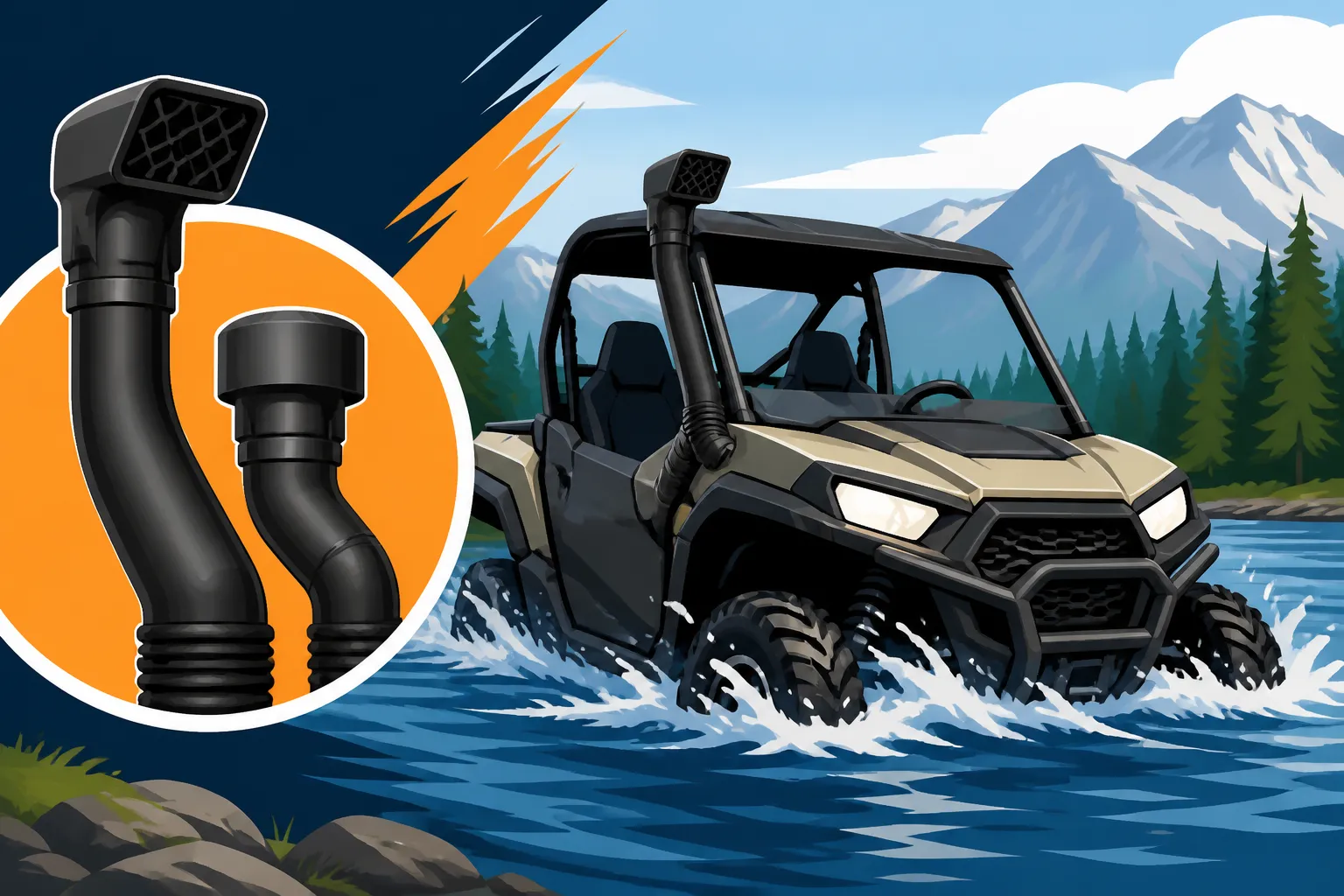
Snorkels for Deep Crossings
A snorkel can help keep an ATV or UTV’s engine and belt intake above water, but it does not make a machine waterproof or make every Alaska crossing safe. Glacial channels can deepen or shift quickly, and water can enter through components a snorkel does not protect. This guide explains what a snorkel does, how to prepare, and when turning around is the smarter choice.
What an ATV or UTV snorkel does
Engine intake and CVT protection
An engine snorkel relocates the engine’s air intake to a higher point on the machine. If the original intake sits low, water entering it can reach the engine and cause serious damage. A snorkel may reduce that risk during a crossing, but only if it is correctly installed and sealed—and only while the water stays below the intake opening.
Many ATVs and UTVs also use a continuously variable transmission, or CVT. The CVT housing often draws in air to cool the belt, and its intake and outlet may be positioned lower than a snorkel’s engine intake. Water in the CVT can cause belt slippage, poor performance, or a breakdown. A setup intended for deeper crossings may therefore include raised CVT intake and exhaust vents as well as the engine intake.
Do not assume the tall pipes on a snorkeled machine protect every system. Differentials, transmission components, fuel-system vents, electrical connections, and other openings may also be vulnerable. Their locations and protection vary by machine and installation. Check the owner’s manual and consult a qualified mechanic about the specific model rather than relying on a generic depth claim.
What a snorkel cannot protect
A snorkel does not raise the whole machine. Water may still enter through wheel bearings, seals, electrical connectors, or unprotected vents. It also does not prevent water from getting into the exhaust, and it cannot keep the machine from being swept sideways or losing traction in a current.
Even a well-prepared machine has limits. A crossing that reaches the seat, covers the airbox, or exposes sensitive components to moving water may be unsafe regardless of snorkel height. If water gets into the engine, continuing to crank or start it can make the damage worse. Follow the manufacturer’s instructions and get qualified help before trying to restart a machine that may have taken in water.
Think of a snorkel as one part of a preparation plan, not a permission slip to go deeper. Pair it with careful route selection, an honest assessment of current conditions, and a willingness to turn back. For a closer look at the risks specific to glacial channels, see Alaska Braided Glacial River Crossings.
Preparing a snorkeled machine for an Alaska crossing
Check the entire installation before riding
Before heading out, inspect the snorkel system and the machine’s other vulnerable points. Look for loose fittings, cracked hoses, gaps around connections, and any parts that have shifted. A tall intake tube is not much help if a joint below it leaks. If you did not install the system yourself, ask the installer to explain what is protected, what is not, and how to inspect it.
Confirm that the engine intake and CVT vents are routed as intended for your model. Check the owner’s manual for operating limits and service guidance, and ask the manufacturer or a qualified mechanic whether modifications affect maintenance or warranty coverage. Do not treat a setup made for one ATV or UTV as automatically suitable for another.
It is also worth checking the machine after previous rides. Mud, silt, and debris can collect around openings and fittings, while vibration can loosen hardware. A quick pre-ride check is easier than discovering a problem at the water’s edge, far from a road or repair shop.
Plan for the route, not just the machine
A crossing decision starts before you reach the river. Check where the route goes, what land it crosses, and whether riding is permitted there. Tools such as onX Offroad can help you review mapped routes and land boundaries, but a map cannot tell you the depth, speed, or channel layout at the moment you arrive. Confirm access independently and treat mapped information as a planning aid, not a real-time safety report.
Look at the day’s conditions and the likely changes along your route. Alaska’s glacial rivers can carry cold, silty water and shift around gravel bars. A route that looked manageable earlier may change as water rises or channels move. Read Reading a Glacial River Before You Cross for additional crossing considerations, and remember that a route trace does not guarantee a safe line through the water.
Build a conservative turnaround point into your plan. Tell someone where you intend to ride and when you expect to return, especially if you are heading beyond cell coverage. onX Offroad can help you organize route information before departure, but carry the navigation tools and emergency supplies appropriate for the trip rather than relying on a single app or device.
| Crossing concern | What a snorkel may help with | What it does not solve |
|---|---|---|
| Engine air intake | Raises the intake opening above the original location | Does not protect against water entering through leaks or other openings |
| CVT air vents | A snorkel kit may raise intake and outlet vents | Does not prevent belt problems if water reaches the CVT |
| Moving water | Nothing directly | Does not prevent loss of traction, sideways movement, or being swept downstream |
| Changing river channels | Nothing directly | Does not make an old route or crossing point safe |
| Wet electrical parts and seals | Nothing directly | Does not protect every connector, bearing, seal, or vent |
How to assess a crossing before committing
Observe from shore and look for changing conditions
Stop well back from the water and take time to observe. Look for the main current, eddies, submerged obstacles, steep banks, and places where the channel may be deeper than it appears. Glacial silt can make the bottom difficult to see. A shallow-looking surface is not proof of a shallow crossing, and a gravel bar can conceal a drop into a deeper channel.
Pay attention to how the water is moving, not just how high it reaches on the bank. Fast or turbulent water can push a machine off line, even when the depth seems manageable. Cold water can also make a minor mishap dangerous quickly. If the route crosses several channels, assess each one separately; finding a safe line through the first does not mean the next is passable.
Conditions may change while you wait. Rising water, new debris, or a shifting channel are reasons to stop and reassess, not to hurry across. For more detail on recognizing a crossing that should be abandoned, see Turning Back at a Deep Channel. If you are unsure about the current, depth, or bottom, the safest choice is not to enter.
Use a conservative approach and avoid testing your limits
There is no universal safe depth for every ATV or UTV. The allowable depth depends on the specific model, the snorkel installation, the condition of seals and vents, the bottom, and the water’s movement. Use the manufacturer’s guidance and the advice of a qualified technician, and leave a margin for conditions that are hard to judge from shore.
Never use a snorkel’s height as your depth gauge. The intake may sit high while other components remain low, and a machine can lose traction long before water reaches the snorkel opening. Avoid entering water if you cannot identify a safe exit, if the current is pushing debris, or if a mistake could leave you stranded in a remote area.
A winch can help recover a stuck machine in some situations, but it is not a reason to attempt a crossing that is otherwise unsafe. Recovery near moving water adds risks for the rider and anyone helping. Read Winches for a Stuck Machine as part of broader recovery planning, and do not put people in the water or in a line of fire to save a machine.
After a crossing and when not to use a snorkel as a reason to go
Inspect and maintain the machine afterward
After riding through water, follow the maintenance steps in the owner’s manual. Depending on the model and conditions, that may include checking the airbox, engine intake, CVT housing, fluids, brakes, and electrical connections. If you suspect water reached the engine or transmission, do not assume the machine is fine because it still runs. Stop and seek qualified advice.
Pay attention to changes in sound or performance. A slipping belt, unusual engine noise, warning light, or trouble restarting deserves attention. Mud and fine silt can also remain in places that are not obvious from the outside. Clean the machine as recommended, and have it inspected if water exposure was significant or if you are uncertain what entered the system.
Keep notes about the ride and any issues you find. That makes it easier to spot recurring problems, explain the exposure to a mechanic, and catch a loose fitting before the next trip. A snorkel system needs regular inspection; it is not a fit-and-forget modification.
Know when the right answer is to turn around
A snorkel does not change land-access rules or make a route appropriate for riding. Check ownership, closures, and local restrictions before leaving the trail. onX Offroad can help you review mapped access and boundaries as part of planning, but confirm permissions and land status with the relevant manager or owner. See Alaska Land Ownership and Who to Ask and Alaska State Land Riding Explained for related access questions.
Also consider what is under the water. A crossing can damage habitat or violate restrictions even if the machine gets through. In wetlands or fragile ground, avoid creating new tracks or widening an existing route; review Alaska Wetland Travel Restrictions Explained before riding in those conditions. When a route is closed, the water is rising, or access is uncertain, do not treat a snorkel as a workaround.
The same caution applies to frozen crossings. A snorkel is not protection against thin ice, overflow, or a changing river beneath the surface. Check the specific rules and conditions for the route, and review Alaska Rules for Riding a Frozen River before considering winter travel. If you cannot verify a safe, permitted route, turning back protects more than the machine.
Disclaimer
This article is for general informational purposes only and does not constitute professional advice. Laws, prices and regulations vary by location and change over time. Consult a qualified professional for guidance on your specific situation.