Which Permit Covers Riding in an Alaska State Park?
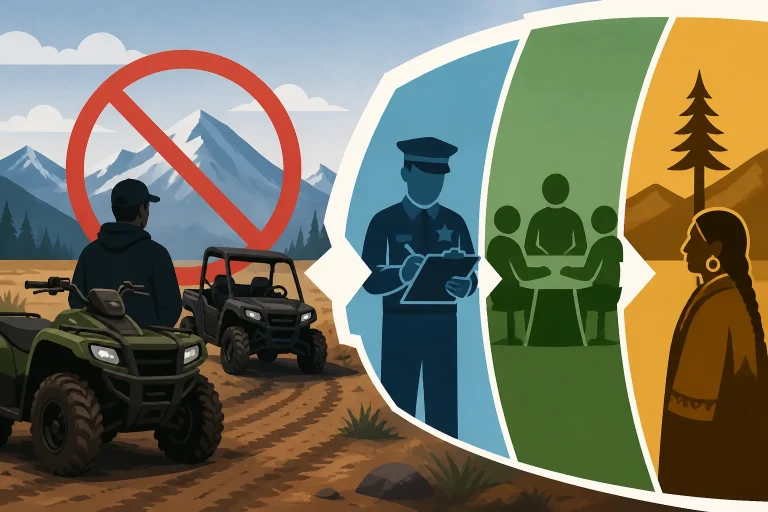
Alaska’s statewide ATV permit can look like the answer to every public-land access question, but state parks are a key exception. If you plan to ride an ATV or UTV inside an Alaska state park, you need to confirm that motorized riding is allowed on your particular route and what park-specific authorization applies. A general permit or trailhead pass alone does not settle it.
The short answer: there is no single permit for every state park ride
Alaska’s statewide general permit for ATV use does not, by itself, authorize riding inside a state park. State parks are excluded from the area covered by that general permit, so an ATV permit that works on eligible state land outside a park boundary does not automatically carry over once you enter the park. See Alaska’s Permit Excludes State Parks and Alaska’s Statewide General Permit for ATV Use for the distinction.
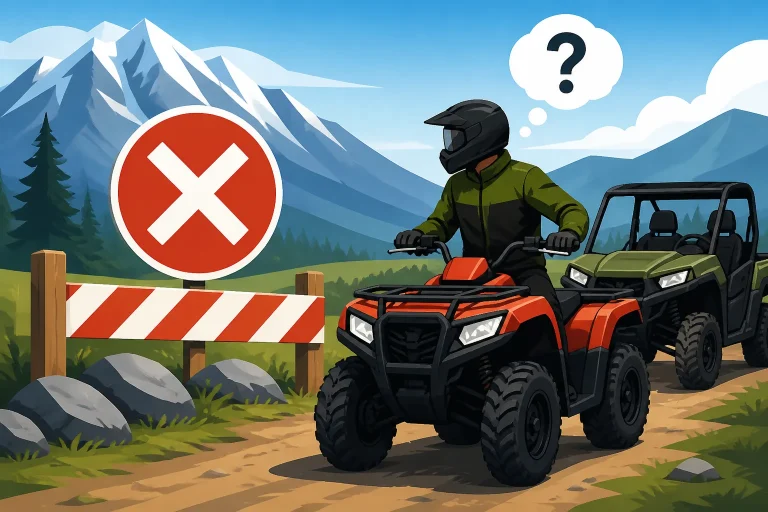
That does not mean every state park has one universal “ATV permit” you can buy instead. Access depends on the specific park unit, the exact route, the type of machine, and any seasonal restrictions or closures. In some places, riding may be allowed only on designated roads or trails. In others, the route you have in mind may not be open to motorized vehicles at all. A park-use or parking pass, if one applies, is not permission to ride wherever you choose.
The practical question is not simply, “Do I have an Alaska ATV permit?” It is: “Does this state park allow my kind of machine on this route, and what authorization or fee applies to that use?” Verify that with the park manager or the state park office responsible for the area before unloading your machine.
| Where you plan to ride | What to check |
|---|---|
| Eligible state land outside a park | Whether the statewide general permit covers that land and activity, and whether other restrictions apply |
| Inside a state park | Whether the park allows ATV or UTV use on your specific route, and whether separate permission is required |
| A trailhead or parking area | Whether a day-use or parking pass is required; a pass does not necessarily authorize riding |
| Private or Alaska Native corporation land | The landowner’s access rules and any required permission or use permit |
| Federal land | The rules and permits of the federal agency managing that area |
What the statewide general permit does and does not cover
The statewide general permit is tied to eligible state land and the permitted activity described in its terms. It is not a blanket license for every public-looking area in Alaska. A boundary on a map can contain land with different owners or managers, and rules can change as you cross from one parcel or management area to another. For a broader overview, see Alaska General Permit Requirements and Alaska State Land Riding Explained.
A state park is managed as a park, not as ordinary state land covered by the general permit. That difference matters even if the park is surrounded by state land, the route looks like a continuation of a nearby trail, or the access point is a public road. The general permit does not override park rules or open a route that park managers have closed to motorized use.
Nor does having a current registration decal prove that a route is open. Registration and land access answer different questions. Registration concerns the machine and its use under applicable vehicle requirements; land access concerns where you may ride and under whose rules. A valid registration is not permission to enter a closed area, cross private ground, or use an unauthorized trail.
The same separation applies to fees. A trailhead pass can pay for parking or a recreation facility without granting permission to ride on the land beyond it. The article A Trailhead Pass Is Not a Land Permit explains why those two authorizations should not be treated as interchangeable.
Before treating a general permit as relevant, check whether the land is actually within its coverage. Use a land status map as a starting point, then verify boundaries and management details with the responsible agency. Maps can be useful for planning, but they may not show temporary closures or the latest route restrictions. See Alaska Land Status Maps and Checking a Land Status Map.
How to confirm ATV access in a state park
Treat access as a park-by-park question. The fact that one Alaska park permits a particular kind of motorized use does not establish that another park does. Even within a park, an authorized road or trail does not mean that all ground nearby is open to riding.
Identify the exact park and route
Start with the formal name of the park unit and the specific route you hope to ride. “Near the park” is not precise enough: your route could cross park land, state land, private property, or land managed by another agency. Mark the starting point, intended trail, turnaround point, and any crossings on a map.
If your ride follows a road, find out whether it is an open park road and whether the park permits your type of vehicle there. A road that is physically passable is not necessarily open to ATVs or UTVs. Likewise, an old track or visible trail does not prove that it is a designated motorized route.
Ask the manager about the activity, not just the permit name
Contact the state park office or manager responsible for the park and give them enough detail to answer accurately. Ask:
- Is ATV or UTV use allowed in this park?
- Is the route I have identified open to that type of machine?
- Are there seasonal closures, temporary restrictions, or limits on vehicle size or use?
- Do I need written authorization, an activity-specific permit, or a reservation?
- Is there a day-use, parking, or other fee, and what does it cover?
- Are there restrictions on unloading, staging, camping, or leaving a vehicle and trailer?
- Does the rule change for a guided tour, group ride, or organized event?
Ask for the route or rule in a form you can refer to later, such as an official map, posted notice, or written response. If the answer is conditional, make sure you understand each condition. “Riding is allowed” may mean only on one named route, during a defined season, or under a particular permit.
For park-specific topics, see [Alaska State Park ATV Rules]. The general principle is to confirm the current rule with the office that manages the place you will actually ride, especially when access depends on a designated trail or a temporary closure.
Confirm both the boundary and the route
Park boundaries are easy to misread when trails run near a boundary or pass through a patchwork of land ownership. Check whether the trail stays inside the park, leaves it, or crosses a parcel managed by someone else. If it leaves park land, the next segment may have a different permit requirement—or may not be open to riding.
Do not assume a public trailhead means public access along the entire route. The land beyond a trailhead may be managed under different rules. If the route crosses private or Alaska Native corporation land, you may need the owner’s permission even if you hold a state permit. Alaska Land Ownership and Who to Ask offers more on identifying the appropriate land manager.
Which authorization might apply to your ride?
There may be more than one requirement to check, and the right combination depends on what you plan to do. A park-specific authorization, when required, is separate from machine registration, trailhead parking rules, landowner permission, and any special permit for an organized or commercial activity.
Riding a designated route
If park staff confirm that a route is open to ATVs or UTVs, follow the conditions they give you. Those may include staying on the named trail, using the route only during an open season, or avoiding areas under temporary closure. A permit does not make an unauthorized shortcut acceptable, and an open route does not necessarily allow cross-country travel beside it.
Ask whether you need a permit for the riding itself or whether the route is open subject to posted rules. Do not infer that a permit is required—or that none is required—based on another park’s process. Park rules and access arrangements can differ.
Parking, staging, and trailhead use
A park may have separate rules for parking, unloading, day use, or overnight stays. Confirm what any fee or pass covers before relying on it. A receipt for parking does not necessarily authorize ATV travel, and permission to use a trail does not automatically reserve space for a trailer or group.
If your planned ride begins at a trailhead outside the park, check who manages that lot and whether it requires a separate pass. The trailhead and the route beyond it may be governed by different agencies. For Mat-Su-area details, Alaska Borough Trailhead Passes can help you distinguish parking requirements from land access.
Events, guiding, and commercial use
A recreational ride with family or friends is not the same as leading a commercial tour, filming, or organizing a larger event. Those activities may require additional permission or a separate permit, even where individual recreational use is allowed. Contact the park office before advertising, collecting payment, bringing a group, or setting up equipment.
Do not assume that a personal-use authorization transfers to a business. If you are planning a guided ride, ask about commercial activity and group requirements directly. See Alaska Event Permits for a Ride and Alaska Commercial Guiding Permits for related permit questions.
Camping and other activities
Camping, fires, fishing, hunting, or using facilities can involve rules separate from ATV access. Permission to ride does not automatically authorize an overnight stay or a particular activity along the route. Check each part of the trip rather than assuming one permit covers the whole outing.
A useful way to avoid confusion is to list every planned activity: where you will ride, where you will park, whether you will camp, and whether the trip is commercial or organized. Ask the park manager which requirements apply to each one.
A practical process before you haul your machine
Use this sequence before setting out. It helps catch the most common problem: having a valid machine registration or general permit but no authorization for the land or route.
- Map the route. Identify the park unit, trailhead, route, turnarounds, and any likely boundary crossings. Do not rely only on a trail name or a route shown on an informal map.
- Check land ownership and management. Confirm whether each section is inside a state park, on other state land, privately owned, or managed by another agency. Start with Alaska Land Status Maps, then verify uncertain boundaries with the relevant office.
- Ask the park manager about motorized access. Give the exact route and machine type. Ask whether ATVs and UTVs are allowed, and whether the route is open for your intended dates.
- Clarify permits and fees separately. Ask what authorizes riding, what covers parking or day use, and whether your group or activity needs extra approval.
- Check for current closures. A route that was open on a previous visit may be closed now because of conditions, maintenance, wildlife concerns, or another management decision.
- Carry proof and follow posted directions. Keep any required permit or written authorization accessible. Follow signs, stay on authorized routes, and be ready to turn around if a closure or boundary differs from what you expected.
If you receive conflicting information, pause before riding and seek clarification from the office responsible for the land. A map, a parking receipt, a registration decal, and a general permit may each be useful, but none should be treated as a substitute for a clear answer about state park access.
Common mistakes that can turn a permitted ride into an unauthorized one
Assuming all state land is covered by the general permit. State parks are not included in the general permit’s coverage. Confirm the land manager and rules at the park boundary rather than carrying the same assumption across it.
Treating the permit as route approval. A permit may apply only to land or activities within its scope. It does not necessarily designate a trail or open every route inside an area. Ask specifically whether the intended route is open to your machine.
Mistaking a parking pass for riding permission. A fee paid at a trailhead may cover parking or day use, not motorized access across the land. Ask what the pass authorizes and who manages the route beyond the lot.
Relying on a visible track. Tire marks, a worn path, or a route shown on an old map are not reliable evidence of current authorization. Use official park information and confirm closures.
Forgetting that routes can cross ownership boundaries. An authorized section inside a park may connect to private land or land managed by another agency. Permission for one segment does not automatically extend to the next.
Assuming a past answer still applies. Park access can change with conditions and management decisions. Recheck before each trip, especially if you are riding early or late in the season, taking a new route, or planning a group activity.
The safest rule is straightforward: identify the land manager for every part of the route, then confirm the route and activity are allowed under that manager’s current rules. If you cannot verify access, choose a route with confirmed authorization rather than relying on an assumption.
Frequently Asked Questions
Does Alaska’s statewide general ATV permit cover state parks?
No. The statewide general permit does not, by itself, authorize ATV or UTV riding inside an Alaska state park. Check the park’s own rules and ask whether the specific route is open.
Is there one ATV permit that works in every Alaska state park?
Do not assume so. State park access is specific to the park, route, vehicle, and applicable restrictions. Contact the park office responsible for the area to learn whether a separate authorization is required.
Does a trailhead pass let me ride into a state park?
Not necessarily. A trailhead pass may cover parking or another defined use, while riding access is controlled separately. Confirm what the pass includes and whether the route is open to your machine.
If my ATV is registered, can I ride on a park trail?
Registration does not establish land access. You still need to confirm that the park allows your machine on the specific route and that you meet any park-specific conditions.
Disclaimer
This article is for general informational purposes only and does not constitute professional advice. Laws, prices and regulations vary by location and change over time. Consult a qualified professional for guidance on your specific situation.