Alaska Group Size on Public Land
A large ATV or UTV group can make a remote ride safer and more social, but it can also create access, parking, and trail-impact problems. In Alaska, there is no single group-size assumption that safely answers every trip: rules can depend on who manages the land, whether the ride is organized or commercial, and the route’s condition. Here’s how to check before inviting everyone.
Is there a statewide group-size limit for riding public land?
Do not assume that one group-size limit applies to every Alaska public land riding area. Land managers can set rules for particular places, routes, events, or activities. A limit that applies to one area may not apply to another, and a large group may need additional permission even where ordinary recreational riding is allowed.
Start by separating the general right to ride from the rules for your specific trip. The statewide permit for certain state lands does not grant blanket access to every public-looking trail, and it does not replace restrictions imposed by other land managers. Alaska’s Statewide General Permit for ATV Use explains the permit’s role; Alaska Land Ownership and Who to Ask helps sort out which authority to contact.
The phrase “public land” can cover land managed by different agencies, and a route may cross more than one kind of ownership. State land, federal land, a state park, municipal land, private property, and Alaska Native corporation land can have different access conditions. A trailhead sign is useful, but it may not tell you every rule that applies farther along the route.
| Trip type | What to check | Why it matters |
|---|---|---|
| A few friends riding recreationally | Land manager rules, route access, and current closures | Ordinary access may still be limited in a particular area |
| A large family or club ride | Group-size restrictions, parking, and staging space | A permitted route may not have room for a large gathering |
| A planned event or organized ride | Whether an event permit or advance approval is required | Organizing a ride can trigger requirements beyond individual recreational use |
| A guided or paid ride | Commercial use and guide authorization | Permission for personal recreation may not cover a business activity |
| A route crossing multiple properties | Rules and permission for each land manager or owner | Access on one segment does not authorize travel on the next |
Before settling on a head count, identify the land and the trip’s purpose. A casual outing with several households is different from a club event with a published meeting point, a schedule, or an organizer coordinating a large turnout. A paid guided ride is different again. If the ride is organized, review Alaska Event Permits for a Ride and, for commercial activity, ask the relevant land manager what additional authorization applies.
A group-size rule may be written into an area’s management requirements, a permit, event conditions, or posted restrictions. It can also be a practical limit rather than a simple number: a narrow trail, small parking area, sensitive ground, or a temporary closure may make a large group inappropriate even if you find no general statewide cap.
How to check the rules before the ride
The most reliable approach is to trace the route, identify who manages each section, and ask about your exact group and activity. A broad search for “ATV rules in Alaska” cannot settle whether a particular trail allows a certain group size on a particular day.
- Map the route and staging area. Record the trailhead, planned route, turnaround point, and any planned stops. Include access roads and connecting trails, not just the main destination.
- Check land status along the route. Use land-status information to see whether the route may cross different ownership or management areas. Alaska Land Status Maps and Checking a Land Status Map are useful starting points, but confirm uncertain boundaries with the responsible office or owner.
- Identify the land manager for each segment. The trailhead agency may not manage the whole route. When ownership or authority is unclear, ask directly rather than relying on a map alone. A route may also pass near private or Native corporation land where separate permission is needed.
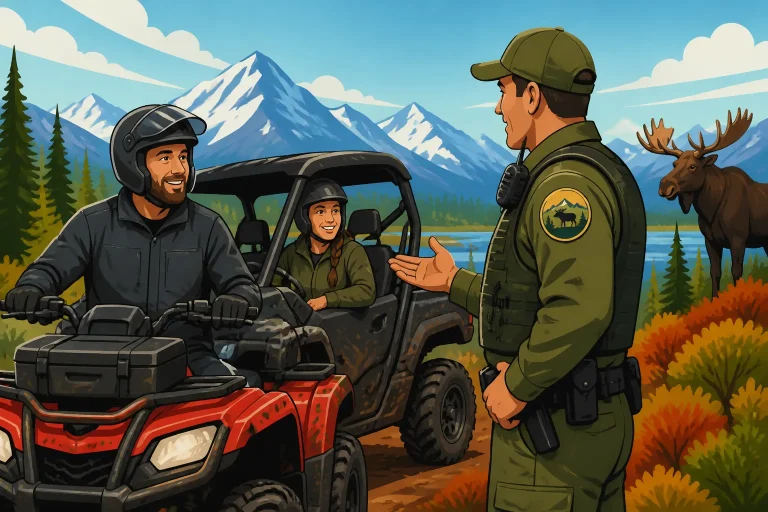
- Describe the trip accurately. Give the manager your estimated number of machines and people, the date, the route, whether the group is organized, and whether anyone is paying for the ride. This helps distinguish a small recreational outing from an event or commercial operation.
- Ask about current restrictions. Check for group-size rules, event requirements, seasonal closures, parking limits, or other conditions that affect the planned route. Ask whether the rule applies to the whole party, each vehicle, or an organized gathering.
- Keep the answer and conditions with the trip plan. If you receive written guidance or a permit, carry it in a waterproof place or keep an accessible copy. Tell the group what was approved and what limits apply.
A precise question gets a more useful answer than “Can we ride there?” For example: “We are planning a noncommercial ride with a specified number of machines on this route, meeting at this trailhead. Is there a group limit, event permit, or parking restriction we need to follow?” If your numbers or plans change, check again; approval for one arrangement may not cover a much larger turnout.
The Alaska General Permit Requirements page can help clarify the state-land permit side of the question. But an area’s rules still matter, and the permit should not be treated as a universal pass for parks, federal land, private land, or land managed by another agency. For a state park, check Alaska State Park Riding Rules and the rules for the particular park rather than assuming the statewide permit covers it.
What counts as a large or organized group?
There is no useful head-count definition that automatically makes a ride “large” everywhere. The number of machines, the number of riders, the way people arrive, and the effect on a small trailhead can all matter. A dozen people in a few vehicles may have a different footprint from the same number spread across many machines, but neither arrangement should be presumed exempt from a local rule.
Organizers should pay attention to how the trip is promoted and managed. A public invitation, scheduled departure, designated leader, planned route, or gathering at a trailhead can make a ride look and function more like an event than an informal outing. That does not automatically mean a permit is required, but it is a reason to ask the land manager before advertising or committing to a date.
Commercial activity requires separate care. If participants pay a guide or operator, or if the ride is part of a business, do not assume that a recreational access permit covers it. Ask the land manager what authorizations apply to guiding, outfitting, or other commercial use. Alaska Commercial Guiding Permits is relevant when a ride involves a commercial guide.
A club ride can also have impacts beyond the trail itself. Several trailers arriving at once may fill a small staging area, block access for other users, or spill onto nearby land. Ask whether there is enough parking and whether the group should stagger arrivals or use another meeting place. Keep the gathering within the designated area and avoid creating a new staging spot beside the trail.
Plan the ride so the group can travel responsibly
Even where a group is allowed, size affects safety and trail conditions. A long line of machines can stretch beyond easy voice range, hide hazards from riders farther back, and make it difficult to regroup. A large party may also take longer to cross a wet or fragile section, increasing the chance that riders spread out or make detours.
Choose a group size that fits the route, the riders’ experience, and the available staging space. If a club or family turnout is bigger than expected, divide into smaller riding groups only if that arrangement is allowed and can be coordinated safely. Splitting a group does not bypass a land manager’s rule: confirm whether a limit applies to the whole gathering or each riding party.
Before departure, designate a lead rider and a sweep rider, agree on stops and regroup points, and make sure everyone knows the route and turnaround plan. Establish a way to communicate if riders become separated. On remote routes, cellular coverage may be absent, so plan how the group will respond to a breakdown, injury, or unexpected closure. Alaska Group Limits on a Narrow Trail and Alaska Trail Etiquette Locals Expect cover related considerations for keeping a party manageable and sharing the route.
Keep the group on the established route and avoid widening a trail to pass, wait, or turn around. If a section is wet, soft, or otherwise vulnerable, stop and assess rather than sending every machine through in quick succession. Respect closures and turn back if conditions or signage indicate that continuing could damage the land or violate access rules. Alaska Trail Closures After a Storm can help explain why a route may be closed or unsuitable after bad weather.
Good group planning includes people who are not riding. Leave space for other trail users, do not block gates or roads, and keep noise and staging impacts in mind. If permission is unclear where a route crosses land you do not control, ask before entering; Asking Before You Ride Through is a useful reminder that access should be confirmed rather than presumed.
The practical rule is simple: verify the current requirements for the land and route, describe the real size and purpose of the trip, and follow any conditions the manager gives you. If the answer is uncertain, reduce the group, choose a route with suitable access and parking, or postpone the outing until you have confirmation. That is more reliable than treating silence on a sign or map as approval for a large ride.
Disclaimer
This article is for general informational purposes only and does not constitute professional advice. Laws, prices and regulations vary by location and change over time. Consult a qualified professional for guidance on your specific situation.