Alaska Trails With Camping
Finding an Alaska ride where you can camp is harder than spotting a trail on a map. A route may cross several kinds of land, and a place suitable for pitching a tent beside your machine may not be open for camping. This guide explains how to match riding areas with overnight plans, check access, and prepare for Alaska’s changeable conditions.
What makes an Alaska trail a good fit for camping
Look beyond the trail mileage
A ride that looks close to camp on a map can turn into a long day when the ground is rough, wet, or crossed by changing streams. Before choosing a camping area, consider the full route: distance, elevation, terrain, fuel needs, likely turnaround points, and how much time your group can comfortably spend riding. A short technical loop can take longer than expected, especially with children, new riders, or a machine that needs attention.
It also helps to distinguish between a trailhead campground and a remote overnight ride. At a developed campground, you may be able to unload, set up camp, and ride from a nearby staging area. A more remote trip may require camping on or near the route, which means confirming both the land rules and the condition of the terrain. A nearby campground does not automatically authorize overnight camping at every point along the trail.
For a first trip, plan a route that lets you return to camp without depending on a long, uncertain crossing late in the day. In Alaska, weather and water can change the practical difficulty of a route. Build in time to turn around rather than treating the farthest point on a map as a must-reach destination.
Start with established camping and staging areas
An established campground can simplify logistics: you have a defined place to sleep, a known starting point, and less guesswork about where camping is allowed. Around the Mat-Su Valley, riders may look at the Jim Creek area near the end of Sullivan Road, while people traveling farther may consider riding options along the Denali Highway. These areas are not interchangeable: access, facilities, land managers, and riding conditions differ, so check current site and route information before leaving.
At Jim Creek, treat the campground and the riding area as separate parts of your plan. Confirm where camping is permitted, where machines may be ridden, and which routes are open to your vehicle type. The nearby [Alaska OHV Camping With Trail Access] guide can help you compare the practical questions to ask when choosing a base camp.
If you are planning around the Denali Highway, remember that a highway corridor and a riding route are not the same thing. The route may include gravel-road travel, side trails, or land with different management rules. Check the relevant local information before assuming you can ride directly from a campsite onto every nearby track. For seasonal planning, see [Alaska Riding Seasons and Breakup] and [Alaska Trails With Camping].
Check land access before setting up camp
Confirm who manages the ground
Alaska’s public-looking landscape can include state land, federal land, state parks, private parcels, and Alaska Native corporation land. Each may have different access and camping rules. A trail being visible, well used, or close to a public road does not prove that you can ride or camp there.
Start by identifying the land manager for the trail and proposed campsite. Then check whether motorized travel and overnight camping are allowed in that specific place. The state’s general land permit does not cover every kind of land, and it should not be treated as permission to cross private property or ride in a state park. Use [Alaska Land Ownership and Who to Ask] and [Alaska's General Permit Covers State Land] to understand which questions to ask.
Mapping tools can help with early planning. For example, onX Offroad can be useful for reviewing routes and land boundaries as part of your research. Do not treat a map layer as final permission, though. Compare what you see in onX Offroad with the land manager’s rules, current closures, and posted signs before you ride or camp.
Separate riding permission from camping permission
Permission to ride through an area does not necessarily include permission to camp there. The reverse can also be true: a campground may welcome visitors but not allow off-road riding from the site. Check each activity separately, including where you may unload, ride, park a trailer, build a fire, and leave a machine overnight.
If the route crosses more than one ownership boundary, plan each section. A legal route across state land could reach a private inholding or land managed by another agency. The boundary may not be obvious on the ground, especially in a wide-open valley or forested area. The guides [Checking a Land Status Map] and [Looking Up Who Owns a Parcel Before You Ride] offer useful next steps for avoiding an accidental trespass.
When you cannot establish that a campsite is open to overnight use, choose a designated campground or contact the manager rather than guessing. This matters especially near villages, cabins, mining claims, and Native corporation lands, where a route that appears informal may cross land with specific access requirements.
Choose a route that suits your group and machine
Compare camping styles before you commit
Your best option depends on whether you want a campground-based weekend, a long day ride with a nearby overnight stop, or a more remote trip. Each asks for a different level of preparation.
| Camping plan | What it can offer | What to check before going |
|---|---|---|
| Established campground near a riding area | A defined place to camp and a convenient base for day rides | Camping rules, machine access, parking, facilities, and any local fees |
| Campground plus a nearby trailhead | A chance to ride a route and return to camp the same day | Whether the trail is open to your machine and whether the trailhead requires a pass |
| Remote overnight trip | More time away from developed areas and a route planned around your group | Land permission, camping permission, fuel range, water crossings, weather, and emergency communications |
| Road-accessible camp with trail riding nearby | Easier logistics for groups with trailers or mixed experience | Whether riding is allowed from camp and whether the connecting route uses public or restricted land |
A campground-based trip is often the gentler choice for a first Alaska riding weekend. You can ride with only the gear needed for the day and return to a known sleeping spot. For a remote overnight ride, every rider should understand the route, carry appropriate supplies, and know what the group will do if weather, water, or a machine problem forces an early stop.
If a trailhead needs a parking pass, remember that a trailhead pass is not the same as permission to camp or ride across all surrounding land. Check the details for the specific trailhead and destination. [Alaska Trailhead Fees and Passes] explains why it is important to keep these permissions distinct.
Match the terrain to the least experienced rider
A route that feels manageable to an experienced rider can become stressful for someone new to riding, especially when carrying camping gear. Added weight changes how a machine handles, and a trailer or loaded rack can make rough ground and steep sections more challenging. Before leaving camp, agree on a comfortable pace and a turnaround time. The goal is a safe return, not reaching a landmark at any cost.
For groups, talk through the route before engines start. Decide who leads, who follows, and where everyone will regroup if visibility drops or riders become separated. Pick a turnaround point that does not depend on reaching a deep river crossing or a difficult section just before dark. The practical advice in [Alaska Group Ride Planning] can help you set expectations for a mixed-experience group.
Use onX Offroad or another mapping resource to plan and discuss the route, but carry a backup plan that does not rely entirely on a phone. Battery life, cold, rain, and lack of service can all complicate navigation. Before you go, share your intended route and return time with someone who is staying behind. [Filing a Trip Plan With Someone] covers why that simple step is especially valuable when riding beyond easy road access.
Prepare for an overnight ride in Alaska
Pack for changing weather and a delayed return
A warm-looking forecast does not guarantee comfortable conditions on an exposed trail. Rain, wind, cold temperatures, and wet gear can turn a pleasant ride into a miserable night. Bring layers that remain useful when damp, reliable rain protection, and a dry set of essentials protected in a waterproof bag. Keep a first-aid kit and basic repair supplies accessible rather than buried beneath camping equipment.
Fuel planning deserves particular attention. Estimate the distance to reliable fuel, account for the terrain and the machine’s load, and leave a reserve for detours or a slow return. Do not use the map’s straight-line distance as a substitute for a real route plan. In remote areas, there may be no convenient place to refill if the route takes longer than expected.
Cell service can disappear well before a route looks remote on a map. Consider what communication method your group will use if a machine breaks down, a rider is injured, or you need to report a delayed return. The related guides [No Cell Coverage Off the Road System] and [Choosing a Satellite Messenger for a Backcountry Ride] can help you think through that part of the plan.
Treat water, mud, and seasonal ground conditions seriously
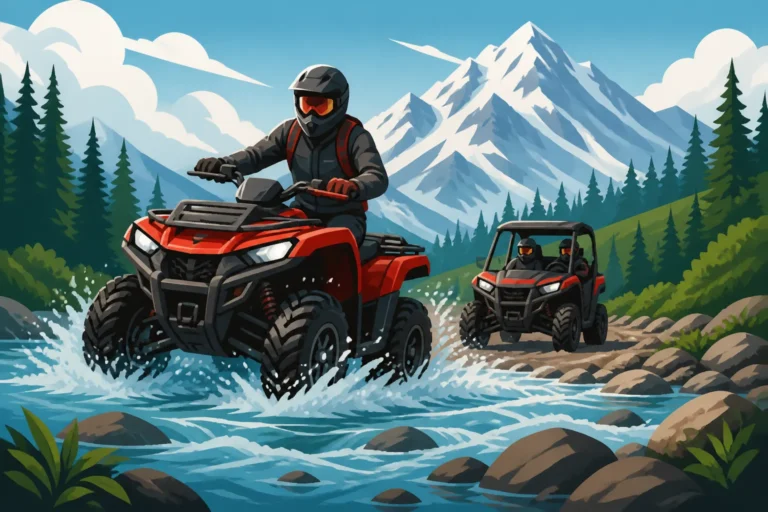
A crossing that appears shallow from the bank may have a soft bottom, a stronger current, or a route that is difficult to see from the approach. Glacial rivers can shift channels, and water levels may change during the day. Stop and assess before crossing; if the route is not clearly safe for your group and machine, turn back. Camping plans should never pressure someone into a crossing they would otherwise refuse.
Wetlands and tundra also need care. A machine can leave damage that lasts long after the riders have moved on, and some ground may be closed or unsuitable for travel during vulnerable conditions. Use established routes where permitted, respect closures, and do not widen a muddy track by riding around the edges. For further planning, read [Alaska Tundra and Wetland Conditions] and [Alaska Stream Crossing Rules].
Before departure, check for current trail or area closures with the responsible land manager. A route that was open on a previous trip may be closed after weather, flooding, maintenance, or resource concerns. If signs on site conflict with your earlier plan, follow the signs and confirm the rules rather than assuming the map is more current.
Leave camp and trail in good condition
Pack out food wrappers, cans, repair materials, and anything else your group brings in. Keep food and scented items secured in a way that follows local guidance, and do not leave scraps for wildlife. Choose a fire location only where fires are allowed, and follow any restrictions in effect. A camp that looks tidy to its occupants can still leave a lasting impact if ash, waste, or vehicle tracks are left behind.
At a campground, follow posted rules for parking, quiet, vehicle movement, and length of stay. At a remote site, avoid creating a new track just to get closer to a preferred tent spot. If the area is saturated or fragile, choose a durable surface or return to an established campground.
The most enjoyable Alaska ATV and UTV camping trips usually have one thing in common: the route is flexible. Confirm land access, choose a suitable base, carry more weather and safety supplies than you expect to need, and be willing to turn around. That approach leaves room to enjoy the ride without turning a camping weekend into a race against changing conditions.
Disclaimer
This article is for general informational purposes only and does not constitute professional advice. Laws, prices and regulations vary by location and change over time. Consult a qualified professional for guidance on your specific situation.