Alaska Has No General Safety Certificate Rule
In Alaska, a family may be ready for its first trail ride and still wonder whether every rider needs an ATV safety card. The answer depends on what you mean by “required”: Alaska does not have one general statewide safety-certificate rule for every ATV or UTV rider, but land managers, military installations, employers, and rental operators may set their own requirements. This guide explains what to check before you go.
What Alaska’s safety-certificate rule means
There is no single statewide course card for every rider
Alaska does not require every person who rides an ATV or UTV to hold one general state-issued safety certificate simply because they are riding an off-highway vehicle. That distinction matters if you are planning an ordinary recreational ride and have heard that a safety card is mandatory everywhere. A course may be useful, and a particular location may require one, but those facts do not create a universal state certificate rule.
The absence of a general certificate requirement is not permission to ride anywhere or in any way. Riders still need to follow the rules that apply to the machine, the location, the road or trail, and the rider’s age. For example, a rule about a driver’s license, helmet, insurance, equipment, access permit, or landowner permission is separate from a rule requiring a training certificate.
It helps to treat the question as two separate checks: “Does this ride require a safety course?” and “What other requirements apply to this ride?” A rider can be exempt from a general course-card requirement and still need to meet other legal or land-access conditions. The useful starting point is Do Only Service Members Need an ATV Safety Course?, which helps distinguish a statewide rule from requirements tied to a specific place or group.
Safety training is different from legal permission
A training certificate does not automatically grant access to public land, private property, a state park, or a trail managed by another agency. Likewise, a land-use permit is not proof that a rider knows how to operate a machine safely. These documents answer different questions, so carrying one does not replace checking whether the other is needed.
Picture a new Alaska resident who takes a course, receives a completion card, and then heads toward a trailhead near Palmer. The course may help that rider understand braking, turning, and terrain, but it does not establish that the selected route is open to ATVs or that the rider has the right permit for that land. Before leaving the parking area, the rider still needs to identify who manages the route and what access conditions apply.
The reverse can also be true. A rider may have permission to use a route but be inexperienced, unfamiliar with local conditions, or unsure how a UTV handles a steep, rutted trail. In that situation, no certificate may be legally required, but training is a sensible way to reduce avoidable risk. Keep legal permission, course completion, and riding readiness in separate mental boxes.
Requirements that can still apply without a certificate
A driver’s license, insurance, or equipment rule is not a course rule
Some ATV and UTV use can bring road-related requirements into play. If you plan to operate an all-purpose vehicle on a road where that use is allowed, check the rules that apply to the rider and machine, including licensing, insurance, and required equipment. Do not assume that an off-road vehicle is free of road rules just because it has no conventional license plate.
A training card does not replace a driver’s license where one is required, and a driver’s license does not prove that the machine meets equipment standards. The same separation applies to insurance: having a safety-course certificate does not satisfy an insurance requirement, while proof of insurance does not establish that a rider completed a course. For road-use questions, review Alaska APV License and Insurance Rules alongside the applicable local rules.
Equipment requirements can also affect a ride even when no course card is involved. Lights, brakes, a muffler, reflectors, and other equipment may matter depending on where and how an APV is being operated. A machine that is suitable for a private trail ride may not be compliant for a road-use situation. Check the relevant requirements in Alaska OHV Equipment Requirements before assuming that a course or a registration decal covers everything.
Permits and land access answer a different question
In Alaska, “Do I need a certificate?” is only one part of a pre-ride check. Riders also need to know whether the land is open to motorized use, whether a permit applies, and whether the route crosses property with separate restrictions. A trail that appears continuous on a map can pass through land managed by multiple owners or agencies.
The statewide general permit is about authorization for certain use of state land, not a general proof of training. It also does not make every road, trail, park, or parcel open to ATVs. Read Alaska General Permit Requirements and confirm that the specific area falls within the permit’s scope. A permit for one category of land cannot be treated as blanket permission for every parcel in the area.
State parks and other specially managed areas may have their own rules. A rider who has a course certificate and a general permit may still need to check whether motorized use is allowed in the chosen park or on the intended route. Start with [Alaska State Park ATV Rules] when a state park is part of the plan, then confirm any site-specific restrictions with the land manager.
A quick comparison of common requirements
| Requirement | What it addresses | Does a safety course replace it? |
|---|---|---|
| Safety-course certificate | Training or a site-specific course condition | No; it documents training only |
| Driver’s license | Permission to operate in situations where licensing rules apply | No |
| Insurance | Financial responsibility where required | No |
| Land-use permit | Authorization for certain land or trail use | No |
| Landowner permission | Access to private or restricted property | No |
| Equipment compliance | Whether the machine has required safety equipment | No |
| Registration or decal | Vehicle identification or registration obligations | No |
This comparison is a useful reminder before a weekend ride: a course card is not a universal “everything is covered” document. If someone tells you a certificate is required, ask which authority requires it and where that rule applies. If someone says a certificate is not required, still check the other requirements that may apply to your route.
Situations where a course may be required
Military installations can set their own course rules
A military base or installation can have access and safety requirements that differ from the general rules for recreational riding elsewhere in Alaska. Service members, employees, family members, and visitors should not assume that the statewide absence of a universal certificate requirement settles what is needed to ride on an installation.
Before bringing an ATV or UTV onto a base, contact the relevant installation office or recreation program and ask about the specific machine, rider, route, and activity. Requirements may depend on whether the ride is recreational, work-related, part of a training activity, or associated with a particular unit or program. A course accepted at one installation or for one purpose may not automatically satisfy another requirement.
This is a good example of why broad internet advice can be frustrating: “Alaska doesn’t require a certificate” may be broadly true as a statewide statement while still being incomplete for a rider entering controlled property. Check Alaska Military Rider Course Requirements well before the ride date, especially if you are coordinating with a group or traveling from another community.
Employers, tour operators, and organized events can add conditions
An employer may require training before an employee uses an ATV for work, even if the state does not require every recreational rider to hold a certificate. A company may have a written safety program, insurance conditions, equipment rules, or job-specific training. Those workplace rules apply because of the work arrangement, not because Alaska has created one certificate requirement for all private riders.
Rental businesses and guided tour operators may also set their own conditions. They can explain a machine’s controls, screen riders for experience, restrict who may drive, or require an orientation before departure. These are operator policies, not necessarily state certification rules. If you are booking a ride, ask what the operator requires of drivers and passengers, what training is included, and whether any separate certificate must be shown.
Organized rides can have event-specific rules too. A club, land manager, or event organizer might require a briefing, proof of experience, or completion of a safety session. That condition can be valid for participation in that event without applying to all riders across Alaska. Get the requirement in writing when possible, and ask whether it applies to each rider, only the driver, or a specific machine category.
Land managers can impose conditions for a particular place
A route may be managed under rules that are more specific than general statewide guidance. A trail, recreation area, worksite, or access corridor can have conditions on vehicle type, rider conduct, time of use, group size, or training. Before setting out, identify the land manager rather than relying only on a map label, a social media post, or what a friend remembers from a prior season.
A practical approach is to call or check the official information for the exact destination and ask one direct question: “Is a safety course or certificate required for this rider and machine on this route?” Then ask separately about permits, registration, and closures. Keeping those questions distinct helps prevent an answer about one requirement from being mistaken for an answer about all of them.
If the ride crosses more than one jurisdiction, repeat the check for each relevant section. A course rule at one managed site does not necessarily carry over to a neighboring trail, and permission from one landowner does not grant passage across another’s property. For a broader access check, Alaska Land Ownership and Who to Ask can help you identify whose rules to confirm.
Why taking a course can still be a smart choice
A new rider can benefit even when no card is required
A new rider often has to learn several things at once: throttle control, braking distance, body position, steering, terrain reading, and how the machine responds when it is loaded with a passenger or cargo. Alaska adds its own challenges, including mud, gravel, water, steep grades, changing weather, and remote stretches where help may be far away. A course can give a beginner a calmer place to practice before those factors pile up.
A certificate is not the main benefit. The useful part is learning how to recognize a poor decision early, such as entering water without knowing its depth, riding too fast for visibility, or following a group onto ground that may not support the machine. A basic lesson can also help a rider understand the difference between a quad and a side-by-side, including how turning and braking feel on each.
A course can be especially valuable when an experienced adult is teaching a child or teen. Parents sometimes know how to ride well but have never had to explain the skill in small, repeatable steps. Structured instruction can give both the young rider and the adult a shared vocabulary for stopping, signaling, spacing, and turning around when conditions change.
Experienced riders may need a refresher too
Time on a machine can build confidence, but confidence and current skill are not always the same thing. A person who rides mostly on a familiar cabin trail may be less prepared for a different machine, a steeper route, a passenger, or an unexpected river crossing. A refresher helps experienced riders notice habits that have crept in over time, such as riding too close behind another machine or relying on memory instead of checking current conditions.
A course can also help when someone switches from a quad to a UTV. The larger vehicle may feel more stable, but that does not make it immune to rollovers, poor visibility, or an awkward line through uneven ground. New controls, a different center of gravity, and passengers inside the cab can change how a driver should approach a trail.
For a rider returning after a long break, practicing in a low-pressure area can restore judgment without the stress of keeping up with a group. That matters in Alaska, where a mistake can be harder to recover from far from a road or service point. Training is most useful when riders treat it as preparation, not as a guarantee that every future decision will be safe.
Choose training that matches the ride you actually plan to do
A useful course should fit the rider’s age and experience, the kind of machine involved, and the conditions they are likely to encounter. A beginner learning on a small quad may need different practice from an adult who drives a two-seat UTV on long gravel routes. Ask what the course covers, whether hands-on practice is included, and whether the instructor addresses the machine type you intend to ride.
For an Alaska outing, look for instruction that emphasizes practical choices: pre-ride checks, protective gear, speed and spacing, trail etiquette, weather changes, emergency planning, and when to turn around. If water crossings or remote travel are part of your plans, ask whether the course addresses those situations without treating them as challenges that every rider should attempt.
Training options can vary by community, provider, and purpose. Alaska Safety Course Options is a helpful starting point for thinking through what kind of instruction may fit your needs. If you are comparing an in-person class with online learning, consider whether the rider will get a chance to practice on a machine with an instructor present.
Preparing children and teens to ride
Check age rules separately from course rules
Parents often ask whether a child can ride if there is no general certificate requirement. Those are separate questions. A child’s age, the size and type of machine, whether the child is driving or riding as a passenger, and where the ride takes place can all matter. A course certificate does not automatically make a machine appropriate for a child, and the absence of a certificate rule does not mean every age or passenger arrangement is allowed.
Start with the applicable youth rules and the manufacturer’s guidance for the specific machine. A child who can reach the controls while parked may still struggle to use them consistently on uneven terrain. Check whether the rider can sit comfortably, reach the controls, operate the brakes, and understand how to stop when asked. Do not use engine size alone as a shortcut for judging whether a machine fits.
Then check helmet and other protective-gear requirements for the place where the child will ride. Road use, public land, a managed recreation area, and private property may not all be governed identically. [Alaska Rules for Young Riders] is a useful companion for separating age-related questions from the question of course certification.
Teach skills in a low-pressure setting
A young rider needs a simple routine that can be repeated before every trip: inspect the machine, put on protective gear, start only when directed, keep a safe following distance, and stop if unsure. Practice those steps in a controlled, open area before heading onto a busy trail or traveling with a large group. The goal is not to make a child ride longer or faster; it is to help them make safe, predictable choices.
Keep practice sessions short enough that the child can stay focused. Fatigue and overstimulation can make it harder to judge speed or follow instructions, especially when the trail becomes noisy, muddy, or unfamiliar. An adult should ride close enough to supervise without pressuring the child to match an older rider’s pace.
For younger riders, instruction should include clear stop signals and an agreed plan for what to do if the group separates. Make sure the child knows not to follow a different group or continue past a point when they cannot see the supervising adult. Those habits can matter more in a remote setting than the card in a wallet.
Passengers need their own safety plan
A child riding as a passenger is not automatically safer than a child driving. The passenger needs a suitable seat, a secure place to hold on, protective equipment, and an adult driver who understands the machine’s limits. A child should not be carried in a position that prevents the driver from controlling the vehicle or that leaves the child exposed to moving parts.
Before the ride, explain what the passenger should do when the machine turns, slows, or stops. Ask the child to keep hands and feet in the intended safe positions, avoid sudden movements, and tell the driver if they feel uncomfortable. A passenger who is frightened or distracted can affect the driver’s attention, so short, familiar routes are often a better first experience than a long trip.
If the ride includes roads or areas with specific passenger and helmet rules, check those requirements directly. A course certificate for the driver does not answer whether the passenger arrangement is legal or appropriate. Read the relevant rules before departure and make a conservative choice if the machine is not designed for the number or age of people you plan to carry.
A practical pre-ride checklist for Alaska
Confirm the route and who controls it
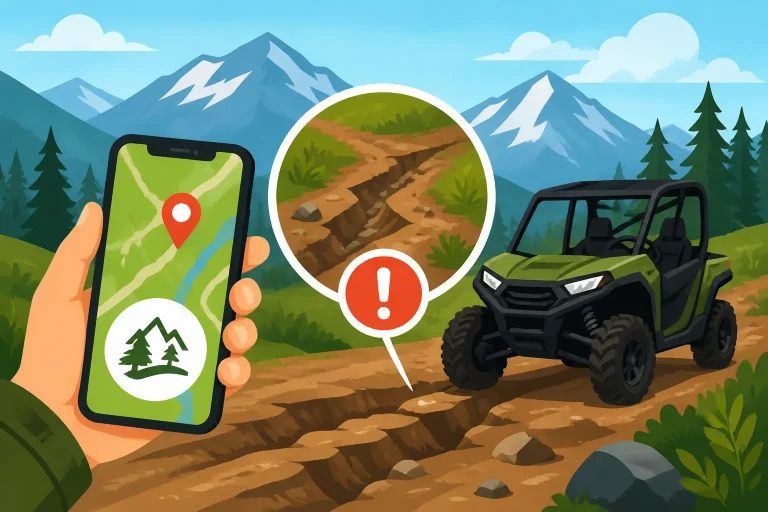
Before loading a machine, identify the exact route and the land manager or owner. Do not assume that a trail shown online is open to motorized use, or that an access road allows ATVs simply because trucks use it. A route may pass from state land to private property, a park, or land managed by another agency, with different rules on each section.
Check whether a permit applies, whether the route is open for the season, and whether temporary closures or conditions affect access. In Alaska, weather and ground conditions can change quickly. A route that was passable during a prior visit may now have deep water, soft ground, damaged trail sections, or a closure intended to protect land or wildlife.
Keep the safety-course question on the list, but not at the top of every other check. Ask the land manager whether a certificate is required for your ride, then verify access and other conditions separately. If the answer is “no course required,” that does not answer whether your machine is allowed or whether your group has the necessary land-use permission.
Check the machine, documents, and protective gear
Inspect the machine before loading it or starting the ride. Check the tires, controls, brakes, lights, throttle return, fuel level, and any visible damage. If the vehicle has been stored through winter, pay special attention to the battery, fuel system, tires, and any parts that could have been affected by cold or moisture.
Bring the documents and equipment that apply to the trip, such as registration information, insurance proof where required, permits, and a way to contact the land manager if needed. Keep documents protected from rain and mud. The right paperwork will not rescue a poorly prepared machine, but missing paperwork can create a needless problem at a trailhead or during an inspection.
Protective gear should be chosen for the conditions, not just for appearance. A properly fitting helmet, eye protection, gloves, sturdy clothing, and boots can make a ride more comfortable and help reduce injury risk. If you shop through Amazon, look closely at the product’s safety-standard labeling, sizing information, and return terms rather than relying on a listing title or a photo alone. Try the helmet on before the ride and make sure it fits securely.
Make a group plan for remote conditions
A group should agree on its route, pace, meeting points, and turnaround conditions before starting. Decide who leads, who follows, and what the group will do if a machine stops or a rider needs help. A rider who falls behind should not be left guessing whether to continue, wait, or turn around.
Remote travel also calls for a realistic communication plan. Cell coverage may be absent, and a phone that works in town may be useless once the group leaves the road system. Consider carrying a suitable emergency communication device, telling someone outside the group where you are going, and agreeing on when that person should expect to hear from you.
Pack for the trip rather than assuming the weather will cooperate. Include water, extra layers, basic repair items, first aid supplies, and any fuel or navigation equipment appropriate to the route. If you use Amazon to source a first-aid kit or dry bag, check the contents and size before departure; a small pouch that looks complete online may not contain what your group needs. A thoughtful plan is useful whether or not anyone in the group has a certificate.
How to verify a claimed certificate requirement
Ask who requires it and where the rule applies
If a friend, employer, event organizer, rental shop, or land manager says a course is mandatory, ask which organization sets the rule and the exact area or activity it covers. “It’s required in Alaska” is too broad to be useful unless the person can identify the rule and its scope. A requirement for a military installation, worksite, or organized event may not apply to a private recreational ride elsewhere.
Ask whether the certificate is required for every rider or only for the person operating the machine. Clarify whether a course from another provider is accepted, whether the rule applies to children, and whether the requirement concerns a particular vehicle type. These details can prevent an unpleasant surprise at check-in or the trailhead.
When possible, confirm the information directly with the authority responsible for the land or activity. Save a note of whom you spoke with and what route or event you asked about. If the answer changes between a website and a phone conversation, ask for the governing written policy before making assumptions.
Keep evidence of the answer and the course
If a course is required, find out what proof is accepted. The organizer may want a completion card, an online record, a training certificate, or another document. Do not assume that a screenshot of a registration email will satisfy a requirement; ask whether proof of completion is needed and whether the document must identify the rider and course.
If the course is optional, keeping its completion record can still be useful. It may help you remember what instruction you completed, make it easier to satisfy a later site-specific request, or provide a record for an employer or family riding plan. Just do not present it as a substitute for registration, insurance, a land permit, or permission from a property owner.
Store important documents in a place where they are accessible but protected from water and damage. A waterproof pouch in a pack or vehicle can work better than a loose paper card in a pocket. Before a trip involving multiple jurisdictions, confirm that the document you have matches the requirement you were told about.
Recheck before each different kind of ride
A rider may go from a local practice area to a state trail, then join a guided tour or enter a controlled worksite. The same certificate status does not necessarily answer every new situation. Each change in land manager, activity, or machine can introduce a different condition.
Make a short habit of checking four things whenever the plan changes: whether the route is open, who controls it, what permission or permit applies, and whether a course or orientation is required. Then check rider and machine rules such as licensing, insurance, registration, age restrictions, and equipment. This takes less time than discovering at the last moment that the group cannot use the planned route.
For everyday recreational riding, the practical takeaway is straightforward: Alaska does not impose one general safety-certificate requirement on every ATV and UTV rider, but particular settings can have their own rules. Training can still be worthwhile, and no course card replaces sound judgment, legal access, suitable equipment, or checking the conditions ahead.
Disclaimer
This article is for general informational purposes only and does not constitute professional advice. Laws, prices and regulations vary by location and change over time. Consult a qualified professional for guidance on your specific situation.