Frozen Ground and Why It Matters
Alaska’s frozen ground can make some routes firmer, but a cold night does not automatically make every trail or wetland ready for an ATV or UTV. Riding too early, during a thaw, or across ground that only looks solid can leave deep damage and create real safety risks. Here’s how to judge conditions, understand what frozen ground does and does not mean, and decide when to turn back.
What frozen ground changes
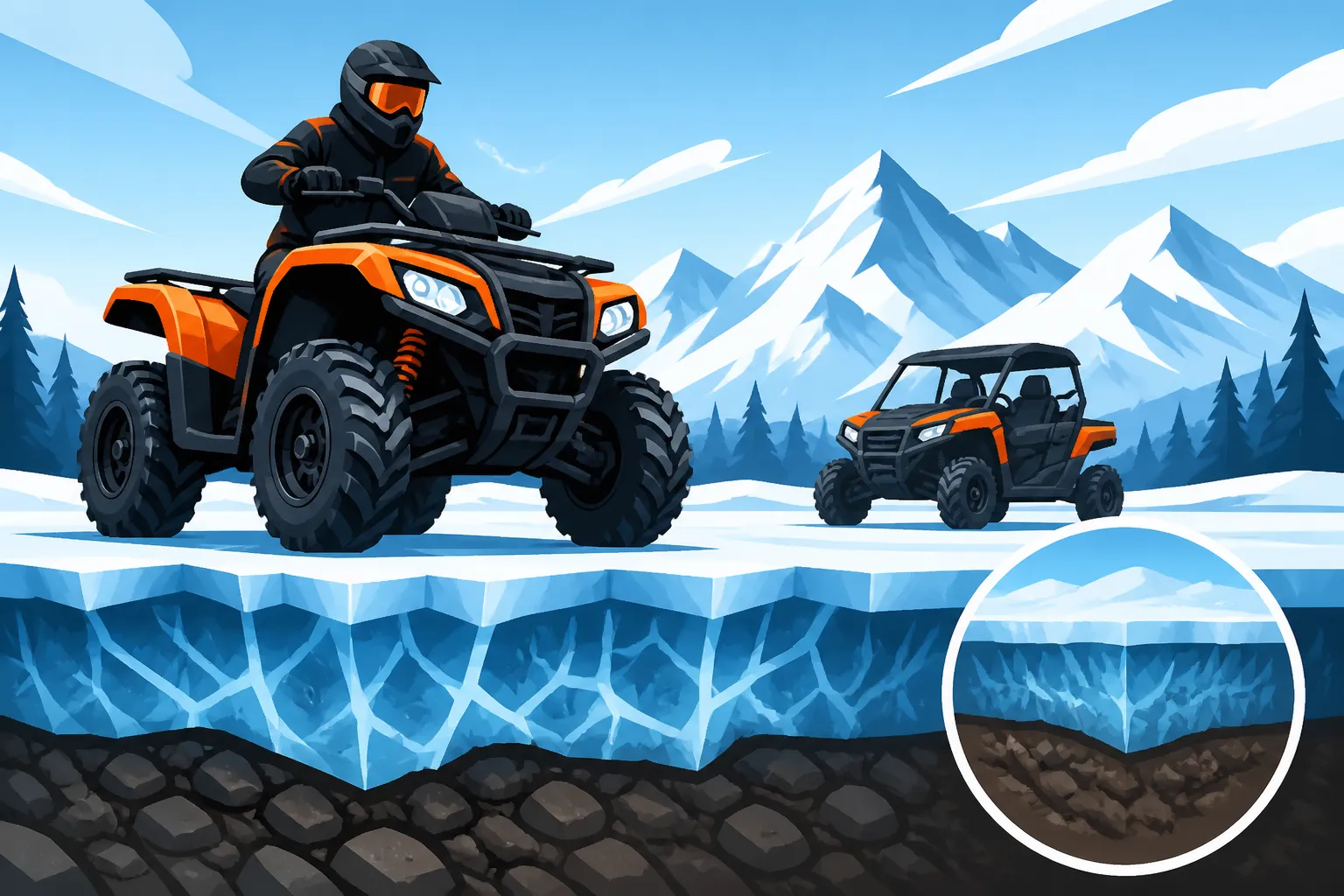
When soil freezes, water in its pores turns to ice, and the surface may become firmer than it was during a wet or thawing period. That can reduce rutting on some established routes. But “frozen” is not a simple yes-or-no condition: ground may be solid in one place, soft beneath a thin crust nearby, and waterlogged a short distance farther on.
A layer of snow can hide these differences. It may cover a firm trail, but it can also conceal open water, soft ground, rocks, ruts, or a shallow layer of ice over wet soil. The machine’s weight and repeated passes matter, too. A route that supports one careful crossing may rut after several vehicles follow the same line.
This is why frozen ground matters for both land impact and rider safety. On soft ground, tires can break through the surface, churn soil, damage vegetation, and widen a route as riders search for firmer footing. On hard or icy ground, the machine may slide, braking distances can increase, and steering can become less predictable. A frozen route is not necessarily an easy route.
| Ground condition | What it may mean for an ATV or UTV | Practical response |
|---|---|---|
| Firm, established trail with a stable surface | Less likely to rut than saturated ground, but traction may still be poor | Stay on the route and ride at a speed that allows controlled stopping |
| Thin crust over soft ground | Tires may break through and damage the surface | Turn around rather than testing the crust with repeated passes |
| Snow concealing water or a rut | The route may be deeper or less stable than it appears | Stop and assess from a safe place; do not assume the snow is load-bearing |
| Thawing ground | The top layer may soften while deeper soil remains frozen | Avoid making new tracks and follow any closure or access guidance |
| Ice over moving or standing water | The surface may be weak or uneven, with hidden openings | Do not treat frozen ground as proof that a crossing is safe |
The table is a field guide, not a test for whether a particular route is open. Conditions change with elevation, shade, snow cover, drainage, recent weather, and the type of ground beneath the surface. A south-facing slope may soften while a shaded section nearby remains firm. A trail that was passable earlier can change after warm weather, rain, or flowing water.
Wetlands and tundra deserve particular care. A surface that looks firm under snow may have a fragile layer of vegetation or organic soil underneath. When that layer is torn up, the damage can persist after the snow melts. See Alaska Tundra and Wetland Conditions and Alaska Wetland Travel Restrictions Explained for more on why seemingly solid ground can still be vulnerable.
Frozen ground does not grant permission to ride
Ground conditions and land access are separate questions. A route can be frozen and still be closed, outside the permitted area, or on land where you need separate permission. A statewide permit, where it applies, does not turn every frozen field, wetland, trail, or river into an authorized route.
Before riding, identify who manages the land and what rules apply to your route. The state’s general permit has limits, including areas it does not cover. State parks, private land, and land managed by other agencies may have different requirements or restrictions. Start with Alaska Land Ownership and Who to Ask and Checking a Land Status Map, then confirm access with the relevant land manager when the map or signs leave room for doubt.
Keep these distinctions in mind:
- A permit is not a condition report. It may address access or land use, but it cannot tell you whether the ground is solid enough today.
- A trailhead pass is not land permission. A parking or trailhead fee does not necessarily authorize travel beyond the area it covers. See A Trailhead Pass Is Not a Land Permit.
- Public ownership does not mean every type of travel is allowed everywhere. Closures, designated routes, seasonal restrictions, and local rules may apply.
- Private or Native corporation land requires particular care. Do not assume that a route across it is open just because it is used by others or appears on a map.
- A frozen surface does not erase a closure. Follow posted signs and current instructions from the land manager.
The state’s general permit is one piece of the access question, not a substitute for checking the route. Alaska’s General Permit Covers State Land explains that permit’s scope, while Alaska’s Permit Excludes State Parks covers an important boundary. For other land, use Alaska Land Managed by Other Agencies to understand why the agency responsible for the ground matters.
This is especially important during freeze-up and breakup. Those transition periods can create mixed conditions: some sections are frozen, others are saturated, and the surface may change within a short distance. A route that was open or firm on a prior trip may not be suitable now. Check for closures and current guidance rather than relying on last season’s experience or another rider’s tracks. Alaska Trail Closures After a Storm is also useful when weather has altered a route.
How to assess conditions before and during a ride
A reliable decision comes from combining route information, recent conditions, and cautious observation. No single clue—air temperature, snow depth, a frozen puddle, or another machine’s tracks—proves that the entire route is stable.
Before leaving
- Confirm that you can use the land and route. Check the land status, applicable permit or permission, posted restrictions, and any seasonal closure. If you cannot tell who manages a section, ask before riding it.
- Look for current local information. Ask the land manager, trail organization, or local office responsible for the area whether the route is open and whether recent conditions have affected it. A general weather forecast is not a trail report.
- Consider recent temperature and precipitation patterns. Several cold days may help freeze some ground, but snow can insulate soil and delay freezing. Warm spells, rain, or water moving across a route can weaken a surface that appeared firm.
- Plan a conservative route and turnaround point. Choose established routes where travel is allowed. Make sure everyone in the group knows that turning back is part of the plan, not a failure to complete it.
- Prepare for a change in conditions. Carry appropriate cold-weather clothing, recovery equipment, and communication gear for the area. A stranded machine can become a serious problem when help is far away or conditions deteriorate.
A useful approach is to treat the first part of the route as a condition check, not as proof that everything farther on will be safe. Observe how the surface behaves under your machine. If tires break through a crust, the machine sinks, or the trail begins to rut, stop and reassess before additional vehicles follow.
On the route
Ride on the established path rather than making a new line around a wet, rough, or blocked section. Bypasses can spread damage, especially when several riders avoid the same obstacle in different places. If a route is too soft or has a closure, turn around or choose another route that is clearly open.
Watch for signs that the surface is changing:
- Tires leaving deep or widening ruts
- Water or mud rising around the tires
- A crust that cracks or collapses beneath the machine
- A trail edge that gives way under modest pressure
- Standing water, overflow, or moving water across the route
- Repeated wheel spin, loss of traction, or difficulty steering
- Fresh signs, barriers, or markers indicating a closure
Do not keep testing weak ground by driving forward and reversing over it. Repeated attempts can deepen ruts, damage the trail, and leave the machine more deeply stuck. A winch or another vehicle can help recover equipment, but recovery gear does not make an unauthorized or environmentally sensitive route suitable for riding.
Water crossings need a separate assessment. Frozen ground nearby does not prove that a creek, river, or flooded section is safe to cross. Water may move under ice, channels can be uneven, and snow may hide thin ice or open water. If the route crosses a stream or other waterbody, consult the applicable rules and current conditions. Alaska Stream Crossing Rules provides relevant background. When the condition or legality of a crossing is unclear, do not attempt it.
When conditions change
A ride can begin on firm ground and encounter softer conditions later. Sun exposure, elevation, drainage, and local weather all affect how a route behaves. If the surface is thawing, the safest and least damaging choice may be to turn back before the machine starts cutting into it.
The same principle applies when conditions are worse than expected. A group should not pressure a rider to continue simply because the trip is underway or a destination is close. Tell someone outside the group where you are going and when you expect to return, and make sure the turnaround decision is understood before the ride begins.
A practical decision rule for Alaska riders
Think of frozen ground as one condition to evaluate—not a permission slip or a guarantee of safe travel. Before you go, confirm access and closures. On the route, stay on established trails, watch for changes under the tires, and avoid crossings or surfaces you cannot assess confidently.
A simple decision check can help:
- Is the route open, and do you have permission to use it? If not, do not ride it.
- Is the surface stable along the route, rather than only at the trailhead? If you see soft spots, deep ruts, or a collapsing crust, turn back.
- Can you avoid creating a new track or widening an existing one? If not, choose another route.
- Can you safely stop, turn around, and return if conditions change? If not, the plan is too demanding for the conditions.
Keep weather, land access, and surface condition as separate checks. A current land-use permit does not tell you whether a route is frozen; a firm trail does not establish permission; and visible tracks do not prove that riding is allowed. For an overview of access responsibilities, see Alaska General Permit Requirements and Alaska Winter Travel on Frozen Ground.
Small decisions make a difference. A rider who turns around at the first sign of softening ground can help prevent avoidable damage and reduce the risk of getting stuck. When the surface is uncertain, wait for better conditions or choose a confirmed open route on ground that can support the machine without breaking apart.
Disclaimer
This article is for general informational purposes only and does not constitute professional advice. Laws, prices and regulations vary by location and change over time. Consult a qualified professional for guidance on your specific situation.