Do Alaska Kids Need an Adult to Ride Along?
Alaska parents often face two separate questions: whether a child may operate an ATV or UTV, and whether an adult must accompany them. The answer depends on who manages the land and which rules apply. Here’s how to sort out the statewide permit condition, local exceptions, and the practical checks to make before a child rides.
When Alaska’s statewide permit requires an adult
On state land covered by Alaska’s statewide general permit for recreational OHV use, a rider under 16 must be accompanied by an adult. That condition matters when planning a ride on covered state land: a child should not head out alone on the assumption that having a registration decal or a parent’s permission is enough.
“Accompanied” should be treated as real supervision during the ride, not simply an adult being somewhere in the area. Read the current permit conditions before setting out, especially if the adult plans to travel on a separate machine. The wording and any land-specific requirements matter; do not assume that an adult waiting at a distant trailhead meets the condition.
The statewide general permit does not govern every piece of land in Alaska. It covers specified state land, with exclusions and other limits. A state park, federal land, private parcel, or land managed by a Native corporation may have separate rules. On those lands, the state permit’s adult-accompaniment condition may not be the only rule—or the rule that applies.
A useful starting point is What Alaska’s Statewide General Permit Actually Authorizes. It helps distinguish the permit’s scope from the rules that come from a land manager, local government, or landowner. The related Alaska’s General Permit Covers State Land explains where the permit applies, while Alaska’s Permit Excludes State Parks highlights one important boundary.
The adult does not replace other requirements
Adult supervision is only one part of a child’s ride. It does not replace applicable requirements for machine registration, land access, helmets, equipment, or road use. A child can be accompanied by a parent and still be riding somewhere the machine is not allowed, on land where permission is missing, or on a machine that is unsuitable for them.
Nor does the presence of an adult automatically make a child eligible to operate every type of vehicle. A child’s age, ability, the machine’s design, and the type of route all matter. Check the land rules and the machine’s owner’s manual before deciding that a child is ready.
A practical answer by riding location
| Riding location | Is the statewide permit’s adult condition enough to rely on? | What to check |
|---|---|---|
| State land covered by the general permit | No. A rider under 16 must be accompanied by an adult under the permit condition. | The current permit language, route access, and any site-specific restrictions |
| State park | No. Do not assume the statewide permit applies inside the park. | Park rules and the agency responsible for the route |
| Federal land | No. The state permit does not automatically authorize riding there. | The federal land manager’s rules and any closures or restrictions |
| Native corporation land | No. Public access cannot be assumed. | The landowner’s permission and any conditions for access |
| Private land | No. The general permit does not grant permission to cross private property. | Permission from the owner and any local requirements |
| Road or street | No. Road-use requirements are separate from off-road land access. | Road legality, local rules, licensing, insurance, and equipment requirements |
The table is a planning aid, not a substitute for checking the exact parcel and current conditions. A trail can cross more than one kind of land, and a ride can leave a permitted area without an obvious change in terrain. Check the route, not just the trailhead.
The permit is not the same as registration or landowner permission
Families sometimes treat “permit,” “registration,” and “permission” as if they were interchangeable. They are not.
Alaska’s statewide general permit concerns specified OHV use on state land. APV registration is a separate vehicle requirement that can apply when an ATV or other machine is used on public property. Registration does not grant access to every trail, and a land-use permit does not replace registration when registration is required. The distinction is explained in Alaska Registration Before Riding Public Land and Alaska APV Registration Requirements.
Land ownership is another separate question. A route may appear open and still cross ground managed by an agency or owned by someone else. The state permit does not grant a right to ride across a private parcel or Native corporation land. Before taking a child onto a route, check who owns or manages the ground and whether access is allowed. Alaska Land Ownership and Who to Ask and Checking a Land Status Map can help with that step.
A permission or permit issued for one area should not be assumed to cover an adjoining area. For example, the rules for state land do not automatically carry over when a trail enters a state park or private parcel. If the route crosses a boundary, find out what changes at that boundary.
Check who must be covered
The permit’s accompaniment condition is about the child’s ride, but families should also read the permit itself for its scope and who it covers. Do not assume that a parent’s paperwork automatically covers every rider, every machine, or every trip. Check whether the permit applies to the planned activity, location, and vehicle, and whether the child must meet any additional conditions.
Likewise, registration is tied to the machine and its use, not a child’s status as a passenger or operator. If the machine needs registration for the planned use, an adult riding along does not waive that requirement. For help separating these issues, see Do You Need to Register an ATV in Alaska?.
Verify the actual route
A ride that begins on state land may pass into a different jurisdiction. A trail map can help with navigation, but it may not show every current land-status boundary, temporary closure, or local restriction. Before the trip:
- Identify the land manager for the starting point and route.
- Check whether the route enters a park, federal area, private parcel, or Native corporation land.
- Read the current permit and land-manager conditions for each section.
- Confirm required registration and access permission.
- Choose a route that allows the child and accompanying adult to stay within the rules.
If the route crosses land with unclear access, ask the responsible land manager before riding. A child’s first ride is a poor time to discover that the route changes ownership halfway through.
What adult accompaniment should look like in practice
The permit’s adult condition is a minimum rule, not a complete safety plan. A child may technically be accompanied and still be far beyond what their experience, attention, or machine control can handle. Good supervision means planning the ride so the adult can respond if the child stops, gets stuck, becomes tired, or encounters a hazard.
Stay close enough to supervise
If the adult rides a separate machine, keep the child within effective supervision. That usually means staying close enough to see what the child is doing, communicate, and respond promptly. Do not let a young rider travel out of sight around a bend, over a ridge, or across a large open area while the adult waits behind.
The exact interpretation of “accompanied” belongs to the permit and land manager, so check the wording rather than relying on a general assumption. Even where a separate adult-operated machine is allowed, the adult should be able to intervene without relying on a phone signal. Many Alaska riding areas have limited or no cell coverage.
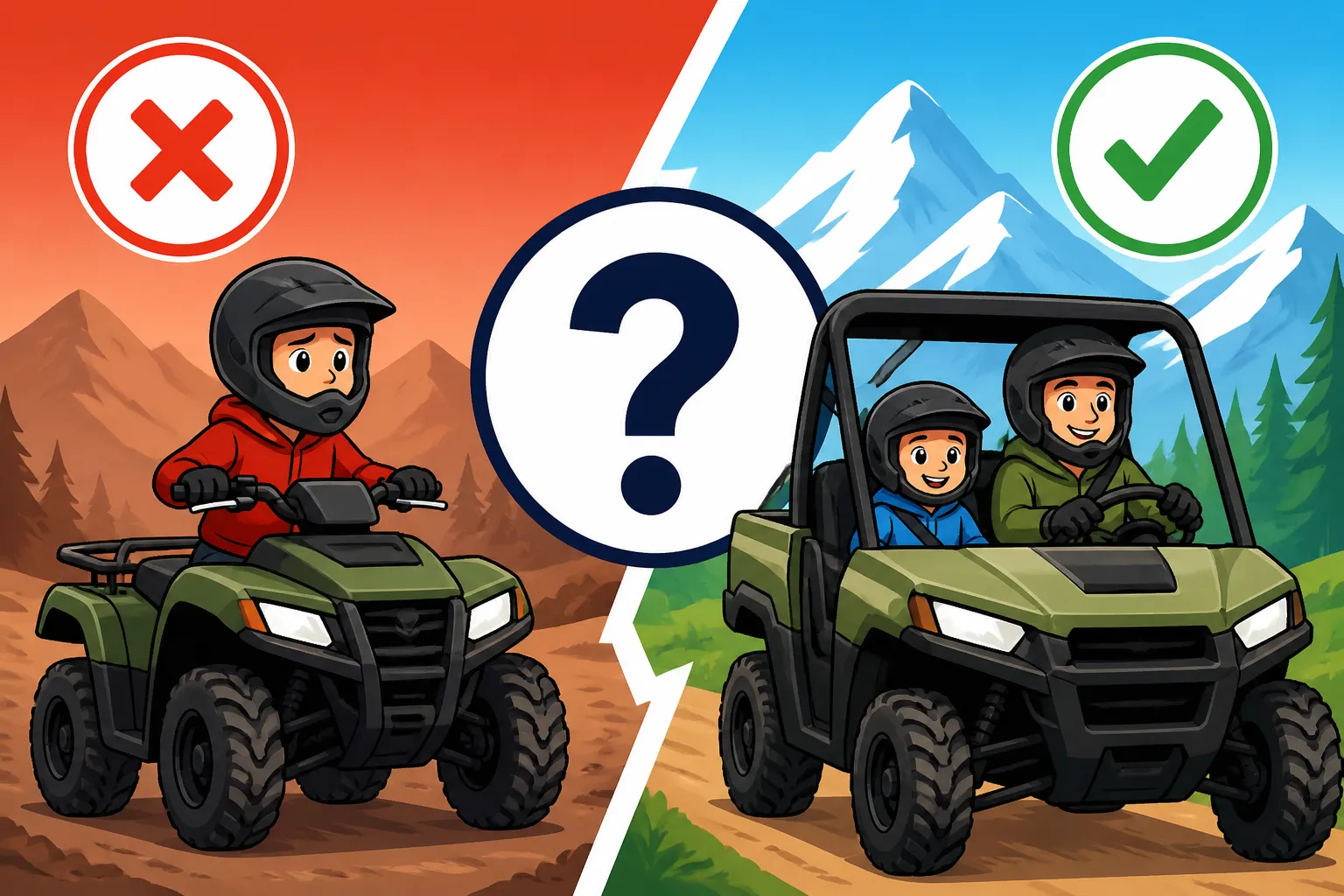
A parent riding on the same machine is not automatically the safer option. A passenger should ride only on a machine designed and equipped for passengers, and only if the operator can control it with the extra weight. Putting a child on a single-seat quad with an adult can create a serious handling problem. See Alaska Rules for Passengers on a Quad before carrying a passenger.
Match the route to the child
An adult can supervise a ride without making the trail suitable for a young operator. A route with steep grades, deep mud, loose rocks, fast-moving water, or long stretches without a safe stopping point can be too demanding for a new rider. A shorter, familiar route with room to stop is often a better first outing than a long destination ride.
Before leaving, agree on simple rules:
- The child stops when the adult signals.
- The child does not pass the adult or leave the agreed route.
- The group stops together if someone has a problem.
- The child waits for the adult before approaching water, a road, a gate, or an unfamiliar junction.
- The ride ends if fatigue, weather, or conditions make control unreliable.
These boundaries help prevent a common problem: an adult assumes the child understands what to do, while the child assumes they should keep moving.
Do not use the adult as a substitute for age-appropriate training
A parent’s presence cannot compensate for a child who has not learned basic controls. Before riding on a trail, the child should understand how to start and stop the machine, use the brakes and throttle, turn at low speed, and respond to a stop signal. Practice should take place in an appropriate area where the child can learn without traffic, steep slopes, or other riders pressing them to keep up.
Check the manufacturer’s age and size guidance for the machine. A vehicle that is too large, powerful, or heavy for a child can be difficult to control even on level ground. For family planning, Matching Engine Size to a Young Rider’s Age and Alaska Parent Riding With a Child offer useful related considerations.
Other rules families should check before a child rides
The adult-accompaniment condition does not answer every legal or practical question. A child may be allowed to ride with an adult on one kind of land but still need to meet other requirements. The details depend on the route, machine, rider, and local rules.
Age, helmets, and equipment
Helmet requirements can depend on a rider’s age and where the machine is being operated. Do not infer the helmet rule from the permit condition. Check the applicable law and local requirements, then use a properly fitting helmet that is appropriate for the activity. A helmet that is too loose, too large, or fastened incorrectly offers less useful protection.
The machine also needs to be in safe working order. Before a family ride, check the controls, brakes, tires, lights where required, and any other equipment required for the location. A child should know how to stop the machine and should not be sent out on a machine with a sticky throttle, weak brakes, or another unresolved mechanical issue.
For the broader youth-riding picture, see Alaska Rules for Young Riders and [Alaska Rules for a Ten-Year-Old Rider]. The needs of a younger child may differ from those of a teenager, so do not treat “under 16” as a single ability level.
Public roads are a separate issue
Permission to ride off-road does not automatically make a machine legal to use on a road. Road use can involve separate vehicle, equipment, insurance, licensing, and local requirements. A child’s ability to operate on a trail should not be treated as permission to operate on a road or street.
Check the route before crossing a road, riding along a shoulder, or entering a community. A short road segment can change the rules for the trip. Alaska APV Road Rules Explained is a useful starting point, and Alaska Communities That Ban APV Road Use explains why local rules can differ.
If a route includes a road crossing, identify a legal crossing point and make sure the child understands to stop and wait for the adult’s instruction. Do not assume that a route commonly used by riders is automatically open to every machine or rider.
Land access may require a different kind of permission
The general state permit does not grant access everywhere. Some land is managed by other agencies, and some is privately owned. Native corporation land may require permission even where a route looks like an established trail. A parent’s supervision does not authorize entry where access is restricted.
The same caution applies to hunting, subsistence, trapline, or cabin routes. The purpose of the trip does not by itself create access rights. Confirm permission and any land-specific conditions before taking a child across unfamiliar ground.
Closures and changing conditions
A route can be legally accessible and still be unsafe or closed. Seasonal conditions, water levels, weather, fire restrictions, and land-manager decisions can affect where riding is allowed. In Alaska, conditions may change quickly, especially around rivers, wetlands, and thawing ground.
A child’s ride plan should include a clear turn-around point. If a crossing looks deeper or faster than expected, or the trail is breaking down under the machines, turn back rather than treating the destination as mandatory. An adult is responsible for making that call even if the child wants to continue.
A pre-ride checklist for parents and guardians
Before the child rides, work through a short checklist rather than relying on a general sense that the outing is allowed.
- Age and supervision: Is the rider under 16, and does the land or permit require an adult to accompany them?
- Land status: Who manages the route, and does the ride enter a park, federal land, private property, or Native corporation land?
- Permission: Is the planned riding allowed on every part of the route?
- Registration: Does the machine need Alaska registration for the planned use?
- Machine fit: Is the vehicle suited to the child’s size, experience, and ability?
- Passenger safety: If anyone will ride as a passenger, is the machine designed for that use?
- Protective gear: Does the child have a properly fitted helmet and other appropriate gear?
- Route difficulty: Can the child manage the surface, distance, crossings, and expected conditions?
- Communication: Can the adult keep the child in sight or otherwise maintain effective supervision?
- Backup plan: Does the group know where to turn around and what to do if the machine stops or someone is hurt?
If any answer is uncertain, pause and verify it with the land manager or the relevant official office. A quick check before departure is easier than sorting out a permit or access problem after a child is already on the trail.
The practical takeaway is straightforward: on state land covered by Alaska’s statewide general permit, a rider under 16 must be accompanied by an adult. But that condition is not a universal permission slip for every Alaska trail. Check the land, route, machine, and other applicable rules, then supervise closely enough to make the ride manageable and safe.
Frequently Asked Questions
Does a parent have to ride on the same ATV as a child?
Not necessarily. The statewide permit condition is that a child under 16 be accompanied by an adult on covered state land. Do not assume that “accompanied” always means the adult must be a passenger or that any distance between separate machines is acceptable. Check the current permit language and maintain close supervision.
Does the adult need to be the child’s parent?
The key question is whether the required adult is accompanying the child under the applicable rule. Do not assume that only a parent can supervise, but confirm the current permit conditions and any land-manager rules before relying on another adult.
Does the statewide permit rule apply in Alaska state parks?
Do not assume it does. State parks are outside the general permit’s coverage, so park-specific rules may apply. Check with the park or managing agency for the exact requirements.
Does an adult’s registration cover a child’s machine?
An adult accompanying a child does not replace any registration requirement that applies to the machine. Check the registration rules for the machine and planned use separately from the land-access permit.
Can a child ride alone on private land?
The statewide permit condition applies only within its scope and does not settle every private-land situation. The owner controls access, and other requirements may still apply. Get the owner’s permission and check any applicable laws before riding.
Disclaimer
This article is for general informational purposes only and does not constitute professional advice. Laws, prices and regulations vary by location and change over time. Consult a qualified professional for guidance on your specific situation.