Alaska General Permit Requirements
Alaska’s general permit can make ATV and UTV riding on some state land possible, but it is not a pass for every public trail or piece of open ground. The key is knowing who owns or manages the route, what the permit allows, and whether a separate closure, access rule, or fee applies. These checks help prevent a legal ride from turning into a trespass or land-damage problem.
What Alaska’s general permit covers
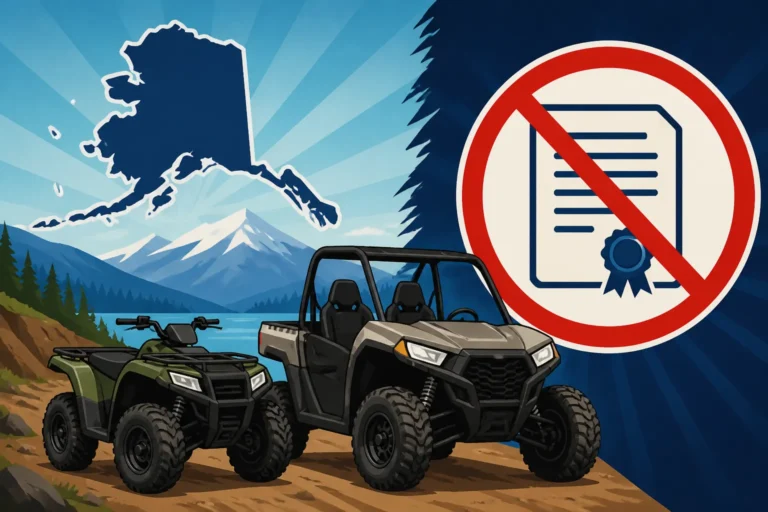
Alaska has a statewide general permit for certain off-highway vehicle use on state land. It is a broad authorization for qualifying recreational use, not an individual permit that grants access to every trail or parcel in the state. The permit’s current terms determine which machines and activities it covers and what conditions riders must follow. Start with Alaska’s Statewide General Permit for ATV Use and read the actual conditions before planning a ride.
The permit’s basic reach is state land where the relevant use is allowed. That does not mean all land that looks undeveloped, remote, or publicly accessible. State land may sit beside federal land, private parcels, Native corporation land, or property managed under a separate rule. A route can cross several types of land in a short distance, and the general permit does not replace permission from other owners or agencies.
The permit is also limited by its purpose. A general authorization for personal recreation should not be assumed to cover commercial guiding, organized events, filming, resource work, or other specialized activities. Those uses may need separate authorization. If a ride involves a business, a paid guide, a large group, or a planned event, check with the land manager rather than relying on the recreational permit alone.
The machine itself matters, too. The current permit conditions define the vehicles and conduct covered. If you ride a UTV, a heavy side-by-side, or a modified machine, confirm that it fits the permit’s definition and limits. Do not assume that a rule for a small recreational ATV automatically applies to every off-highway vehicle.
| Where you plan to ride | What the general permit means | What else to check |
|---|---|---|
| Eligible state land | It may authorize qualifying recreational OHV use subject to its conditions | Land status, closures, route conditions, and machine eligibility |
| State park land | The statewide general permit does not replace park rules or authorization | The park’s current OHV rules and any site-specific restrictions |
| Federal land | An Alaska state permit does not authorize use on federal land | The managing federal agency’s rules and access requirements |
| Private land | The permit does not grant permission to cross or ride there | Permission from the landowner |
| Alaska Native corporation land | The permit does not grant access to corporation land | The corporation’s access rules and any required authorization |
| A trailhead with a fee or pass | A land-use permit does not automatically cover parking or trailhead charges | Any separate trailhead pass, day-use fee, or parking rule |
For a closer explanation of the permit’s scope, see What Alaska’s Statewide General Permit Actually Authorizes and Alaska General Permit Requirements. The practical point is simple: the permit is one part of the access check, not proof that every part of your route is open to riding.
Where the permit stops
State parks and designated areas
State parks are a common source of confusion. A statewide general permit for state land does not automatically authorize riding in a state park. Parks can have their own rules, approved routes, seasonal limits, or restrictions on motorized use. Check the park’s specific requirements before entering, even if a nearby route appears to be state land. Alaska’s Permit Excludes State Parks explains this distinction, and Which Permit Covers Riding in an Alaska State Park? is useful when a route enters park boundaries.
Other designated or restricted areas may also have limits. A closure, land-use designation, seasonal restriction, or local management rule can take priority over the general permit. A track on a map is not proof that riding is currently allowed there. Look for current notices, signs, gates, and agency updates, and be prepared to turn around if the route is closed or the ground is too vulnerable to travel.
Federal, private, and Native corporation land
The state permit cannot authorize use on land managed by a federal agency. Federal land may have its own OHV rules, approved routes, seasonal closures, or permit requirements. A route that begins on state land can cross into a different jurisdiction without an obvious change in the landscape. Identify the land manager for the entire route, not just the trailhead. Alaska Land Managed by Other Agencies provides context on these boundaries.
Private land is separate, too. A road or trail that appears to be open does not necessarily come with a right to ride across it. Get permission before entering or crossing private property, and do not treat the general permit as a substitute for that permission. The same principle applies to Alaska Native corporation land, where access may be controlled by the corporation. See Alaska’s Permit Excludes Private Land and Alaska Native Land Access Permits for more on those limits.
Roads and access routes
The general permit is not a road-use authorization. An ATV or UTV may be subject to separate requirements when operated on a public road, and a route that connects trails may pass through a community with its own restrictions. Check the rules for the specific road and municipality before using it. A permit that allows off-road recreation on state land does not make a machine street legal or override local road rules.
The same caution applies to access roads, driveways, utility corridors, and informal tracks. Their location on state land does not necessarily mean they are open to all riders. A road may be managed by another entity, closed to motorized use, or subject to a specific access agreement. Confirm both the land status and the right to use the route.
How to check your route before riding
Do this check before loading the machine or setting out. It is especially important for longer rides, routes near boundaries, and trips that follow a river, road, or informal trail.
- Map the full route. Mark the trailhead, planned route, likely turnarounds, and destination. Include connecting roads and any detours you might use if conditions change.
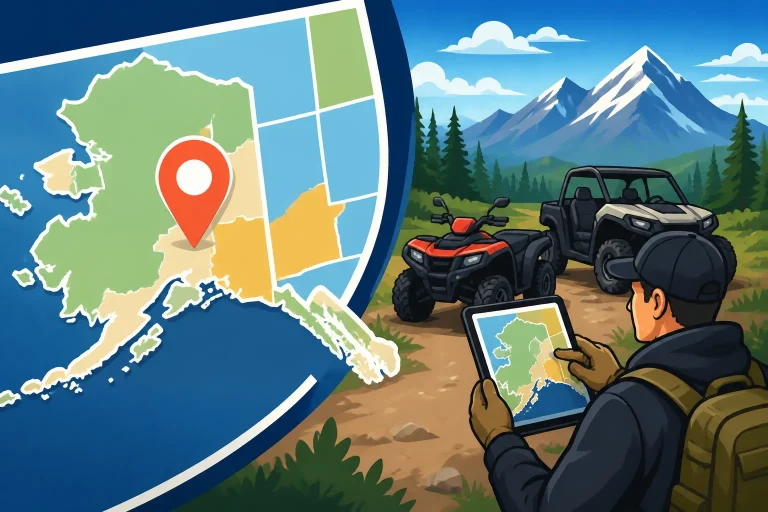
- Check land ownership and management. Use a current land-status map and identify where the route crosses state, federal, private, park, or Native corporation land. Alaska Land Status Maps and Checking a Land Status Map can help you understand what to look for.
- Read the applicable permit conditions. Confirm that your machine and planned activity fit the statewide general permit. Check whether the permit is limited by vehicle type, weight, use, location, or other conditions. If the answer is unclear, ask the responsible land manager.
- Look for closures and site-specific rules. Check agency notices and local information, and pay attention to signs and gates at the trailhead. A general permit does not cancel a temporary closure or an area-specific restriction.
- Arrange any separate permission or pass. Contact the landowner or agency where needed. Check whether the trailhead or recreation area requires a separate pass or payment; Alaska Trailhead Fees and Passes covers that distinction.
- Recheck conditions before departure. Weather, water levels, ground conditions, fire restrictions, and access rules can change. If a route is wet, damaged, or closed, choose another route rather than trying to push through.
When checking a map, treat boundary lines as a starting point, not a guarantee that a route is open. Mapping layers can be incomplete or difficult to read at a small scale. If the route appears to cross a parcel boundary or the land manager is uncertain, ask before riding. A short confirmation is safer than assuming the general permit covers the whole trip.
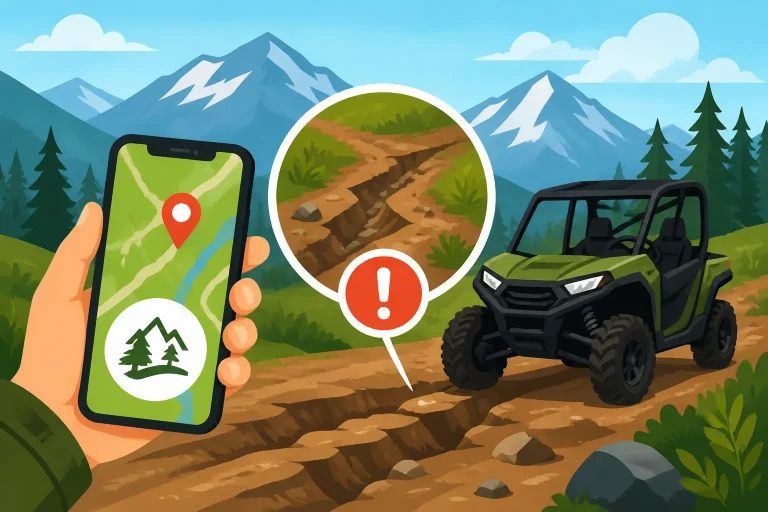
Also keep the riding conditions in mind. The permit does not excuse damage to land or trails. Avoid creating new tracks, widening a route, or riding through ground that is soft or easily rutted. Follow posted instructions, use established routes where required, and turn back when conditions make continued travel likely to damage the land. The permit’s conditions and other land-management rules still apply throughout the ride.
Common mistakes and practical checks
One frequent mistake is treating “public land” as a single category. Public land can be state, federal, or locally managed, and different rules may apply to each. Another is assuming that a state land permit provides a right to cross land owned by someone else. It does not. Confirm the route’s ownership and access before relying on a map, a trail marker, or another rider’s description.
A second mistake is confusing land-use authorization with vehicle registration. Registration requirements, where applicable, are a separate issue from permission to ride on a particular parcel. Likewise, a trailhead pass or parking payment does not authorize riding in a closed area. Each requirement answers a different question: whether the machine is properly documented, whether the land manager allows the use, and whether a specific facility requires a fee or pass.
Use this quick test before you ride:
- Is the route on land covered by the statewide general permit?
- Does the current permit cover your machine and the kind of use you plan?
- Does the route enter a state park, federal area, private parcel, or Native corporation land?
- Are there closures, local restrictions, or posted limits along the route?
- Do you need separate landowner permission, an agency permit, or a trailhead pass?
- Are the ground and weather conditions suitable for travel without causing damage?
If you cannot answer one of those questions, pause and contact the relevant land manager. For general permit details, Do You Have to Carry Alaska’s General Land Permit? can help clarify what riders need to have available. Whatever documentation you choose to carry, the most important preparation is knowing the rules that apply to the route you intend to ride.
Disclaimer
This article is for general informational purposes only and does not constitute professional advice. Laws, prices and regulations vary by location and change over time. Consult a qualified professional for guidance on your specific situation.