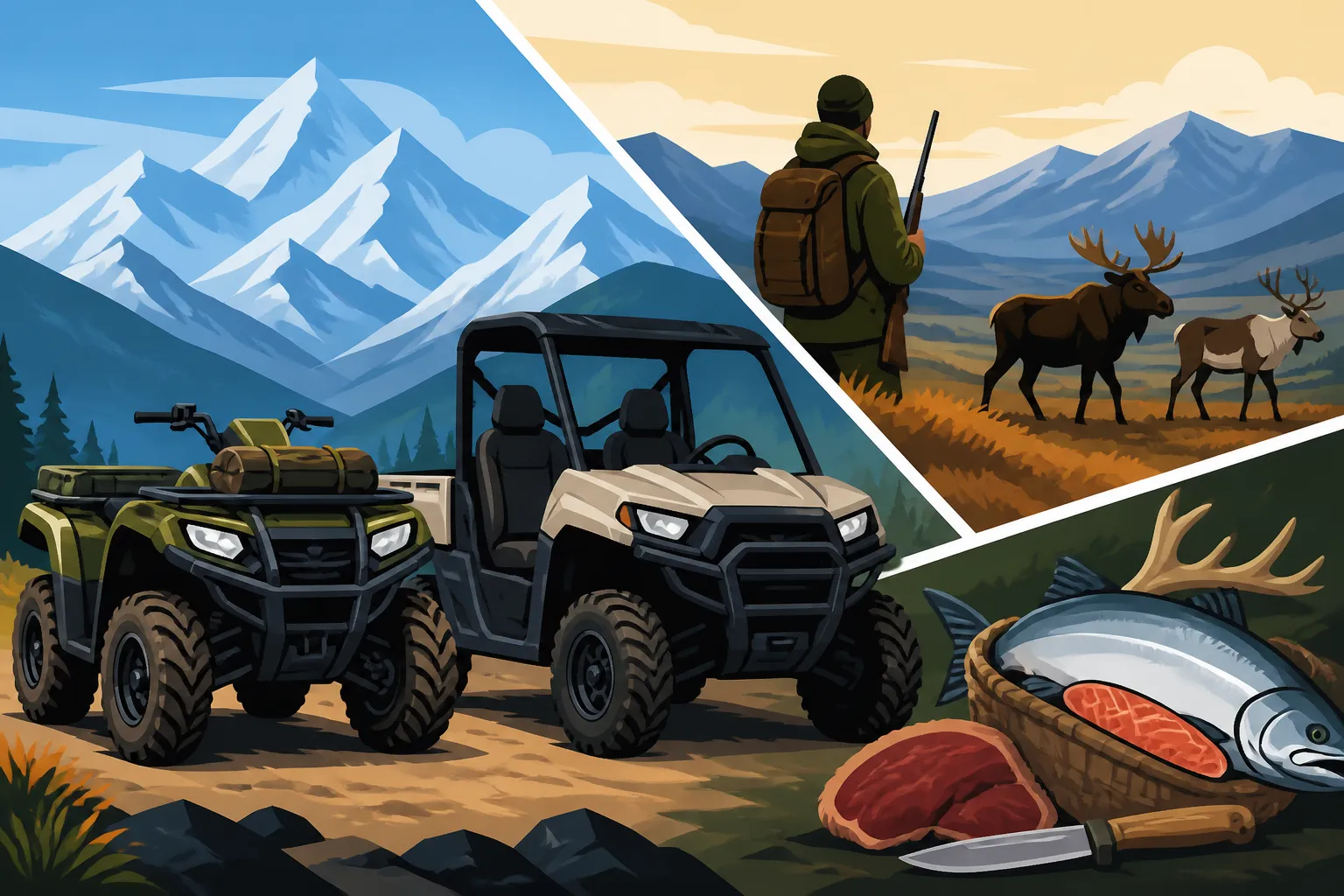
Alaska Subsistence Use and Machines
Subsistence travel and ATV use often overlap in Alaska, but a subsistence purpose does not automatically make a route or machine use legal. The key is to check three things separately: who manages the land, what access permission applies, and which harvest and transportation rules cover your trip. That distinction helps prevent a lawful subsistence activity from turning into an access or wildlife violation.
Subsistence use does not automatically authorize machine access
Subsistence describes a way of using wild resources for customary and traditional needs. It is not, by itself, a permit to ride wherever those resources are found. A hunter or gatherer may be allowed to harvest in a particular area but still need separate permission to travel across the land by ATV or UTV.
The rules can differ depending on whether the ground is state, federal, borough, municipal, private, or Alaska Native corporation land. Federal subsistence rules apply to qualified users on federal public lands, while state rules govern other areas and may also apply to state-managed lands. Eligibility, seasons, species, methods, and access restrictions depend on the applicable regulations and location. Do not assume that a subsistence designation means every Alaska resident has the same rights everywhere.
It helps to treat these as separate questions:
- Can you harvest here? Check the applicable hunting or other resource regulations, including eligibility, season, permit, and method requirements.
- Can you ride here? Identify the land manager and confirm that motorized travel is allowed on the route and at the time of year.
- Can you carry the harvest this way? Check the rules for taking and transporting the specific resource in that area.
- Does the machine need its own paperwork? Registration or other vehicle requirements are separate from land access and harvest rules.
A subsistence purpose does not erase private property boundaries, road or trail closures, seasonal restrictions, or rules against using a motorized vehicle in a particular area. It also does not replace an ATV registration requirement where one applies. For a broader overview of how land status affects access, see Alaska Land Ownership and Who to Ask.
Check land access before planning a route
Start with the actual route, not only the hunting destination. A route may cross several kinds of land, and permission from one manager does not necessarily cover the next parcel. A trail that looks continuous on a map can pass through private or Native corporation land, a restricted area, or land managed by another agency.
Alaska’s statewide general permit for certain off-road vehicle use is not a blanket permit for all land. It covers eligible use on specified state land subject to its terms and exclusions. State parks, designated areas, private land, and land managed by other agencies can have different requirements. Review Alaska’s General Permit Covers State Land and Alaska’s Permit Excludes Private Land before relying on the state permit for a subsistence trip.
A trailhead pass is also different from a land-use permit. A pass may cover parking or use of a particular recreation site, while a land permit addresses whether motorized travel is authorized on the land itself. Neither should be treated as permission to cross a separate parcel. The distinction is explained in A Trailhead Pass Is Not a Land Permit.
| Land or route situation | What to verify before riding |
|---|---|
| State land covered by a general permit | Whether the permit covers the location, machine, activity, and season |
| State park or designated area | The specific park or area rules; the general permit may not apply |
| Federal public land | The managing agency’s motorized-access rules, closures, and any required permits |
| Alaska Native corporation land | The corporation’s access terms and whether permission or a land-use permit is required |
| Private land or an inholding | Permission from the landowner, including permission to cross |
| A route crossing multiple land types | Access authority for every segment, not just the destination |
Maps can help identify boundaries, but a map alone is not permission to ride. Use land-status information to work out who manages each section, then confirm current access conditions with that manager. For practical starting points, see Alaska Land Status Maps and Checking a Land Status Map. If a route crosses Native corporation land, review Alaska Native Land Access Permits and seek permission from the relevant corporation rather than assuming a public trail gives access across its property.
When land ownership or a boundary is unclear, stop and ask before crossing. A subsistence need does not make an uncertain crossing safe to assume. A land manager or landowner can explain whether motorized access is allowed, whether the route is open, and whether any conditions apply to the machine or activity.
Match machine use to harvest and transportation rules
Access permission answers where you may ride; it does not answer how you may hunt or transport game. Hunting regulations can restrict motorized travel in particular areas, limit how a machine may be used while hunting, or set conditions for transporting harvested animals. These rules may vary by species, management area, season, and the land involved.
Read the regulations for the exact hunt and route. Look for restrictions on motorized vehicles, off-road travel, game retrieval, and transportation. Do not rely only on a general hunting summary or on what is allowed in a neighboring unit. Alaska Hunting Regulations and Machines is a useful related topic, while Alaska Hunting Access by Machine focuses on the access side of a trip.
It is especially important to separate riding to an area from using a machine while pursuing or taking game. A route may be open to ATVs but still have hunting-method restrictions. Conversely, a harvest may be lawful while the route used to reach it is closed to motorized travel. Check both sets of rules instead of assuming one approval covers the other.
Transporting a harvested animal by ATV or UTV can raise separate questions:
- Is motorized game retrieval allowed in the area?
- Are there restrictions on the time, route, or type of machine used?
- Are there requirements for evidence of sex, salvage, or other parts of the animal?
- Does the harvest need to be reported or documented before transportation?
- Does a federal, state, or local rule apply to this particular hunt?
The answers can depend on the species and the rules in force for the hunt. Review Alaska Game Transport by Machine for the transportation issue, and confirm the specific details in the current regulations for the area. A rule that applies to one species or management unit may not apply to another.
Also keep harvest eligibility distinct from access rights. A person may be qualified to participate in a subsistence harvest under a particular set of rules without being authorized to cross another owner’s land. Likewise, being allowed to ride on a parcel does not establish eligibility to harvest there. Check each permission independently.
A practical pre-trip check
Before loading the machine, write down the route and verify the land, harvest, and vehicle requirements in order. This is more reliable than relying on a single map, a previous year’s trip, or advice that does not specify the exact area.
- Define the trip. Identify the species or resource, management area, intended dates, and the route you plan to ride.
- Confirm harvest rules. Check eligibility, season, permits, methods, reporting, and any restrictions on motorized access or retrieval.
- Trace the route by land manager. Identify every land segment, including access roads and the final approach to the harvest area.
- Confirm permission for each segment. Check state permit coverage, agency restrictions, private-land permission, and Native corporation access requirements where relevant.
- Check machine requirements separately. Confirm whether registration, an access permit, or other documents apply. Do You Have to Carry Alaska’s General Land Permit? can help clarify the state-permit question.
- Ask about current closures. A route that was open on an earlier trip may be closed now because of seasonal conditions, land-management decisions, or resource protection.
- Carry useful records. Keep required permits and harvest documents accessible and protected from water. Carrying a copy does not cure missing permission, but it can make it easier to show what authorizes your trip.
If you cannot verify the status of a route, choose a confirmed route or postpone the trip until you can reach the land manager. Do not treat a customary route, visible tire tracks, or a nearby public road as proof that the entire path is open.
The simplest rule is to make three separate checks: permission to harvest, permission to ride, and permission to transport the harvest by machine. Subsistence use may explain why the trip matters, but the rules governing each part still depend on the land and the activity. Confirming those details before departure is safer than trying to resolve a boundary or regulation question in the field.
Disclaimer
This article is for general informational purposes only and does not constitute professional advice. Laws, prices and regulations vary by location and change over time. Consult a qualified professional for guidance on your specific situation.