Alaska Permit Questions Riders Ask
Before taking an ATV or UTV onto a trail, it is easy to confuse vehicle registration with permission to ride on the land. They are separate questions, and an open-looking trail or a map symbol does not settle either one. Here’s how to check what applies, distinguish state-land permits from other rules, and avoid assuming that one document covers every ride.
Registration is not the same as permission to ride
Vehicle registration concerns the machine. Land access concerns where you plan to ride. A decal or title does not, by itself, establish that you may use a particular trail or cross a particular parcel.
Alaska’s DMV offers off-highway registration terms of two, four, or six years, and each term runs until September 30 of its final year, according to the Division of Motor Vehicles, State of Alaska. That registration is different from a land-use permit. For help with the terminology, see Alaska OHV Registration Terms Explained and Alaska’s APV Class Explained.
Road use creates a separate set of requirements. According to the Division of Motor Vehicles, State of Alaska, an APV is an ATV used on public roads or highways with a speed limit of 45 mph or less. In communities where APV road use is permitted, an APV intended for that use must be titled and registered. The agency says this requirement began January 1, 2022.
That does not mean an APV can be ridden on every road in Alaska. Local restrictions still matter. Anchorage, for example, is listed by the Division of Motor Vehicles, State of Alaska, as a community that prohibits APV use on roadways. Check the applicable local rules before planning a road connection; Alaska APV Rules by Community explains why the community is part of the answer.
The road-use rules also affect who may operate the machine. According to the Division of Motor Vehicles, State of Alaska, an APV operator must hold a valid Class D or higher driver’s license and carry proof of liability insurance. APV passengers must wear a helmet. These requirements are separate from any permission needed to enter the land.
| Question | What it concerns | What to check |
|---|---|---|
| Is the machine registered? | The vehicle and its registration status | Applicable DMV registration or title requirements |
| Is this land open to my machine? | Access to the ground or trail | Landowner, land manager, and local restrictions |
| Is a separate permit or pass needed? | Specific access conditions or fees | The relevant agency or trailhead information |
| Is road travel allowed? | Public-road operation of an APV | Community rules, APV requirements, and road conditions |
A trailhead pass is not a substitute for a land permit, and neither one substitutes for vehicle registration. For more on that distinction, see A Trailhead Pass Is Not a Land Permit and Alaska General Permit Requirements.
Which land rules apply to an ATV or UTV?
Start with land ownership and management. A route can pass through areas with different managers, and permission to ride one segment does not necessarily carry over to the next. If the route crosses a boundary, check each relevant segment rather than treating the whole trail as one unit.
On state land, the general rule is relatively simple but has conditions. According to the Alaska Department of Natural Resources, ATVs and UTVs that meet specific weight and size criteria generally do not need a separate land permit for use on state lands. Because the criteria matter, confirm that your machine and intended use qualify instead of assuming that every ATV or UTV is covered. Alaska’s General Permit Covers State Land offers more background.
The general permit does not cover state parks, according to the Alaska Department of Natural Resources. State park access depends on the rules for the particular park and trail. A park trail may allow some kinds of travel while excluding others, so check the current park information for the route you want rather than relying on a statewide rule. See Alaska State Park ATV Rules for related details.
Federal land may have its own requirements. The Alaska Department of Natural Resources and Bureau of Land Management state that commercial, competitive, or organized group use on public lands managed by federal agencies such as BLM requires a Special Recreation Permit. Do not assume that a state-land permit or an informal group plan satisfies a federal agency’s requirements. Contact the land manager about your specific activity.
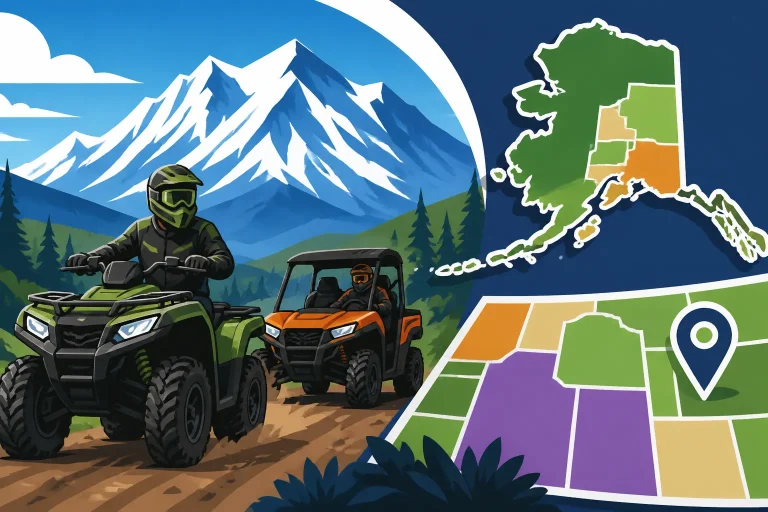
Private land and Alaska Native corporation land are separate questions as well. A state-land permit does not grant permission to cross private property, and a route shown on a map is not proof that the landowner has authorized access. For parcel questions, start with Alaska Land Ownership and Who to Ask and Alaska Land Status Maps. If a route crosses land managed by a Native corporation, check the relevant corporation’s access rules; Alaska Native Land Access Permits may help you identify what to ask.
Visitors riding a machine registered elsewhere should also avoid treating an out-of-state decal as blanket access permission. Registration and land access are different. Before setting out, confirm with the relevant Alaska office whether your machine’s registration is acceptable for the planned use, then check the land manager’s rules independently. Alaska Rules for an Out-of-State Decal covers that registration question.
How to check a trail without mistaking a map for permission
Maps are useful for planning, but they answer only part of the question. A map may identify a trail or show motorized use, yet you still need to verify the current rules, land status, and any restrictions for the particular route.
The Alaska Department of Transportation & Public Facilities provides a comprehensive trail map that can be filtered to show motorized trails, including ATV and snowmachine routes. The department also formally recognizes trails as part of Alaska’s broader transportation system alongside highways, airports, and ports. Treat the map as a planning tool: confirm the rules with the manager responsible for the land and trail.
Alaska State Parks also provides snowmachine trail maps for areas including Anchorage Hillside, Big Lake, the Caribou Hills, the South Denali Highway, the Lower Susitna-Yentna area, Petersville, Caswell, Lake Louise, and Willow. A map labeled for snowmachines is not, by itself, confirmation that ATV or UTV use is allowed there. Check the trail’s permitted uses before riding.
The Alaska Department of Natural Resources notes that Trail Class 1 and Trail Class 5 trails are typically not designed or actively managed for ATVs, although use may be allowed. That is a reason to check the specific trail conditions and rules, not a substitute for doing so.
For state park trails, the Division of Parks and Outdoor Recreation makes Google Earth trail maps available for locations including Chugach State Park, Denali State Park, Kachemak Bay State Park, Caines Head State Recreation Area, and Hatcher Pass Management Area. Maps can help you understand a route, but Alaska State Parks should be contacted for current conditions and openings, according to the Alaska Department of Natural Resources.
A useful example of why trail-specific checking matters is the Bird Creek area. According to the Alaska Department of Natural Resources, ATVs are allowed on the Bird Creek Trails from April 1 through November 30, and ATV and bike access ends 4 miles up the valley. The agency also says ATVs are allowed in the lower valley of the Bird Valley Trail System during summer. Those details concern particular trails and do not establish access elsewhere in the park.
The trail program’s administrative home has also changed. In Fall 2025, Administrative Order 361 transferred the Recreational Trails Program from the Department of Natural Resources to the Alaska Department of Transportation & Public Facilities. DOT&PF says the transfer was intended to strengthen coordination and investment in Alaska’s trail network. The department issued a formal Request for Information about the program’s structure and the Alaska Recreational Trails Advisory Committee, abbreviated ARTAC. For a question about the program, DOT&PF lists Frontier Roads and Sustainability Program Manager Rebecca Garrett at 907-223-4664 and [email protected].
A practical route check looks like this:
- Identify the land manager for the trail and any connecting segments.
- Confirm that the trail permits your type of machine and intended use.
- Check whether the route crosses state park, federal, private, or corporation land.
- Ask whether a permit, pass, or additional authorization applies to your activity.
- Check current closures, seasonal conditions, and local restrictions before leaving.
- Carry any registration or permit documents the relevant agency tells you to bring.
If you are unsure who manages a section, use land-status information as a starting point, then confirm with the agency or landowner. Checking a Land Status Map and [Questions Worth Asking a Land Manager] can help frame that inquiry.
Common permit questions riders ask
Does registering my ATV let me ride any public trail?
No. Registration concerns the machine; access depends on who manages the land and what rules apply there. A registered ATV can still be barred from a trail, park, or parcel. Check both the vehicle requirements and the route’s access rules.
Do I need a separate permit for state land?
Not necessarily. According to the Alaska Department of Natural Resources, ATVs and UTVs meeting specific weight and size criteria generally do not require a separate DNR land permit to use state lands. Verify that your machine and use fit the criteria, and remember that this general state-land permission does not extend to state parks or land managed by another owner or agency.
Does an Alaska state-land permit cover a state park?
No. The Alaska Department of Natural Resources says the general permit excludes state parks. Check the park’s rules for the particular trail, and confirm current openings and conditions with Alaska State Parks. A trail shown on a map should not be treated as permission by itself.
What if my ride includes a commercial outing or organized group?
Ask the manager of each land segment before organizing the ride. The Alaska Department of Natural Resources and Bureau of Land Management say commercial, competitive, or organized group use on public lands managed by federal agencies such as BLM requires a Special Recreation Permit. Requirements may differ across land managers, so get confirmation for the route and activity.
Can I switch an APV back to off-highway registration?
According to the Division of Motor Vehicles, State of Alaska, an ATV registered as an APV can be switched back to off-highway registration by surrendering the APV title and registration. Contact the DMV for the current process and paperwork before making the change. For related title issues, see Alaska APV Title Requirements.
The safest habit is to treat registration, land access, and trail conditions as separate checks. Confirm the machine’s status with the DMV, identify who manages the ground, and ask that manager whether your route and intended use are allowed. That extra check is especially important when a ride crosses land boundaries or depends on a trail map made for a different type of vehicle.
Sources
- Division of Motor Vehicles, State of Alaska — OFF‑HIGHWAY & ALL‑PURPOSE VEHICLES, Division of Motor Vehicles, State of Alaska (checked November 3, 2026)
- Alaska Department of Transportation & Public Facilities — Alaska Trails and Local Access Systems – A Vital Part of Alaska's Transportation Network, Alaska DOT&PF (checked November 3, 2026)
- Alaska Department of Transportation & Public Facilities — Alaska Trails and Local Access Systems – A Vital Part of Alaska's Transportation Network, Alaska DOT&PF (checked November 3, 2026)
- Alaska Department of Natural Resources — birdvalleytrailguide.pdf (checked November 3, 2026)
Disclaimer
This article is for general informational purposes only and does not constitute professional advice. Laws, prices and regulations vary by location and change over time. Consult a qualified professional for guidance on your specific situation.