Asking Before You Ride Through
A route that looks open on a map may cross private or Native land, and a public trail connection does not automatically answer who controls the ground. Before taking an ATV or UTV through, identify the landowner and ask the right person for permission. A clear request can prevent a wrong turn and help you understand where access begins and ends.
Find out who controls the ground
Start by tracing your intended route, not just your destination. A ride to a river, trailhead, cabin, or neighboring community may cross several parcels, and the person or organization that controls one section may not control the next. Alaska Department of Natural Resources advises riders to ask the landowner or appropriate Native corporation for permission before riding through private or Native lands.
A line on a recreational map is a useful starting point, but it does not necessarily tell you who owns or manages every part of the route. Use an ownership or land-status map to investigate the ground beneath the trail, then confirm unclear boundaries with the relevant land manager. For help with the first step, see Alaska Land Ownership and Who to Ask and Checking a Land Status Map.
Treat the route as separate sections
Break your planned trip into sections and note where ownership or management may change. A trail can leave public land, cross a private parcel, and then continue onto land managed by a different organization. Permission for one section should not be treated as permission for the whole route.
It also helps to distinguish between using a trail that is open to riders and crossing land to reach that trail. A trail map may show a route, but it may not explain whether riders can cross an adjoining parcel, where they should enter, or whether access is limited to a particular purpose. Ask about the exact connection you intend to use.
For a route that passes through Native land, contact the appropriate Native corporation or other landholder rather than assuming that a nearby village office, public trail sign, or map is the right authority. Alaska Native Land Access Permits and Alaska Regional Corporation Land Rules cover related questions about access and landholder permissions.
Use maps to plan, then verify
Alaska’s comprehensive trail map can be filtered to show motorized trails such as ATV and snowmachine routes, according to the Alaska Department of Transportation & Public Facilities. The Division of Parks and Outdoor Recreation also provides trail maps for particular areas. These tools can help you spot a potential route and prepare questions, but do not treat a trail line as proof that every adjoining parcel is open to you.
The Alaska Department of Natural Resources produces a map for planning, and it advises contacting Alaska State Parks for current conditions and openings. That distinction matters: a trail may be shown on a map yet have access conditions, closures, or land boundaries that need separate confirmation. When you are unsure whether a trail is designed or managed for ATV use, check with the agency responsible for the area rather than relying only on a downloaded map.
If a route crosses a village area, look into both land ownership and local access expectations. The right contact may differ depending on whether you are asking about corporation land, village land, or a privately held parcel. See Alaska Village Corporation Land Rules and Who to Ask in a Village Before Riding Through for questions specific to those situations.
Make a clear permission request
A useful request gives the landholder enough detail to understand what you want to do. “Can I ride through?” may be too vague if it does not identify the route, timing, or kind of use. Give the person or organization a concise description and ask them to clarify any limits.
Include details such as:
- The route or trail segment you want to use, with a map or marked route if possible.
- Whether you are riding an ATV, a UTV, or another type of vehicle.
- The general timing of the trip and whether you expect to return by the same route.
- Whether you are traveling alone or with a group.
- Your reason for crossing, such as reaching a trail connection or accessing a destination.
- Whether you expect to stop, camp, hunt, fish, or leave equipment on the land.
These details help distinguish a request to pass through from a request to use the property for a longer activity. Do not assume permission for one purpose covers another. If you are asking only to cross, say so. If you also want to stop or use the land in another way, ask about that explicitly.
Ask the right person
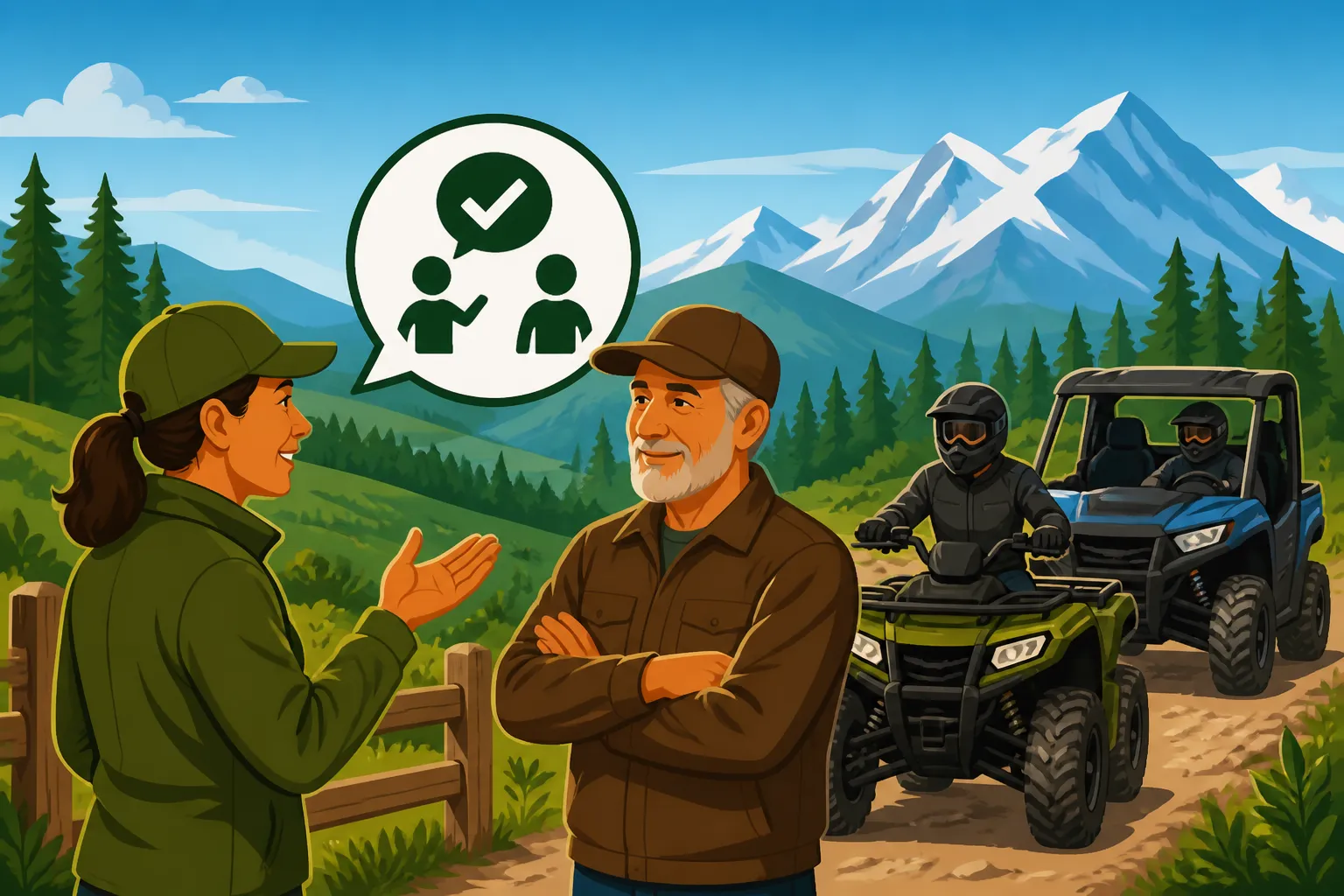
For private land, contact the landowner or the person authorized to manage access. For Native land, contact the appropriate Native corporation or the designated contact for the parcel. If you are not sure which organization controls the ground, ask who can confirm ownership and handle access requests rather than sending the same request to several people and assuming silence means approval.
When a village office, council, or local contact points you elsewhere, follow that direction and confirm that the person you reach can authorize the specific use. A friendly conversation with someone who lives nearby may be helpful, but do not treat it as permission unless that person has authority to grant it. Asking Who Owns the Ground First and What a Village Council Can Require of Riders offer more context on identifying the right contact.
Keep the tone practical and respectful. Ask whether access is allowed, where the permitted route starts and ends, and whether any conditions apply. The answer may be yes, no, or yes with limits. A request is not a guarantee of access, and the landholder may set conditions or decline.
Ask about boundaries and conditions
If permission is granted, make sure you understand its scope. Ask the landholder to identify the approved route, any entry point, and any areas you should avoid. Clarify whether the permission applies to the riders and vehicles in your group, whether it is limited to a particular trip or period, and whether you need to contact the landholder again before a later ride.
Ask about practical restrictions that could affect the trip, including gates, seasonal closures, sensitive ground, other users, or changing conditions. Do not treat a gate left open, tire tracks, or a worn path as an invitation. Those signs do not establish who controls the land or whether access is currently allowed.
If the landholder refers you to a separate permit or access process, follow that process before riding. Alaska Village Land Permission explains why asking the appropriate village contact can matter, while When a Landowner Charges You to Cross Their Land discusses the possibility that a crossing may come with conditions or a fee.
Keep a record and follow the limits
When access is granted verbally, it is sensible to ask for confirmation in a message or other written form. Written confirmation helps you remember the route and conditions, and gives your riding group a shared reference. It is a practical safeguard, not a substitute for following the landholder’s instructions.
Keep the confirmation with your route notes and make sure everyone riding with you understands what was approved. A waterproof document sleeve can protect a printed map or permission message from rain and mud; a basic pouch from Amazon is one option if you need one. Keep digital copies available as well, but do not rely on a phone alone if your route may take you beyond reliable service.
A clear record should capture:
- Who gave permission and how to contact them.
- Which land or route segment the permission covers.
- The activity and vehicles approved.
- Any limits on timing, route, group, stopping, or other use.
- Any instructions about gates, closures, or contacting the landholder again.
If any of those details are unclear, ask before setting out. Do not extend permission to another route, another activity, or a later trip unless the landholder confirms that it applies. A yes to crossing a particular parcel does not necessarily mean you can explore nearby ground or continue beyond the described route.
If conditions change while you are riding, stop and reassess rather than pressing on because the original plan was approved. A blocked route, a new closure sign, a damaged crossing, or uncertainty about a boundary can make the approved path unusable. Contact the landholder or responsible manager for direction where possible. If you cannot confirm that the route remains open, choose another route.
Permission is also separate from vehicle registration and trail access rules. Registration does not grant permission to cross land, and permission from a landholder does not by itself establish that a vehicle is registered for the kind of riding planned. Check each question on its own: who controls the ground, whether access is allowed, and whether the vehicle and ride meet applicable requirements. Alaska General Permit Requirements and Do You Have to Carry Alaska’s General Land Permit? can help with related questions about land access, but they do not replace asking a landholder before crossing private or Native land.
If a landholder says no, respect the answer and ask whether there is an alternate route or a formal process to request access. Do not assume that a route used by other riders is authorized. For more on the risks of misunderstanding access, see What Follows a Trespass Complaint on Alaska Native Land.
A practical checklist before the ride
Use this sequence when a planned ATV or UTV route may cross land you do not control:
- Mark the full route, including the connection to and from the trail.
- Check land status and identify any sections that may be private or Native land.
- Contact the owner or appropriate Native corporation with a specific request.
- Ask what route, activity, timing, and conditions are approved.
- Get the answer in a form you can keep and share with your group.
- Confirm that signs, gates, closures, and conditions still match the permission when you arrive.
- Turn back or choose another route if access is unclear or conditions conflict with the instructions.
If you cannot identify the right contact, do not guess. Ask a land manager or the organization responsible for the map or nearby trail to help direct your question. A trail map can guide the conversation, but the landholder or authorized manager is the one who can clarify permission for the ground they control.
Disclaimer
This article is for general informational purposes only and does not constitute professional advice. Laws, prices and regulations vary by location and change over time. Consult a qualified professional for guidance on your specific situation.