Group Limits on a Narrow Trail
A large ATV or UTV group can turn a narrow Alaska trail into a bottleneck, even when everyone rides carefully. The hard part is knowing whether a group-size limit is a legal condition, a land manager’s permit rule, or simply a safety recommendation. Check who manages the trail, confirm any event requirements, and plan a ride that leaves room for other users and changing conditions.
Is There a Statewide Group Limit?
Do not assume one number applies to every Alaska trail. Group-size rules can depend on the land manager, the specific area, and whether the ride is an organized event or commercial activity. A limit may appear in an area-specific permit or operating condition rather than in a rule that applies to every ATV and UTV ride statewide.
Alaska’s statewide general permit covers certain uses of state land, but it does not make every parcel or trail available under the same conditions. State parks, private land, designated areas, and land managed by other agencies can have separate rules or permission requirements. Check what land the route crosses before deciding that a group may ride it. Alaska’s Statewide General Permit for ATV Use explains the general permit’s scope, while Alaska Land Managed by Other Agencies is useful when a route crosses beyond state land.
| Situation | What to check | Why it matters |
|---|---|---|
| Casual ride on state land | General permit conditions and any area-specific restrictions | A general permit is not permission to use every parcel in every way |
| Ride through a state park | Park-specific rules and authorization | State parks are not covered by the statewide general permit |
| Route crosses private or Native corporation land | Landowner or corporation permission | Public access nearby does not establish a right to cross private ground |
| Club ride or organized outing | Event permit requirements and group conditions | Organized activity may need approval beyond individual riding permissions |
| Commercial tour or guided trip | Applicable commercial authorizations | A group’s size and purpose can affect which approvals apply |
The phrase “group limit” can mean different things. A land manager may set a maximum number of machines for an organized event, restrict how many riders may occupy a specific area, or require a group to divide into smaller units. In another location, there may be no stated numerical cap, but the permit may still require safe operation, protection of the land, and compliance with closures or posted conditions. Read the actual terms rather than treating a recommended group size as a legal limit—or assuming that no posted number means there are no obligations.
For a club ride, event, or planned gathering, ask the responsible land manager whether permission is required and whether it includes a group-size condition. Alaska Event Permits for a Ride and Permits for a Club Ride on State Land cover the kinds of questions to raise before organizing a ride. A casual group of friends is not automatically the same as an organized event, but the distinction can depend on the activity and location. If the ride has a coordinator, advertised participants, a set route, or a commercial purpose, describe those details when asking.
Before setting out, verify each part of the route. Use a land-status map as a starting point, then confirm uncertain boundaries and access conditions with the relevant manager or landowner. Checking a Land Status Map can help identify why a route may pass through more than one jurisdiction. A trailhead sign or an existing track on a map is not, by itself, proof that the whole route is open to your group.
Why Narrow Trails Need Smaller Riding Units
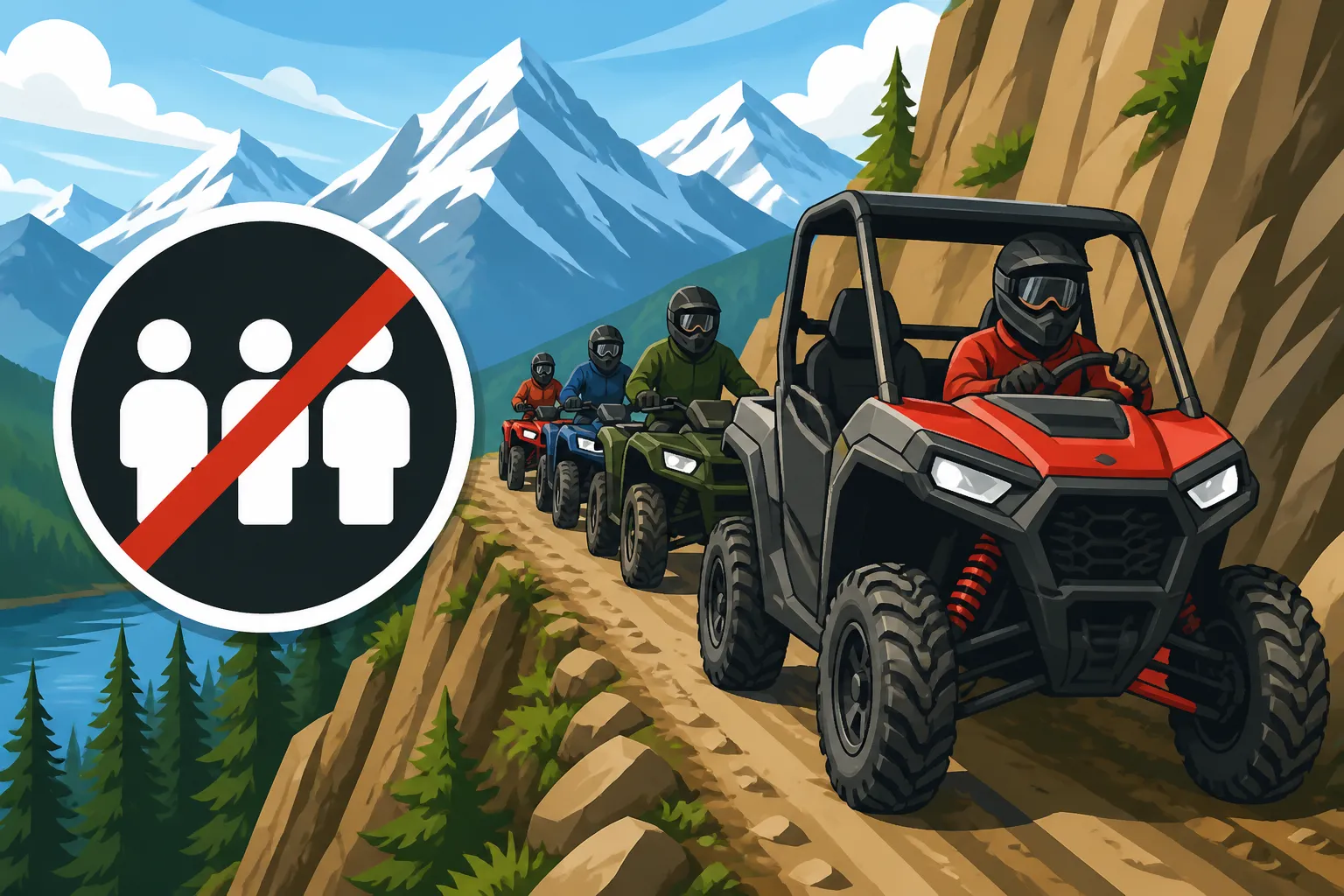
Even when no formal group cap applies, a narrow trail may be safer and less disruptive when a large party rides as several smaller units. A long line of machines can block an entire corridor, make it difficult for other users to pass, and leave riders at the back unaware of a sudden stop near the front. Dust, blind corners, soft shoulders, and limited pullouts can make those problems worse.
Smaller riding units are easier to keep together without crowding one another. They can also use a pullout without filling the entire space, and they give riders more room to stop if someone needs help. The appropriate number depends on the actual trail: its width, sight lines, surface, traffic, and availability of safe places to wait. A roomy route with regular turnouts is different from a single-track section with steep edges and no practical passing spots.
Do not treat a smaller unit as a way to evade a permit condition. If a manager sets a maximum for the event or area, splitting into subgroups does not necessarily make the overall activity exempt. Ask whether the limit applies to each riding unit, the total event, or the number of machines present in a defined area. The answer matters when organizing a larger outing.
A workable plan usually includes:
- One person responsible for route and permit checks.
- A lead rider who knows the route and can stop the group before a hazard.
- A sweep rider who knows nobody should be left behind.
- Riding units small enough to stop in a safe place without blocking the trail.
- Predetermined regrouping points where the whole party can gather off the traveled corridor.
- A plan for changing conditions, including a blocked route, a closure, or a river crossing that cannot be safely completed.
Set expectations before starting. Agree that riders will remain in their assigned unit, avoid passing within the group unless necessary, and stop at the agreed points rather than waiting in the middle of a narrow section. If the lead rider stops, the riders behind should avoid bunching up around the machine. Leave enough space for braking and for the next rider to react to loose gravel, mud, or an obstacle.
Group etiquette matters as much as the head count. Give hikers, cyclists, hunters, and other trail users room to pass where it is safe, and keep machines on the established route rather than widening it to make a passing lane. On a particularly narrow or fragile section, it may be better to wait at a broad staging area until the trail is clear. Alaska Trail Etiquette Locals Expect offers further guidance on sharing riding areas.
Planning Spacing, Stops, and Passing
Spacing is a practical safety tool, not a fixed distance that works everywhere. Riders need enough room to see the trail and respond to a stop without riding through the dust or rear-ending the machine ahead. On a tight, slow section, the gap may be shorter than on a fast, open route, but riders should still avoid traveling so close that one sudden brake becomes a chain reaction.
Dust can hide rocks, ruts, and the rider ahead’s brake lights. If visibility drops, ease off and let the gap grow. Do not close it just because the convoy has stretched out. The lead rider should consider slowing or stopping at a safe, visible location if the rear of the group is falling behind. Avoid stopping just beyond a blind corner, on a steep slope, or where an oncoming rider would have no room to get by.
For opposing traffic, use established pullouts where available. If there is no safe place to pass, the group should not force a meeting into an unsafe squeeze. Riders may need to wait or carefully backtrack to a wider section, depending on the terrain and the machines involved. Keep the trail surface and edge in mind: a shoulder that looks firm may be soft, eroded, or unstable. Never assume a smaller machine can safely leave the trail to make room for a larger one.
A few procedures make a narrow-trail ride more predictable:
- Brief the group at the staging area. Explain the route, riding order, signals, regroup points, and what to do if separated.
- Choose a pace that fits the slowest rider and machine. A group that moves too quickly tends to bunch up at obstacles and junctions.
- Keep each riding unit together without tailgating. The lead and sweep should know who is in their unit.
- Stop only at safe locations. Move completely out of the travel path where the terrain allows, and keep machines from blocking a junction or turnout.
- Recount after major stops or route changes. Confirm everyone is present before continuing into a remote section.
- Turn back when the trail cannot safely accommodate the group. A permit does not make a dangerous crossing, damaged trail, or blocked route safe.
Radios can help coordinate a large outing, but they do not replace visual checks or a clear plan. Agree on a channel and simple messages before riding; test the equipment and keep a backup way to signal. If you shop for communication gear through Amazon, check that the device is suitable for the route and that riders know how to use it before leaving coverage or the trailhead. Do not assume a radio will work reliably around terrain, distance, or interference.
A sweep rider should not be expected to solve every problem alone. The lead should stop at suitable intervals, especially after confusing junctions or difficult sections, and confirm that the next unit is still together. If one machine breaks down, move the group to a safe place rather than leaving riders scattered along the trail. For a larger outing, Alaska Group Ride Planning can help with the broader logistics of route coordination and communication.
Check the Rules Before Organizing the Ride
Start by identifying who manages the trail and what kind of land the group will cross. A route may move from state land onto a state park, federal land, private property, or Native corporation land. Each transition can change the applicable rules or permission requirements. Do not rely only on a trail app, an old trip report, or another rider’s memory; access conditions and closures can change.
Then describe the ride accurately when contacting the relevant office. Include the planned route, approximate number of machines, whether participants are invited or paying, whether a guide is leading, and whether the group expects to use a staging area or camp. Ask directly whether a group-size limit applies, whether the limit covers the total party or separate riding units, and whether a permit or advance approval is needed. Keep a copy of the response and any permit conditions with the ride documents.
If the route enters a state park, check park rules rather than assuming the statewide general permit settles the question. If it crosses private or Native corporation land, get the required permission from the appropriate owner or authority. A trail that appears continuous on the ground can cross property boundaries that are not obvious to riders. Alaska State Park Riding Rules and Alaska Native Corporation Land Permissions address two access situations where separate requirements may apply.
For an event or club outing, build flexibility into the plan. A group that fits the permitted size may still need to divide for trail safety, and a trail that was passable during planning may become unsuitable after rain, high water, or damage. Establish a turnaround point and make sure participants understand that the lead rider can shorten or cancel the route. Avoid pressuring someone to cross an obstacle simply because the rest of the group has already gone through.
Finally, explain the rules to every participant. A rider who joins at the trailhead should know the route, the group’s stop-and-regroup procedure, and any access restrictions before the machines move. Keep the group off closed sections, do not widen the trail to pass, and leave room for other users. Alaska Land Ownership and Who to Ask can help when it is unclear who controls access.
The useful rule of thumb is simple: follow any stated permit or land-manager limit, and make riding units small enough to manage safely on the actual trail. When the limit or access status is unclear, ask before the ride rather than trying to sort it out in a narrow corridor.
Disclaimer
This article is for general informational purposes only and does not constitute professional advice. Laws, prices and regulations vary by location and change over time. Consult a qualified professional for guidance on your specific situation.